Over the past year, AI has grown from a question-and-answer conversational tool to an executive that can handle a whole body of work. In financial institutions, agents are used to simulate the decision-making structure of an institution, competing with each other to filter out noise; in the legal field, it has gone from retrieving assistance to gradually formalizing the process of reasoning and even modeling the entire process in court.
In the field, it is able to arrange visual models and knowledge charts to diagnose diseases; in cross-border trade, it is responsible for understanding and organizing, assigning tariff calculations and sanctions screening to determination modules; in hospitals, it has gone from knowledge infusion, capacity alignment to the full path of agent execution. AI is spreading across industries and transforming into real productivity.
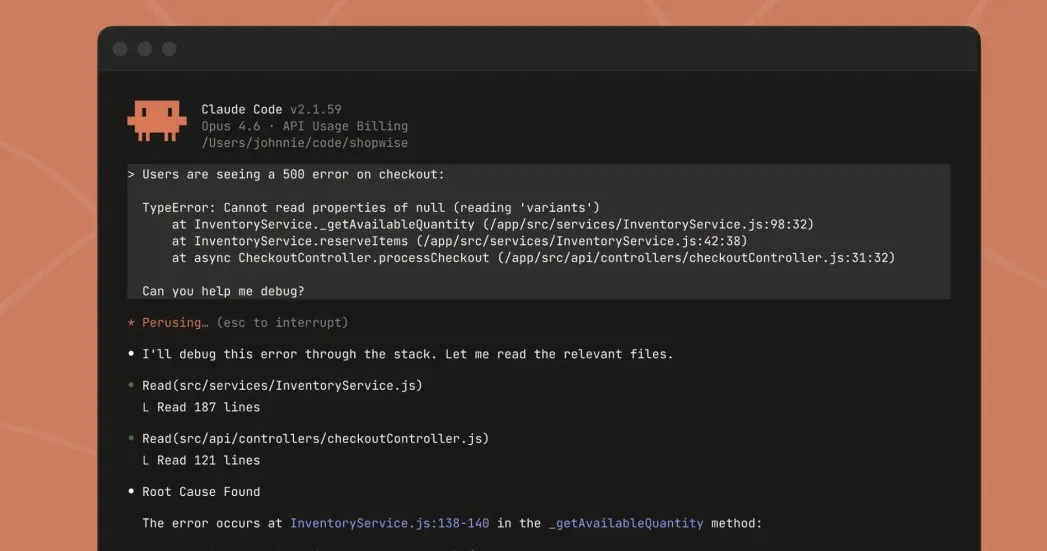
Claude Code automatically modulates the code library in the terminal.
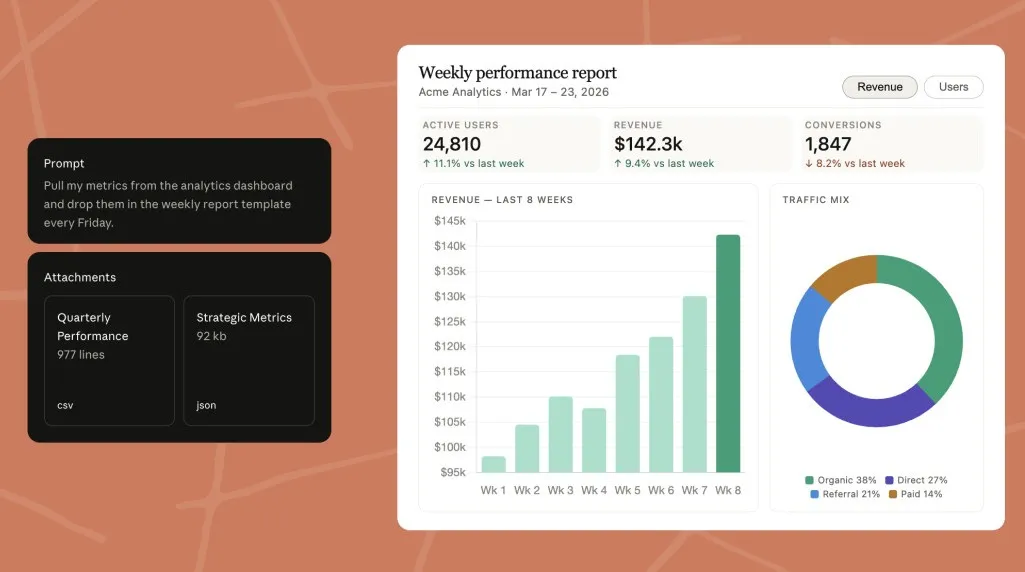
Claude Cowork takes local fragmented data into a visual report and runs it in a timely manner.
From steam engines to electrification to digital networks, the tool revolutions have similarly restructured the way mass production is organized, but they are mainly amplified by a specific aspect of human work, which is highly efficient within a predetermined range, and once beyond the established processes, it is still necessary to judge and take hands. Agentic AI, unlike previous tools, while having universality and autonomy, is thus becoming a new production tool and improving relationships. It is not only meant to speed up a single task, but also to reorganize the execution of work, coordination and responsibility. However, this restructuring is precise by which mechanisms it occurs, and which systems are always missing in each industry.
In response to the critical question of "How to truly transform AI capabilities into sustained productivity growth", the AI4X Project Team, which consists of 12 institutions, including the University of Zhejiang, Stanford, Berkeley, Princeton, and Oxford, recently released a 68-page review of AI for Productivity in the Age of Agentic AI. The review presents two mechanisms for efficiency and expansion, establishes a four-phase framework for the Production Responsibility Commission, which examines the real applications, representation systems and evaluation benchmarks of eleven key industries, and summarizes the five structural factors that determine the depth of proliferation, in an attempt to provide insight into how the next round of production will change.

AI for Productivity in the Age of Agentic AI
Link to the paper:https://github.com/ai4x-org/AI4Prod/blob/main/AI_for_Productivity_in_the_Agentic_Era.pdf
The main page of the project:https://ai4x-org.github.io/
The code repository:https://github.com/ai4x-org/AI4Prod
One, Agentic AI:
The first class of production tools that can take over the entire work
The difference between different economic eras is not in what is produced, but in how it is produced and with what labor resources it is produced.
Marx's theory of capitalism
Looking back at the historical process, the replacement of every round of production tools transfers a part of the work that was originally done by humans to machines. The steam engine mechanizes the physical labor, achieving a large-scale replacement of manpower and livestock; the electrification and flow lines revolve around standardization, continuity and high throughput reorganization of production organizations; computers and digital networks amplify technology from physical labor to cognitive, administrative and organizational tasks. Industrial machines undertake physical execution, and information systems undertake computing, storage, and regulation processing, both of which are carried out within a predetermined scope. Agentic AI undertakes the entire process from receiving targets to delivering results.
Agentic AI's ability to take on full process tasks that previous production tools could not, stems from two new properties.
One is universality. Traditional software is only effective in predefined processes, and replacing scenarios often requires repetition; the same agent can be used repeatedly between different types of tasks, such as language, analysis, operations, and can be created in a cross-task, cross-domain, cross-knowledge context. The agent is therefore closer to an asset that runs through the entire production pipeline rather than a single function attached to a single link.
The second is autonomy. Given a goal, the agent is able to maintain the context, dismantle the goal into subtasks, call external tools on request, and make feedback-back corrections, without the need for continuous intervention of the entire closed loop.
Overlapping the two, AI is transformed from an auxiliary tool for dealing with scattered tasks to an executive that can be responsible for an entire workload from end to end. The next question arises: What does it do to transform this "responsibility" into real productivity?
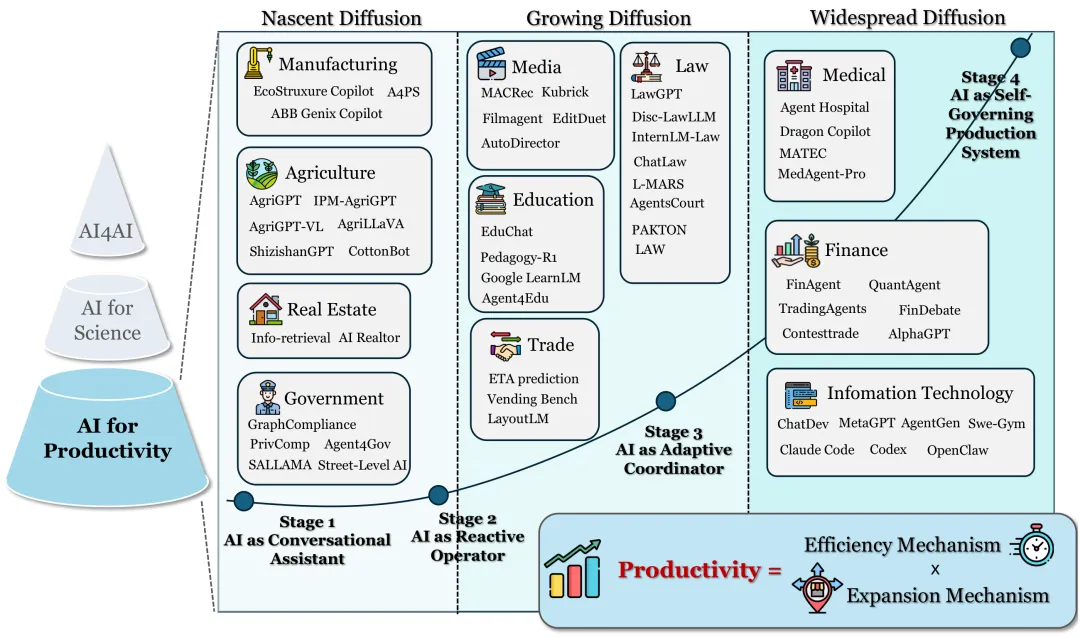
The formula in the bottom right corner is central: Productivity = Efficiency Mechanism × Expansion Mechanism, both of which magnify each other
Efficiency and expansion:
Agentic AI transforms into two mechanisms of productivity
Agentic AI enhances productivity through two mechanisms: an efficiency mechanism that reduces the human input required for existing output, and an expansion mechanism that unlocks new production tasks, enabling jobs that were originally too expensive, cyclically too long or too complex to be feasible.
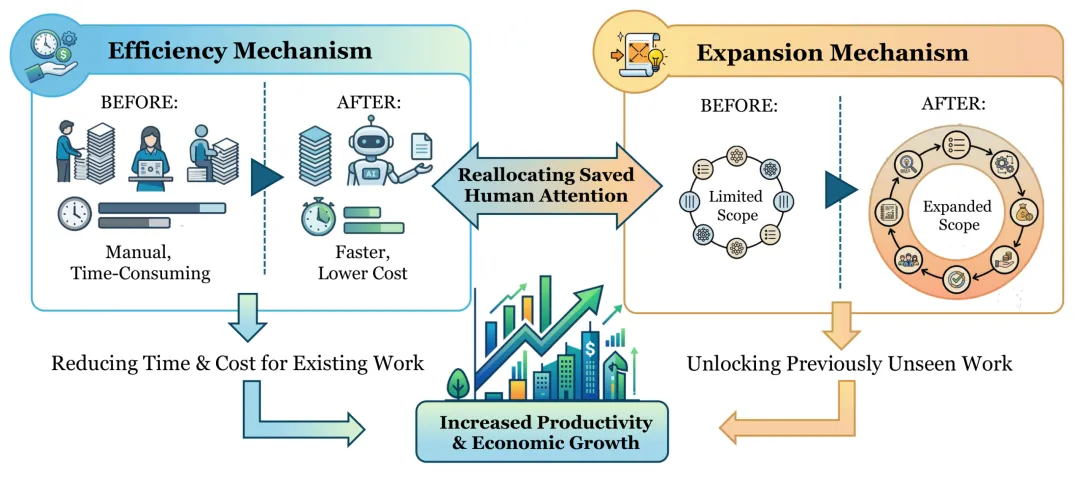
Efficiency mechanisms compress the costs of work already done, and the expansion mechanism unlocks the work that could not be done before.
When the cost of running an agent is less than the time it takes to perform the same task manually, the efficiency mechanism begins to take effect. Anthropic's time estimate, based on about 100,000 AI-assisted dialogue tasks, shows that a task that takes about 90 minutes without AI can shorten the time by about 80%; in a joint experiment with the Harvard Business School, BCG improved the speed of consulting tasks with AI by 251% and quality scores by 40%.
Another broader, but more easily overlooked, path is the expansion mechanism. For example, with AI tools such as Claude Cowork, non-technical marketing managers can independently build updated daily real-time dashboards to turn budget adjustments into forward-looking decisions. Anthropic data also shows that about 27% of AI-assisted tasks are described by users as, "If it wasn't for LLM, I wouldn't be doing this at all".
There is a precedent between the two mechanisms: the efficiency mechanism must first be deepened to the extent that it eliminates coordinated spending, and the expansion mechanism begins to take effect. If only one sees how many jobs are saved, it will significantly underestimate its actual benefits.
Three levels of delegation:
Four levels of responsibility for production transferred from people to systems
The two mechanisms explain the source of income, but measure the actual progress of an industry, depending on the degree of transfer of responsibility for production. This transfer exists at a clear level: execution, coordination, monitoring and even strategic control are transferred by humans to the system, according to the four delegation stages.
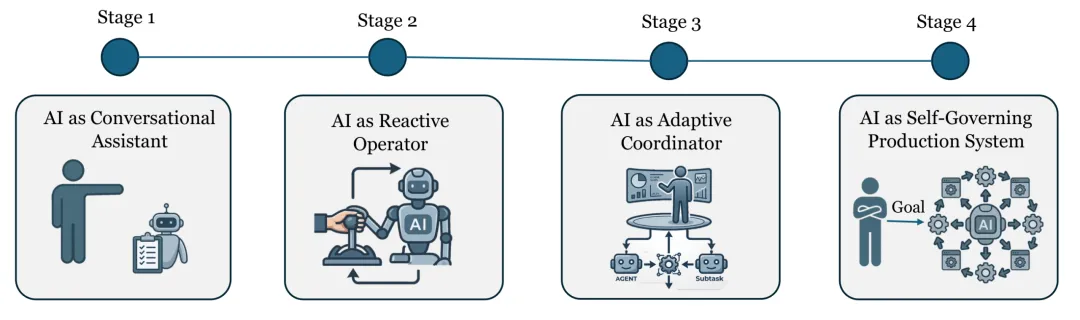
The four commissioning phases: from dialogue assistants to reactive operators, adaptive coordinators, and ultimately autonomous production systems.
The four stages correspond to four very different human-to-human relationships:
Stage 1: Conversational Assistant: Capable of retrieval, drafting and preliminary analysis, but unable to interact with the real environment, the entire process is still manually driven.
Stage 2: Reactive Operators: Can be executed autonomously to a limited extent, but each step still requires man-made testing and error correction.
Stage 3: Adaptation Coordinator: Human resettlement scheduling position management multi-group agents, coordination responsibilities start to shift.
Stage 4: Autonomous Production Systems: Human beings only need to set targets, and the system itself can complete the complete loop from execution to monitoring.
The nature of the bottleneck has also changed radically over time. The common bottleneck of the first three stages lies in capabilities. Limited to the limits and stability of AI's capabilities, humans must be at the bottom of the execution, supervision or problem-defining linkage. By Stage 4, capabilities have ceased to constitute constraints, the bottleneck has shifted to goal alignment and data limitations. Systems rely solely on quantifiable information, a lack of adequate awareness of complex human factors and the value of unpredictable real events. Its value is also in this: through scalable heterogeneous decisions that exceed the limits of human attention, AI has substantially expanded its production by organizing previously unmanageable activities that are too complex or expensive.
Four, the industry spread chart:
Level of delegation in eleven key sectors
The four-phase mandate framework provides a measurement scale, but it is not possible to judge the depth of AI application in an industry by a rating list alone.