In the field of breast cancer, the ability of AI-assisted screening and early diagnosis has gradually matured, allowing more patients to be accurately diagnosed. But the improvement in screening capabilities brings to the forefront a key question: who will manage long treatment periods after patients are screened and diagnosed?
The incidence of breast cancer in China is growing at an average rate of about 3% to 4% per year. Of these, about 70% are hormone receptor-positive (HR+), requiring 5 to 10 years of endocrine-assisted therapy, which is diagnosed in a few days, and the surgical period is only a few weeks, but the treatment takes five to 10 years. A multi-central study led by the Council of Breast Cancer Professionals of the Chinese Association Against Cancer Association showed that 39.1% of breast cancer patients in the country failed to adhere to five years of standardized endocrine-assisted therapy. This means that nearly four out of every 10 patients who benefit from long-term treatment should give up the treatment in the middle. This is not a medical decision-making error, but a lack of daily management support.
After being diagnosed, the hardest part is finding certainty day in and day out.
Ms. Liu was diagnosed with HER2-positive (ER/PR/HER2) immersive breast cancer before the age of forty. She went through a complete process of new complementary chemotherapy, breastfeeding, complementary chemotherapy and targeted therapy, although the treatment itself was successful.
Another patient, Chen, who had been diagnosed for nine years, was faced with a different dilemma: nine years of accumulated inspection reports filled with two bags of documents, which she had to scroll over and over before each inspection, trying to remember how much of an indicator was the last time.
Their situation was different, but over the course of their long treatment cycles, they were plagued by the same problem: a relatively certain and comfortable life. They were consumed not by a major decision at a certain time, but by a small problem that repeatedly occurs every day, no one responds to it, daily and trivial.
A breast cancer patient once said: "Well, I don't trust a doctor, there are a lot of problems that I don't have to see a doctor, but I really need someone to help me judge.
Traditional patient management has tried to bridge this gap, but it's always stuck in a triangular contradiction: the human-power model can be deeply accompanied, but it can't be scaled, and the content drive that can cover a large number of users can't be personalized. In recent years, the ability of AI big models has seen a breakthrough in the industry, but access to a big model is not the same as doing well in patient management.
It's not a choice, it's a must-have. Relying on larger models alone, a more comprehensive library of content can't meet these two requirements at the same time. It requires a complete set of engineering designs from data sources to clinically closed circuits. Over the past few years, companies in the industry have been exploring deeply, and deep-to-technology is one of those triangles, and its core judgment is: patient management isn't an algorithm, it's a system.
Starting from a systemic gap
Deep-to-Tech founder Juri Star mentioned a pivotal issue: we've been doing six years of intelligent ultrasound at the grassroots level, covering nearly 700 grade hospitals and more than 30,000 grassroots institutions, adding more than 3,000 breast BI-RADS 3 and above users per month.
Behind this turnaround, there is a systemic gap throughout the pathway of patient management: not a single link is not doing well, but the problem of "connecting" between the linkages. AI-assisted diagnosis, improved early screening coverage, but emerging patients often face a gap: screening report suggests that further diagnosis is needed, that treatment pathways can be accessed after diagnosis, and long-term follow-up management is broken, and even after follow-up, the resulting data is scattered across systems that cannot be recycled to form an effective support for diagnostic decisions.
Since 2018, deep-to-deep-tech ground-level intelligent imaging equipment has covered about 380,000 ground-level medical institutions nationwide, with about 150,000 active devices per day, about 50,000 diagnostics reports per day, and a device activity rate of about 42%.
The significance of this group of numbers lies not in the commercial scale, but in the fact that it constitutes a structural advantage: patients who are discharged have access to the management system with complete image data from the first day when they have a device source. AI "knows" from the first day she/he knows the BI-RADS classification, the location and characteristics of the disease, subsequent treatment information, drug records, follow-up data accumulate continuously throughout the use, and the data is not complementary but continuous from the source.
Third-party collaboration: not a single-point tool
The team realised that solving this gap could not be done with a single point tool: a follow-up app could not solve the problem of data breaking, an AI query robot could not solve the problem of depth management, a data board could not solve the problem of therapeutic attribution. A truly effective solution would be to have the data "flow" into patient management, to have the evidence generated in management "flow" back into medical decisions. This is the structural starting point for deep-to-technology patient management, and it also gives rise to a matrix of three smart products from deep-to-technology: a patient-facing matrix (Cx), a physician-facing matrix (Dx), a pharmaceutical-facing matrix (Px), a patient-facing matrix (Px), a physician-facing matrix (Px), a pharmaceutical-facing matrix (Px), a pharmaceutical-facing matrix (Px), and a shared solution: where the data comes from, where the value is delivered, and where the data goes backwards.
The core design of Cx is a smart body collaboration architecture for the field of breast cancer verticals, which operates in multiples of two axis lines:
The first axis addresses the question of "who I am". The first axis addresses the question of "who I am". The first axis addresses the question of "who I am". The first axis addresses the question of "who I am". The first axis addresses the question of "who I am". The first axis addresses the question of "who I am". The first axis addresses the question of "who I am". The first axis addresses the question of "who I am". The first axis addresses the question of "who I am". The first axis addresses the question of "who I am". The first axis addresses the question of "who I am". The first axis addresses the question of "who I am". The first axis addresses the question of "who I am". The first axis addresses the question of "who I am". The first axis addresses the questions of "who I am" and "who I am" and "who I am" and "who I am" and "who I am" respectively.
The second axis addresses the question of "what to give her". Once the patient is precisely positioned, on the basis of adequate information and images, the system begins to deliver the corresponding clinical medical depth.
AI automatically undertakes management work in more than 80% of low-risk scenarios; when detecting high-to-medium-risk signals involving drug decisions, side effects beyond the scope of residential management, review results require clinical interpretation. The AI system actively sends alerts to doctors, doctors through Dx-side review disposal, and decision results are transmitted back to Cx-side updated management plans.
The key to "managing" patients is not having more functionality, but continuing to provide services that exceed expectations. Cx Health does not create new needs, but instead embeds the ability to do what patients need to do each day: cope with medication, eating, sleeping, emotional and psychological support. In patients using Cx Health, medication reminders and review reminders are repeatedly cited as the most valuable functions.
Clinical verification: from product logic to real clinical scenarios
In addition to providing online services to patients, Shenzhen Health also collaborates with physicians through AI capabilities to solve more complex and personalized clinical problems. Deep to state-of-the-art recently revealed three clinical collaborations with two 3A hospitals in Shanghai (a comprehensive hospital and a oncology clinic) that point to the technical evidence, operational evidence and academic evidence respectively. Together, the three respond to a question: Can AI management capabilities really effectively be embedded in breast cancer treatment?
In the specific collaboration, Cx is embedded in the entire process of surgical peripheral surgery, post-operative recovery and long-term follow-up; pre-operative stages, system-based disease breakdowns, treatment regimens (including reconstructive procedures); digital imaging of past treatment information, while recording pain, organ function, psychosocial status and patient reporting outcomes (PROs), matching individualized educational content. After discharge, patients are sustainably submitted to the system for symptomatic injury and flow images, pain scores, activity levels, rehabilitation training completion, and diagnostic feedback; rule engines and multi-mode and AI are responsible for identifying conventional induction, clinical nucleation, confirmation of risk and bed replacement; new content, questions, and rehabilitation training are returned to the Cx end of the patient, followed by a cycle of follow-up.
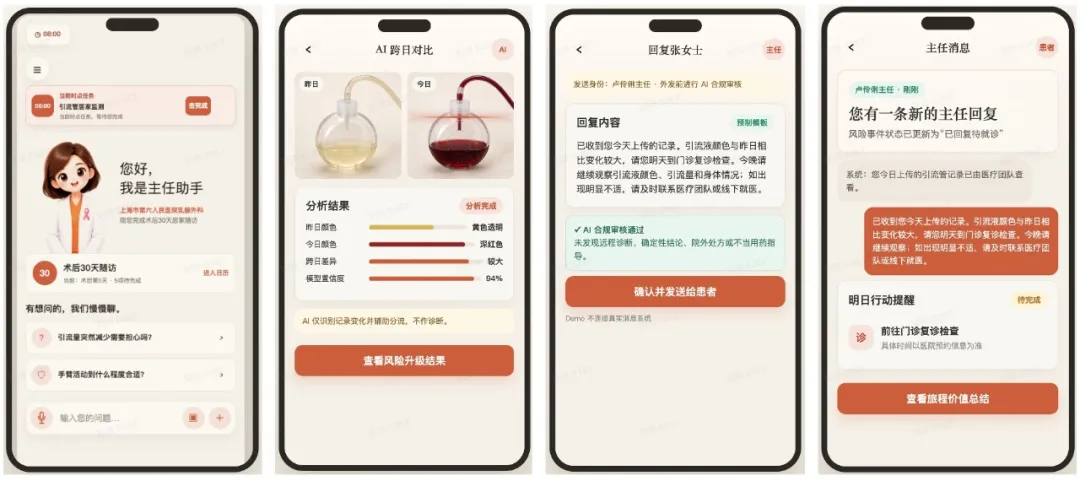
Key boundaries: AI serves only as an auxiliary identifier and classifier, not a substitute for physician decision-making; pre-warning, review, disposal, and follow-up all leave traces, forming executable, traceable SOPs.
For patients, this means that AI no longer stays at the level of "answering a question", but extends an in-patient clinic to an out-patient receiver, a timely identification of risks, and a continuous care process where physicians can act accordingly.
On top of this management framework, there are three clinical collaborations with different clinical proposals.
Sharing real-world data: A hospital has had a very tough number of cases of large retinal breast reconstruction surgery, but the advantage over trauma and recovery remains long-term at the experiential narrative level. In collaboration, Cx's ePRO system will automatically recover withdrawal pulse time, lymphoma incidence rate, patient satisfaction, structured inventory and complete traces, forming the core evidence for the technique's "technical decline" at the treatment node.
Collaborative family-level patient management and IIT data capabilities: In collaboration with Breast Surgery at Hospital B, Cx will communicate with AI intelligent interaction, teaching and phone follow-up of regular patients. Unlike previous "reminder class" tools, Cx's dependent intervention on the motivational level.
For the institute's IIT studies, Cx provides ePRO high frequency collection and auditable quality control: long-term continuous data that is unavailable to conventional clinics based on sex, side effects, menstrual status, quality of life, accompanied by follow-up completion rates, absence rates, complete traces from curves, and targeted support for real-world studies of Luminal-type breast cancer endocrine therapy that affect more than 20 percent of the factors.
Baseline unification, data not out of the hospital, capabilities reusable
The three collaborations share the same set of data collection baseline, but the original patient data of each hospital remains within its own compliance boundaries. CX is dominated by post-dysensitivity management pathways, field standards and quality control models, non-hospitalization data, reusable data. This architecture design is a prerequisite for subsequent multi-center expansion and pharmaceutical collaboration: Periodic PRO data provides auditable support for academic promotion; laboratory operating models work directly with drug-dependent continuity and therapeutic efficacy (DOT); high-quality papers provide academic backgrounds for pipelines related to KOL networks.
From doctors to pharmaceutical companies: the synergy logic of a three-way closed loop
If Cx is the "management center" for patients, then Dx and Px have the ability to collaborate with doctors and pharmaceutical companies respectively.
The most energy-consuming issue in clinical decision-making is not that there are standard answers, but that guidelines provide a pathway, but specifically how the patient makes the decision for the time being, doctors will still need to do their own searches, cross-referencing, and cross-referencing in the bulk literature. Dx will combine distributed ledger information into structured recommendations, receiving patient information provided by doctors through text, voice, and AI images, and also accepting hospital outpatient data from Cx. This is a source of information that is completely absent from the traditional inpatient system.
Px addresses the fundamental anxiety of whether pharmaceutical companies can "invest in quantifiable returns". The traditional patient support program PSP faces a structural dilemma: spending a substantial budget each year, clearly reporting on how many patients are covered, how much material is released, but when management asks "how much clinical compliance has been improved", almost no one can give an accurate answer. The policy environment of 2026 makes this issue more serious. The National Health and Safety Authority (NHS) has issued two real-world evaluation guidelines, launching RWE trials in 11 provinces, and "real-world" is no longer an academic aggregate, but is likely to determine the conditions for access to the product market lifecycle. The response to Px will be to improve the content of each enterprise into "an enterprise-to-market".
A competitive barrier built into deep-technology is to close the data loop between the three ends, synchronizing the data generated at each end with the other two ends, forming a continuously rotating flywheel:
Daily behavioral and symptom data collected by the Cx end stream to the Dx end, providing continuous information to physicians outside the hospital; physician decision-making and follow-up data fed into the Px end, becoming the evidence base for therapeutic attribution; Px end analytical conclusions and reverse driving Cx end intervention strategies optimization. Physicians play the role of "co-signatories of therapeutic evidence" in the closure, increasing the public credibility of data conclusions at the compliance and academic levels.
At the network level, the screening network consisting of 380,000 grassroots institutions is a natural patient entry, customers are not dependent on advertising, but on real medical scenarios, user quality and data integrity are much higher than traffic. At the technical level, 62% of the more than 300 domestic and foreign patents are focused on AI computing, research results published in leading journals such as Science, Nature Communications, and AI's Big Model Algorithms have been passed through the National Internet Backup.
From "Sometimes Surprise" to "Help once a day"
Ms. Chen and Ms. Liu are just representatives of the many patients who are struggling with breast cancer endocrine therapy, but their problem is never the lack of a "surprising" AI conversation experience, but the need for a system that can help them once a day on a five-year, ten-year scale to help them persevere.
Is AI capable of solving the triangular contradictions of "scalization, personalization, continuity" in patient management? Deep down, technology has given its own answer: dual-agent architecture allows personalization depth and medical depth to be multiplied by correlation, solving "deep and precise"; Px-Cx-Dx triangular closed loop allows more data to be used, models to run more accurately, and physician collaboration to be smoother.
In the end, this stepping stone points to an industry judgment: the real value of medical AI is not in improving the efficiency of single-point tools, but in synchronizing the scale effect of evolving in the "data cryptography algorithm cryptography ecology". The more accurate the data models, the more users are allowed to cross the model, and the more users are left with the data.
With more than 15,000 breast cancer users covered by the system remaining > 70% the next day, and users continuing to grow at a rate of 3000+ per month, an industry-level proposition is being answered specifically: patient management is moving from a "human-driven experience system" to an "intelligent-driven evolutionary system".
([1]) Raiding the AI medical device market: How are the medical tech giants positioned?
([2]) Current and prospective state of the Chinese AI medical device industry in 2025, including market size, regional distribution, number of approvals and product coverage.
([3]) Improvement in the endocrine treatment of breast cancer in response to sexual harassment
([4]) Increased dependence on endothelial treatment for breast cancer - Goodreads Online
([5]) AI Agent + Healthcare Industry Report 2025, together with the full text, can be downloaded.