Invidia has acquired Hugging Face.
According to the latest reports from The Information, people familiar with the matter revealed that Invidia has agreed to acquire Hugging Face for $12.9 billion. The latter, best known as one of the world's largest AI model communities, has an open source AI model code library similar to GitHub.
Just a few days ago, foreign media reported that "Hugging Face is looking for a buyer with a potential transaction valuation of more than $13 billion". Today, media reports said that UK and Hugging Face have been in serious discussions about the acquisition.
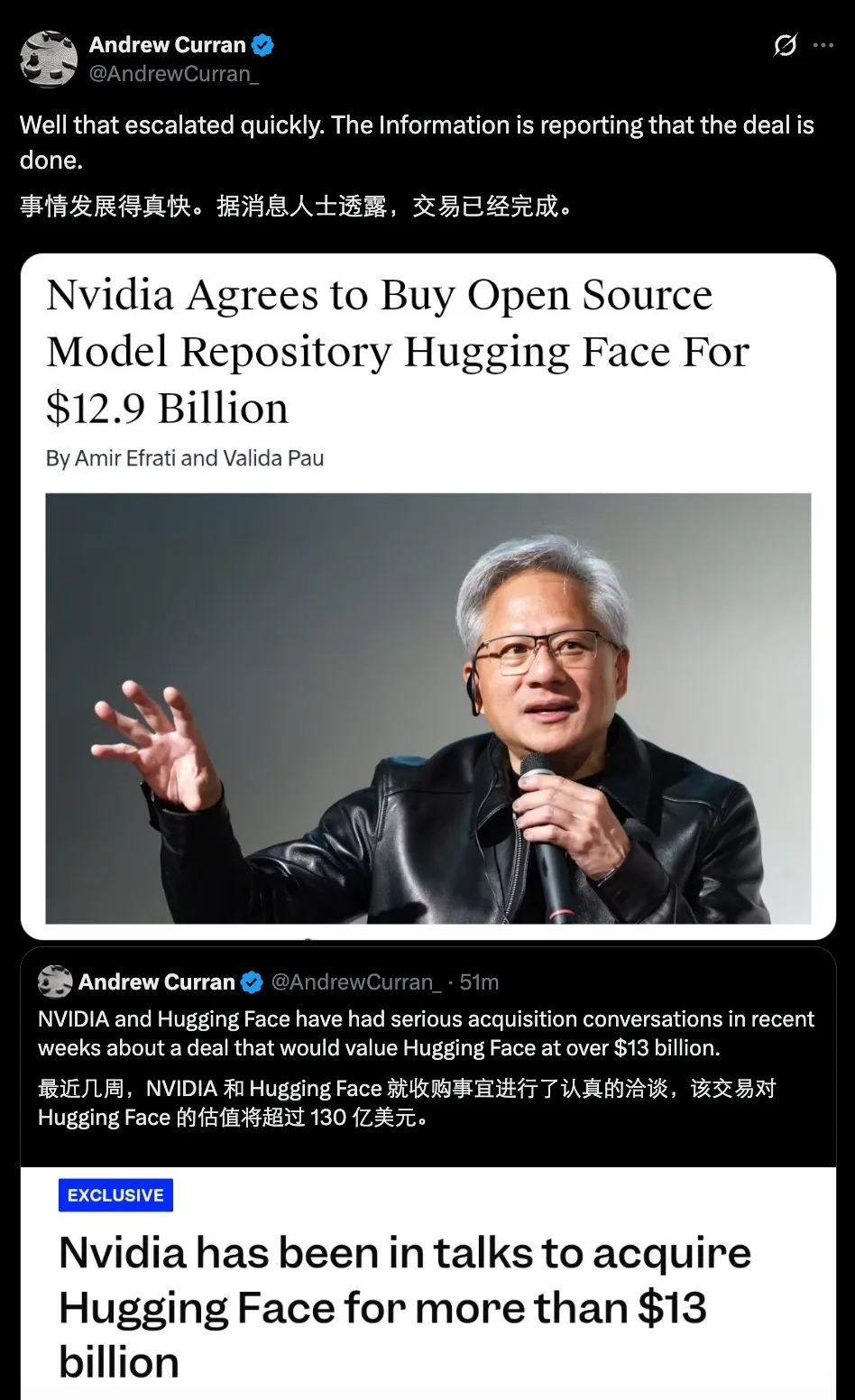
If the transaction ends, it will mean more than just buying another company. After all, Hugging Face's annual revenue last year was only about $150 million, or $12.9 million, which is more than 80 times its annual revenue.
What Enida really sees is the entire open model ecosystem behind Hugging Face.
From a chatbot,
It became the world's "GitHub".
Many people know Hugging Face today because they downloaded the model.
If you want to find an open source model, go to Hugging Face; if you want to find a dataset, go to Hugging Face; if you want to train a new model that needs to be weighted around the world, the first reaction is to upload Hugging Face.

But this company didn't do this in the first place.
In 2016, Clément Delangue, Julien Chaumond, and Thomas Wolf founded Hugging Face in New York, initially wanting to create an AI chatbot aimed at young people. The team later found that the NLP tools they developed to create chatbots were more popular than chatbots themselves.
Especially after the launch of the Transformer model, the PyTorch implementation of the Hugging Face and the Transformers library quickly became popular among researchers, and the company gradually abandoned consumer chat robots and turned to service machine learning developers.
As a result, it gradually occupies a very special position.
Hugging Face itself doesn't have to train the world's strongest models, but it can get a lot of the world's models through its own platform. A bit like GitHub isn't responsible for writing the best software in the world, but software developers around the world can't get away from GitHub.
This is why Hugging Face's list of shareholders has always been interesting.
In 2023, Hugging Face completed a $235 million round of financing valued at $4.5 billion. Participants nearly lined up the major players in the AI infrastructure industry chain at the time: Salesforce, Google, Amazon, U.K., AMD, Intel, Qualcomm, IBM, and others.
Even competitors are willing to pay for it at the same time. Because everyone wants Hugging Face to remain a relatively neutral platform role.
Interestingly, earlier in the day, Hugging Face had even declined a potential $500 million investment in Ingrid. A major concern at the time was that the company didn't want some overly powerful investor to influence Hugging Face's independence.
After a few months, things have obviously gone in a different direction.
It's worth $12.9 billion.
From a financial standpoint alone, Hugging Face is not a company that can easily raise a valuation of $12.9 billion.
The Information reported this week that Hugging Face's recent annual revenue has surpassed $150 million.
The good news is that it has grown rapidly recently. A few months ago, the figure was only about $100 million. That is, it has recently risen by about 50%. In the first half of this year, the number of paid subscribers on Hugging Face doubled. CEO Clem Delangue has previously said the company is "near profitable".
Hugging Face is a way to make money, and it's not just about "charging a GitHub membership fee".
Businesses can purchase subscriptions such as Team, Enterprise; developers need to store increasingly large models and data; model training and reasoning require computing; deployment of applications also requires infrastructure.
These will eventually be converted into storage and calculation fees.
Today, Hugging Face has even integrated different reasoning service providers into a unified system of Inference Providers. Developers can run models between different service providers through a single interface, or even select the back end according to factors such as speed and price.
So Hugging Face is no longer just a "model warehouse". From finding, downloading, training, optimizing, deploying, and finally actually running the model, it's extending to the infrastructure layer of AI development.
But even so, $12.9 billion is still very expensive. According to the current estimate of annual revenue of more than $150 million, the price paid by Ingrid is still equivalent to more than 80 times its annual income.
If you want to understand why Huang Jin is willing to make this money, you can't just look at how much Hugging Face can make.
In fact, I'm not afraid of what I'm saying.
It's like everyone's starting to make their own chips.
Today's Great Britain seems to be almost in the most comfortable position in the AI industry chain. Whether it's OpenAI winning, Anthropic winning, or which new AI company is suddenly killed, as long as we continue to train and run larger models, we need to buy GPUs.
But this business model actually has an increasingly obvious risk: the largest customers of Invisalign are trying to buy a little less Invisalign.
Google has TPU, Amazon has Trainium and Inferentia, and Microsoft is developing its own AI chips. More importantly, even model companies are starting to do it themselves.
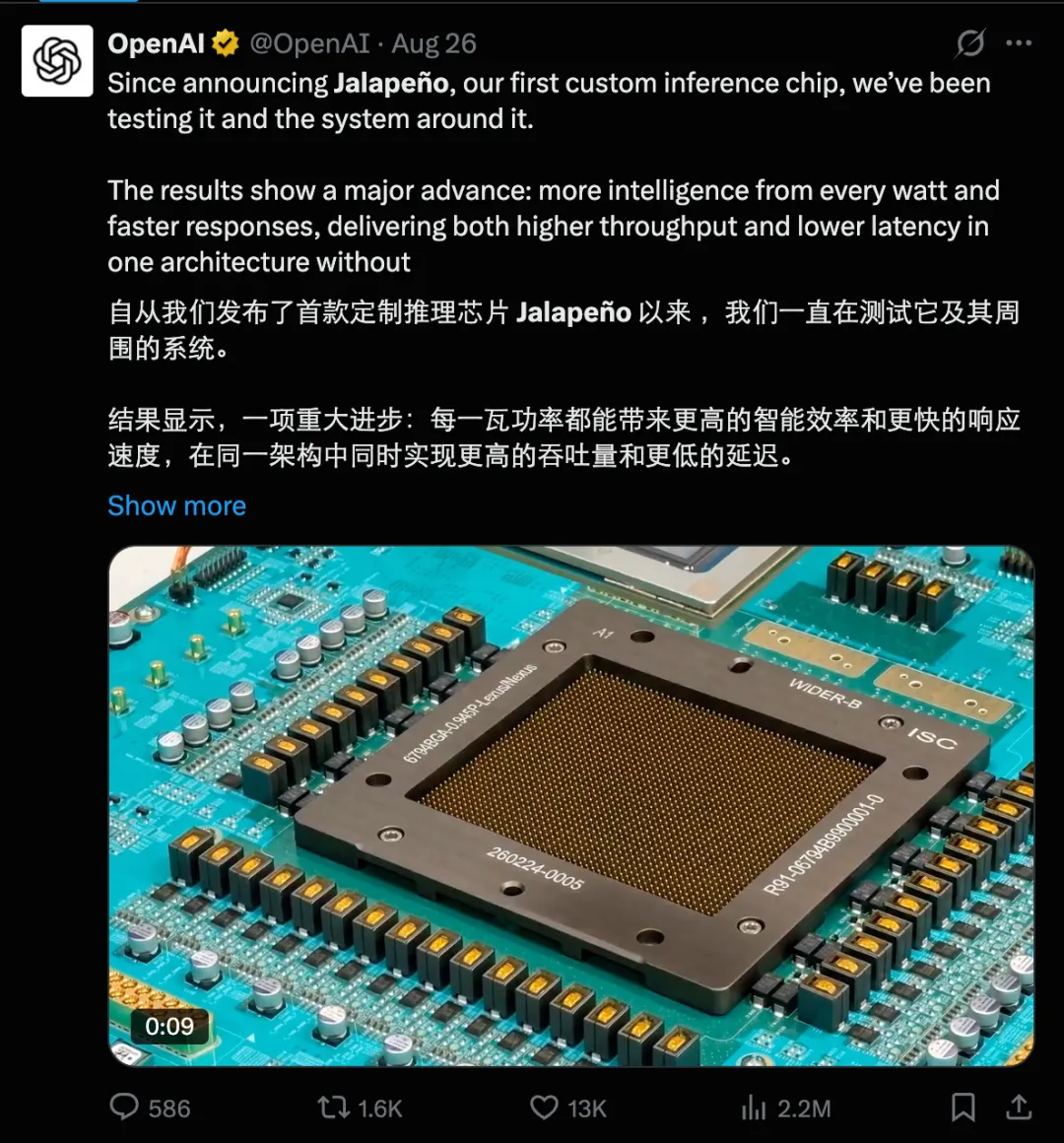
In June, OpenAI released the first self-designed Jalapeño logic chip, developed in collaboration with Broadcom, with the aim of reducing reliance on the Intelligent GPU. Just yesterday, OpenAI released the latest test results of Jalapeño: it can simultaneously increase throughput and reduce latency, achieving both while maintaining high energy efficiency.
Anthropic is doing the same thing. In August, Anthropic confirmed that it is building its own custom silicon team that wants to co-design models and chips; at the same time, it would have used AWS Trainium, Google TPU and Intel's GPU at the same time, rather than putting all of its computing needs on Intel.
From this point of view, the success of OpenAI, Anthropic, these closed-source model companies is somewhat subtle for Ingrid.
They are the big customers of Intel today, but if the future AI world is increasingly concentrated in the hands of a few supermodel companies, these companies will naturally have increasingly strong bargaining power and even ultimately control the hardware themselves.
In India, there is a need for another force to balance them - an open model.
The model is free.
But running models can't be free.
After realizing this, many of the recent seemingly "discriminatory" moves by Ingrid have suddenly been connected.
It has been expanding its Nemotron model family, not only releasing model weights, but also publicly releasing training data, training methods, and other information.
In March of this year, United Kingdom formed the Nemotron Coalition, a group of AI companies including Black Forest Labs, Cursor, LangChain, Mistral AI, Perplexity, Reflection AI, Sarvam, Thinking Machines Lab, and others to develop open-ended models. The first collaborative outcomes plan formed the basis of the Nemotron 4 series.
Less than a week before the news of Hugging Face's acquisition, Ingrid recently reached an unusually exaggerated deal with AI programming company Poolside: $6 billion to purchase a non-exclusive license to develop its AI model technology, another $1 billion to invest, and invitations to work for more than 100 Poolside employees.
This summer, Invidia also acquired Kumo AI and absorbed the team and technical talent of Essential AI. Kumo AI's main research focuses on the basic model of enterprise predictive tasks, and Ashish Vaswani, co-founder of Essential AI, is one of the authors of the 2017 Transformer paper.
These deals look in different directions, but in fact they all point to the same thing: INVEDA is giving an open model an eco-friendly path.
This logic is very much in line with Ingrid's business model. The most desirable scenario is that everyone uses the OpenAI model. The most desirable scenario is that everyone uses Claude. But Ingrid doesn't need you to use any particular model. In theory, the more models, the better.
In other words, models can be free, and computing can't be free.
As long as the entire open model ecosystem continues to thrive, even if there are 100 different model companies, Intel has the opportunity to sell GPUs to these 100 companies. This is why Intel has been very active in the debate around open models this year.
Huang Yi has publicly stated that open models are an important driver of innovation and global participation in the AI revolution. The company's own open source page shows that the company has now released over 650 open models and over 250 open datasets on Hugging Face.
From this point of view, the acquisition of Hugging Face is almost a step in the right direction: If you've decided to bet on an open model, why not directly buy the most important distribution gateway to an open model?
And by the way, the cloud business that hasn't been done,
Do it again.
There is another layer of meaning that is easily overlooked: clouds.
A few years ago, Intel thought very seriously about itself as a cloud. The model for DGX Cloud was even a bit twisted: cloud providers such as AWS, Google Cloud bought Intel's GPUs first, Intel leased its own GPU servers to these cloud providers, and finally leased them back to corporate customers such as Amgen, ServiceNow and others.
In a sense, it's equivalent to "leasing back the GPUs you sold yourself".
The Information previously reported that Invisalign had pledged about $13 billion to lease cloud servers for this, and at one point believed that DGX Cloud could eventually grow into a $15 billion-a-year-level business.
The problem is obvious. AWS, Google, and Microsoft, both of whom are UK's largest GPU customers, suddenly find out that they are starting to directly grab their own cloud customers.
Starting last year, Invidia gradually downsized DGX Cloud's business to external enterprises, shifting more computing power to internal research and development.
Hugging Face offers a different path. It's naturally between models and computing. Users first come to Hugging Face to look for a model and decide where to run the model; the platform can provide model optimization, reasoning services, storage and computing, and shield the underlying infrastructure.
Therefore, the acquisition of Hugging Face can also be understood as a more natural approach to the cloud business: not necessarily becoming a second AWS in person, but controlling developers' access to the world of computing.
Huang Rinpoche is crazy about "buying an AI ecosystem".
Hugging Face is not an isolated transaction either.
Quarterly data just released by INVEDA illustrates just how radical Huang Ren has been lately. As of the end of July, INVEDA's holdings of broadband equity investments have reached about $99 billion, with about $25 billion in future equity commitments.
At the top are AI applications and model companies such as OpenAI, Perplexity; at the middle are cloud and computing companies like CoreWeave; and further down are land, power, and data center infrastructure.
Simply put, it used to be said that India is the "man who sells turkeys" in the AI mining industry. Now what Huang Rin is doing is increasingly like selling turkeys, investing in mines, power grids, transportation routes and even part of the mining companies.
Hugging Face happens to be a very important piece here. It mastered the connection between models and developers.
I'm not sure if I'm going to be able to do that.
It will also bring a new problem.
If the deal is finalized, it will leave a very real question: Can Hugging Face continue to remain neutral?
What's so special about Hugging Face is that it doesn't belong to any of the major cloud providers, model companies or chip companies. A model of AMD can be placed here, a model of Intel can be placed here; models of Google, Meta, Mistral, Microsoft and even a large number of startups can be distributed on the same platform.
When it comes to financing Hugging Face in 2023, Google, Amazon, U.K., AMD, Intel, and even becoming investors at the same time, it's a good indication of the importance of this neutrality.
It's certainly not impossible for the platform to continue supporting competitors like AMD, Intel and others, but the outside world will inevitably start to ask: which hardware models are optimized for, which endpoints of reasoning get better input, and will data and developer behaviour provide an additional advantage for the company?
The open model ecosystem has been opposed to being controlled by a handful of companies, but one of its most important platforms is now likely to be bought by the world's largest AI chip company.
Even Hugging Face itself has been worried about similar issues before. The company's concern was that a single investor had become too strong when it declined to invest $500 million. So this is perhaps the next best place to look for the deal.
Why Intel is willing to spend $1.9 billion is becoming increasingly clear. It can buy models, it can buy talent, and it can buy a growing AI infrastructure company. But more importantly, it has bought a path to millions of AI developers, countless models and datasets.
In the last three years, Ingrid's greatest success has been to be the computational backbone behind all AI models. The next thing it wants to do is probably make it more difficult to bypass: not only do models run on Ingrid, but even developers find ways to model, deploy models, use computing, and best of all through Ingrid. This is where Hugging Face is really worth the money.
The link is as follows: