At zero on August 17, DeepSeek's new API price officially came into effect.
The entire V4 system enables peak valley hourly billing, working days from 9:00 to 12:00, 14:00 to 18:00 to settle for peak prices, the rest of the time the price is halved.
Third-party billing shows that the price of cached non-hit input during the V4 Flash pump has increased by about 57%, the price of pumped output has increased by about 136%, and the price of output during peak times is close to 4.7 times the old price.
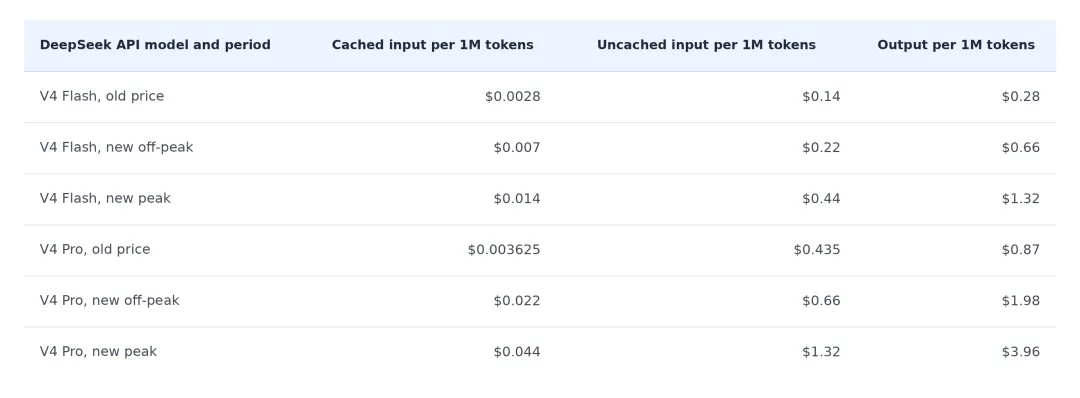
API for the DeepSeek V4 series New and old price comparisons.
In the past, OpenAI, Google and Anthropic have successively upgraded API prices or shortened free quotas. Over the past two years, major model manufacturers have pushed prices downward, and in the second half of 2026, the price curve began to collapse collectively.
The reason for this is not complicated. The growth in rational demand overcame the growth in the supply of computing, and Agent turned a single call into dozens of calls. When the bills went from "one question to one answer" to "one task runs for several hours", they could not cope with the low prices maintained by subsidies.
This has become a must-have question before the big model really enters the production environment.
Recently, Ali has released a satisfactory response: Qwen 3.8-Flash, simultaneously open source Qwen 3.8-Flash-Next, both of which are the same model, the first being the API version name and the second being the official name of the open source version.
Its performance was quite prominent. On the DeepSWE 1.1 smartphone programming benchmark, it scored 58.7 points, while the parametric scale was only 16.5 points for its three-fold predecessor Qwen3.7-Plus; on the long-cycle office task CoWorkBench and the professional positioning task JobBench, it scored 73.9 and 55.7 points respectively, significantly higher than the 68.2 and 36.6 points for Claude Opus 4.6 ((Max); benchmarks like AndroidWorld, ERQA, MathVision were also significantly ahead in multi-modeling.
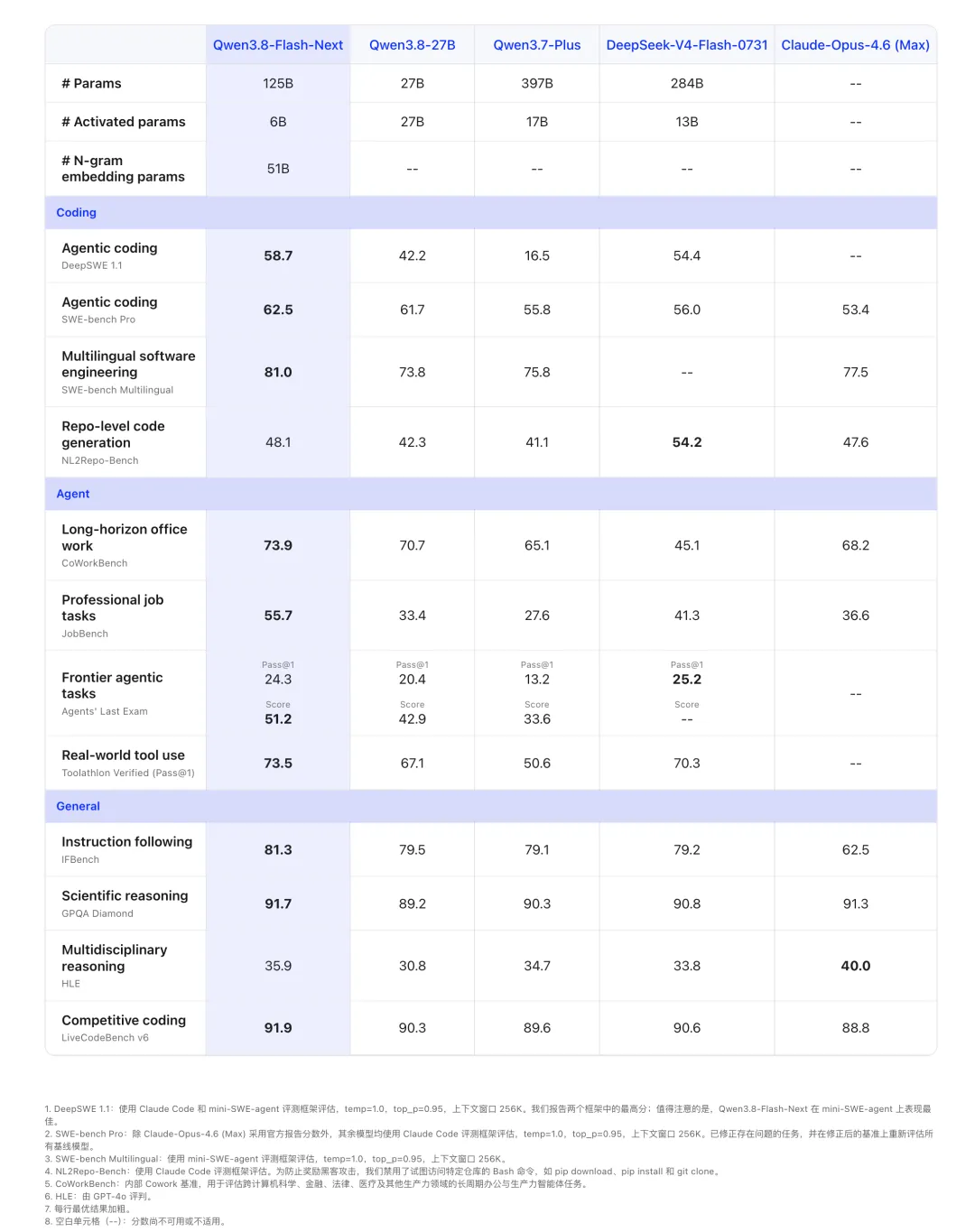
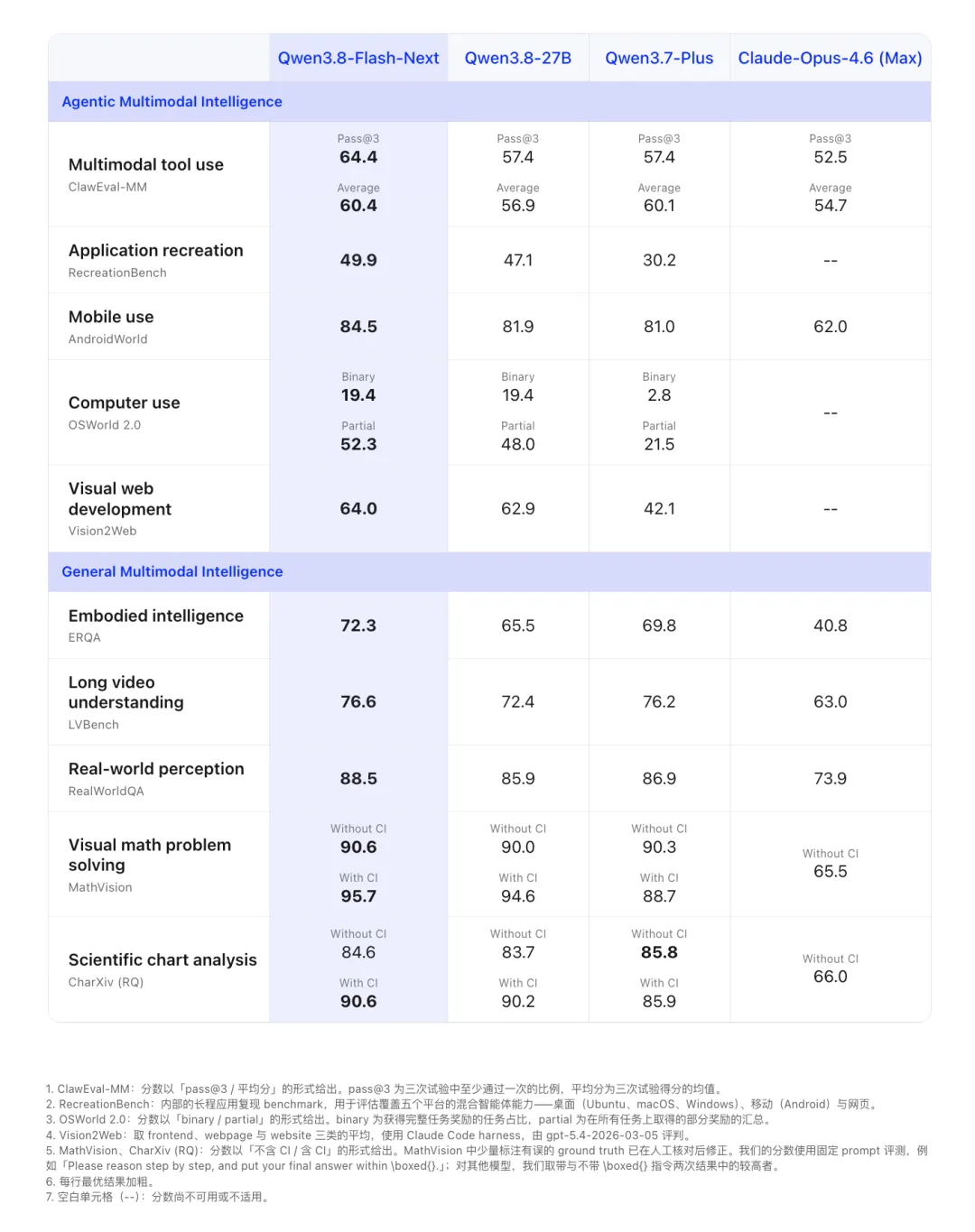 Scroll to the left and look.
But the real drawback is in the price. Qwen 3.8-Flash is priced at 1 euro per million tokens for input and 3 euro for output, only one-twelfth of the Qwen 3.8-Max, which was released earlier this month, and less than the clock price of the DeepSeek V4 Flash, which was priced on August 17.
In a month when almost all models are priced higher, subsidy is clearly not a sustainable answer. Qwen's answer is that the model architecture needs space to rewrite the production bills for each token.
The deadline for AI
"Killing line" is a saying that has gained popularity in the Chinese AI circle over the past six months: large model switching costs are extremely low, developers replace the underlying model with little to no migration burden, and the price of a model that falls below a certain line does not slowly lose its share, but rapidly loses its commercial presence.
It is worth noting that the graph of this line is changing. The unit of measurement is no longer how much money per million tokens, but how much money it will cost to complete a real task.
One important industry reference is the "per-task cost" adopted by Artificial Analysis. According to this calibre, Claude Opus 4.8 scored 57 points on the highest-reasoning capability intelligence, costing $2.03 per task; DeepSeek V4 Pro scored 53 points on the peer, costing $0.25 per task; V4 Flash 0731 scored 52 points, $0.11, even lower than the price of the same GPT-5.6 Luna, at just $0.05.
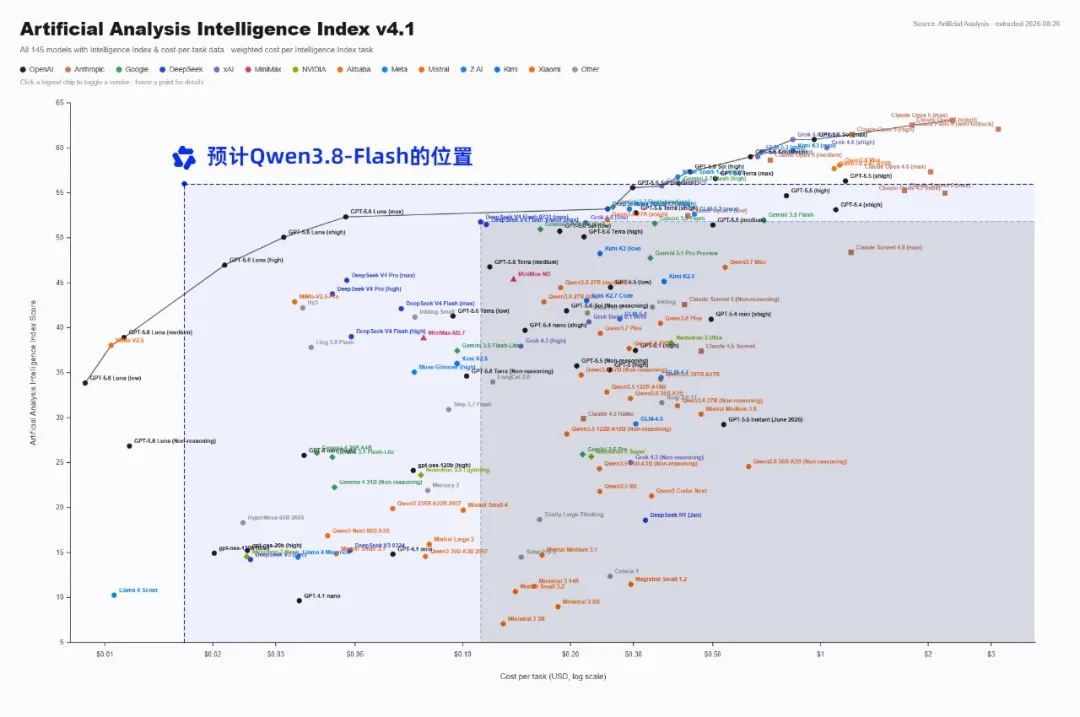
This is where the "kill line" really started to get rough. Previously, DeepSeek-V4-Flash had pushed a series of "weaker-capacity but higher-priced" models beyond the sexual price front with lower mission costs and relatively higher capabilities. Now, Qwen3.8-Flash is also trying to continue to push this front: from the current Qwen3.8-Flash's third-party performance level and API pricing, which is stronger than DeepSeek-V4-Flash, the price is less than one-third of it, this "kill line" model will once again rise higher, as shown in the diagram, pushing the AI big model industry in the direction of higher intelligence and lower real prices.
Another phenomenon is also noteworthy: In an analysis on June 30, Artificial Analysis noted that the Claude Sonnet 5 costs $2.29 per mission, twice as much as the previous generation, and its single input-output price is unchanged. The increase is all due to token usage: in two knowledge work assessments, its smart body rotation is about three times that of its predecessor.
Not only that, but the gap is also widened in the other direction. The success rate of a multi-step task is about the same as the success rate of each step, with 95% and 90% only five percentage points behind, and 36% and 12% after twenty steps, and a failed iteration will have to repay the token. A cheap but often unsuccessful model does not end up saving more money.
This puts the pressure back on the model itself. Since low prices cannot be sustained by long-term subsidies, and capacity cannot be discounted, the only way out is to extract more intelligence in the same computation.
The answer to Qwen 3.8-Flash lies in its other name.
Next: Preview of the next generation of models
In the name of Qwen 3.8-Flash-Next, "Next" is very noteworthy. As stated on the Hugging Face and ModelScope model pages of the day: Qwen 3.8-Flash-Next is a preview of the Qwen4 architecture.
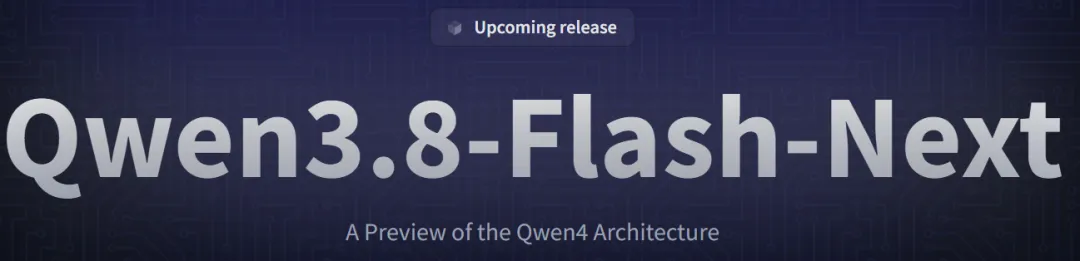
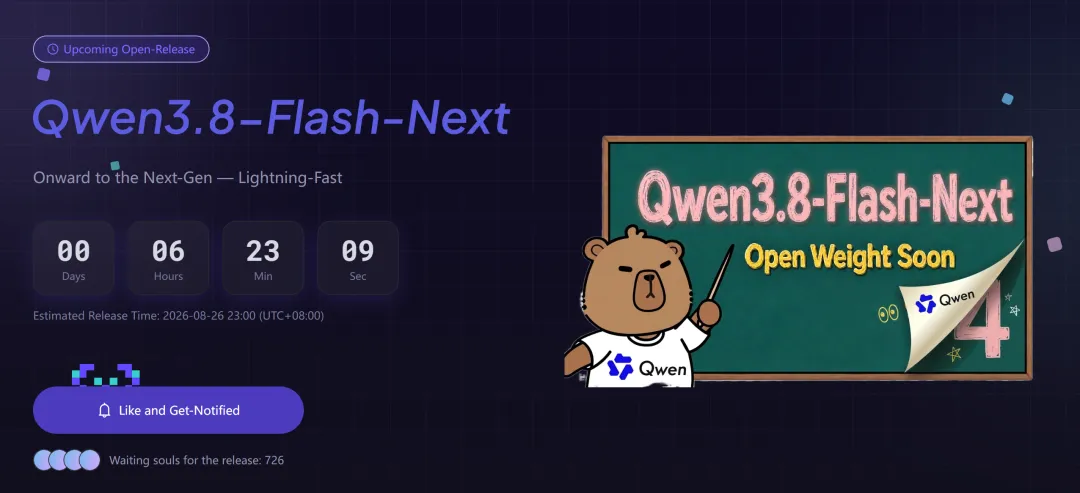
In fact, this is a preview that Ali has done before.
Qwen3-Next, released in September 2025, introduced a mix of Gated DeltaNet and Gated Attention, and was subsequently used by Qwen 3.5 along the way to the Qwen 3.8 series. It was not the flagship of a generation, but a structural prediction: the new architecture was first developed on a medium-sized model for community testing and then laid out for the entire family.
This time, it's the same set of actions. Qwen makes it clear in a technical blog that Qwen 3.8-Flash-Next's role is consistent with Qwen3-Next's role in Qwen 3.5, which is a preview of the model structure used by Qwen4, releasing structural changes in advance to allow community testing before building a complete Qwen4 model family on it.
If we put it back into the Qwen 3.8 product line, we can see a bigger picture.
Qwen 3.8-Max, released on August 3, is the range's capability limit, with a total parameter of 2.4T, activating 95B, supporting around 1 million token context and image video inputs, open-weighted Qwen 3.8-2.4T-A95B on August 12, is the first open source in Qwen's Max-class flagship. On August 14, Qwen 23.8-27B, which is geared towards local deployment and developer ecology, topped the Image-to-WebDev platform's open source model rankings yesterday.
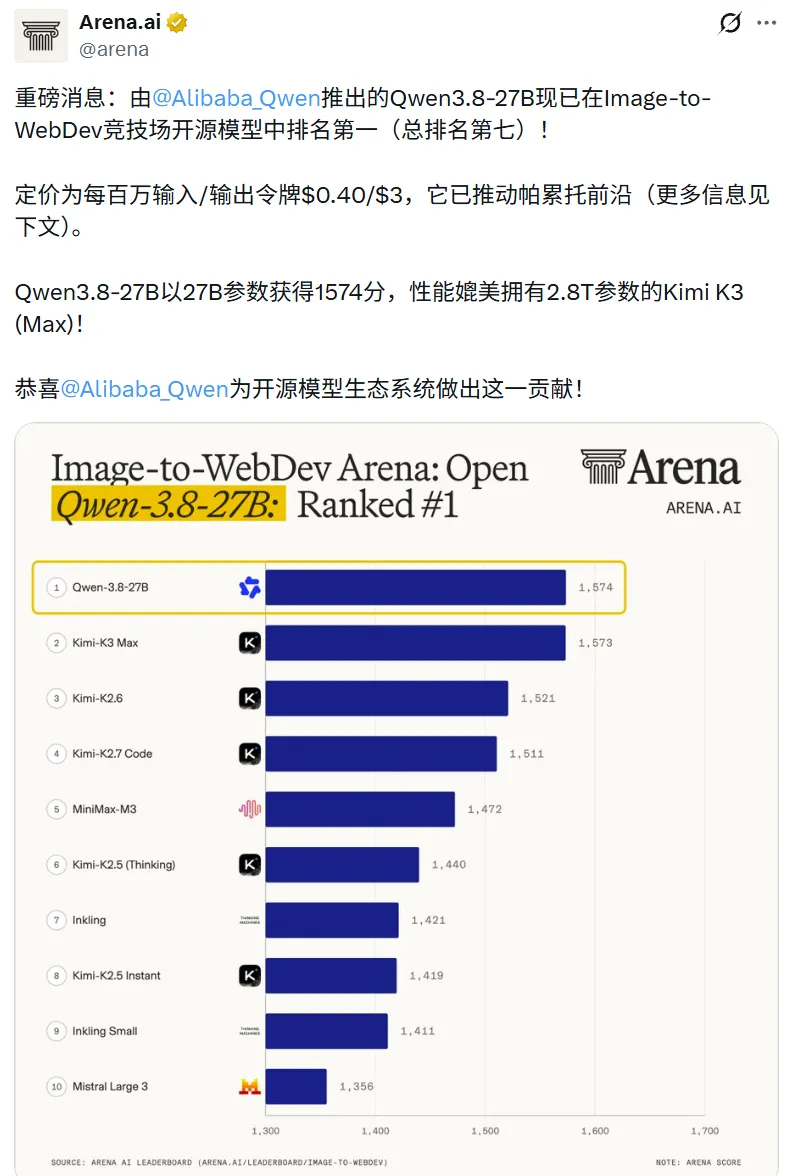
Just recently, Qwen 3.8-Flash has added a final location, taking on high-frequency, long-term, scalable real calls. But its architecture is very different from the other models in the family: Qwen 3.8-Max is a replacement for the previous generation of Qwen 3.5 architecture, and this time, Qwen 3.8-Flash uses a whole new set of architectures.
In other words, the new architecture is not given to the flagship first, but to the price of sex.
As has been the custom for the past few years, architectural innovation usually proves itself first on the largest-scale model, then gradually down, which is the opposite path this time around. One possible explanation is that the architecture wants to improve not only the level of intelligence, but also the "unit computed intelligence output", that is, "with less computation to complete the same or even more complex tasks under extreme architectural optimization.
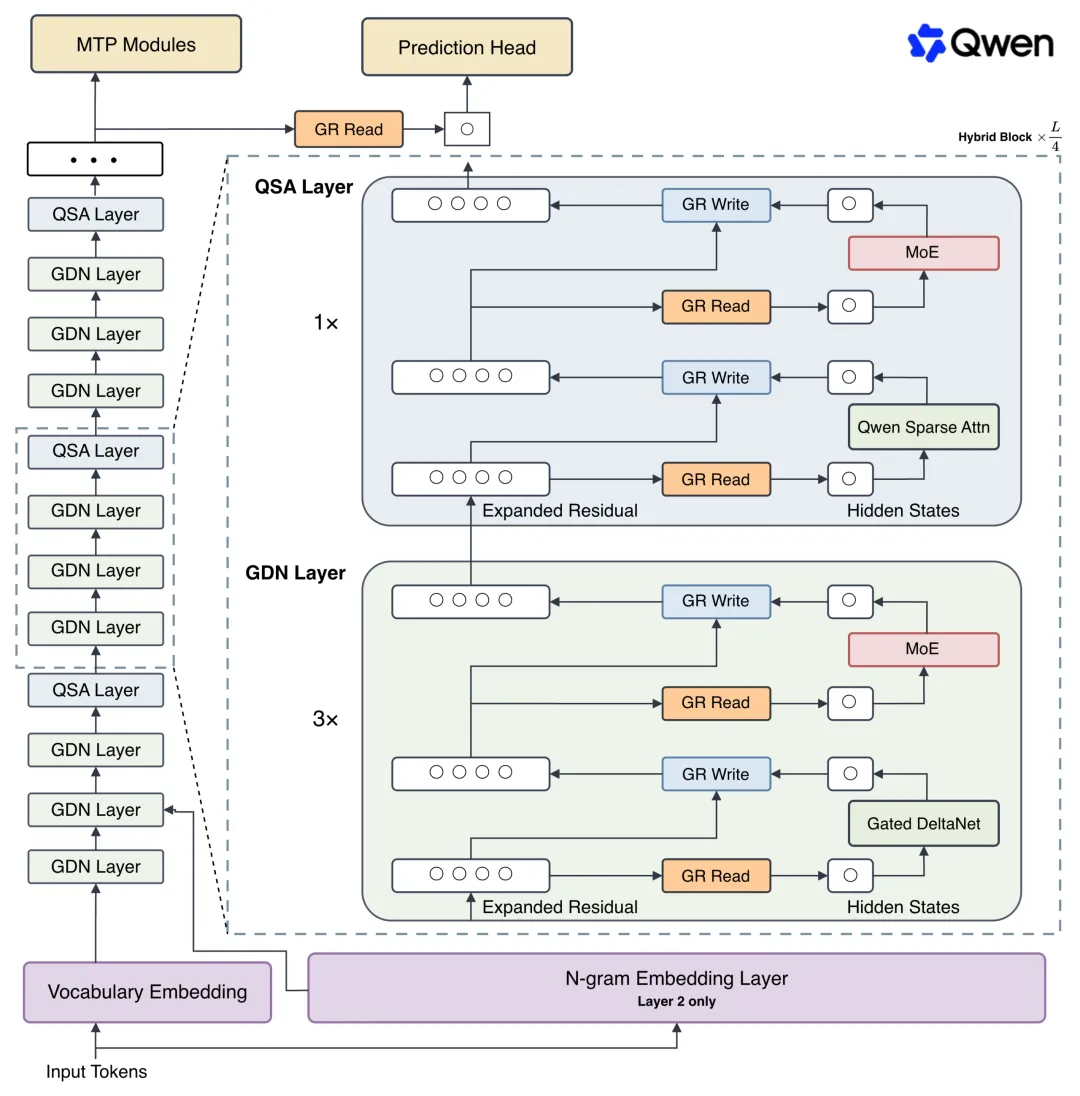
According to the Qwen team, the system upgrades revolve around four aspects: Attention, Residual, Embedding, and Optimization, which correspond to the model's attention mechanisms, layered information pathways, parametric storage, and training optimization programs.
Four major technological innovations and the efficiency of bulletproof models
Qwen 3.8-Flash is a multi-modal MoE model with a main model parameter of 125B, plus a 51B N-gram Embedding, where each token only activates the 6B parameter. It supports 262,144 tokens in context and can be expanded to 1 million tokens via YaRN.
The most critical of these numbers is 6B. In contrast, it is taken as a counterpoint to its predecessor Qwen 3.7-Plus total parameter 397B. Activate 17B. That is, the new model uses less than one-third of the activation parameters of its predecessor to replace the equivalent or even stronger capability.
The four upgrading directions of Qwen 3.8-Flash correspond exactly to four components of the cost structure: Attention decides how much data to count and move in the context; Residual decides how much information will be lost between layers; Embedding decides that parameters cannot be placed out of storage; and Optimization decides that the entire structure cannot be trained to be stable and low-cost.
Attention: GDN is responsible for remembering, QSA is responsible for finding
This is the age of the intelligent body and the age of the context, and the problem with the context is that the computational complexity of standard attention increases secondarily with the length of the sequence, and the real bottleneck is often not in the calculation itself but in the data transfer. The two phases of reasoning are not the same: the prefill phase card calculation, the decode phase card bandwidth, and the latter's bandwidth needs are proportional to the number of layers, the number of generated sequence lengths, the number of KV heads, the number of head dimensions and the number of accuracy bytes. The longer the sequence, the GPUs need more time to wait for data.
The industry's solutions are roughly divided into two routes:
Linear attention, compressing past states into fixed-sized hidden states, replacing secondary growth with constant-level memory, and the cost of accurately tracing specific information will decrease.
Rarity of attention, a form of standard attention retained, but only for the really important part of the calculation.
This is not the only option: Qwen3-Next is already a hybrid architecture of Gated DeltaNet (GDN) and Gated Attention, the two intersecting in a 3:1 ratio, with three-quarters of the layers using linear attention and one-quarter retaining standard attention.
The design point of the GDN is that the gate control mechanism is responsible for rapid removal of outdated memory, and the delta rule is responsible for accurately updating specific memory locations rather than total coverage, thus approximating the expression of complete attention while maintaining linear complexity. Part of the gate control comes from the Qwen team's paper titled Gateed Attention for Large Language Models, which won the NeurIPS 2025 Best Paper Award, and the core conclusion is that gate control introduces attention to nonlinearity and input-related rarities, and in turn eliminates attention pools and massive excitement, significantly reducing loss fluctuations in the training process.
What's new this time is a layer of what's left. Qwen introduced the self-developed Qwen Sparse Attention (QSA) to global attention.
However, there is a cost that can be easily overlooked: to know which contexts are important, it is necessary to calculate itself. Qwen points out in a technical blog that existing programs such as DSA often still require a token-level indexer to find important positions, and the expense of the indexer itself will gradually become negligible as the contexts grow.
The QSA approach is to compress this step as well. The lightweight indexer combines the sequence into a micro-block, estimates the context's importance on the block graph, and selects the most relevant region to perform Attention. This reduces not only the actual calculation of Attention, but also the indexing cost of "searching for important contexts".
Furthermore, QSA completes sequence compression independently within each layer, with less reliance on cross-layer attention similarity, which is particularly critical for the hybrid architecture that emerged in the GDN and Attention alternations.
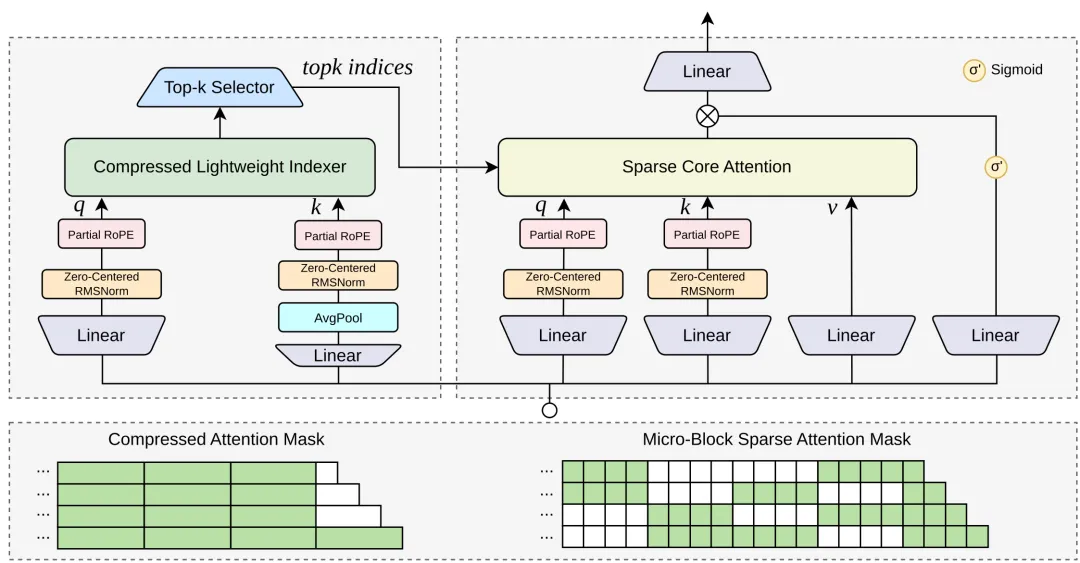
GDN is responsible for efficient "remembering" and QSA is responsible for accurate "searching".
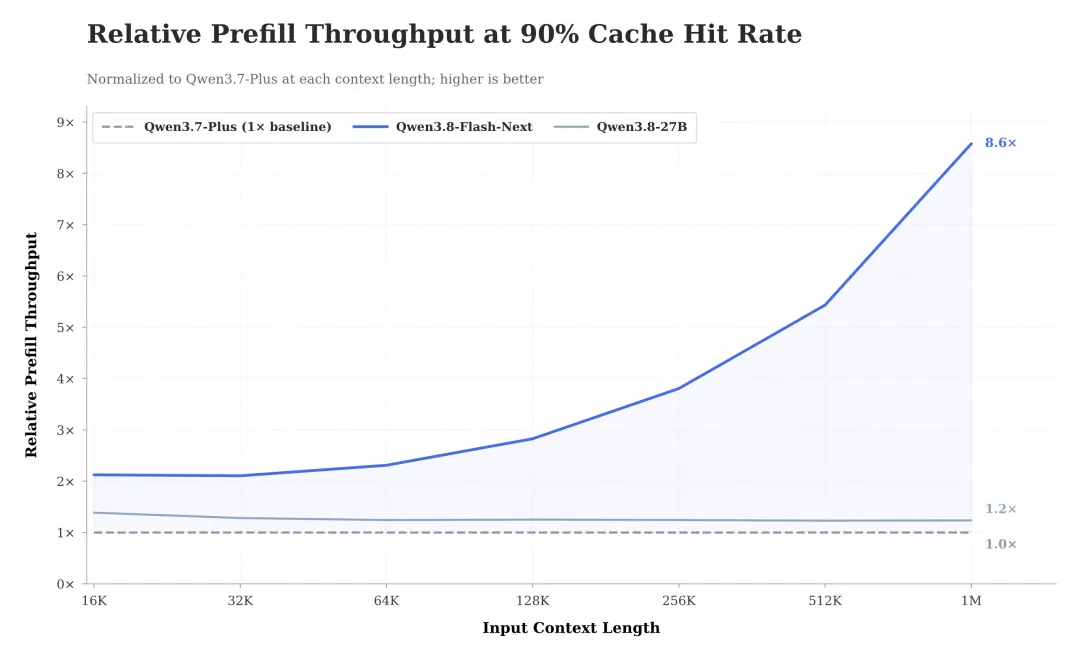
As a result, in the 1M token setting, QSA's Attention Kernel achieved a maximum acceleration of 7.6 times and 4.9 times in the Prefill and Decode phases, respectively. In the nearer-line high caching repeatability experiment, the Prefix Cache life rate is 90%, and Qwen3.8-Flash has a Prefill throughput of 8.6 times that of Qwen3.7-Plus in the context of 1M.
As an industry benchmark, other teams at the same time were moving on to adjacent but different branches. DeepSeek's native scarcity of attention was that the NSA dismantled the focus into three branches of the compression, selection and sliding window and re-assembled the door controls; with the April release of the DeepSeek V4, the scheme became a combination of CSA and HCA, the former compressing the KV entries and then making scarcity selections, accompanied by an FP4-precision Lightning Indexer acceleration index.
On the one hand, it is a linear dilution mixture, and on the other hand, it is a combination of compression and dilution. These are two mainstream solutions that are currently parallel to the problem of contextual efficiency.
Leftovers: One passageway becomes four
The Qwen team also upgraded the classic residual components in the Transformer.
In traditional Transformers, the layers continue to read and write information on the same Residual Stream, the deeper the network, the more early features are mixed with subsequent information, and the easier it is for important information to be gradually diluted.
The Gated Residual (GR) introduced by Qwen is a combination of two ideas. On the one hand, it continued Hyper-Connection and expanded the residual stream into a multi-branch design, while on the other hand, it integrated the GatedNorm's element-by-element dynamic gate control into the residual read. Eventually, the original single residual stream was expanded into four parallel branches, where the model could decide from which branch how much to read and write to which branch based on the current content dynamics.
This can be understood as extending an information channel into multiple channels: some branches are responsible for local information transmission, while others can retain early information directly to the deepest layer of the network. The Qwen team observed that one of the branches would naturally form a long-distance channel connecting the first layer Attention and most of the middle and back layer. This observation was more convincing than the design itself: it showed that the branches were not redundant, and the model did use different branches.
GR also simplified Hyper-Connection. The Qwen team found that when read and write were flexible enough, additional branch mixing was no longer a significant gain, so it was eliminated directly, reducing visit storage costs and unstable factors.
Putting this change back into the industry, from byte-bouncing Seed to Hyper-Connection, to DeepSeek using its mHC to solve its deep signal dissemination problem and using it on V4, a decade-long unchanged residual connection that is becoming a new architectural battlefield in 2026.
N-gram Embedding: Low Cost to Expand Model Capacity
This is probably one of the most detailed aspects of this architectural change.
The scaling of model parameters has become increasingly expensive. The more parameters the greater the knowledge capacity, but each token has to pay a computational cost for the part of the parameter that is activated, while the dilution energy of MoE is compressed by the activation ratio, not compressing the remainder of the parameter itself.
Qwen's approach is to separate one dimension from the Transformer parameters: ordinary embedding is based on a single token checklist; N-gram embedding combines the current token with the local context of the previous few tokens to checklist, providing additional representation for common phrases and local patterns. Its core advantage is that it can add a large number of parameters while barely increasing the computation of each token.
Qwen 3.8-Flash additionally introduced the N-gram Embedding parameter of 51B, while the model used only one layer of N-gram Embedding on the front.
This means that the 51B parameter can be directly stored in the Host Memory by means of asymmetrical Prefetch and model computation overlapping, without the need for long-term GPU occupancy. This is also pointed out in the evaluation of the Base model by Qwen: 51B's N-gram Embedding parameter is a determining matrix address, not entering the matrix budget of each token.
The design was inspired by the work of Gemma 3n's Per-Layer Embedding and DeepSeek Engram. It is worth noting that Engram's DeepSeek itself did not enable it on V4, only listing it as a future direction; and Qwen chose to advance this idea into an upcoming open source production model.
Architecture and Optimized Collaborative Design
The first three changes are aimed at improving the efficiency of models, while the fourth change is the way they are trained.
Qwen 3.8-Flash uses Muon optimizer training. Muon accelerates convergence by converging the dynamic matrix positively, previously used by Moonlight, Kimi K2 and DeepSeek V4; Qwen further engineers its use, focusing on the precision of convergence, the parametric division of Muon and AdamW, and the three problems of the division of the convergence matrix.
The divisional principle is that the parameters that are actually used as two-dimensional linear mapping, such as Attention, GDN, and MoE Expert, have the main weight in Muon; while the lower-order parameters of Embedding, MoE Router, GR, etc., continue to be assigned to AdamW. The QKVs, SwiGLUs, and GDN Projection that are integrated into the engineering implementation are disassembled by the actual corresponding independent linear transformation, and then executed as convergence respectively.
For new structures and new optimizers, the Qwen team also re-adapted the Scaling Law.
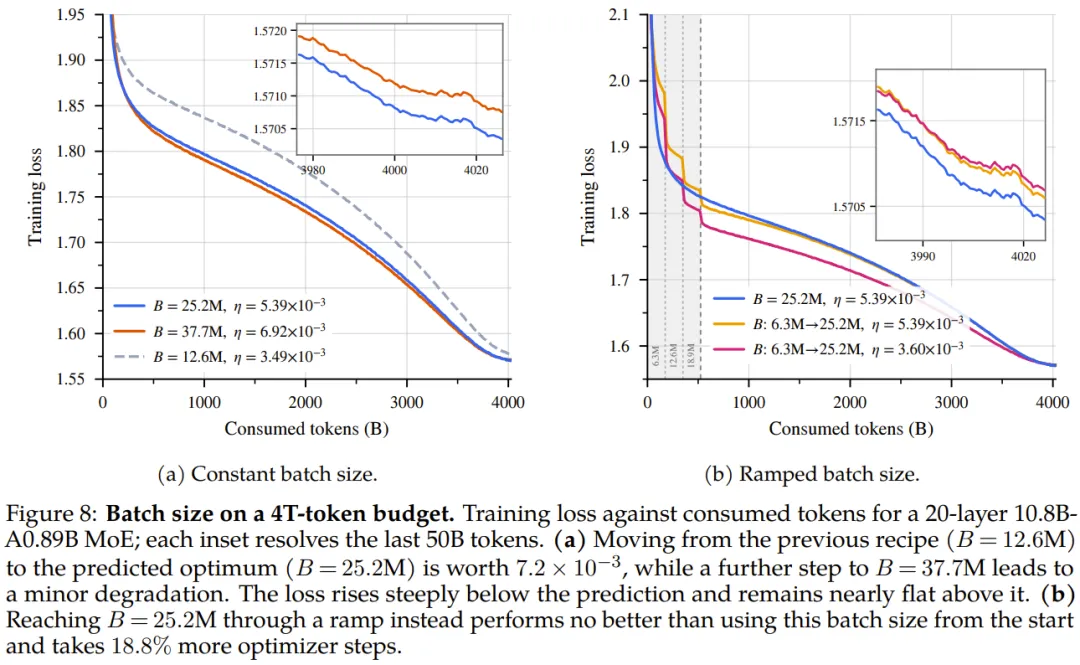
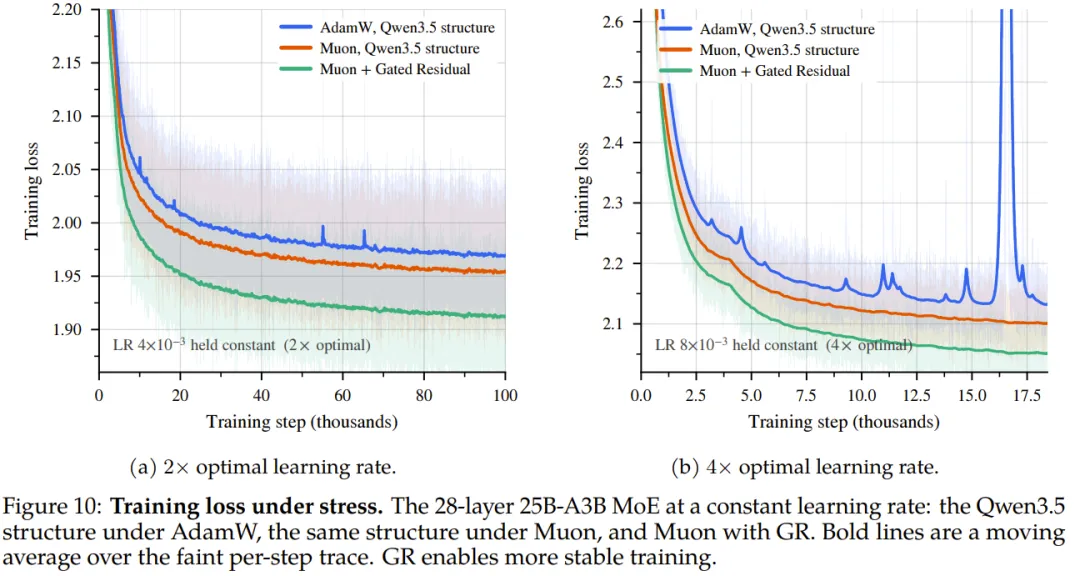
The result is that models can steadily use larger learning rates and batch sizes, thus improving convergence efficiency and large-scale parallel training throughput. One of the findings is enough to change the default configuration of many teams: Batch Size Warmup, common in previous large-scale model training, is no longer necessary. Experiments show that the gradual increase from the small batch to the target batch does not improve the end result, but instead adds 18.8% optimizer steps. The final training configuration starts directly from the target batch size.
The rest of the components follow the Qwen3-Next established and continuously refined designs in the Qwen 3.5 to Qwen 3.8 series, including the extremely rare MoE (larger pool of experts; each token is routed by only a small number of experts with a shared expert); multiple token predictions; MTP modules trained in a multi-step manner to maintain consistency in training and reasoning, where the entire attention layer is also replaced by QSA); and a set of training stability measures.
These innovations combined give Qwen 3.8-Flash a significant model efficiency advantage: its training costs are only about one-ninth compared to Qwen 3.7-Plus.
Under the 6B activation parameter, Qwen3.8-Flash-Next-Base outperformed 8 out of 14 benchmarks, while the other 6 were close to Qwen3.7-Plus-Base.
The conclusion is clear: only one-third of the activation parameters; training costs only one-ninth of the models, which in most pre-training assessments is equivalent to or even more than three times that of its predecessor. This does not mean that Scaling stopped, it simply changed direction: from expanding the scale of the parameters to improving the intelligence that unit computing can carry.
What is the meaning of this verse?
This generation of architectural transformation is also an industry-wide signal.
In 2026, for the first time in the history of super-large cloud providers, capital expenditures will exceed training expenditures, and core contradictions will shift from computing to clustering to memory bandwidth and communication delays.
This time around, the direction of change is exactly the same: QSA cuts along with indexing expenses, N-gram Embedding removes the entire 51B parameter, and the residual state of gated residual can be stored as FP8. The model no longer defaulted to put all the data into expensive GPUs, but began to actively design a layered storage system consisting of GPUs, HBMs, and host memory.
After the release of the DeepSeek R1 in January 2025, "cheaper models mean less computing" once became a consensus, the United Kingdom plunged almost 17% in one day, market value evaporated about $589 billion, creating a daily decline in U.S. stocks and stocks alone. When DeepSeek released a stronger and more economical V4 in April 2026, the United Kingdom shrank 4.3%, returning $500 million in market value.
Back to the price curve at the beginning. When subsidies are no longer a sustainable source of lower prices, it is the architecture itself that can reduce costs. The core of the competition is changing: from raising the level of intelligence to raising the efficiency of models, that is, delivering smart enough at the lowest cost.
Qwen 3.8-Flash's open weight has been released to Hugging Face and ModelScope, and technical reports can be found on the GitHub repository; the production version is available on the Millennium AI platform.
Hugging Face:
ModelScope:
Tech blogs:
Technical report: