In FinanceAgentBench v2, the Mint-Agent of 27B reached 60.49%, overtaking GPT-5.6-Sol and Claude Opus 4.8; the cost of single-issue reasoning was only about 22% and 10% respectively. At the same time, Mint-Agent's commercial orders have reached trillions of dollars and have begun to move from model capability verification into the scaling-up financial scenario verification phase.
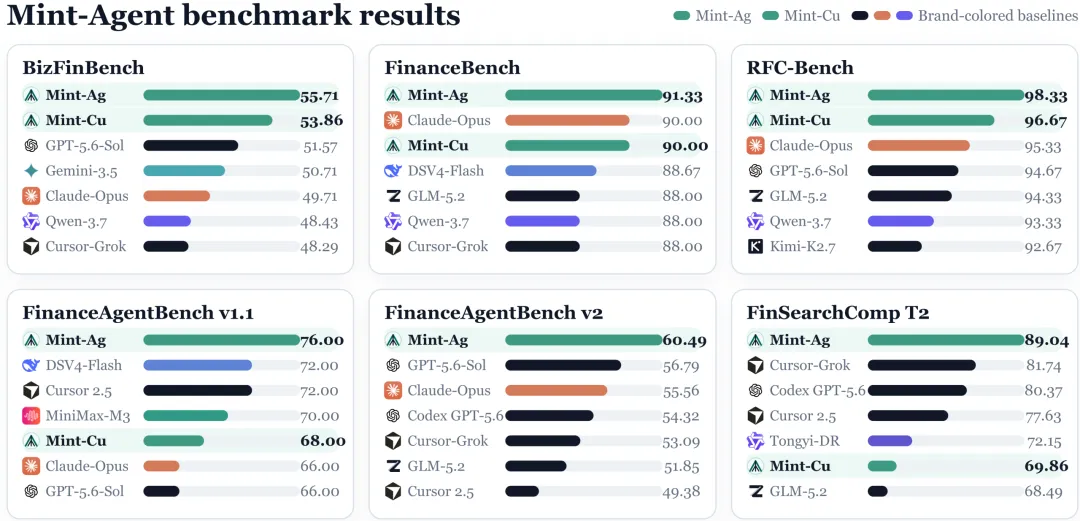
Figure 1 shows the performance of Mint-Agent in six core financial assessments: top-ranked financial reasoning and reliability, bottom-ranked search in open environments, tool calls and long-range execution; FinanceAgentBench v2 for three running averages.
Mint-Agent project site:
Mint-Agent technical report:
Mint-Agent published
Mint-Agent's excellent performance demonstrates that performance improvements in financial professional tasks do not necessarily come from a larger budget of reasoning, but from the synergy of financial reasoning, long-term execution and evidence management capabilities. In finance, performance is only the first threshold.
The Mint-Agent team introduced the Mint-Cu of the financial native Agentic Foundation Model family:9B and the Mint-Ag of 27B. The model incorporates the source, time, numerical values and operations into the same recoverable chain; reliability is no longer an abstract score, but a concrete step in the proof, extraction or calculation of whether errors can be positioned.
For the financial base model, performance, efficiency and auditability must be established at the same time.
Improved performance, not at the expense of higher implementation costs
Mint-Ag scored 60.49% on FinanceAgentBench v2, one of the most influential financial intelligence benchmarks in the industry, higher than GPT-5.6-Sol and Claude Opus 4.8; while achieving higher accuracy, its single-item reasoning costs were only about 22% and 10% respectively.
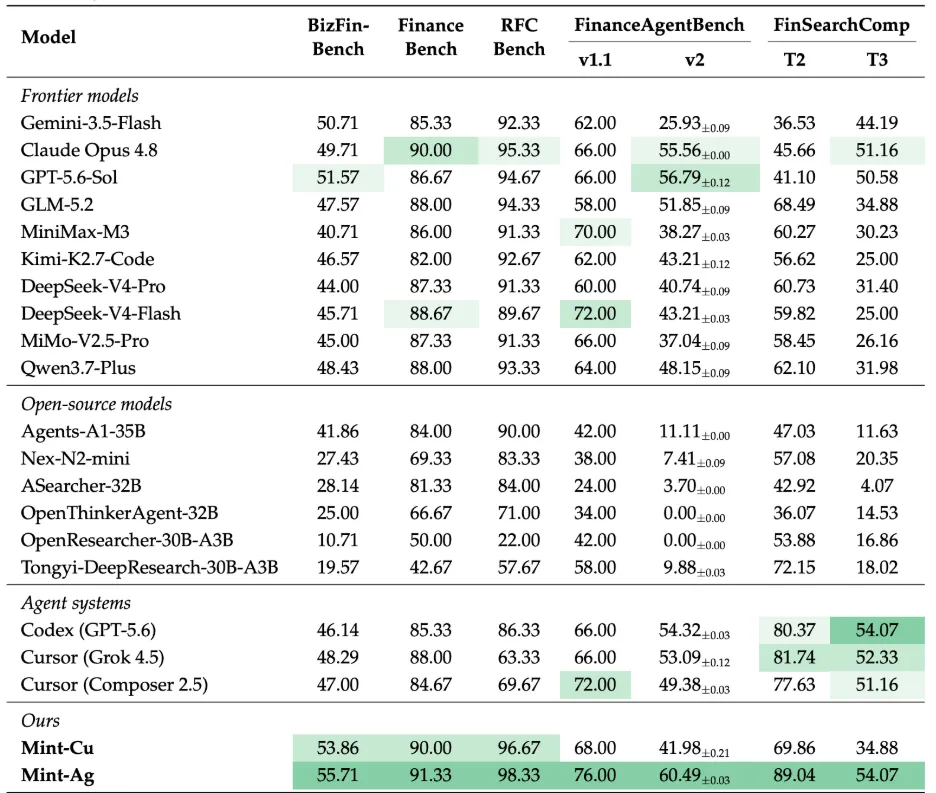
Mint-Ag is on the cutting edge of performance in high-difficulty financial tasks: the model maintains both financial reasoning and long-term execution capability, while significantly reducing reasoning costs. The Mint-Cu of 9B further demonstrates the efficiency potential of the compact model in financial search and execution.
The real threshold is not a threshold, but a threshold.
Real financial research is rarely directly answered by a single piece of knowledge. Agentic Model must find authoritative material on its own, identify the correct reporting period, extract indicators, unify units, complete calculations, cross-source verification and form conclusions. Any deviation from the final text may seem logical, but it may actually be incorrect.
Mint-Agent therefore redefined the task as a recoverable chain: from source to fact, from fact to computation, from computation to conclusion. The answer is not isolated text, but is supported by evidence and operational claims. This also changed the way of evaluating: not only comparing the final answer, but also checking whether the evidence is valid, whether the computation is closed, whether the process can be reset.
From Financial LLM to Auditable Agentic Model
The boundaries of financial intelligence's capabilities are shifting from generating answers to completing tasks and accepting checks.
01 Financial LLM Financial Knowledge and Answers
It's about the financial calculations and analytics.
3 Financial Agentic Model is a tool for searching, calling, and executing long-range tasks.
04 Agentic Foundation Model is evidence traceable, computationally reproducible, and process verifiable.
Mint-Agent targets the last layer of the Agentic Foundation Model: not to add a financial questionnaire, but to make the research process itself a verifiable system. The first three layers address the question of whether or not an agent can answer, whether or not it can analyze, whether or not it can act.
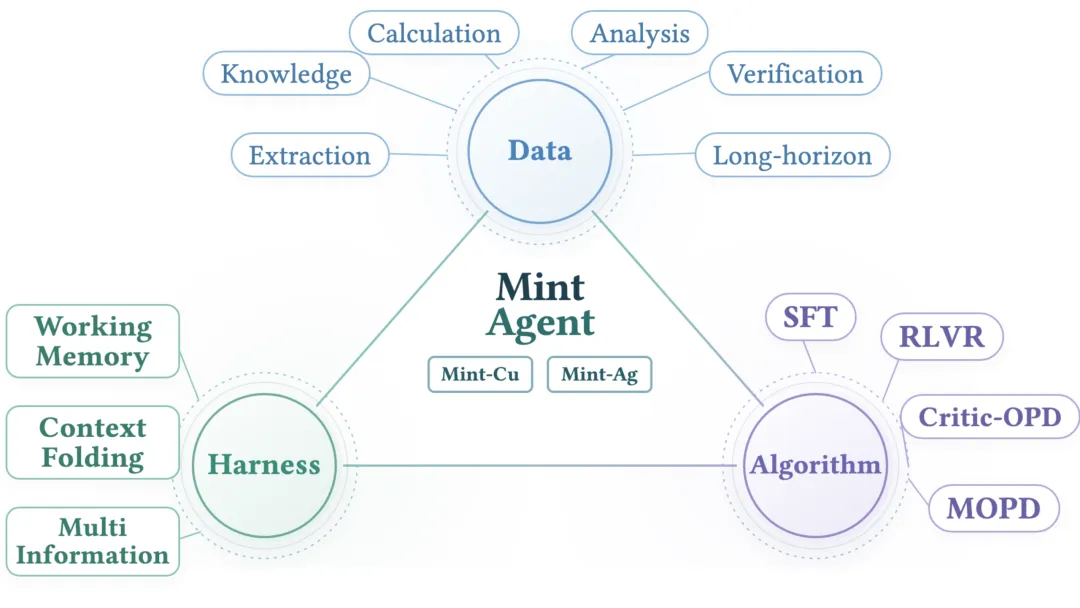
Figure 2 of Mint-Agent's Trinity Technical Kit: Data defines what calculations are, how Harness preserves models are executed, and the algorithm puts reasoning and execution training into the same strategy. The three parts are not parallel functions, but share the same set of financial correctness criteria: source, reporting period, indicators, numerical values, units and calculations must be re-checked.
Data: Let's define what constitutes constellation first.
Data engines first construct knowledge, extract, calculate, analyze, verify five types of atomic missions. Materials come from EDGAR, company investor relations pages, XBRL, exchange records, FRED and accounting classification systems; each fact binds to an entity, reporting period, indicator, numerical value, unit, and original location only. Evidence supports, calculates replaceable, and the only sample of answers enters training.
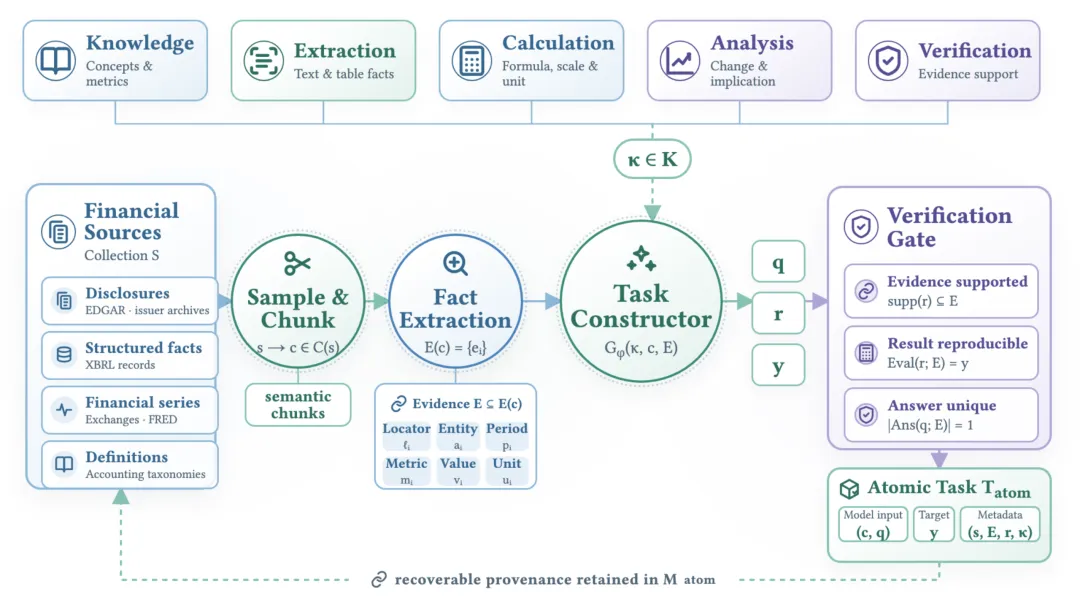
Structure of atomic financial tasks: system sampling material from EDGAR, XBRL, exchange records, FRED and accounting classification systems, extracting data from source locations, entities, periods, indicators, numerical values and units, and generating tasks based on knowledge, extraction, computation, analysis, verification of the five categories of capabilities; only evidence-supported, computationally replaceable and the only sample with answers enters training.
Long-range tasks intentionally hide material, exposing only research objectives. The system builds a hidden evidence graph in advance, fixes the required facts, sources, and operations paths, and saves a snapshot of the time for dynamic pages. The model must recover the path itself in an open environment without being able to get answers from the subject. Therefore, the correctness of the same problem no longer depends on the wording, but on a set of fact nodes and operations relationships that can be verified by machines.
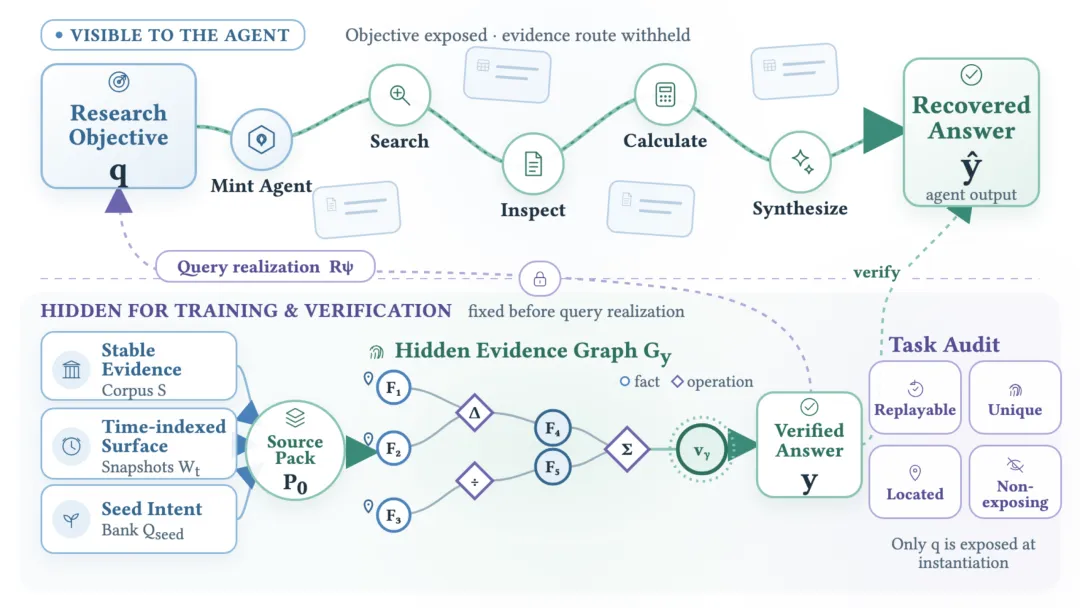
Figure 4 Long-range Agentic task construction and verification: Agentic Model only sees research objectives and must search, check, calculate and integrate self-recovery responses; underlying source packets and hidden evidence charts are not exposed to the model, but are used to verify whether the trajectory can be relocated, whether the answer is unique, whether the evidence can be located, and whether the subject area leaks established paths.
Harness: Evidence cannot disappear with context
MintHarness transforms the research process into a state-of-the-art execution cycle. The model determines the next action; Harness is responsible for testing tools, budgets, and output formats, and writes the effective results into the Evidence Ledger. The ledger maintains an entity, period, indicator, numerical value, unit, source location, and access time, and a strict separation between the failed detection path.
The current context changes and old conversations can be compressed, but the evidence ledger, working memory and complete movements are still preserved outside the context of the model. The model sees a narrow view of the current task, and the auditor keeps the complete research record. Even if the task experiences a web page failure, search redirection, or multiple compression, the confirmed evidence will not be covered by subsequent conversations.
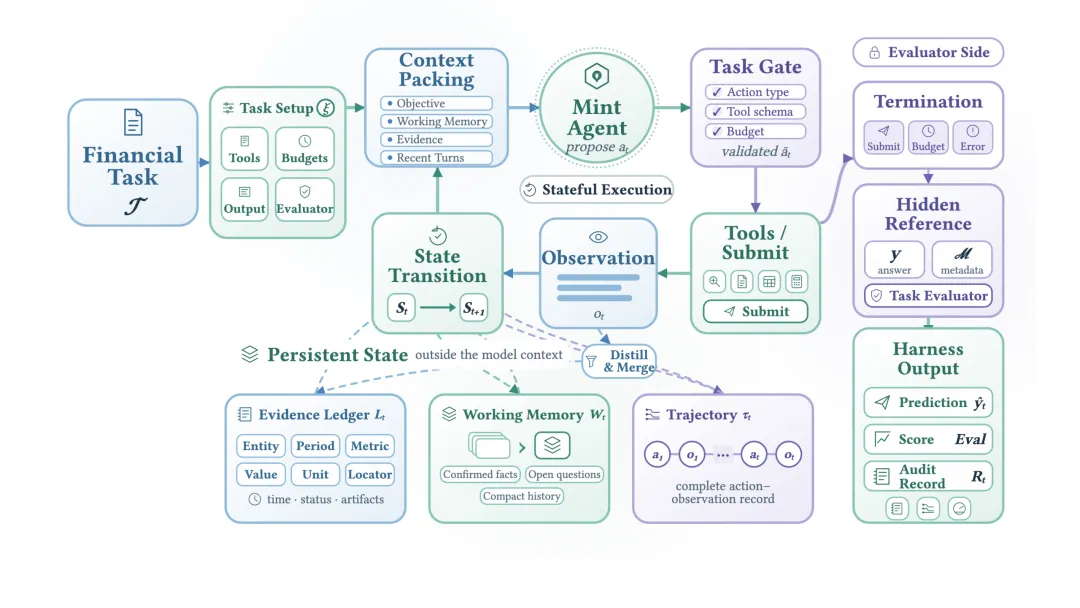
Figure 5 states the execution cycle of MintHarness. Once tasks, tools and budgets have entered the cycle, the evidence ledger, working memory and complete trajectory are continuously updated; the hidden answers remain on the isolated evaluation side only.
Therefore, even if an answer happens to be correct, as long as the evidence cannot support it, the time limit cannot be established or the calculation cannot be repeated, it will not be considered a true completion of the task.
Algorithm: Bi-nuclear training, combined capabilities
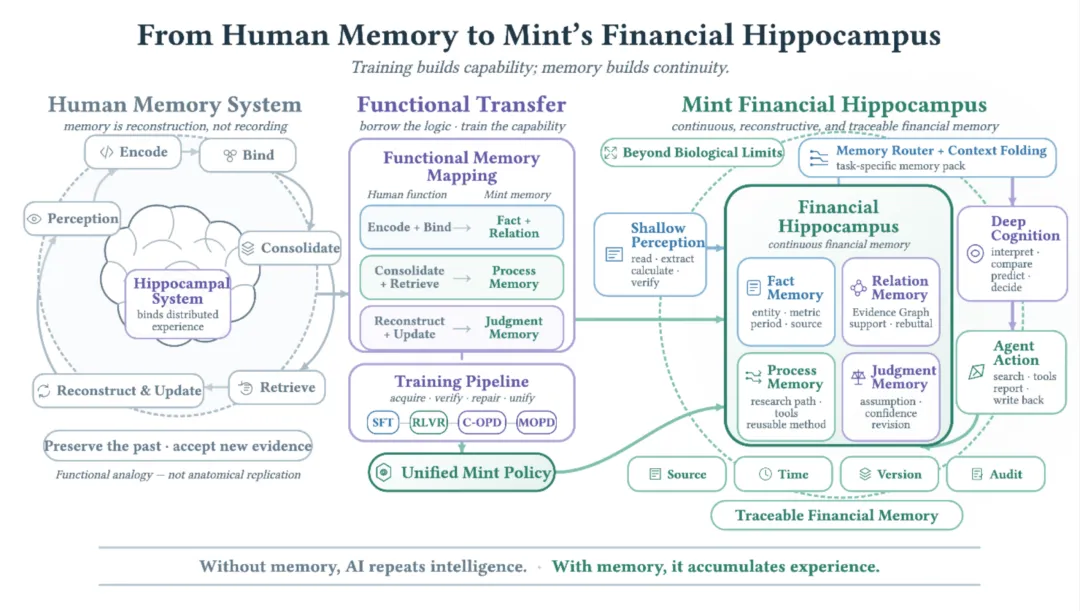
From human cognition to scalable intelligence. Human cognition is focused on the biological constraints of memory stability and range of action; Mint gains expertise through SFTs, continuously improves RLVR from verifiable feedback, and uses MOPD to distill and merge multiple specialized instructors. The resulting unified intelligence body combines durable memory, verifiable reasoning, tool enhancement and long-range execution mechanisms to expand limited internal cognition into durable, verifiable and scalable intelligent systems.
Mint-Agent started from the same basic model and trained financial reasoning and Agentic to execute two paths: the former to strengthen computation, analysis and verification, the latter to strengthen search, tool call and failure recovery. Both paths went through a complete SFT-based OPD-based RLVR-based Model merging/Multi-teacher OPD training path. The team developed its own core algorithm to integrate the two specialties into the same model.
In addition to the results, the trajectory is really worth seeing.
The trajectory chart not only records what the model ultimately responded to, but also records how it handles failed retrievals, evidence locks, calibration corrections and computational retrievals. The following two representative trajectories, respectively, show retrieval recovery capabilities and long-range maintenance status.
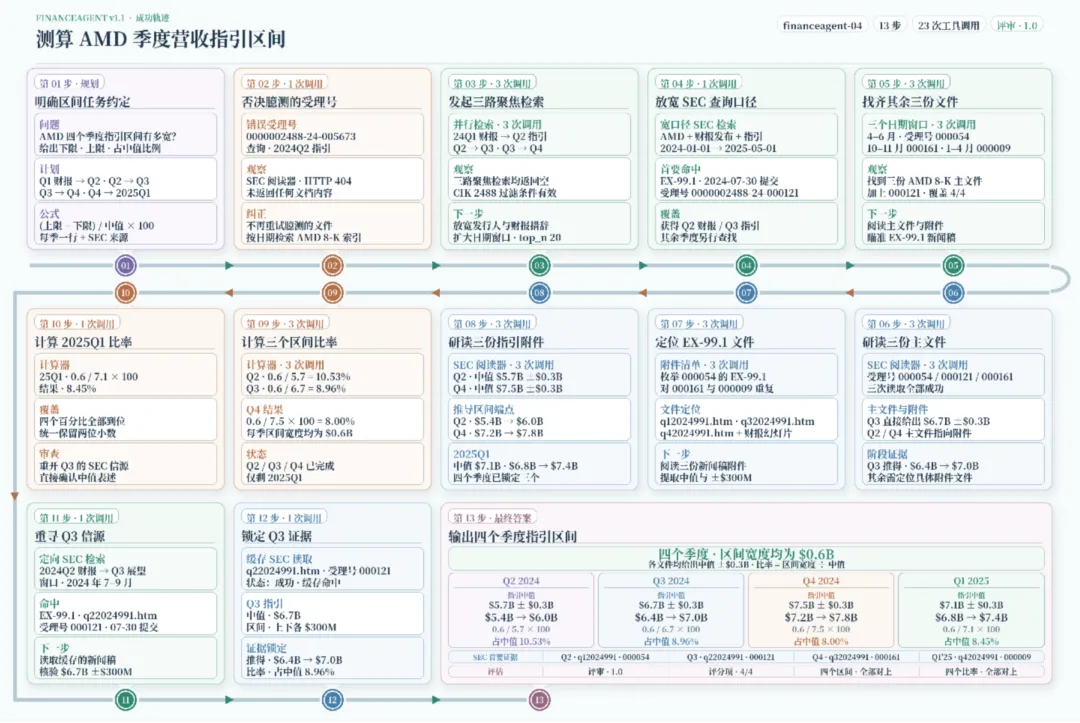
Figure 7 AMD revenue guidance trajectory: 13 steps, 23 tool calls. The model rejects error access, expands the SEC retrieval, locates EX-99.1 for four quarters, and reopens Q3 source verification before output.
The key is not that the file never fails, but that the failure is clearly recorded and triggers traceable path corrections; both the original file, the intermediate value and the final ratio can be re-checked. In other words, the system allows for visible, correctable failures, but does not accept an inexplicable correct answer to the file.
CASE 02 - Long-range status and computational reproduction

Figure 8 - Revenue evolution trajectory for the first quarter of 2025: 37 steps to execute across reporting constraints, quarterly page mistakes, annual data misuse and statistical window corrections; the model continues to maintain effective guidance and monthly revenue records, ultimately restoring the 2022-2024 calibre and completing recoverability calculations.
This trajectory test is a persistent state of long-term execution. The model always maintains a confirmed first-quarter guidance and monthly revenue record for 2025 in the face of multiple source failures and qualitative circumvention; recalculates the historical March growth after the three-year window of 2022-2024, derives the March 2025 revenue, and estimates quarterly revenue at NT$825,110 million. The final NT$8,010 million difference can be fully recalculated along the original evidence and computation process as the guidance median and exchange rate conversion averages are locked in the ledger.
The two trajectories are common: auditability is not just a reference to a conclusion, but a continuing validity of evidence, status, and computation in long-range execution. The AMD case shows path corrections after a failed retrieval; the cumulative electrical case shows how the model retains and recalculates the confirmed material after multiple rounds of circumvention and calibration corrections. For the more difficult FinanceAgentBench v2, the key is not only to find the source, but also to convert the source into complete, accurate and re-playable financial evidence.
It's not going to be tolerated by the financial system.
Mint-Agent does not continue to stack financial content into the general model. It builds on a more rigorous financial baseline model (Agentic Foundation Model): data defines evidence, Harness maintains execution status, and algorithms are trained to write the right behavior into the strategy.
The judgments given by this route are clear: auditability is not an explanatory layer of reasoning, but a foundation upon which data, execution and training rely together. A financial base model with Agentic capabilities, the next stage of competition will not be about who is more like an analyst, but who can complete the task and leave a verifiable basis for each conclusion.
It's a great way to get to know each other.
Bringing research into the financial realm
The project is led by Dr. Liu Li, Director of the Shanghai Institute of Artificial Intelligence Finance at Guangdong Teaching University, and relies on the faculty and related product research platforms. The team members come from leading tech companies and universities at home and abroad, including former financial AI researchers at major domestic factories, postdoctoral researchers at South China University of Technology, and the National University of Singapore.
The team covers big models, agentic models, reinforcement learning, fintechs and credible AI, continuously connecting cutting-edge algorithm research, financial scenario verification and industry transformation, and forming a complete loop of Silicon Model R&D, Silicon Financial Problem Definition, Silicon Engineering deployment, and Silicon Real-Scenes Feedback.
From the cutting edge of technology to the industrial window:
Financial baseline model enters infrastructure competition
As Agentic Model moves from information retrieval and content generation to autonomous planning, tool calling and complex decision-making assistance, the competition for financial AI is changing. For high-value, high-risk, tightly regulated financial businesses, model capability is just the first barrier to the core production environment; stability, explainability, traceability of evidence, and auditability of the entire process are becoming key conditions for determining whether models can be deployed at scale.
This also presents a technological and industrial barrier to the financial underpinning model that differs from the general large model: it requires not only cutting-edge model research and development capabilities, but also a deep combination of financial business understanding, credible AI, security governance and industrial engineering capabilities. The core of the competition is shifting from how strong the silicon model is to whether it can enter the real production environment and leave a verifiable basis for every conclusion and action.
In this context, teams with both cutting-edge model R&D capabilities, financial business understanding capabilities, and industrial engineering landing capabilities are conspicuously scarce. The project team, which relies on the platform of the Shanghai Institute of Artificial Intelligence Finance and Production at Washington University, has developed a comprehensive technological system that covers large models, the Agentic Model, reinforcement learning, fintech and credible AI, and continues to drive cross-sectional testing between cutting-edge algorithm research and real-world financial scenarios. Currently, Mint-Agent's commercial orders have surpassed USD 1 billion, demonstrating the real needs of financial institutions and industrial customers for their technology routes and landing capabilities; at the same time, the team is launching a new round of strategic financing and engaging deeply with industry capital and investment firms.
At the next stage, Mint-Agent will further push the financial native Agentic Foundation Model into a real production environment and build an integrated technology system around the aluminum model. As financial institutions move from aluminum to core business depth deployment, credible, secure, and auditable financial AI capabilities will become the most important barriers to financial intelligence infrastructure.
From model leadership to multibillion-dollar commercial orders, Mint-Agent is moving across the critical thresholds of financial AI, from leverage to leverage, from technical verification to scale deployment. The team is advancing a new round of strategic financing to build the next generation of secure, credible and auditable financial intelligence infrastructure with financial institutions, industry partners and long-term capital.
The following is a link to the Mint team:wang.kun@minttruth.com