Imagine a scene like this: A puts a cup in a closet and B doesn't see it.
Q: B: Where do you go next to get the cup?
If the world model only knew the physical facts, predicting error B would be the next decision: "The cup is now in the cabinet, we should go find it".
But at the same time, models that understand people's minds correctly predict: "B didn't know the cup was moving, so assuming the cup was still on the table, he would probably go back to the table to look for it".
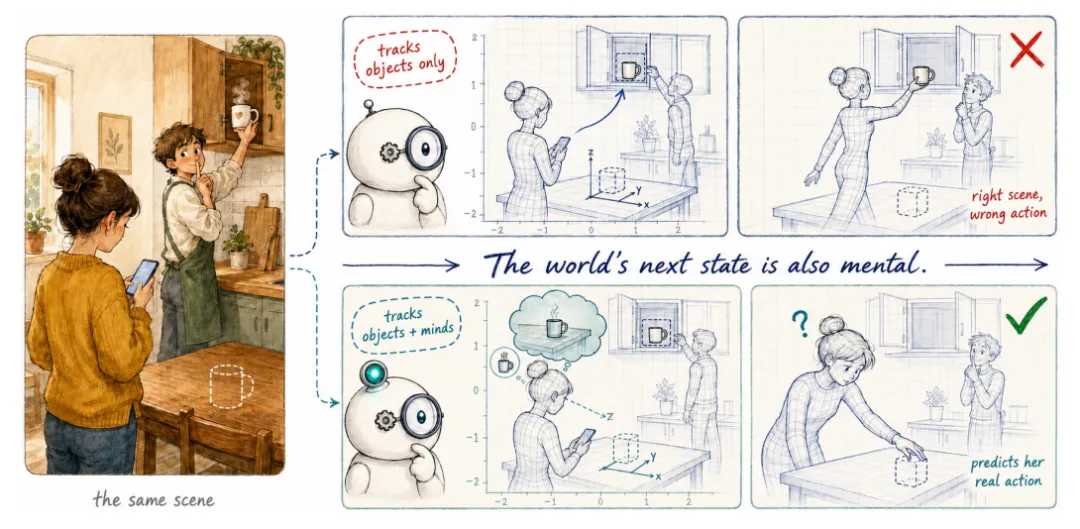
The next state of the world is also determined by mental changes.
This reveals a key problem: a world model that only tracks objects, locations and movements can be predicted to be "physically reasonable but behaviourally flawed".
Recently, a team of researchers from the University of Oxford and the National University of Singapore has proposed a general framework for mental world modeling (Mental World Modeling, MWM), which incorporates these mental variables into the world state itself rather than simply interpreting them as post-hoc explanations.

The title of the paper: Mental World Modeling
Link to the paper:https://arxiv.org/abs/2607.27201
The main page of the project:https://mental-world.github.io/
Open source code:https://github.com/mental-world/Mentis
As of this writing, MWM has topped the Hugging Face Daily Papers daily list.

Hugging Face Paper:
The other half of the missing world model
Most existing models of the world focus mainly on the physical plane of the world:
What objects and intelligent agents exist?
Where are they?
How will the scene evolve?
In these models, people are often just an object that moves, performs actions, and their inner state does not really enter the model of the world.
For human-centered intelligence, this is far from enough.
Why? Because human behavioural decisions are not simply determined by the external environment of objects, spatial structures and physical laws, but by the interaction of the external environment with internal mental and social changes.
For example, a service robot needs to judge whether a user is confused, has lost patience, or is seeking help indirectly; a medical assistant needs to consider the patient's cognitive, risk-sensitive, fear-mongering, and confidence levels; and a collaborative intelligence body needs to recognize that certain behaviors, while physically feasible, may not be appropriate due to social norms, role relationships, or the context of human interaction.
All of these scenarios require intelligent systems to be able to continuously track the mind and social state of an intelligent being, including what they know, believe, care about, want, intend to do, feel, and what behaviors are permitted by social norms. Even if the two scenarios are physically exactly the same, as long as the individual's beliefs, goals, emotions, relationships, or social responsibilities are different, they can produce distinctly different behaviors.
In a nutshell: a world model may not be able to accurately predict human behavior even if it can accurately reconstruct physical scenarios.
Cognitive science has studied these abilities through theories such as mental models, theory of mind, ToM, BDI, intelligent body model, belief system, desire system, intentional agency, and embodied cognition.
However, most current AI studies either construct models of the physical world that lack a state of mind or simplify psychological reasoning into isolated mind-theory question-answering tasks.
Both viewpoints are insufficient to describe a truly complete world, because the next state of the world is determined not by physical factors alone, but by the jointly physical and mental evolution of the physical and mental states.
How do we really integrate mind-altering into the state space of a model of the world?
This study attempts to provide a formalized framework for modeling the world of the mind in order to construct a world model that can express both physical and mental dynamics.
The goal of modeling the world of mind is not to simulate an individual's subjective consciousness and experience, but to build an external, approximate, task-relevant world simulator. The global state of the simulator includes both physical variables and mental variables.

Two subjects, three operating modules, a physical mind-body combination. The mind-world model serves as a global simulator in which the target intelligent body can see and infer information and then allows the intelligent body to act on the basis of that cognition.
First, the model of the mental world maintains a coupled physical mental world state, which represents the potential mental state of the physical environment and the intellectual body.
Second, a target agent can only observe this global state after conversion, and the first-person perspective of the part is presented as partial, first-person r.