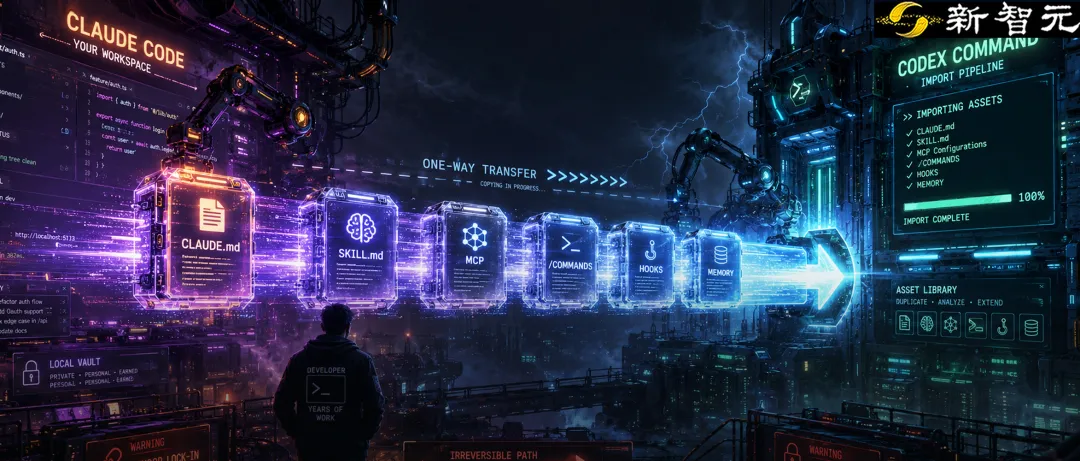
It's the first time in the history of the world.
AI programmed World War II and took over the home of enemy users.
Instead of an AI programming tool, the most expensive is never a subscription fee, but the one you've changed for half a year to Cloud.md, the dozens of tricks you've accumulated, the permissions you've got on an MCP server, and a slew of sliding commands that you can knock out with your eyes closed.
These things don't cost money to buy, but Claude Code's instructions work for you. Instead of the codex, the instructions are scrapped and everything has to be written from scratch.
The real reason why developers can't afford to leave is this half-year-old house installed on their machines.
What OpenAI has recently done is to pack the whole house and move it into its own home.
On August 11, OpenAI unified the instructions for importing external smart objects into a document.
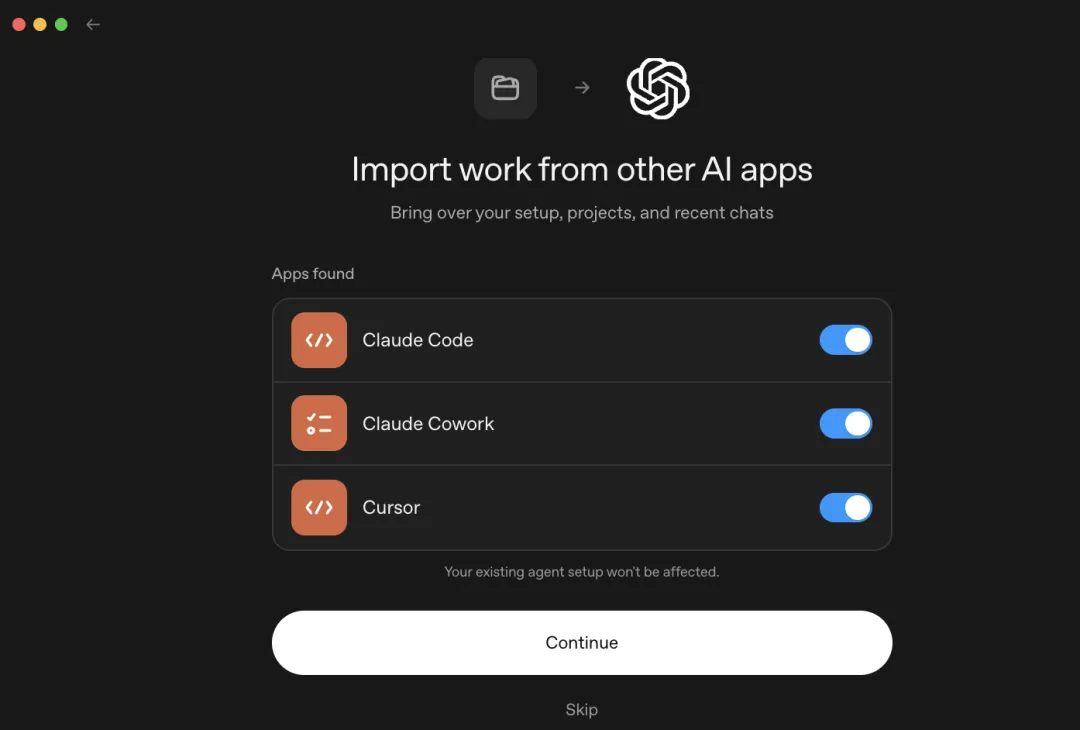
Open the ChatGPT desktop and set up another Import to browse to Claude Code, Claude Cowork and Cursor; tap one/import in the Codex CLI to recognize Claude Code and Cursor.
These tools keep the configurations, skills, plugins, projects, and the last 30 days of chatting on your machine, moving back and forth.
It's a copy.
The official documentation is clear: the import will not modify or remove your existing smartphone configuration.
It's the equivalent of sending a moving car to your opponent for free, putting the container on the door, and leaving the house next door as it was.
I went through the entire documentation of the process, and there was a word that didn't filter/export from beginning to end.
You can't move in, you can't move out.
Things that are moving.More than you think.First, let's talk about what the car can fit, and the official gave us a "moving list checklist":
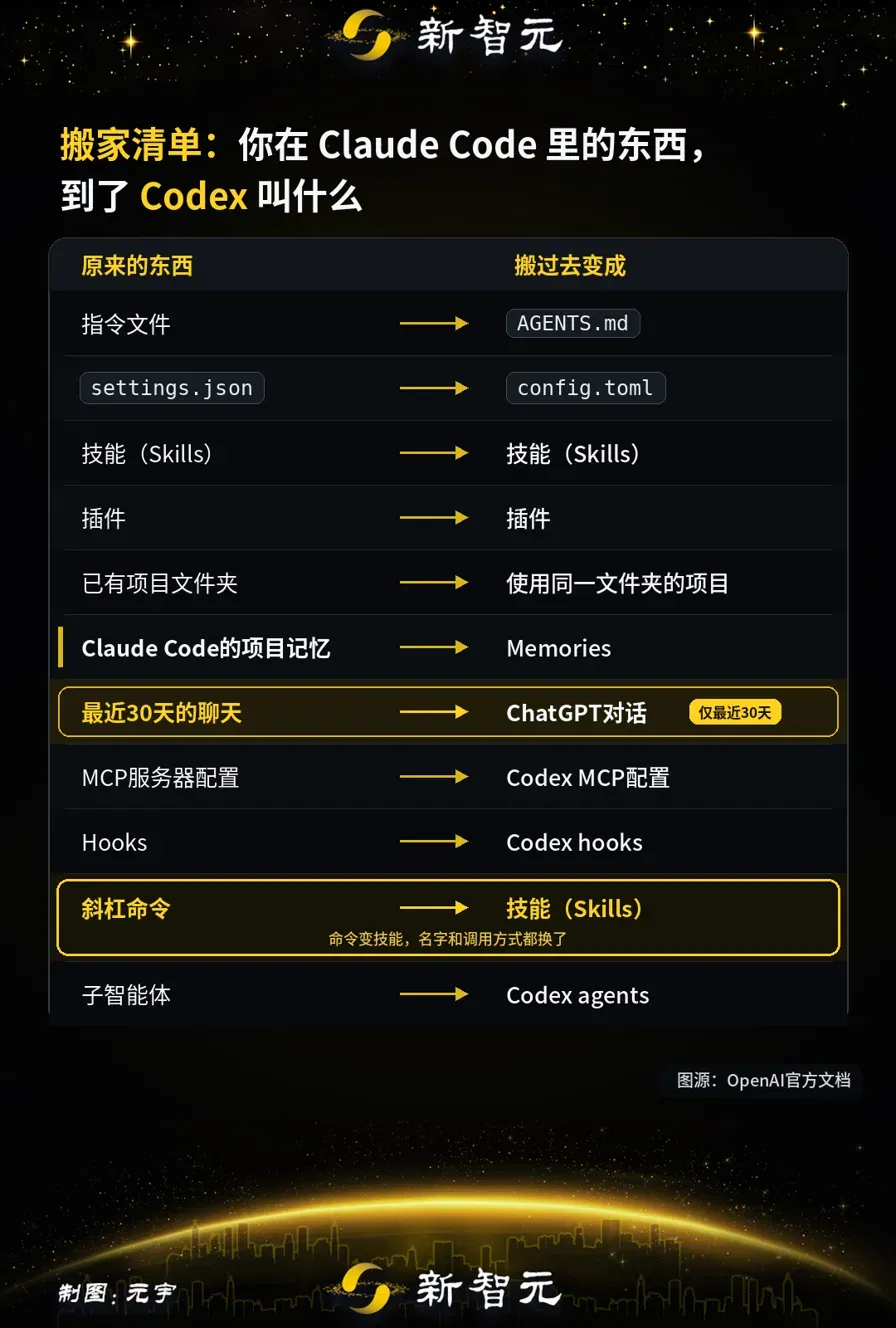
The instruction file (Claude Code on this side is mainly CLAUDE.md) to move past to AGENTS.md;
settings.json moves past to config.toml: Claude Code, a mixture of JSON and Markdown, into a single TOML file on the side of the Codex;
Skills or Skills, plugins or plugins, but plugins can't be used directly.
MCP servers are configured for the MCP configuration of the Codex, Hooks are configured for the Codex hooks, and sub-smart bodies are configured for the Codex agents.
Those slash commands that you wrote yourself: shut down a continuous process/xxx, the one that the team shared, don't call the command after moving past, turn it all into a skill.
The commands in the plug-in are the same, and are converted when installed.
The name has been changed, the method of calling has changed, and the scope of use may change as well. So strictly speaking, this item is not a relocation, but a modification.
Claude Code's project memory is turned into Memories.
As for "project migration", the official motto is that already existing project folders will become "projects using the same folder".
Let's face it, the codex just takes over your native directory, not uploading or copying the entire repository to OpenAI.
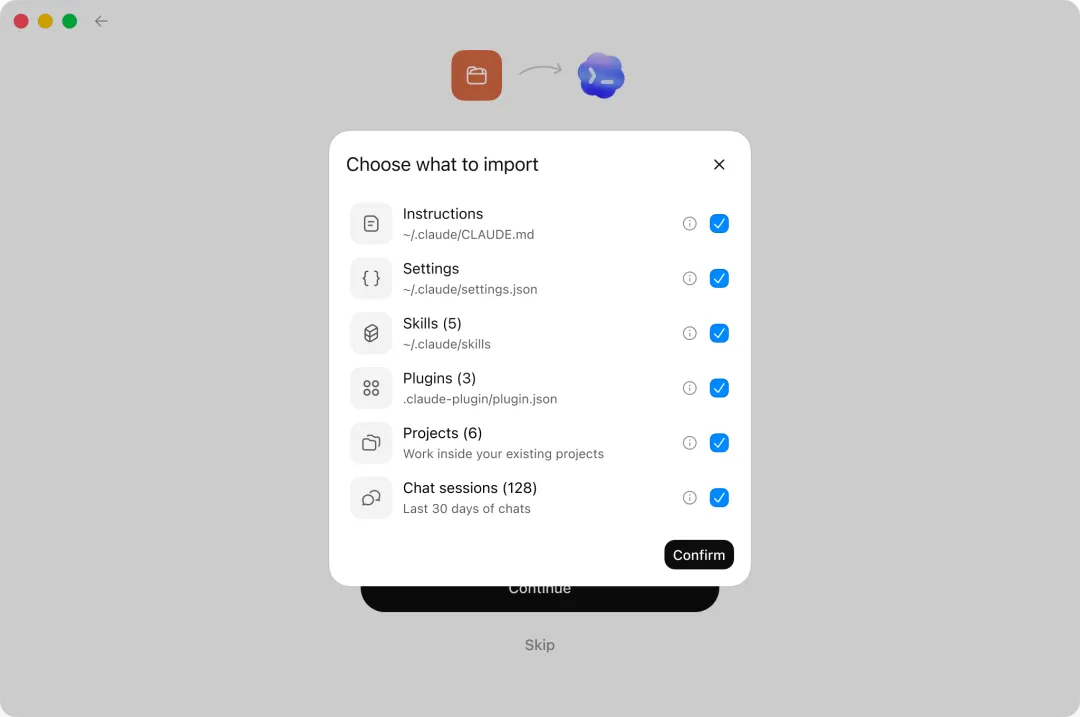
Select a list of instructions, settings, skills, plugins, projects and chats.
There is a detail here that shows that the child was not taken seriously.
It's been so long since I've moved from Claude Code, it's been so long that I can't even read the codex.
On the other hand, this is usually a misunderstanding, and the rest is up to you.
Codex's approach was thoughtful: when the meeting moved in, it hand-written a note: how long the conversation was, how much volume it took.
When you go back to that old conversation, the first sentence after you've moved, it automatically shrinks the previous one, picks up the place, and then goes back down.
You don't need a pipe, you don't need to remove it, you move in and you can keep talking.
The codex was imported and it didn't come out of nowhere today.
/import first appeared in CLI 0.140.0, where only Claude Code's settings, skills and chat records could be moved, and Cursor users could copy them themselves.
On June 9, the Codex app 26.608 moved the import process to the desktop end and plugged it into the boot that was used for the first time.
On July 21, CLI 0.145.0 was a truly scalable version, extending to six migrations: settings, MCP servers, plugins, sessions, commands, and project-level memory.
0.147.0 on 7 August adds additional Cursor skill input and subsequent synchronization of input sessions.
Three months, three iterations.
It seems that OpenAI can't wait to get the users of Claude Code.
I can only move in, I can't move outIn the entire documentation, there is no command to move the configuration of the codex out.
What you change in the Codex will not be rewritten by Claude Code.
The desktop does have an automatic update switch that can be switched on in the settings and checked for import history.
But look at the direction of its synchronization: its role is to constantly synchronize the source of new things on the Claude Code, the Cursor side, to the ChatGPT side.
It's been a while since I've been able to do this.
CLI's mouth is smaller.
Codex CLI 0.147.0 released on 7 August adds two things: imported skills hosted by the Cursor, and subsequent changes to synchronized imported Claude, Cursor sessions, and no duplicate content.
What door you move in from determines how much contact you have with your household.
You think you've been handing out tools, but you've been stealing assets.
Now, someone has told you that these assets can be packaged away and updated on a regular basis.
It's not the same as moving, and they've both done it.
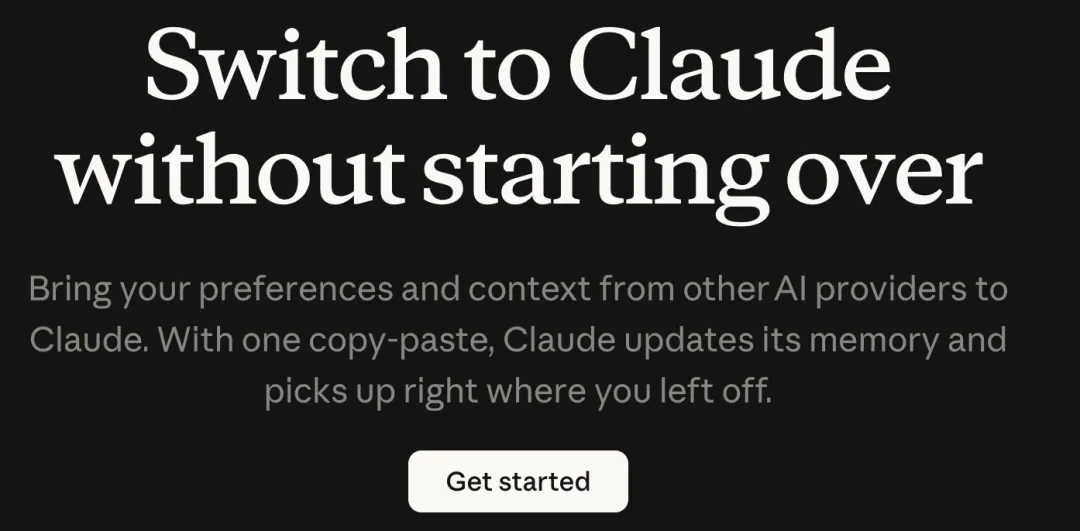
In early March, Anthropic launched Memory Import, an online memory migration tool aimed at ChatGPT users, to import your preferences and context in ChatGPT, Gemini, into Claude.
Its supporting documentation also reads: "You can also export Claude's memories for backup or migration".
It goes in both directions.
On March 30, OpenAI sent an Apache 2.0 open-source plugin codex-plugin-cc, which allowed the codex to run inside the Claude Code, making its own code review and task management a slide command in the opponent's terminal.
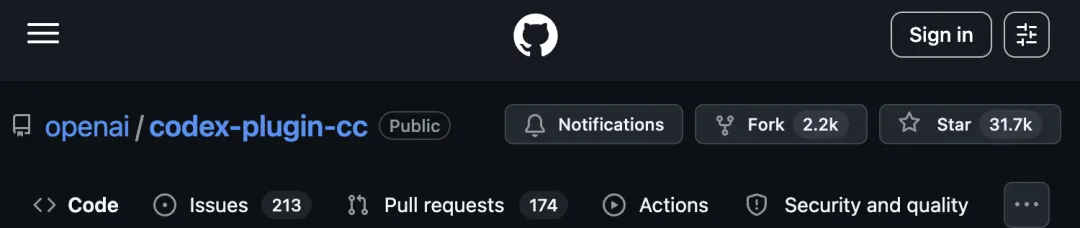
The plug-in has a /codex:transfer, which translates the current Claude Code session into a durable Codex thread. The plug-in document states that it is used by the codex's external smart speaker importer, and that today's input is the same set of conversion rules.
From "incoming into an opponent's house" to "taking people away". Over four months, OpenAI's action has taken a turn for the worse.
Four things can't move.Developers who made the complete migration in the community gave the following description: Ninety percent of configurations can automatically complete format conversions.
The tenth part is to be taken.
The first is power.
You've done half a year of fine-grained white lists in Claude Code, and you've hit the codex sandbox with only three rough grades: read-only, write-only, completely open.
This is not a matter of changing the name of a file, you have to rethink the original intent behind the white list and translate it into a file in three files.
Codex has three built-in permissions configurations: read-only, write-only, and fully open.
The second way, Hooks.
Claude Code's monkey model is richer with conditional groupings and asymmetric processing chains.
There is no equivalent in the Codex.
The complex chain of hooks is not a transformation, it is a redesign. The official documentation itself warns that Hooks may behave differently after being imported.
Thirdly, the model itself.
The first two ways are to move the luggage, and the same way is to move the employee.
Codex was originally based on OpenAI's Responses protocol and did not recognize the Anthropic model. That is, you moved the CLAUDE.md, Skills, MCP configuration entirely into the Codex, but from now on the configuration is GPT, not Claude.
The suggestions, which were tuned by Claude Chabrol, have now been personally executed.
Unless you have a compatible gateway, register as a model provider, and separate a profile to refer to the past. This is the only one on the entire migration list that does not have a native correspondence.
Fourth, the boundaries of the recorded conversation.
Only local meetings can be moved.
Conversations on the claude.ai webpage, conversations on the end of the cursor webpage, are not available.
Some developers counted Claude Code's skill fields: a total of 18, of which only 6 are common, and the remaining 12 are recognized only by Claude Code.
You can only take a third of your writing skills.
Officials also provided an imported checklist: permissions for skills and smart entities, MCP servers that need to log in again, Hooks that may change behavior, plugins to follow manually, and command templates for parameters and file paths.
One button moves, then a manual check for half an hour.
This is the whole process.
It's not about users.It's the user's home.The model score is a six-month change, you're number one today, and next month you're likely to be knocked off the top by a new version.
But the configurations, the memories, the skills, the historical sessions are unchanged: they lie on the developers' own machines and get thicker by the day.
The house is both the property of the developer and the fortress where OpenAI and Anthropic keep users.
OpenAI is the hand that is rushing to drain its opponents' fortresses.
But when a man's water is dried up, the man himself is dried up. If he wants to draw water out of another man's house, he digs the well first, but the well is doubled.
SKILL.md, AGENTS.md, standard MCP definitions, which formats are growing into fact-based standards.
The more general the format, the harder it is to lock who in.
Today you can order something to move into the codex and tomorrow you can theoretically order something to move to another home.
For developers, it's simple: bet on a portable format, not on a tool.