This scene took place at the finals of the Embodied Model Challenge——
There was a participating team that was confident enough that the team leader chose to create new data from scratch even though the organizer had already provided a high-quality data set...
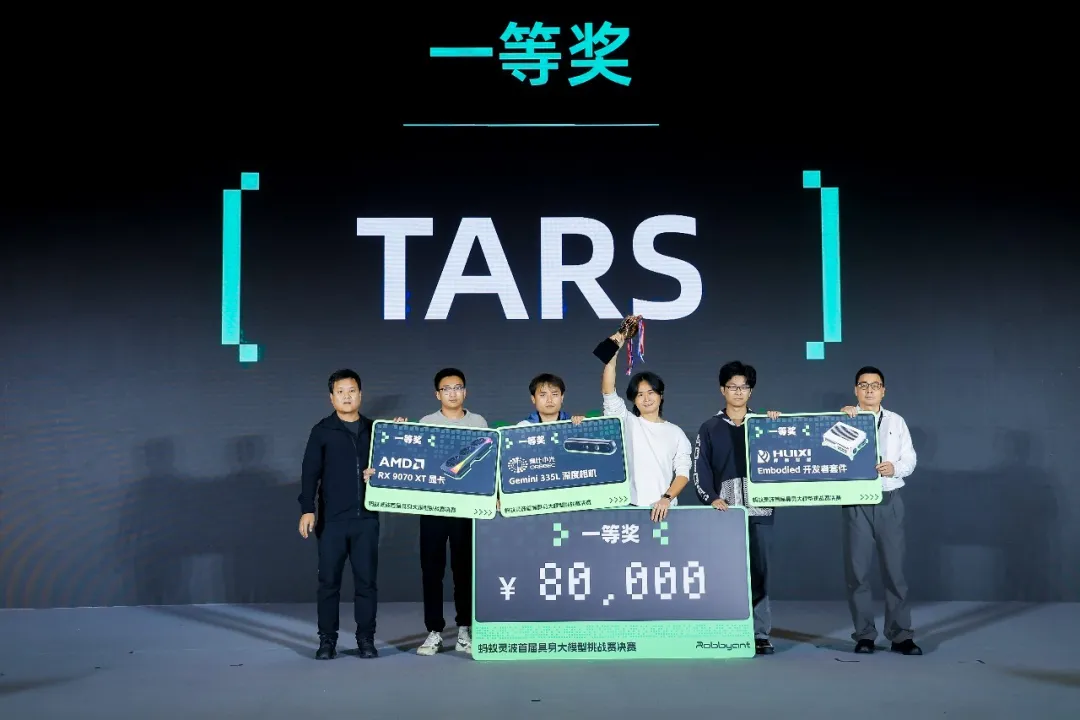
Then, with a final score of 82 points, he won the first place in the competition and won the grand prize of 80,000 yuan!
Here's the thing.
The final lasted for a total of 48 hours. The 15 shortlisted teams needed to complete data collection, model tuning and real machine deployment in such a short time, and use the same model to handle three tasks:
- Arrange fruits according to instructions;
- Put cosmetics into the designated layer of the transparent storage rack;
- Use both arms to clean up trash.
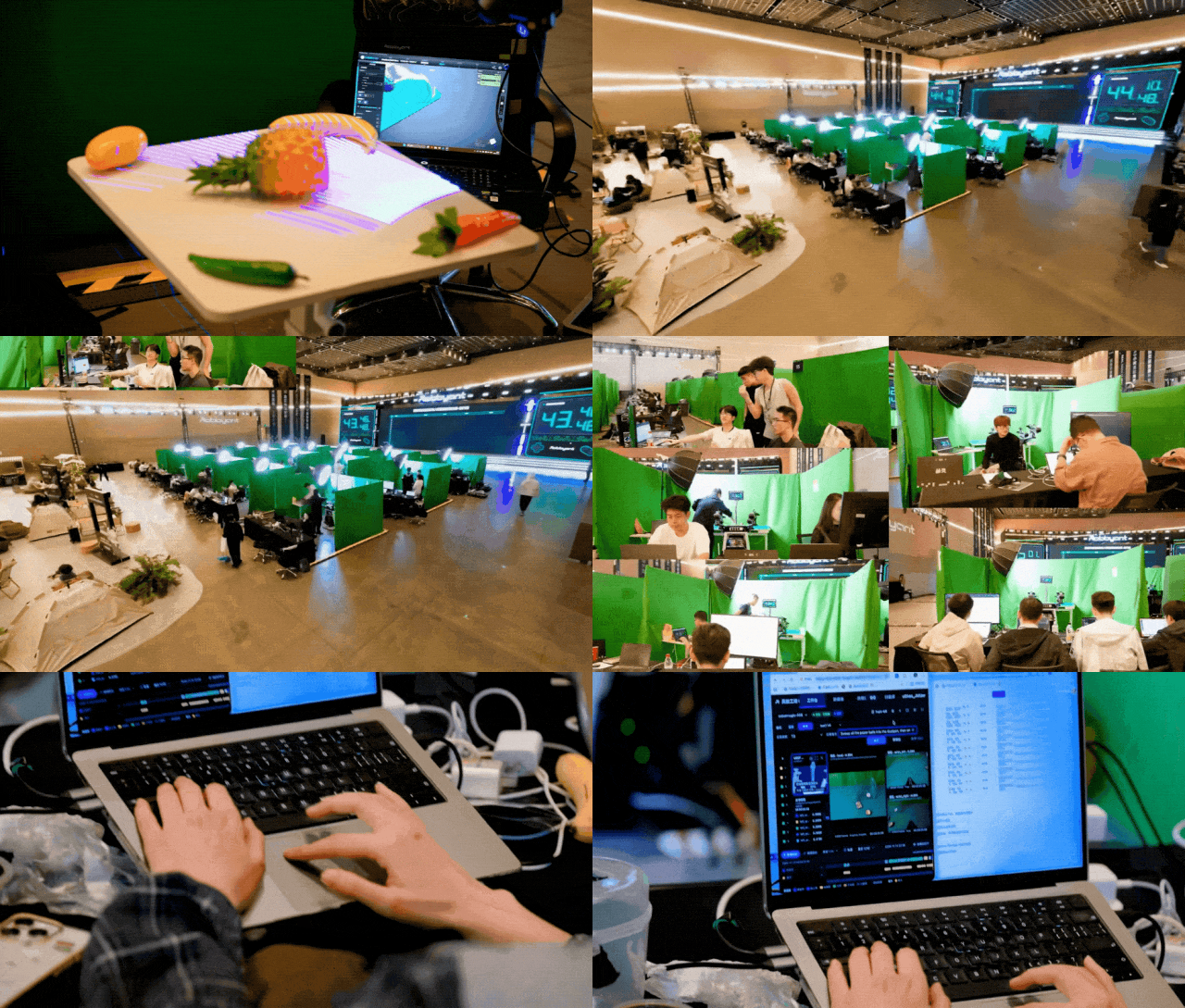 Then the championship team believed that the first two items were problems of grabbing and placing, so they used Qianwen to identify interference objects, and then erased them according to the background color in the image, making it easier for VLA to see the target and destination. The first two items basically followed the official data.
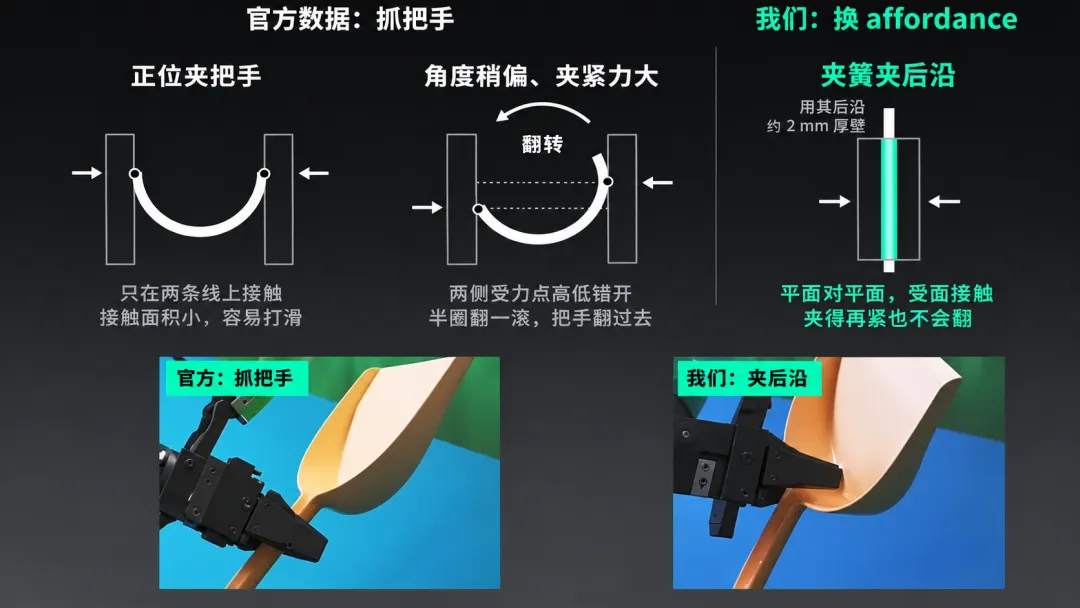
However, when it came to the third task, they found that the 210 pieces of official data all used the method of grasping the handle of the dustpan. This not only has a small contact surface, but also makes it easy to slip and flip if it deflects slightly.
Therefore, they decisively decided to collect again by themselves and changed to grabbing the back edge of the dustpan. The purpose was to stabilize the tool first and then complete the subsequent actions.
But in this case, it is equivalent to putting most of the team's energy into just this one task...
It was this kind of courage and desperate effort that allowed this team to overtake the second place and win the championship in one fell swoop just minutes before the competition!
Exciting, really exciting.
So what kind of game is this?
It’s no secret that this is the final of the first Embodied Model Challenge (and the first developer conference) organized by Ant Lingbo; as early as the preliminary stage, it attracted 1,855 teams and 3,252 players from all over the world, and finally 15 teams entered the 48-hour real machine finals.
The team that won the championship this time was TARS (named after the robot in "Interstellar"), with an average age of only 25 years old.
Team leader Wu Haonan is a post-2000 graduate who is about to graduate with a master's degree from Tianjin University. The five team members come from Futian Laboratory, Northwestern Polytechnical University, Pudu Robotics and Tianjin University.
What’s more interesting is that during the communication between Qubit and the Ant Lingbo team, we learned that they were also surprised by the operation of the TARS team.
For those who dare to bet all their chips on self-collected data in the final round of the final, for this courage, we would like to call Wu Haonan "Brother Confidence."
But if you look at the entire game, "Brother Confidence"'s operation is only a part of all the excitement; almost every team in the finals showed their own skills, which is worthy of watching by friends in the real world.
48 hours of rush hour
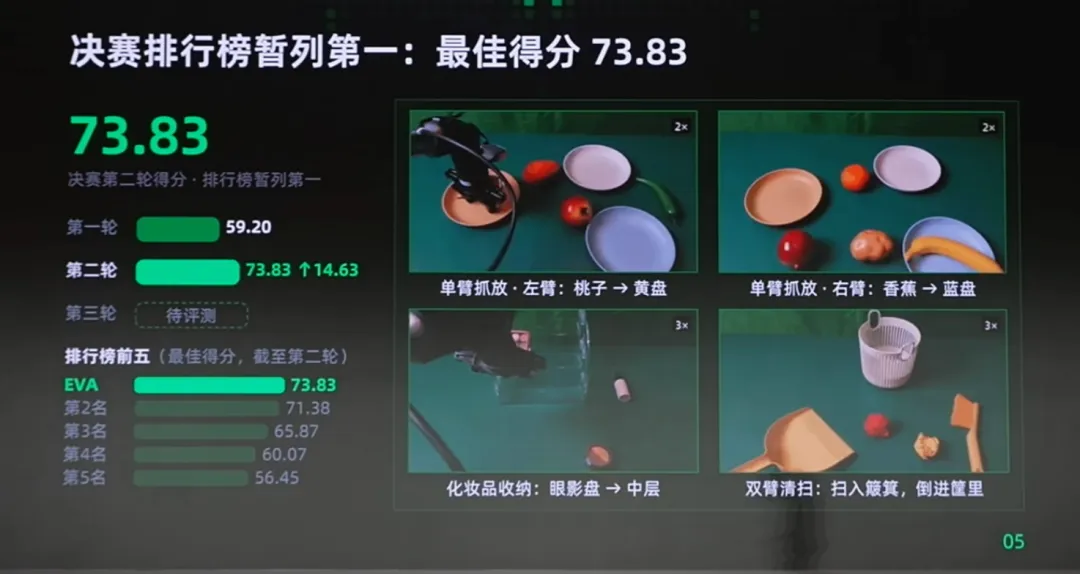
Just now we mentioned that the team that was overtaken by TARS is the EVA team from Huazhong University of Science and Technology, Tsinghua University Shenzhen Research Institute and Hubei Yuanyi Intelligence.
When they did the road show PPT, they still ranked first in the rankings. But when the game ended, the ranking changed, and the record in the PPT became a footnote in this chasing battle.
However, when it comes to counterattack, EVA itself has also gone through a round.
According to captain Wu Xianjin, after training with official public data on the first day, their real-life success rate was only about 10%. As for why the robot didn't do a good job, it's hard to tell at a glance.
It may be that the demonstration data is not clean enough, it may be that the training method is inappropriate, or it may just be that the placement of objects during collection and execution does not match; it is obviously not enough time to check one by one and then retrain within 48 hours.
So, EVA decided to start where the robot failed.
They let the model execute first and check the trajectory; when encountering an unseen situation or the action has gone astray, people will provide additional demonstrations and take over to correct errors. Then, with the help of large model evaluation and annotation, the sorted data is added back to training.
In this way, the mistakes the robot just made will have a chance to appear in the next round of "review questions."
Following this idea, EVA completed about 7 rounds of data reflux iterations during the competition, and collected more than 700 additional pieces of demonstration and takeover data. In order to use these new data as soon as possible, they also optimized the training process, increased the training speed by 2.7 times, and finally scored 73.83 points.
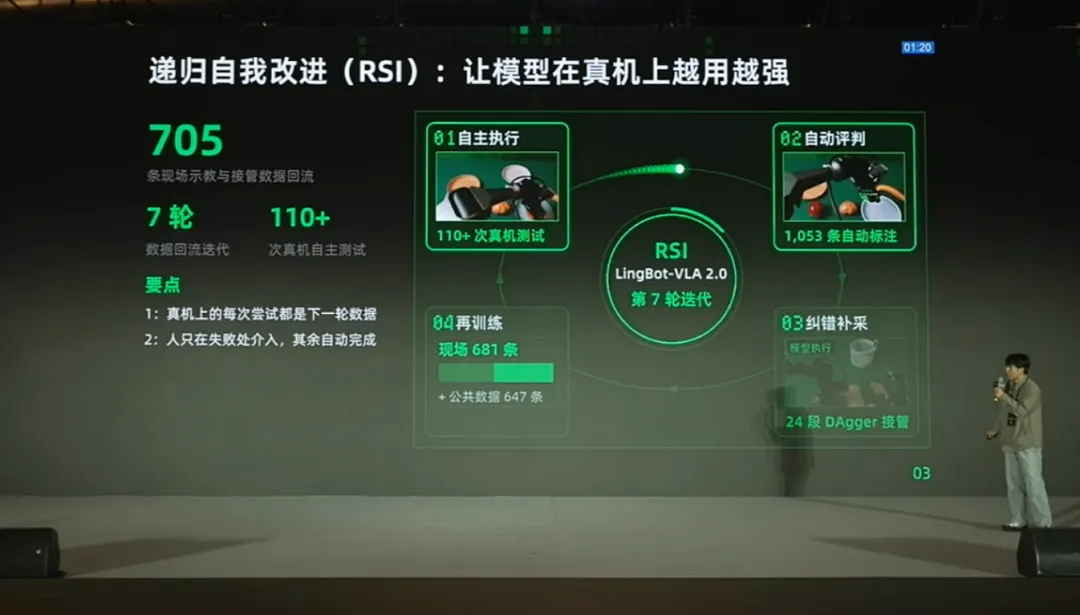
This scheme of EVA is exactly RSI, which stands for Recursive Self-Improvement. However, Wu Xianjin also mentioned that the current data collection, manual takeover and final success determination still require human participation. What the team hopes to achieve further is to let the robot practice on its own, and then use the large model to judge success or failure, and use these execution records to continue training.
In other words, this competition allowed them to get through part of it, and it also allowed them to see clearly what links they still need to make up for next.
While EVA was improving its performance through continuous supplementary data collection, the third-ranked SST team chose another path—they collected only three additional pieces of data.
This number may seem a bit exaggerated at first glance, but it should be noted that SST also uses official data. Their main energy is spent on how to deal with these existing demonstrations.
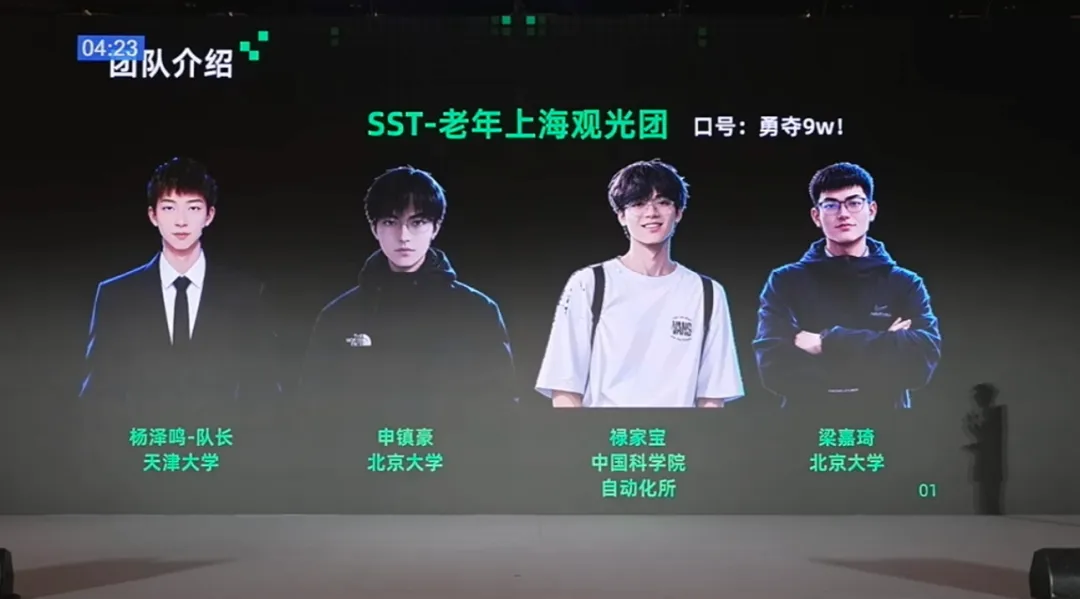
Speaking of this team, they also have a Chinese name that makes people laugh, called "Senior Shanghai Tour Group".
The captain is Yang Zeming, a senior student at Tianjin University, and the other three members are all graduate students. The word "old age" comes from their ridicule of the three seniors.
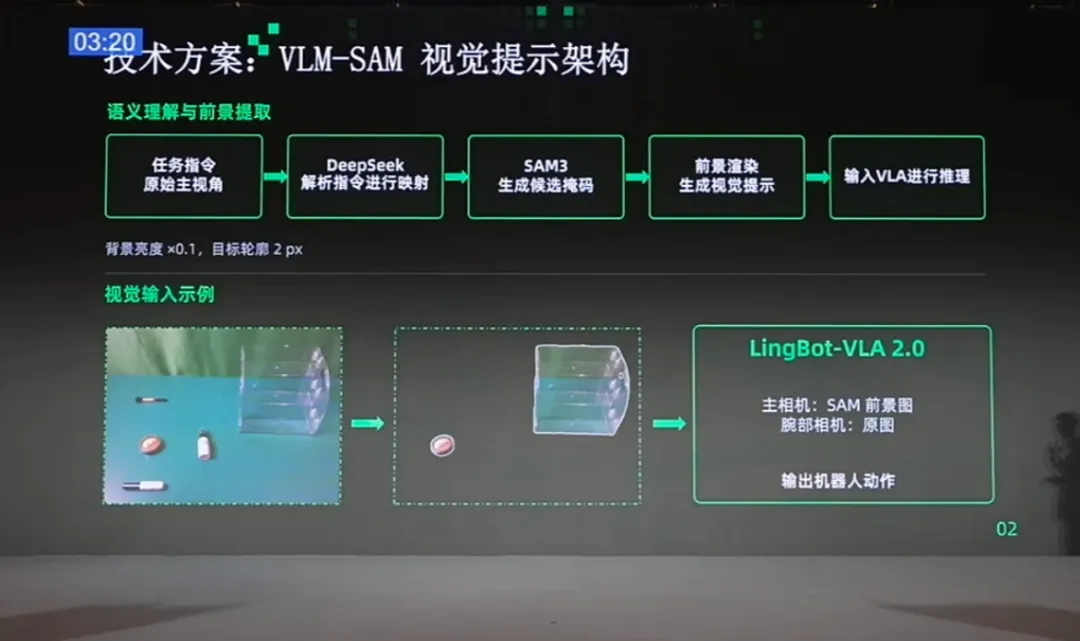
Although the name is relatively random, their idea of solving the problem is clear - since the clutter on the desktop will interfere with the robot's judgment, can you help the robot mark the target before it takes action?
To this end, SST asked DeepSeek to parse the task instructions, and then handed the text prompts of the target object to SAM 3 for segmentation. They retain the original image of the target area, darken other areas, and then send the processed image to VLA.
This way, the model can still see the desktop environment, but this time it will be much clearer which object it should operate on.
But the team soon discovered that this plan still had a hurdle. The original SAM 3 was in the field and could not reliably segment the objects they needed based on text prompts. If the target is wrong from the beginning, subsequent actions will naturally be impossible.
SST then thought of playing the video backwards, because it is usually easier to judge which object was picked up and where it was placed at the end of a demonstration.
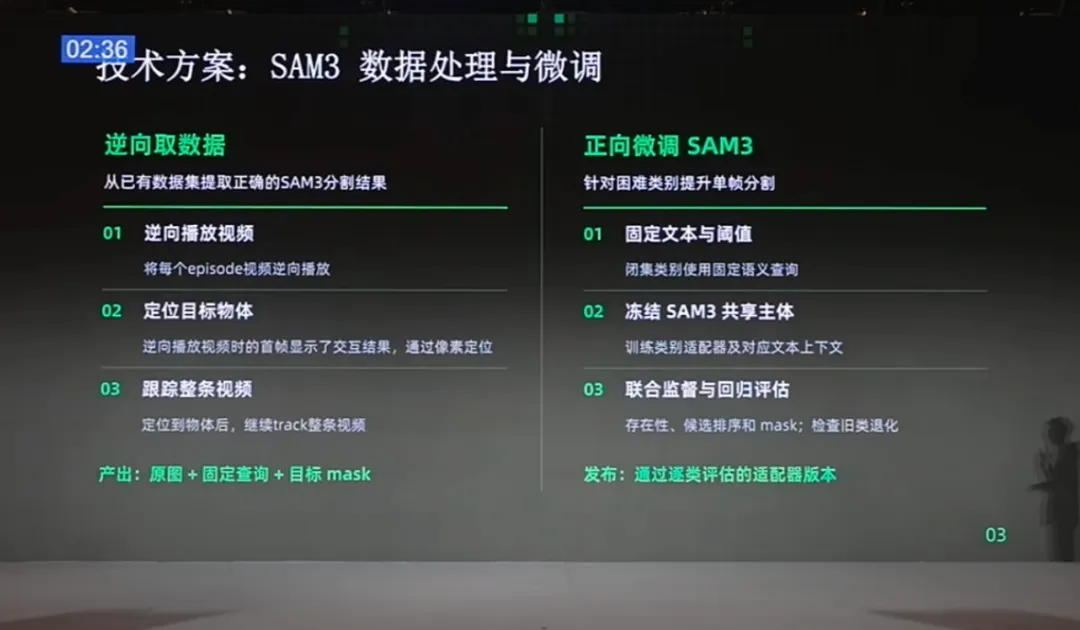
They first used the Agent to find the target from the scene at the end of the task, and then handed the target's pixel position to SAM 3, allowing it to continue tracking along the reversed video to complete the segmentation annotation of the entire demonstration.
With this batch of data, the team can train VLA and fine-tune SAM 3 at the same time. According to Yang Zeming, the fine-tuning of SAM 3 takes about an hour, and then the previous command analysis process can be connected.
In addition to this, they also adjusted the way the robot performed its movements. The model generates 50 actions each time, and they only execute the first 16 steps, and then re-infer and smooth the actions to make the operation more precise.
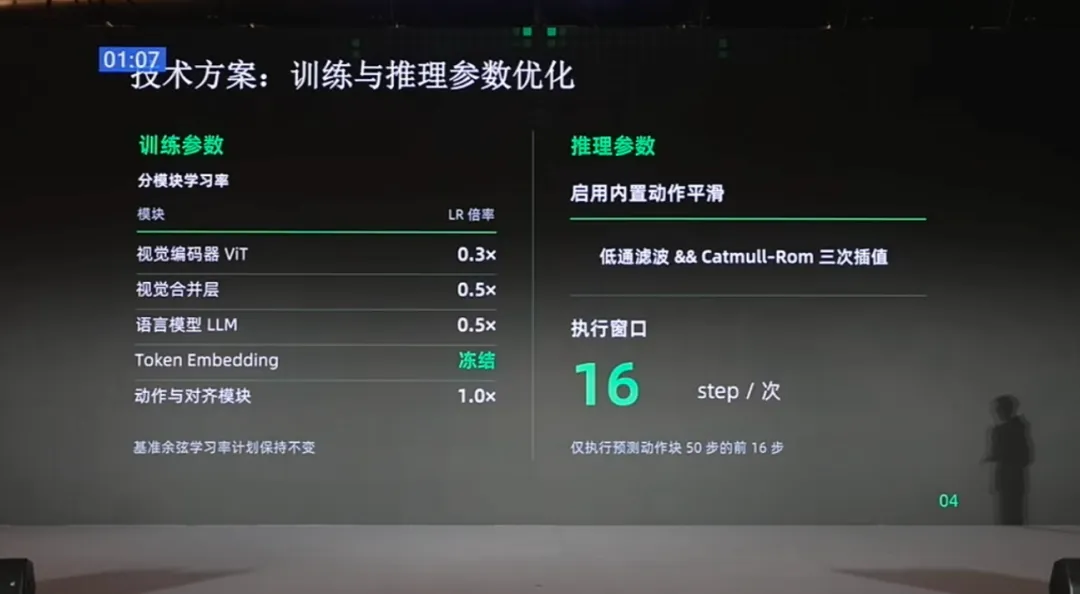
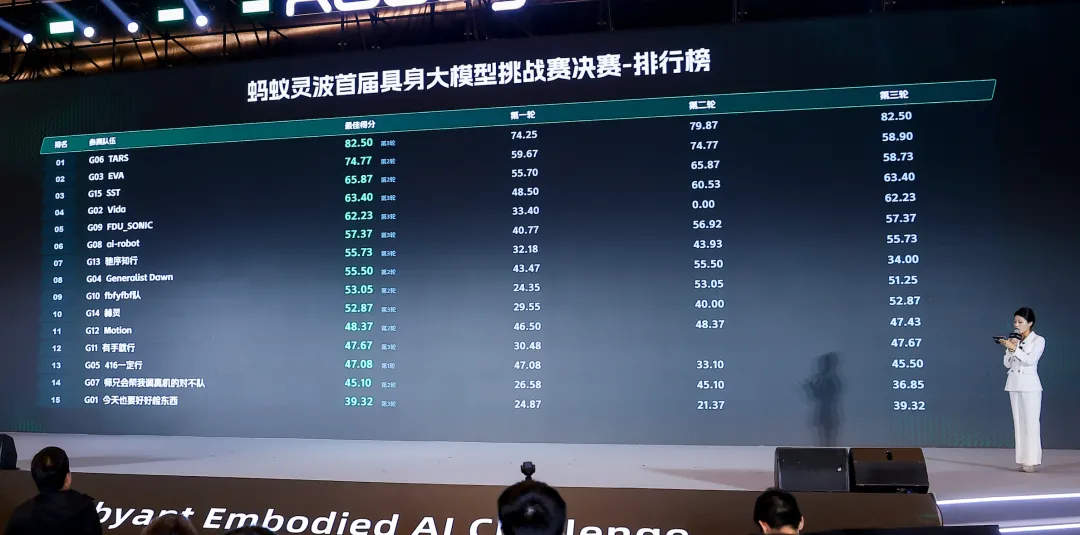
With these adjustments, SST scored 65.87 points. They and EVA both won the second prize, the champion TARS won the first prize, and Vida, FDU_SONIC, and ai-robot won the third prize.
Results for all teams are as follows:
Seeing this, you may feel that the key to the competition is who is better at processing data.
It is true that each team has worked hard on this matter, but everyone's judgment on "what to make up for and how to make up for it" is very different.
For example, the Vida team found that there were few demonstrations of grabbing across the center line of the desktop in the public data, so they re-collected these difficult layouts; star fruit did not appear in the public data, and they also collected it specifically.
The FDU_SONIC team trained and checked the performance of the real machine, and then worked backwards to figure out what data needed to be supplemented based on where the robot failed, and finally won fifth place.
These plans must be effective within 48 hours, and the training speed must also keep up. Chixu Zhixing, who was born in AI infrastructure, accelerated training by about 3.7 times and iterated more than 30 model checkpoints during the competition; TARS reduced the single-step training time from about 15.6 seconds to 3.4 seconds, gaining time for the continuous addition of new data.
But as more data is collected, scores may not necessarily rise.
After the Motion team supplemented the data of Tasks 2 and 3 and continued training, they found that the performance of Task 1 had worsened. "Brothers will help me adjust the real machine, right?" The team mentioned during the review that five members took turns to collect, and each person's operating habits were different. Some people raised their hands first, and some moved forward first, resulting in the model not being able to learn stably within the limited time.
Putting these experiences together with the top three solutions makes this competition even more interesting, because everyone is working hard to teach robots to work, but by demonstrating how to do it and what experiences are worth retaining, the developers themselves are also learning by doing.
Why does Ant Lingbo hold this competition?
If the data problems are still within the expectations of the players, then the troubles encountered by other teams are more like actual combat.
For example, the "Let's Check Things Today" team has made a fairly complete plan. They scan objects, build simulation assets, and then use the upper-layer model to observe and dismantle tasks for VLA to execute.
But when it came to the real machine, the robot frequently made deviations when placing objects. After review, the team found that the distance between their robotic arm and the table was about 5 centimeters different from other teams, which affected the accessibility and placement of the robot.
But by the time they figured out the problem and adjusted their positions, there was not much time left in the game...
For developers who are accustomed to adjusting models in software, this situation can especially catch people off guard. There seems to be no major problem with the training process, and the robot is indeed executing the instructions. However, once the position of the table changes, the original actions may not work.
This also explains why some teams have reached more than 70% in the simulation preliminary round, and Ant Lingbo will arrange another 48-hour real machine final——
Hardware adaptation, cross-task generalization, and engineering capabilities to locate and solve problems in a short time all need to be verified on real robots.
In particular, this competition requires three tasks to share a set of models. Developers have to consider whether adjustments to one task will affect the other two. The performance decline encountered by the Motion team shows that this balance is not easy.
And this is why Ant Lingbo has been emphasizing "original embodiment", as explained by Shen Yujun, the chief scientist of Ant Lingbo:
“Forward development means first thinking about what the robot needs and then preparing what it needs.
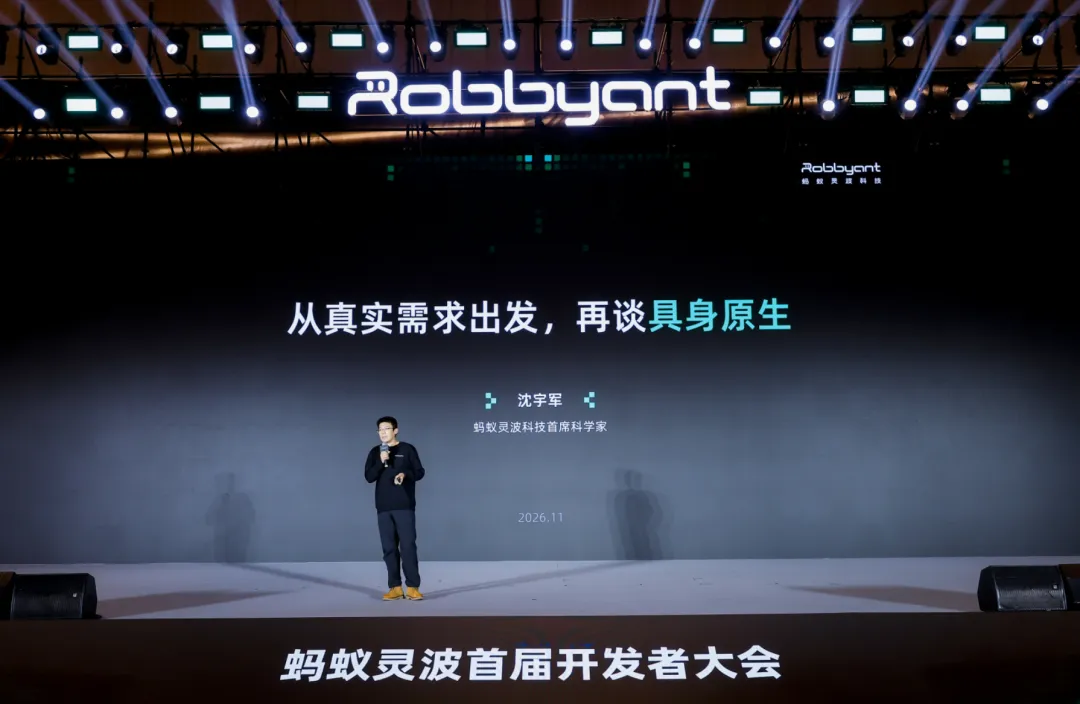
On the field, the transparent storage rack is difficult to position, the dustpan is unstable, and each team has to repeatedly adjust the execution of their actions. The players have to solve these seemingly small problems that are enough to cause the mission to fail.
After the competition, there will be more problems, not less. For example, if the model is adjusted today, how much effect can be retained by changing a set of shelves, changing the lighting, and adding several types of objects?
In a word, if every time a new scene arrives, it is necessary to collect and train again, and then send people to debug on site, it will be difficult to reduce the deployment cost.
Therefore, Shen Yujun's other judgment about the data also echoes this game. He believes:
“The industry needs to find the lower limit of data quality and figure out what standards the data reaches so that the model can achieve effective gains. The blind pursuit of higher quality will continue to increase collection costs.
Coincidentally, Ant Lingbo CEO Zhu Xing also talked about the reality of industrial implementation. He warned, “Don’t be blindly optimistic, and don’t be overly pessimistic.”
Zhu Xing explained that the Scaling Law path of embodied intelligence is still being explored, but in the past year, progress has been made in data collection and supply, model capabilities, and pilots in factory and logistics scenarios. He predicts that starting from 2027, the implementation of industrial applications will accelerate, and abnormal data from real operations will be brought back to help the model continue to iterate. The difficulties currently encountered need to be solved step by step through these specific practices.
Therefore, an important reference that this competition can provide is to let everyone see how the same basic model will be used by different developers and where they will encounter difficulties.
Of course, these solutions still need to be verified in more scenarios, but if the developers clearly explain the effective methods and the reasons for failure, at least the next attempts will be more directed.