Chip development takes years, while AI models can change in months. By the time a new chip reaches production, the workloads it was designed for may already have shifted. Tongxin Smart is betting that AGI hardware must anticipate these changes rather than wait for model requirements to stabilize.
Founded in April 2026, Tongxin Smart was initiated by AI researcher Song-Chun Zhu and incubated by the Beijing Institute for General Artificial Intelligence. The company says it has completed seed and angel rounds totaling several hundred million yuan in its first six months. The funding will support core architecture design and pre-tape-out research and development.
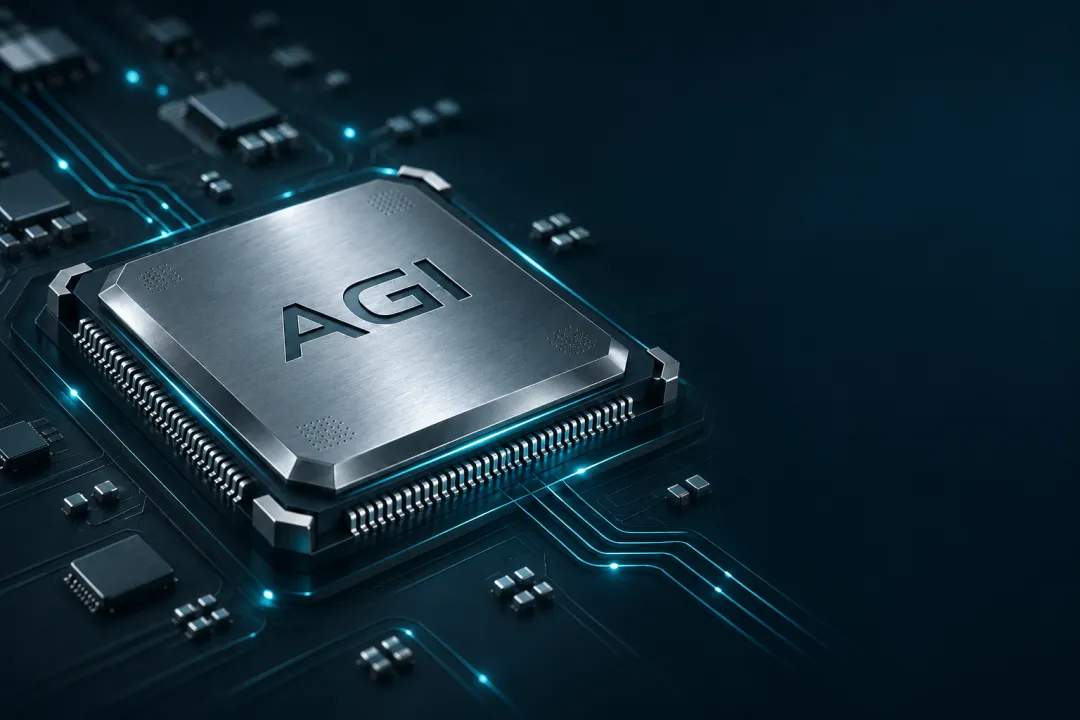
The company aims to develop an inference chip for AGI workloads that can run current mainstream models while adding dedicated hardware support for logic, causal inference and value-based reasoning.
The question behind it is quite challenging: What kind of computing will the next generation of AI require? Can we start defining it now?
To this end, Tongxin Smart brings together AGI researchers and engineers with experience taking large chips to mass production. They need to identify from the ever-changing algorithms those calculations that will be called repeatedly and deserve special acceleration, and then decide how the chip should be organized.
The model will continue to evolve, but Tongxin has already begun to make choices about which capabilities are worthy of being built into the hardware in advance.
AI moves towards the real world, and chips usher in new propositions
The boundary of AI is gradually moving from interaction again and again to the real physical world.
As early as the first half of this year, LeCun, who left Meta to found AMI Labs and completed US$1 billion in financing, pointed out that large language models are "helpless" when facing the physical world. The solution given by LeCun is a world model. Given the current state and an imagined action, predict the next state of the world, and then use this prediction for planning.
Just last month, Google DeepMind announced the world model Genie 4. Users can change the weather, add characters or objects in the simulated environment, and the model will generate the subsequent changes in the environment in real time. DeepMind clearly lists the construction of a training environment for robots and agents as an important application direction of this model.
 △From Google DeepMind official website
These explorations make the tasks faced by AI more specific: not only to understand what is in front of you, but also to predict what will happen after taking action and provide a basis for the next decision. How the intelligent agent evolves also affects the design of the underlying chip. This matter has entered the vision of global giants.
In September this year, AMD announced the signing of an agreement to acquire World Labs founded by Fei-Fei Li for approximately US$8.2 billion. When discussing the deal, AMD CEO Lisa Su said that building next-generation AI computing platforms requires a close understanding of how models are evolving.
What deserves attention here is that those who make chips need to figure out earlier what the next generation of AI will be and where its efficiency will get stuck. World models and robot algorithms are still evolving, but hardware design needs to make choices in advance, which also brings model research and chip design closer.
Fei-Fei Li pointed out more bluntly: "Without dedicated hardware investment, the efficiency and scale of AI will be constrained." At the same time, she also revealed that World Labs and AMD have launched technical cooperation around model training and inference optimization on GPUs.
At CoRL, Lisa Su made the point more directly: hardware optimization takes years. The deeper you understand what calculations the model needs to do and where the technology will go, the more opportunities there will be for collaborative optimization of hardware, software and systems.
Demand for faster interactive responses is also prompting NVIDIA to adjust its inference systems. In response to the agent's demand for low latency, NVIDIA paired the GPU with Groq's dedicated accelerator to hand over different computing links to more suitable hardware execution while taking into account overall throughput and interactive response speed.
These changes point to a common question: When AI needs to make timely judgments and take actions based on environmental changes, how should the chip support it?
Modern GPUs are good at large-scale parallel computing and cooperate with specialized matrix operation units. This is the main reason why they dominate the era of large language models.
But an intelligent agent that wants to act in a real environment has to deal with another set of tasks: repeatedly querying the relationship between objects, updating the state of the environment at any time, and deducing the possible consequences of actions.
When these tasks are implemented using graph structures, dynamic branching, etc., calculations may become fragmented and data access more irregular. The GPU can execute these algorithms, but parallel resources may not be fully utilized. Part of the time will be spent looking for data, moving data, and waiting for the results of the previous step.
At this point, just looking at how many operations the chip can do per second can no longer explain how quickly the task is completed. Software optimization, storage organization, computing units and scheduling methods all have to be reconsidered together.
The computing power advantage in the era of large models cannot be directly converted into operational efficiency in the real world.
Behind the efficiency issue, there is also an expanding inference market. China Insights Consultancy (CIC) forecasts that China’s AI inference-chip market could reach about RMB 1.17 trillion by 2030.
The opportunities Tongxin sees lie in the efficiency gap between new tasks and existing computing methods. From the cloud to the robot end side, tasks have different requirements for throughput, response speed and power consumption, which also leaves room for Tongxin to redefine the computing architecture based on the task.
The trend of AI moving towards the real physical world has become clear, and the implementation route is still evolving. Judgment requires returning to more basic questions: are the pain points real, how will the demand change, which calculations are worth leaving to dedicated hardware, whether the theory can guide product definition, and whether the engineering team can make it happen.
The AMD–World Labs deal also illustrates how chipmakers are seeking to understand model development more closely. Defining next-generation AI chips requires both a theory of how intelligence works and the engineering capability to implement it in hardware.
Only by looking along this line of thinking can we understand why Tongxin Smart says its chip architecture draws on Professor Song-Chun Zhu’s theory of intelligence.
Starting from understanding intelligence, redefining AGI chips
Perhaps the biggest problem when designing a chip for a load that has not yet been finalized is that there is no reference.
At the beginning of GPU development, there was graphics rendering for benchmarking, and AI accelerators had matrix multiplication for optimization. When it comes to AGI chips, there are still differences in model routes, computing requirements have not yet been finalized, and the answer cannot be obtained by observing the current situation.
Demand is still changing, and there must be a basis for judgment on what should be put on the silicon chip. The starting point of Tongxin is the CUV framework proposed by Song-Chun Zhu’s team.
Professor Song-Chun Zhu has received the Marr Prize and the Helmholtz Prize. He has conducted research at the intersection of vision, cognition and robotics for thirty years. A paper by his team in the journal Engineering presents the CUV framework, which organizes three aspects of an agent: cognitive architecture (C), capabilities (U) and values (V). Among them:
- C is the cognitive architecture, which organizes the internal modules of the intelligent agent and its collaboration methods to connect perception, memory, reasoning and other links;
- U is the ability system, covering callable skills such as identifying objects and planning paths;
- V is the value system, describing goals, preferences and constraints, and providing a basis for choosing actions. Falling on the robot can be to complete service tasks or to take into account safety and the needs of others.
The CUV framework puts what you see, what you can do, and what you should do into the same decision-making process. What drives intelligence growth is "what you want" rather than "how much data you feed."
These issues have been discussed by Song-Chun Zhu's team in the paper as early as 2020. In the era of deep learning, Professor Song-Chun Zhu and his team wrote a paper on "small data, big tasks". The five invisible things in pixels, including function, physics, intention, cause and effect, and utility, are called the "dark matter" of vision.
Six years later, world models and spatial intelligence have become prominent, and the industry has begun to ask how AI understands the consequences of an action. As for this issue, Song-Chun Zhu and his team have already highlighted the key points.
It is worth mentioning that "small data, big tasks" emphasizes the use of prior knowledge such as physical laws and common sense to cope with a wider range of tasks with less training data. This knowledge is equivalent to an instruction manual to help machines understand the world.
Taking the guest pouring water as an example, according to Tongxin's design ideas, the robot can organize the positional relationship between the cup, water source and the guest into an analytical diagram, then plan actions around the water delivery goal, use skills such as cup taking, water receiving and movement, and finally deliver the water to the guest.
During the water delivery, if the guest changes location, the information that is still valid will be retained, and the affected status and path will be updated to reduce repeated calculations.
The chip needs to complete more specific work during this process: store the current state and target state, access the relationship between objects, perform probability calculations, compare different solutions, and schedule corresponding skills. These processes need to be implemented into executable algorithms and then broken down into basic operations, that is, operators.
Tongxin's job is to identify the parts suitable for acceleration from these operators and further define the computing units, storage and data paths.
Vector and tensor operations are an important computing basis for large language models, and this is the home field of GPU. An agent that wants to act in the real world must repeatedly answer the question "What will happen if this is done and is it worth doing?": reason about the relationship between objects on the graph, make probabilistic inferences about uncertain situations, deduce the physical consequences, and then score each candidate action.
So in Tongxin's definition, the AGI chip is not a faster GPU. It adds a new layer of operation types in addition to vectors and tensors. What is added is structure, rather than simply increasing computing power.
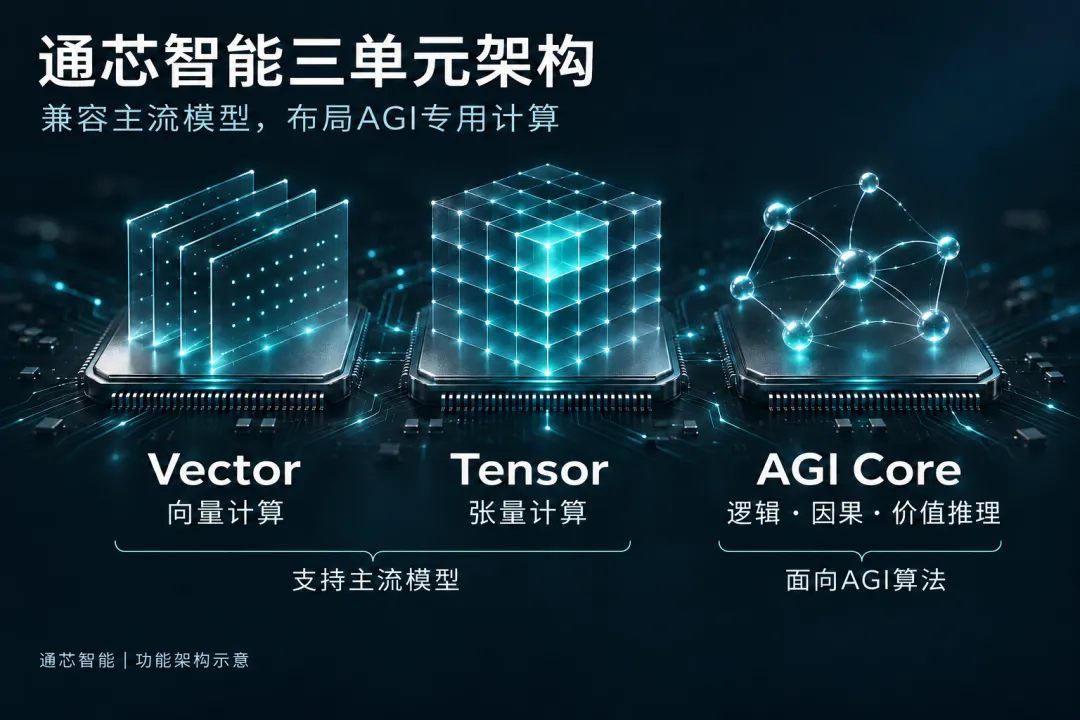
Implementing Tongxin's chip solution, the company has planned three types of units: Vector, Tensor and AGI Core. Vector and Tensor are responsible for vector and tensor calculations, supporting mainstream model architectures such as CNN and Transformer; AGI Core is designed with dedicated acceleration capabilities for logic, cause and effect, value reasoning and probability calculations based on analytical graphs.
These computing needs that Tongxin AGI Core targets also appear in the research routes of other teams in the industry.
Fei-Fei Li's spatial intelligence focuses on how machines understand the three-dimensional environment, while DeepMind's graph network uses entities and relationships to organize information. Faced with the situation of incomplete information, the probabilistic programming supported by DARPA attempts to combine existing knowledge and complete inference with less data; Pearl's causal theory further asks what consequences will be brought by changing a condition. Silver, Sutton, and others proposed in "Reward is Enough" that agents pursue rewards through trial and error and may develop various abilities such as perception, learning, and reasoning.
In Tongxin's view, the storage and processing of graph structures, probability and causal inference, and evaluation of action results are all worthy of special acceleration, and AGI Core has planned corresponding computing units accordingly. Professor Song-Chun Zhu’s theoretical system provides a clear starting point, from which Tongxin hopes to extract computing power that can be used by more models.
Each company may have different understandings of intelligence, but as the base of intelligence, what the chip needs to look for is the greatest common denominator.
Putting the theory on silicon, what does the core rely on?
After having a systematic theoretical framework and understanding intelligence and algorithms, we still have to build the chip.
Wang Haiyang, the founder and CEO of Tongxin, studied under Academician Xia Peisu, one of the founders of China's computer industry. Wang Haiyang himself is a founding member of Loongson CPU. He once served as chief architect for Hygon’s first four generations of CPU chips and later co-founded a GPU company. He has 25 years of experience in chip R&D and 15 years of SoC architecture design, and has participated in the entire process from R&D to mass production of three major chips: CPU, GPU, and GPGPU.
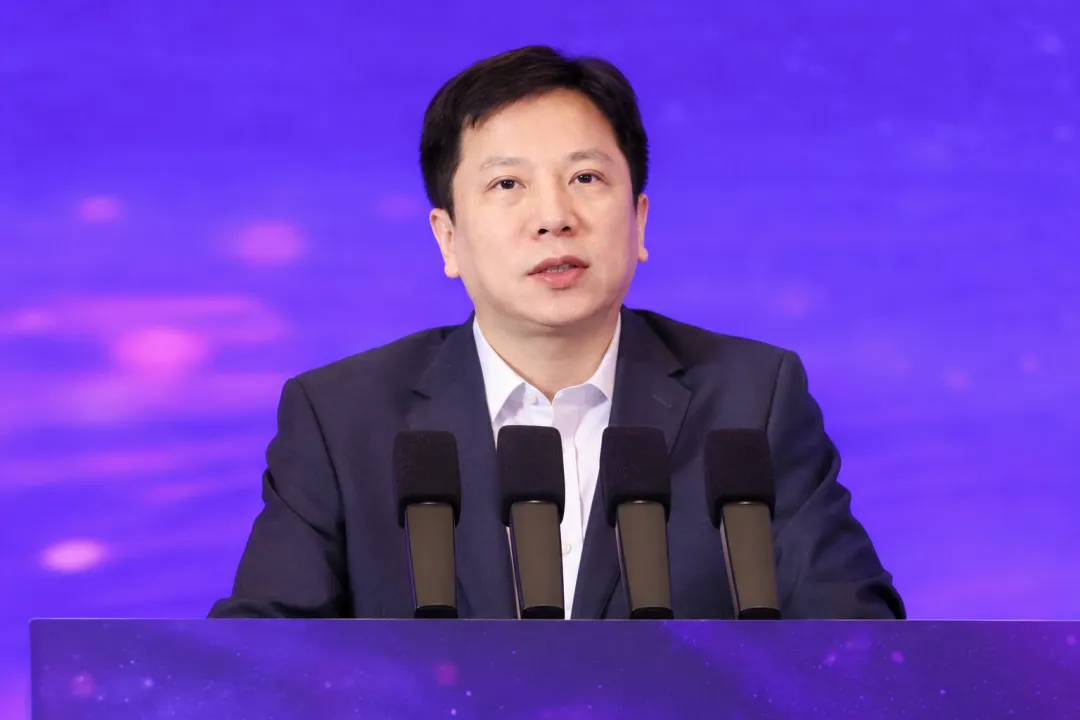 △Wang Haiyang, founder and CEO of Tongxin Smart
Another company founder, Shi Feng, studied under Professor Song-Chun Zhu, who graduated from UCLA with a doctorate. He is responsible for the technical roadmap and architecture definition of Tongxin AGI Core, and also serves as the director of Tongyan AGI Chip Center.
Both founders have participated in Loongson research and development. Later, Wang Haiyang mass-produced large chips in the industry from generation to generation, while Shi Feng combined intelligent algorithms with chip design and was responsible for converting model and algorithm requirements into computing units in AGI Core.
The founding core team behind them has an average of more than 20 years of experience in the industry. The backbone comes from Haiguang, Baidu, Byte, Alibaba and other companies. They have gone through the entire process of more than ten large chips, from architecture definition, front-end and back-end design to tape-out and mass production delivery.
These experiences turned into several specific trade-offs.
One design consideration is memory. Wang Haiyang is one of the first people in the industry to propose the idea of integrating hybrid storage and computing. Tongxin does not intend to make an integrated storage and computing chip. It regards the integration of storage and calculation as a means to alleviate the "memory wall": different tasks have different requirements for access speed, capacity and cost, and Tongxin will match them with different storage and computing methods. Use a kitchen knife to cut vegetables and a fruit knife to peel fruits. What you save is the overhead of data transfer back and forth and computing units.
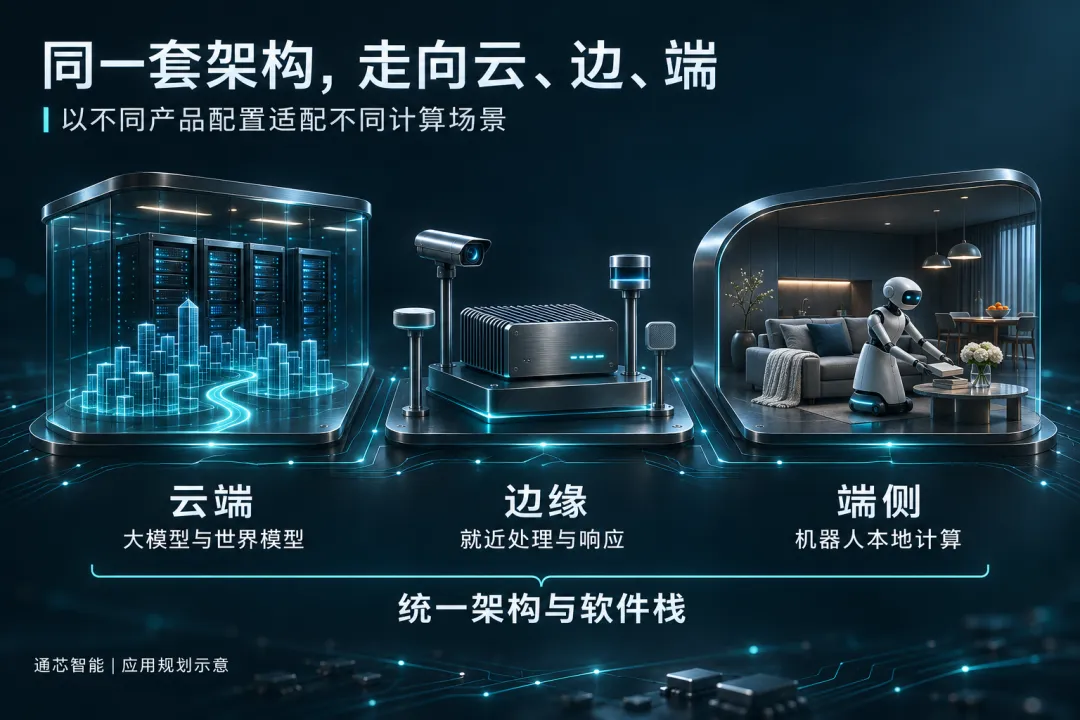
Next is the area. The reconfigurable design allows some hardware resources to be reorganized according to tasks. The general units maintain compatibility and the dedicated units improve efficiency. To meet the different needs of the cloud, edge, and terminal, Tongxin plans to adopt Chiplet design: based on the same architecture and software stack, through different configurations, it can meet the throughput requirements of the cloud and the power consumption and volume requirements of the robot end.
In terms of product rhythm, Tongxin has not taken a step forward into the future. Because a chip designed only for tomorrow, no one can use it today.
Tongxin's first-generation product is positioned as a cost-effective inference chip, targeting large cloud models, world models and edge robotics. Existing models can be run directly, AGI Core will be launched simultaneously, and new computing capabilities will be verified in stages.
AGI chips and GPUs are not an either/or relationship. Tongxin positions itself and GPU-centered solutions as symbiotic: the large language model is still an important component of the AGI system and one of the ways for intelligent agents to understand the world. The AGI Core is designed to complement GPUs, not replace them.
Progress is faster than most people think. Tongxin Smart says it completed its architecture design and project setup within three months of founding. It has now entered the chip design stage and will conduct FPGA prototype verification in early December. The company identifies three initial deployment areas: cloud inference, general-purpose agents and on-device embodied AI, and large-scale cooperation intentions have initially been formed.
In addition, Tongxin also plans to adapt to Tongyan's general intelligent agent "Tongtong" and related large models, and build a joint laboratory with Peking University, Tsinghua University, the Institute of Computing Technology of the Chinese Academy of Sciences and leading large-model partners.
Wang Haiyang mentioned that for Tongxin, architecture definition is only the starting point, followed by design, verification, tape-out and mass production. The architecture chosen today must remain useful as models and tasks continue to evolve.
This also gives Tongxin’s exploration greater observational value: As AI moves into physical environments, chip designers need to understand the algorithms early, identify recurring operations and decide which are worth accelerating in hardware.
This path will ultimately prove its value with more timely responses from robots, lower operating costs for agents, and more convenient deployment for developers.
From theory to algorithms, from operators to silicon chips, and then to real tasks, Tongxin Smart aims to bring these stages together.
The competition for the next generation of AI chips has already begun before the birth of silicon chips: understanding how intelligence works and defining what kind of computing it requires.
For Tongxin, early entry is just the first step. Next, it needs to use a chip that actually runs to prove that today’s judgment of intelligence can turn into tomorrow’s efficiency advantage.
As Professor Song-Chun Zhu mentioned: "The chip is the heart of the embodied robot. Developing this core starts with the chip."