Smells from the Monastery of Panfi
QbitAI is public.
Google's little cup is a little overwhelming.
I can run.This is 2.5 times faster than the previous generation.Code Agent has more than tripled its scores, and even its own big cup has been overtaken by it???
A new member of the Gemini 4 family has just arrived.
Gemini 4 HydrogenIt's official.
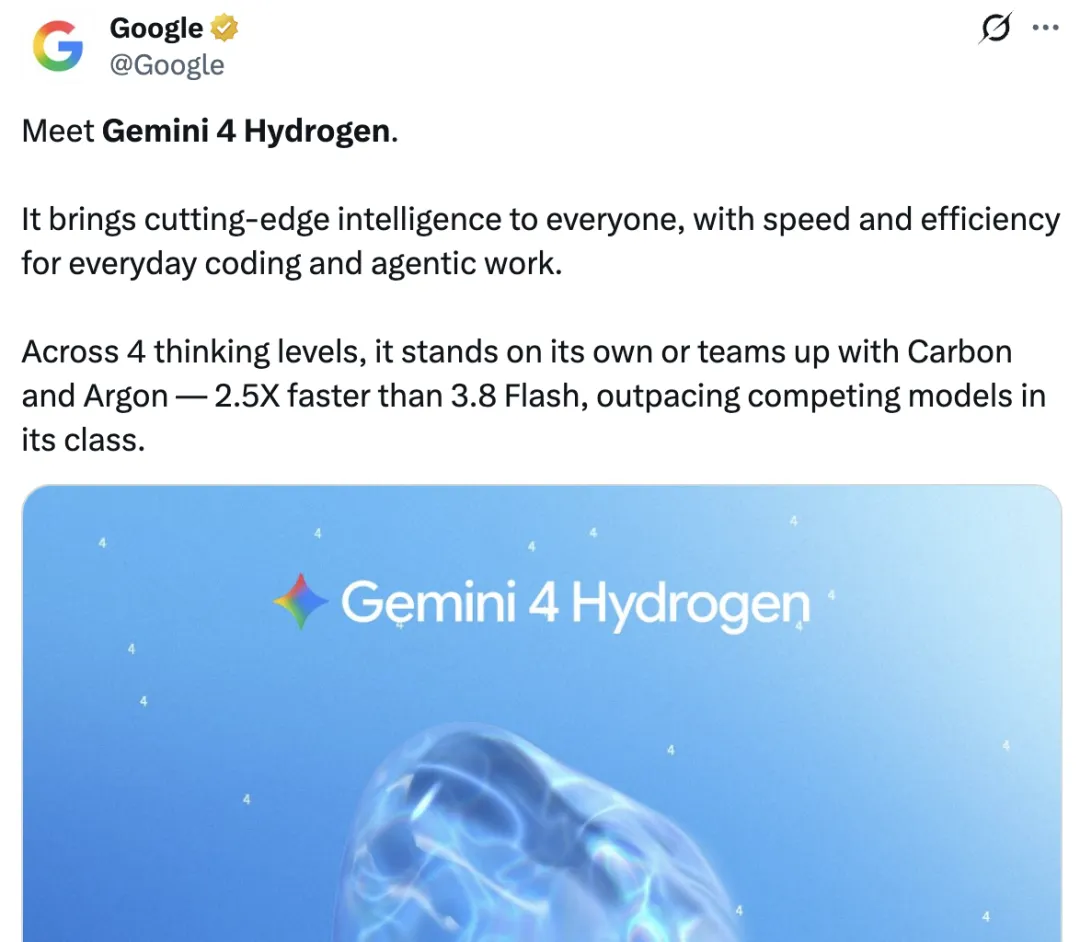
As a lightweight model to replace the Gemini 3.8 Flash, Hydrogen was originally supposed to be responsible for fast response, daily programming, and Agent tasks that didn't require a top-down model.
The result is that Google publishes the results, good guy.
In the Artificial Analysis Intelligence Index, the default High Thinking rating of Hydrogen has dropped 51 points to over 50 points for Gemini 4 Argon.
If the thought intensity is pulled to a maximum of xhigh, the hydrogen can be pushed further up to 54 points.
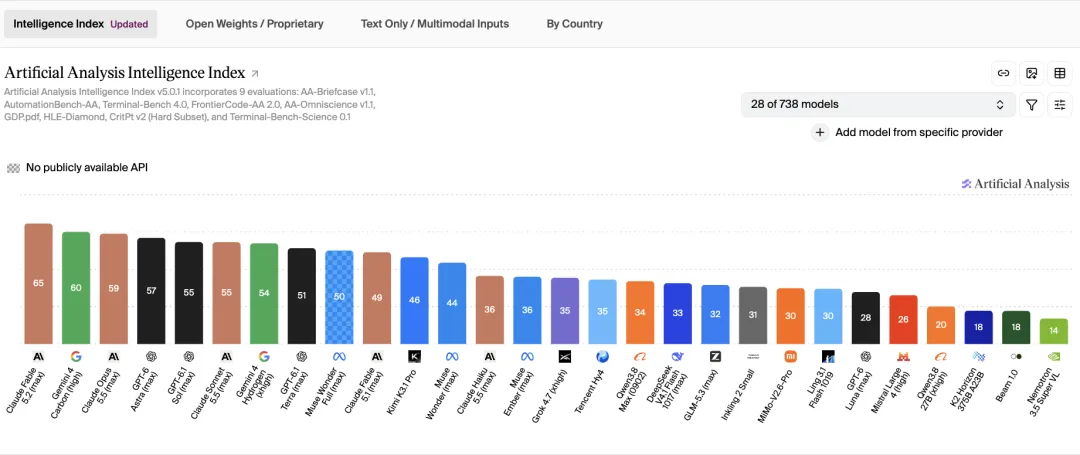
Argon, of course, is still primarily focused on complex reasoning and long-range tasks, but the scale of this upgrade is not small.
It's the same as the Gemini 3.8 Flash:
The speed of mission completion improved 2.5 times, and the Terminal-Bench 4.1 score rose from 18.2% to 57%, reducing fictitious statements by more than 5 times.
Hydrogen has been added to the list of priority upgrades for writing code, bugs, checking data, operating tools, and handling complex documents.
Some netizens have previously tested Gemini 4 Hydrogen High in Antigravity to build a viable future city.
With just one round of follow-up optimization, the rendering effect is still relatively smooth.
It can also work with the Gemini 4 Carbon team to get large models to coordinate, small models to execute, and AI agents to work with large cups.
Currently, Hydrogen is open to users around the world, with entrances such as Google AI Studio, Gemini API, Gemini App, and Google Search available online.
In the full context window of 1 million tokens, its input pricing is fixed at$1.50/million Token。
Three times the capacity to code
Hydrogen has made a number of special optimizations for code scenarios.
In the face of large code repositories, it can simultaneously read multiple files, search for relevant code, and avoid reviewing each file one at a time.
When modifying Bugs, they try to move only the parts that need to be modified, not to rebuild a bunch of unrelated code.
In a SWE-sweep that detected specific code defects and corrected them, Hydrogen took 13.5% off.
(For comparison, Claude Sonnet 5.5 is 3.1%, and GPT-6.1 Terra is 5.8%)
In addition to the code, the performance of Hydrogen on long-range Agent missions is not dependent on it.
Last Exam v1.1 was down 71.6%, up from 60.4% for Claude Sonnet 5.5 and 69.8% for GPT-6.1 Terra.
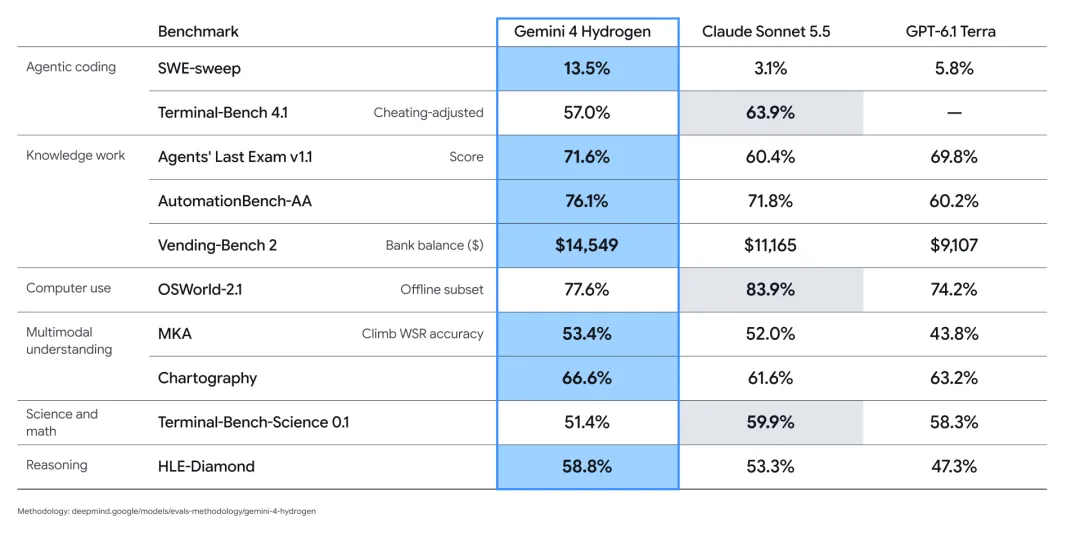
It's been a long time since I've been able to do anything.
Under the default High Thinking Rate, hydrogen completes tasks at 2.5 times the speed of Gemini 3.8 Flash.
Several companies have also released test results that have been anticipated:
Box observed that in data-intensive workflows, hydrogen runs at about twice the speed of the previous generation, while token consumption decreases by 12%.
Pixelcut tested 276 design tasks, improving the speed of completion of hydrogen by 1.8 times, and generating code with a 30% improvement in purity.
In tests involving graphing, SQL and other tasks, STAN has seen a 2.8-fold increase in speed.
……
As it turns out, this time Hydrogen has improved the execution efficiency of the entire Agent workflow.
It's easy to draw on tables.
In this official presentation, there are some very interesting cases.
One of the games:
Let AI directly draw animations in Google Sheets.
Hydrogen picks up thousands of units as pixels and controls the display effects of different units through Python, Google Sheets native LET formulas, and conditional formats.
Eventually, a plain table becomes a pixel canvas for playing animation.
Another demonstration is more in line with daily office needs.
After capturing a video from a YouTube broadcast, it can automatically generate a full PPT in Google Slides, as well as auto-circulate proofreading, auto-correct text overlapping, and editing errors.
Google has also demonstrated how to build e-commerce websites using hydrogen.
With only one instruction, the model can generate a web page that contains WebGL2 topographic colorants, step-by-step scrolling narratives, 3D frame parameters cards, and interactive configurations.
There is also a shared pixel wind island called Geminisland.
By entering a sentence, the user can generate new 3D buildings in real time, add them directly to the map, and others can explore them from a first-person perspective.
The big cup is responsible for thinking, the small cup is responsible for doing
In addition to fighting alone, Hydrogen has a rather interesting position:
It's designed specifically for large models.
Now for complex software projects, an agent from start to finish may need to repeatedly read code, plan architectures, call tools, and check execution results.
If the most powerful and expensive models were to be used at every step, the cost would naturally not be low.
Google has introduced a new feature in Antigravity this time.This is the first time I've ever heard of this song.。
Users do not need to switch back and forth between carbon and hydrogen manually.
The orchestrator will dynamically select different models to complete the work depending on the needs of the task.
For example, when starting a complex software project, it is necessary to determine the overall technical architecture, part of which can be given to a more capable carbon.
Once the architecture has been determined, the next step is to write the code, perform tests, verify modifications, and get Hydrogen to take over.
More complexly, Carbon can also act as a coordinator, allowing multiple Hydrogen Agents to simultaneously execute and check different modules.
The big cup is responsible for planning, the small cup is responsible for running.
Google's tests on Terminal-Bench 4.0 found that Orchestrator was able to achieve a mission success rate that was close to using Carbon alone, while reducing quota consumption by an average of 24%, and improving completion speed by 19%.
Hydrogen also provides four levels of thinking intensity:
Low, Medium, High and newly added xhigh.
The API is priced at $1.50 per million of tokens input and $7.50 per million of tokens output.
Within the context window of 1 million tokens, this price is uniquely used.
At the moment, Gemini 4 Hydrogen has started its global launch.
Google Search will also introduce Hydrogen, enhancing our understanding of complex, multi-conditional search questions, and generating more intuitive, visualized answers.
The link is as follows:
[1]
[2]
[3]