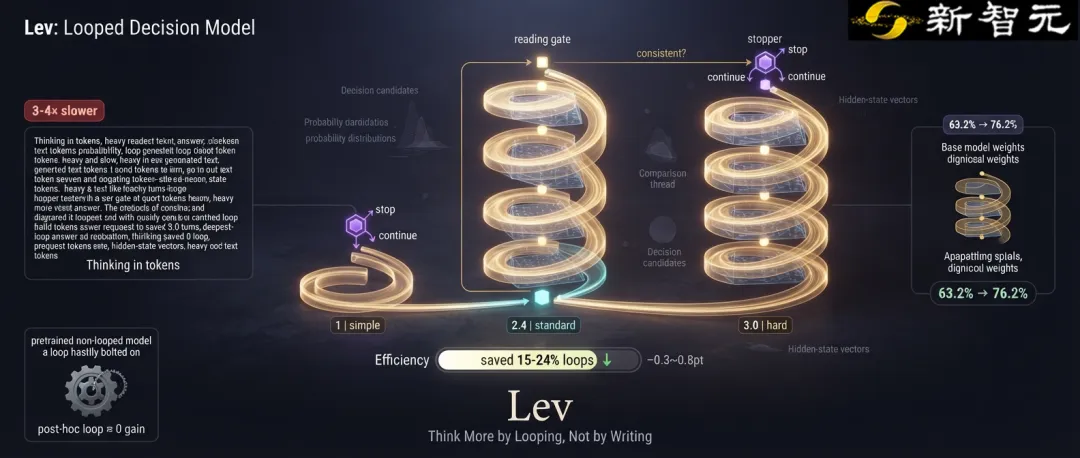
Imagine a customer system flowing into hundreds of thousands of user requests every second.
Every article has to go through a "distributed clinic": is it a refund, logistics check, or a complaint?
These issues have one thing in common:The answer lies in a few given options.。
This is why the industry has specializedDecision-making modelFor example, in Jev and open-source Kev. They read requests and candidates and give the probability of each option back and forth.Tens of millisecondsYou can go back without generating any text.
But problems come with it.
"I want a refund" and "What I bought last month was changed once, this time it's bad, can't be refunded directly, who can pay for the shipment?"In the eyes of the decision-making model, it takes the same amount of computation.。
Simple requests are over-served, and complex requests can't be overlooked.
Let's have the model write a rationale first and then answer it.Each request is paid for the reasoning of the textEven if it's just a "I want my money back".
Is there a model where the simple questions are as fast as the small ones and the difficult questions are as thoughtful as the big ones?
To answer this question, a team of researchers from Lehigh University, the University of British Columbia, and the Vector Institute came up with the idea.LevOne:Think deeply about cycles instead of tokensThe decision-making model.
Link to the paper:https://arxiv.org/abs/2610.20951
The main page of the project:https://openlair.github.io/lev/
The code link:https://github.com/OpenLAIR/lev
Models and datasets:https://huggingface.co/collections/songdj/lev
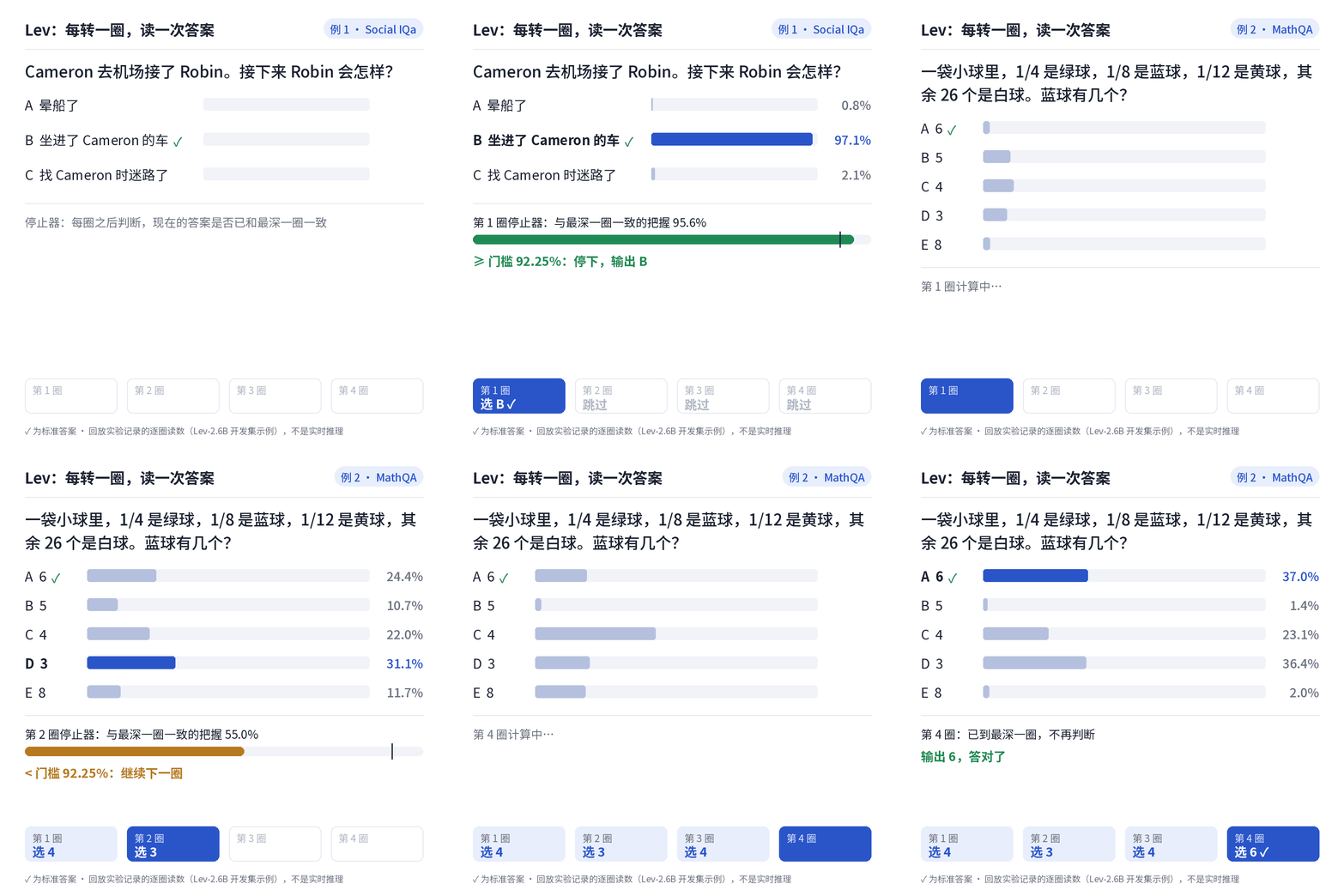
Lev circle-by-circle answer: In case 1 circle 1, the correct answer is selected B, and the stop device can stop; in case 2 circle 1, the correct answer is selected 4, to circle 4, the correct answer is selected 6. (source: redraw the circle readings of the project's home page records, relay experimental data, not real-time reasoning)
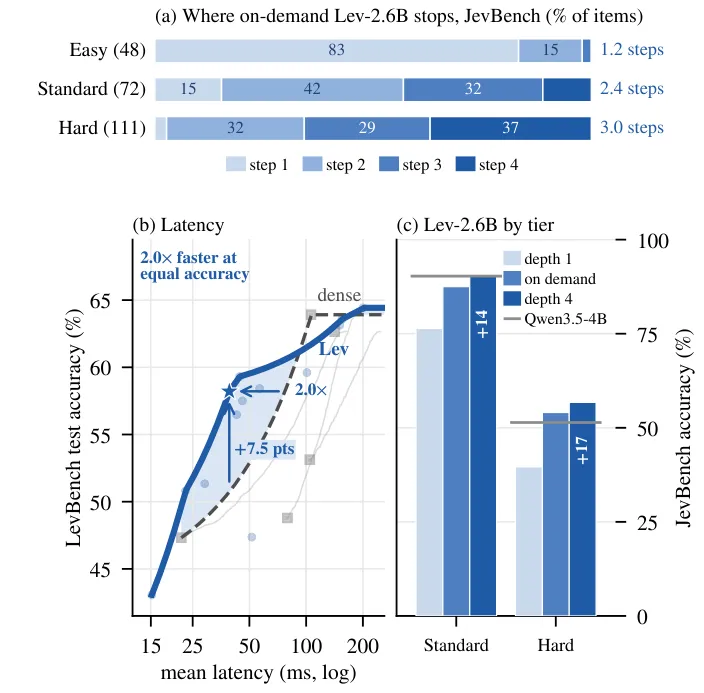
Paper Chart 1: The required depth Lev-2.6B is the number of rounds used in simple, standard, and difficult JavaBench problems, as well as accuracy and latency.
Lev's core thinking can be summarized in one sentence:The same set of network layers run repeatedly, and each loop reads a response.
The authors call this method of computationSystem 1.5It retains the "direct decision-making" interface of System 1 and is able to calculate more on complicated problems like System 2, but these computations occur in a hidden state, rather than written in text.
The result is intuitive:
In JevBench's 231 open questions, the same Lev-2.6B checkpoint is taken from a circle.63.2%It's up to four circles.76.2%increased13.0 points;
Stoppers don't see the difficulty of the subject, but they are used on average on simple, standard, and difficult problems.Two, two, four, three circles.;
On-demand depth in offline statisticsLess than 15% to 24%.Loss of accuracy in the calculation of the circuitLess than a point.;
It's not.Within 50msThe delay intervals of Lev-1.4B and Lev-3B are higher than the non-circular models and ratings of the same delay.5.4 to 8.8 points high.(Single H200, one request test at a time)
Additional arithmetic is useful only on a few topics
Lev's starting point comes from a set of case-by-case contradictions.
The authors take two public decision-making modelsKev-0.8BandKev-4BThe two trained data sources are the same, and the large model polynomials are the same in the JevBench 231 open-ended question.28 roads。
It's the 28th.It's all from standard questions and problems.The simple question is that both models are correct.
And the two models have different problems.42 roadsThe big model, however, spent more on all 231 questions.
If the confidence of a small model is used to pick out at least half of the uncertainty, and the accuracy is given to a large model, then the accuracy is greater than that of a small model.It's almost as big as the model's total answer.。
Conclusion: Additional calculations are only rewarding on a small number of subjects, and an inexpensive initial reading can find them.
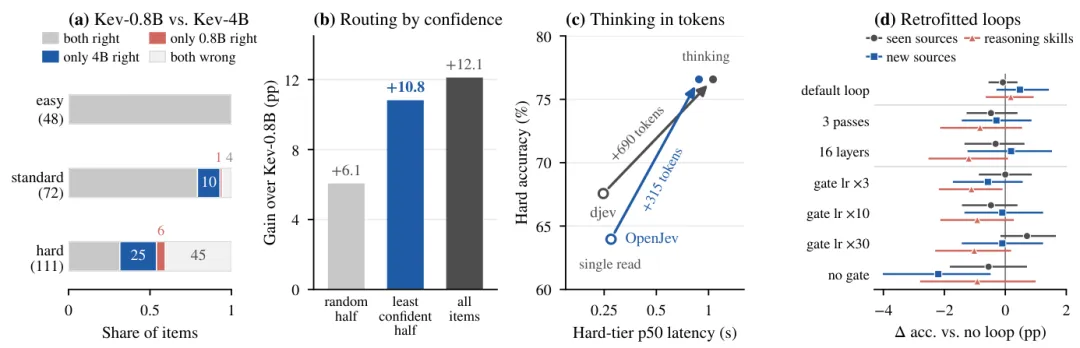
Figure 2: (a) Kev-0.8B and Kev-4B for the result of the queries; (b) only give at least half the uncertainty to the effect of the large model; (c) generate a reasoning contrast with the one-time readings; (d) give the average.Pre-training modelChanges in accuracy after adding cycles.
So why aren't the three existing "calculator" schemes enough?
ClassifiedKev-0.8B's median delay is already79msKev-4B is108msIt's easier to read them over and over and over again, and it's much slower to deploy a model than using a big model directly.
Produced reasoning textOn two open-source Jev services on the same 26B base, open thinking improves the accuracy of the problem.9 to 13 points.But the middle of the problem is that it's time-consuming.Three to four times。
Give it to me.Pre-training modelPackage cycleQwen 3.5-0.8B: The author takes the middle eight layers of the Qwen 3.5-0.8B into a gate-controlled loop, changing the accuracy rate.Less than half a point.The door control is always close to zero, and the loop is equivalent to not opening.
The last one is particularly important. It explainsCycling is best learned in pre-training.It is not a temporary supplement to decision-making training.
Lev's three key designs
Recently, Circular Transformer has received renewed attention in the industry.Original cycle language modelAs the base: bytes of SeedOuroIt's the first time I've ever been in the same situation.Nanbeige4.2-3B(circle two)
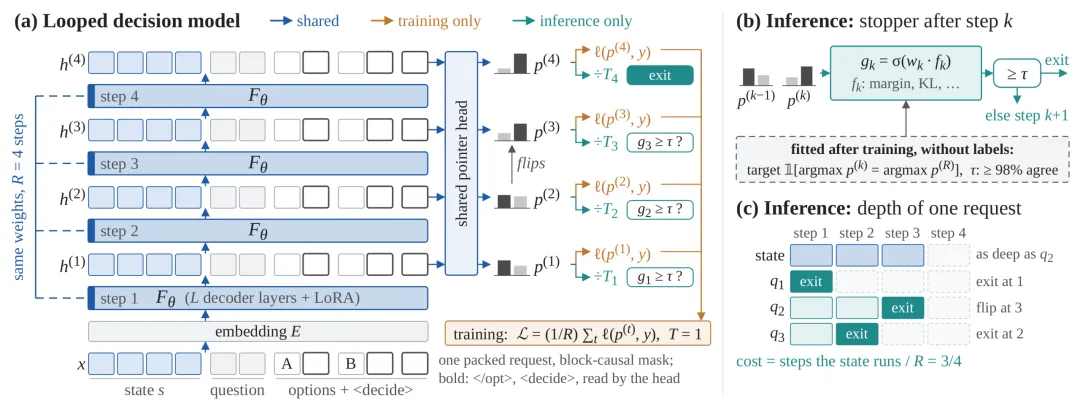
Treatise Figure 3: Lev's overall structure. The same set of decoding layers run in cycles, with the shared pointer head reading an option each round; the stop decides which round of each round the question exits from.
Design One: Read the answers in each round.
Requests and all candidates are packaged in a sequence. The same set of decoding layers are repeated, after each round,The same pointer head.Read the options and<decide>Hidden state of location, output a probability of an option.
Design 2: All circles train together.
The pointer head and the LoRA adapter are shared between the circles.LossesAverage of all circlesSo the first, second, and fourth circles are decision models that can be used independently.
When using a k-circle to serve, only the previous k-circle is counted; when you need to think more about a circle, continue to count from the hidden state of the previous one.Please don't read it again.。
Design 3: The stop predicts "whether it is consistent with the deepest circle".
A common rule of thumb is that "confidence is high enough to stop". But the authors found that the shallow layers read on the new data.Serious overconfidenceLev-2.6B: Topics stopped in the first round, in the calibration set94.8%That's right, we're just switching to new data sources.78.9%But the confidence is almost the same.
What is more, confidenceI can't figure out the wrong thing about counting one more circle to get it right.The AUROC is only 0.46 to 0.61.
So Lev's stop is changing the target:Not predicting "the current answer is wrong", but predicting "the current answer is very different from the deepest circle".。
The "standard answer" to this goal is the deepest output of the model itself.Fitting stoppers and selecting thresholds do not require manual marking■ deployments can be directly calibrated using unlabeled requests from their own businesses.
The results of the experimentOne weight, multiple points of work
The authors trained three Lev models using exactly the same 31,329 training data and formulations, as well as three non-circular controls, such as Qwen3-1.7B, Qwen3.5-2B, Qwen3.5-4B. The evaluations consisted of three optimization sets, two held-out test sets, and LevBench was self-constructed by the author.It's frozen before any model is read.He is also the author of 231 Open Questions by JeffBench.
Conclusion One: The deeper the depth, the lower the yield.
Lev-2.6B on the JevBench, a circle to four circles in succession is63.2%、71.0%、75.3%、76.2%On average, hold-outs were 51.3%, 62.0%, 64.8% and 65.7% respectively. Most gains came from the first extra round, with the fourth round being up to one point.
The further away from the training data, the deeper the usefulness: upgrades of about 7 points on the training data source, upgrades on the stranger test set.9.0 to 19.5 points。
Conclusion 2: Increase focus on difficult problems.
From one circle to four circles, Lev-2.6B solves the 111th difficulty.The net answer is 19.In 72 standard questions, the net polynomial is 10 times. 29 of the problems are corrected correctly, and 10 are corrected incorrectly.
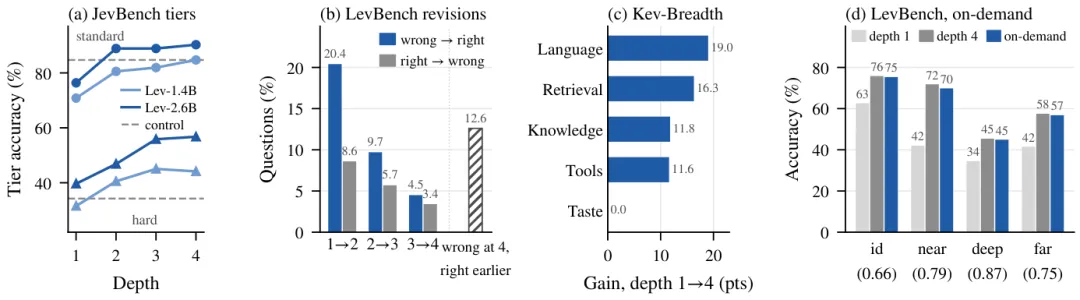
Paper Chart 5: Where depth plays a role, including variations in the difficulty arcs of JevBench, modifications between adjacent circles, and improvements in the application areas.
Different tasks benefit differently: In Kev-Breadth, depth improves language understanding of class tasks19.0 pointsIt's a lot of fun, and it's a lot of fun, and it's a lot of fun, and it's a lot of fun, and it's a lot of fun, and it's a lot of fun and it's a lot of fun.There is no profitThe authors hypothesize that additional circles provide the sequential computation needed to combine multiple facts.
Conclusion 3: Less than 15% to 24% depending on the depth required, and the accuracy rate is almost non-reduced.
In two sets of held-out tests, the stop used only the deepest loop.76% to 85%Loss of calculation accuracy0.3 to 0.8 points.The maximum losses occurred on the locking test, which was only read once after the formula and stoppers were all set.One and a half.。
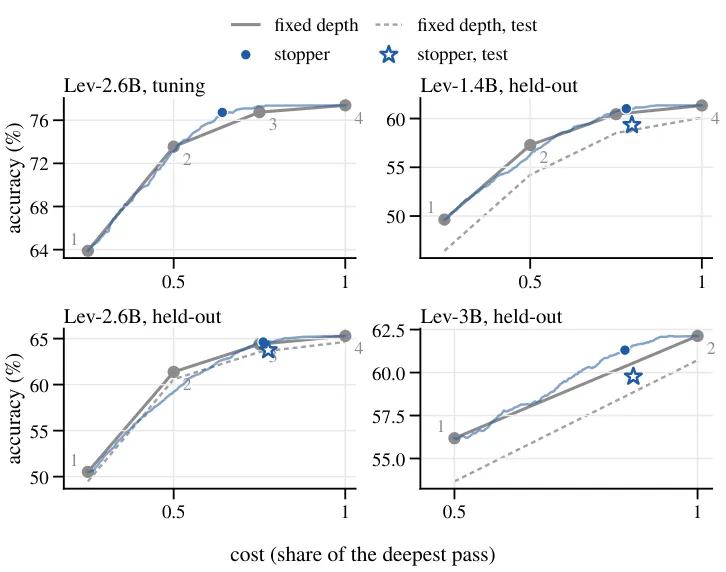
Chart 6: Accuracy and computational costs. Gray for fixed depth and its front, blue for stop, and star for locking tests.
Conclusion 4: The key is to calibrate target traffic.
As long as you select a threshold as "consistent with the deepest answer" in a non-labelled target request, like a stopwatch,A simple maximum probability threshold can be less than 0.2 points with a stop.Every turn.500 Unlabelled TopicsThat's enough.
Conclusion 5: The advantage of the low delay interval is obvious.
It's not.39 to 46msOn demand, Lev-1.4B and Lev-3B are higher than the only levels available for the same delay.7.0 to 8.8 pointsIt's higher than the best non-recycling schemes5.4 to 7.5 points。
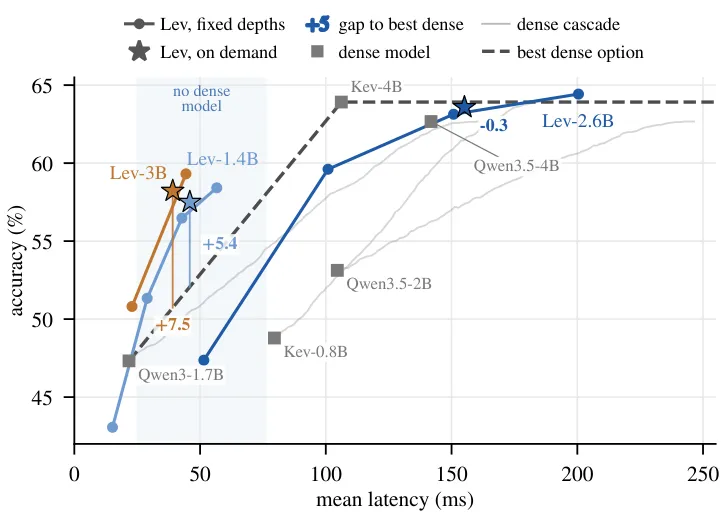
Paper Chart 10: LevBench locks the accuracy rate and average delay on the test, the star number is Lev at the required depth, and the number is the gap between it and the best non-circulating solution.
In the paper, the authors make it quite clear that the scope of application of the results alternates:
There is little advantage in terms of depth on demand compared to the fixed depth of equivalent costs.Lev-2.6B is only 0.2 points higher on the hold-out and Lev-3B 1.0 points higher; the locking test of Lev-2.6B is parallel to the fixed depth front.
"Less" is offline statistics.Saving is the computation of the circuit, which is converted into online throughput or delay, requiring the packing scheduling of different depth requests to be supported by the service end.
Advantages are delayed, not calculatedAccording to the floating-point calculation, each Lev model is at or below the level of the non-circulating model, as each circle runs through the entire base. Some of the delay advantages also come from the non-circulating model's gap between 22 and 79 ms.
Delayed measurement conditionsA single H200, bf16, one request at a time, and all systems do not use convergence algorithms, graph capture or state caching.
It's not a bad idea.On LevBench, the first additional round corrected 20.4% of the questions and 8.6% of the errors; there were 12.6% of the questions with a shallow yes to the deepest round.
Summary and Prospects
Lev reveals the following:The basic life cycle can transform "how deeply to think" from a constant during a training to a set by choice of subjects during service.The same decision-making model can be used to make a trade-off between delay and accuracy for each issue rather than for each deployment.
The author proposes two follow-up directions:
Designing new stop targets to salvage the "shallow answer right, deep answer wrong" themes, thus exceeding the accuracy of the deepest circle;
On the basis of the larger circle, it will be examined whether the gains on the difficulty will continue to grow with scale.
Currently, the papers, the code, the three models and the three datasets are all open to the public. The datasets are sub-sets filtered by source redistribution terms, with reconstruction instructions attached to unmanageable sources.
Presentation by the team
What are you doing?(DingjieSong, first co-author): PhD student at Lehigh University.
Zhiling Yan(Co-author number one): PhD student at Lehigh University.
Yuxuan ZhangHe is a PhD student at the University of British Columbia, Vector Institute.
Lichao Sun(Author of the communication): Assistant Professor at Lehigh University