Dreams from the Monastery of Phineas
QbitAI is public.
Google has a new RSI!
Recently, Google DeepMind has officially released a new generation of robot model Gemini Robotics 2.5.
It is also Google's first robot base model with the ability to accelerate the development of the Gemini 4 Argon and self-improvement.
Wow! Folding clothes, finishing cakes, making butterflies, mastering a skillful and delicate one, and hundreds of everyday skills that are straightforward to pinch.
In fact, people have been directly targeting Mercedes-Benz factories as "spare parts workers", and the success rate of auto parts has been as high as 96%.

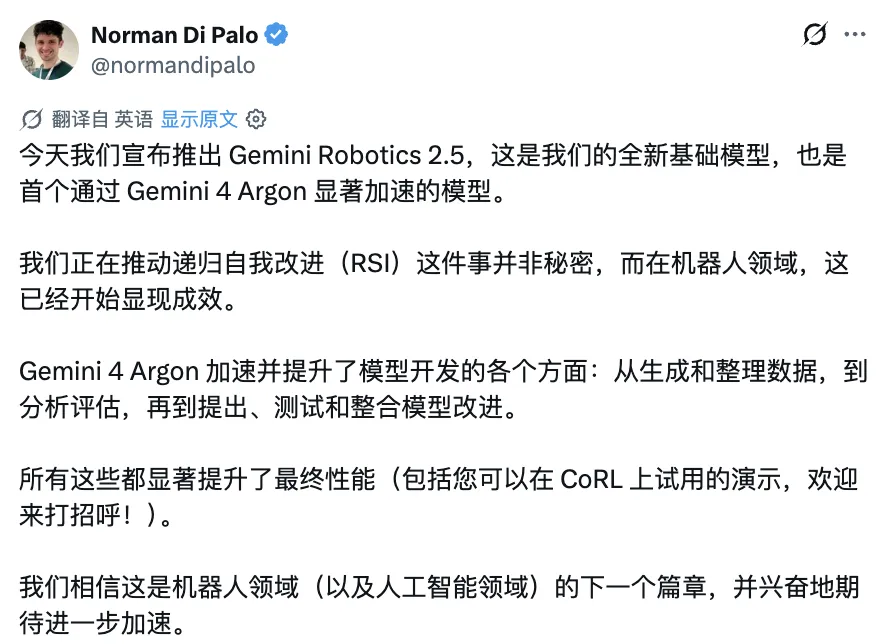
Google DeepMind researcher Norman Di Palo proudly reveals: "This is also the latest outcome of our robot RSI.
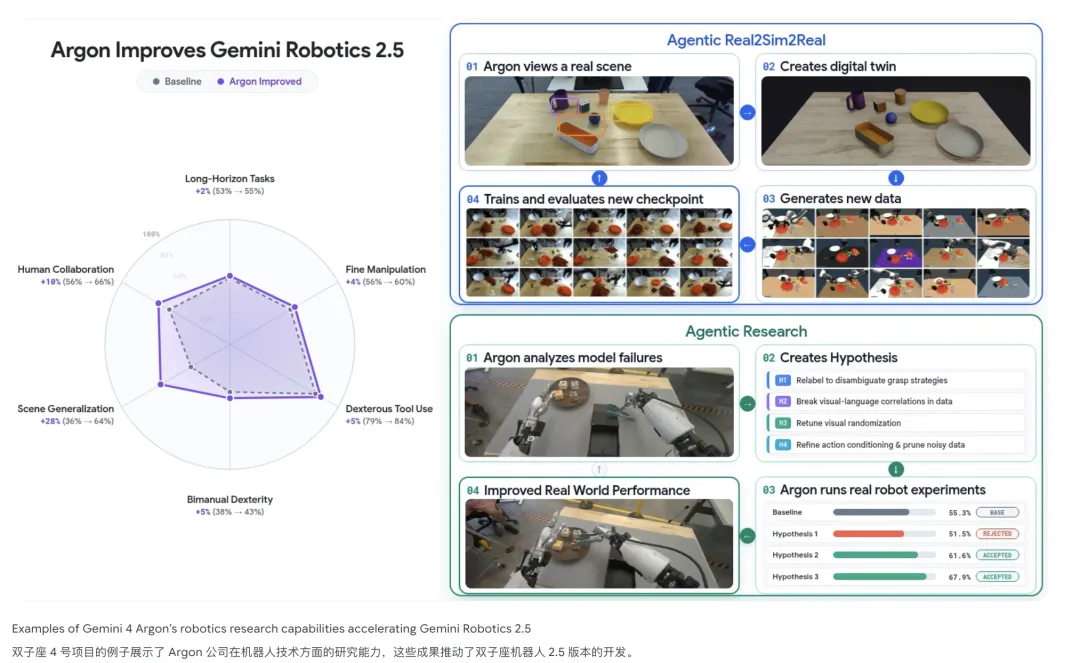
Gemini 4 Argon can build a virtual training ground based on real-life scenarios, allowing robots to repeatedly try and make mistakes in it and learn to improve by analyzing the causes of failure themselves!
It can do hundreds of different things, minds, and understands the RSI, and this model seems like it does something.
Over 200 missions have been fully upgraded, with success rates ranging from 5% to 100%!
Let's see if this new model is a real thing.
Gemini Robotics 2.5 is a VLA model, which is a visual language robotics model.
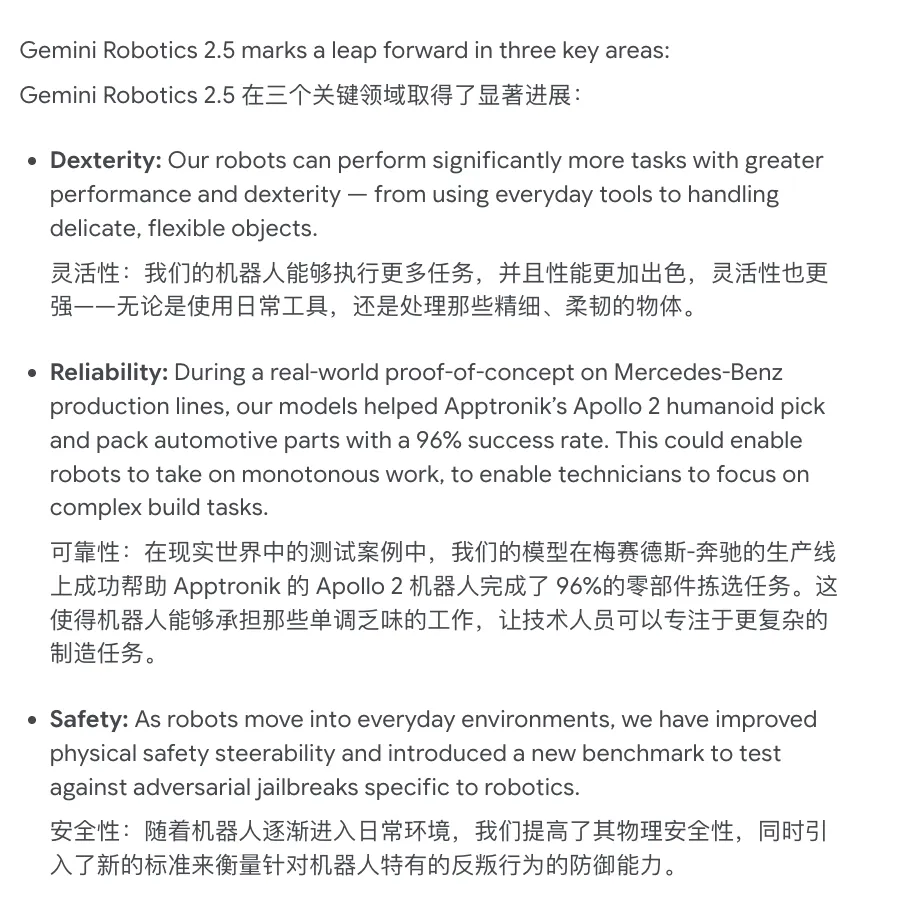
Compared to the previous generation of Gemini Robotics 2, Google's focus on the new generation of models adds three lessons.
Flexibility To accomplish more complex tasks, from using everyday tools to handling flexible objects, movements are more flexible and success rates are higher.
Reliability: The success rate of the Apollo 2 humanoid robot in assorting automotive parts was 96 percent in a Mercedes-Benz real-life production line test.
Safety: Increased physical shelter capabilities and introduced new benchmarks to test the ability of robots to resist malicious orders and jailbreak attacks.
Of course, the improvement in the lighting capacity is useless, but we still have to talk about the actual results.
In fact, this time Google directly arranged 200 different tasks, from daily housekeeping to fine-tuning operations, to give the new model a skill test.
It is worth mentioning that the new model has a 30% 100% success rate compared to the previous baseline, and a 20% 30% increase in completion speed.
We have spoken before of the most skilful of monkeys.
It sounds simple, but the actual demands for strength are quite high, lightweight, heavy and easy to deform food.
In comparison tests, Gemini Robotics 2 had a 5% success rate of performing this task, but it did 100% directly after upgrading to version 2.5.
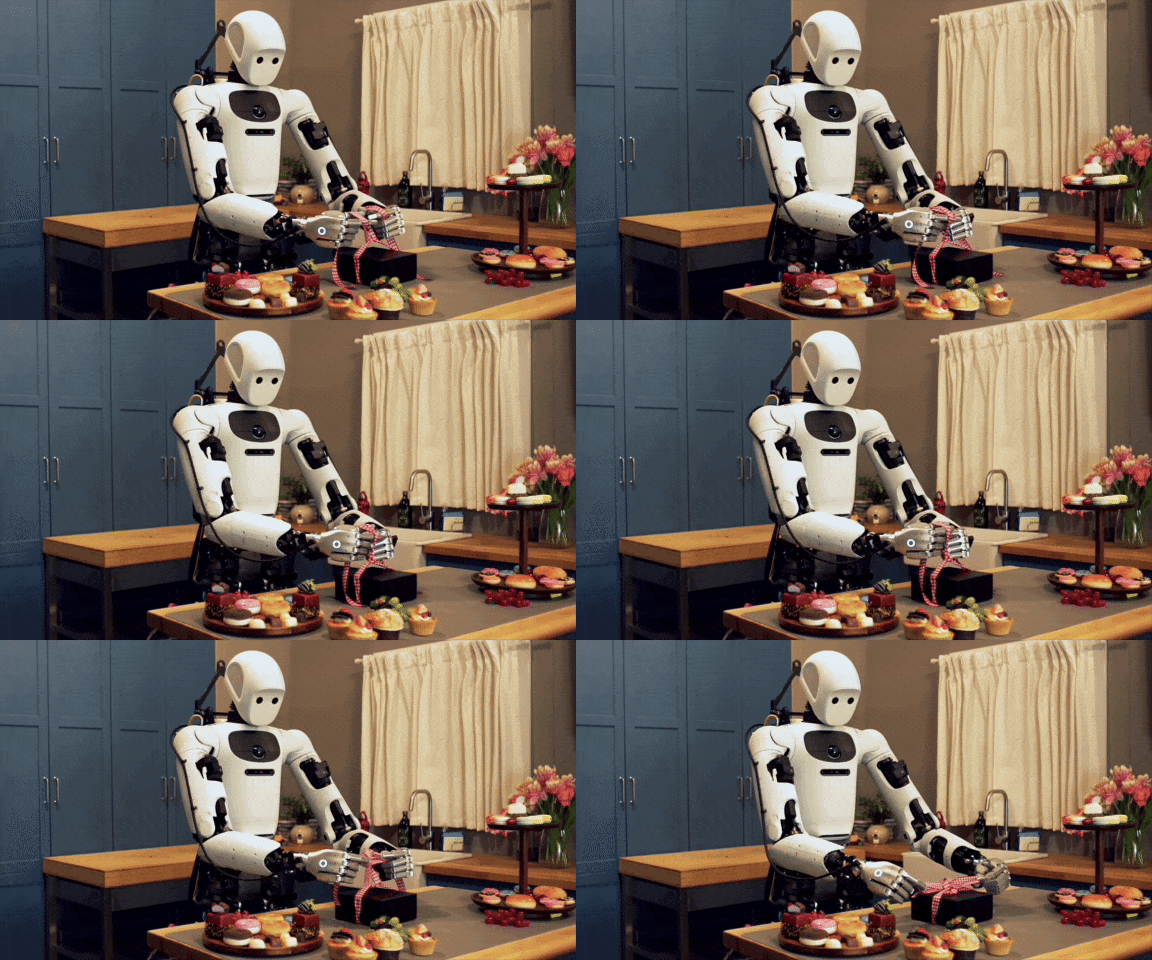
In a nutshell, it's just a matter of getting up there, picking up the coconut, baking the cake, putting the cake in the box, and doing a few moves, be like:

I'd like to take a closer look at some of the more experimental "finger operations", such as undoing a good butterfly knot.
The difficulty of this task is that the robot must first identify the cross-link between the ribbons, then find the correct position, and work with the fingers to unlock them!
It is worth mentioning that the previous model had a success rate of 0%, while Gemini Robotics 2.5 worked directly to 70%:
There's also more ground gas.
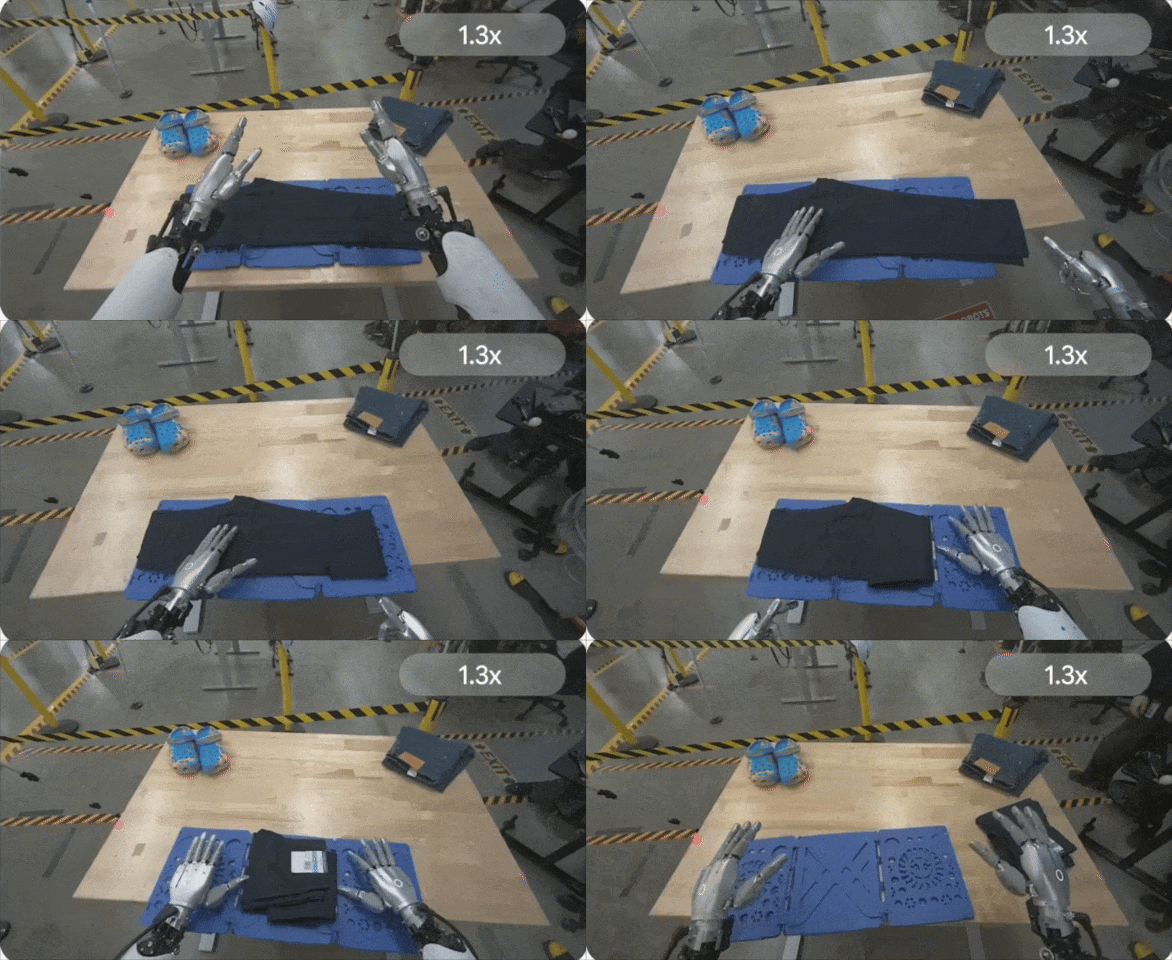
T-shirts increased success rate from 0% to 62%; folding, from 0% to 40%.
Don't look at these operations as unusual, in fact, flexible objects like clothing and ribbons have always been hard bones in robot operation.
In particular, flexible objects such as clothing and ribbons, which change shape as they clutch and pull, robots have to look at the state of objects and adjust their actions in real time:
However, Google is clearly not satisfied with getting robots to show their talent in the lab, and this time, directly to robots to work in the factory!
And there's a bit of a line in the workplace: the Mercedes car factory.
Testing took place at the Mercedes production facilities in Sindfingen, Germany and Ketch Kemet, Hungary respectively.
Aptronik's Apollo 2 humanoid robot, equipped with 22 degrees of freedom and five fingers, is responsible for the addiction.
This time, it's more than the hard core of a pie pie: car parts support sorting!!
For this reason, Google has also set up a "brain-handed division" kit for Apollo 2.
Gemini Robotics ER is responsible for understanding the task, planning the process, and Gemini Robotics 2.5 is responsible for commanding the hands to actually do the work.
In the end, in this real-world proof of concept, Apollo 2 delivered 96% mission success rate.

It was created by Gemini 4 Argon, and the robot also rolled the RSI.
The problem is, you see here, maybe a friend of a friend will ask you.
It's the old Google, which doesn't fit in with the old Google, and it's the old Google that makes robots progress so fast, right?
The answer is that all Tibetans are backed by Gemini 4 Argon and RSI (recurring self-improvement).
You know, the smartest kids ever were the dirtiest, fatiguedest, most burned-up kids:
The data was collected, the quality was checked, robots rolled over, and the engineers had to look at the video repeatedly, find the cause, adjust the parameters...

However, this time, the Gemini 4 Argon landed directly on the ground.
It's time to take over and accelerate the entire chain of model development!
Simply put, using a stronger AI, a dragon is hiring, educating and upgrading the next generation of robot AI.
It's a straightforward way to get robots to practice in the virtual world first!
According to a study published by Google in October, Argon can even start from a real desktop RGB photo and autonomously recreate a physical simulation environment.
What's on the table, how big the object is, where it is, it's identifiable, and then we build a digital gym based on reality.
More interestingly, Argon also makes its own puzzle, which changes the position and position of objects, allowing robots to repeat exercises under different conditions.
Even after the robot fails to execute the action, Argon can analyze the video, speculate on the reasons for the failure of the task, and propose improvements.
It's the equivalent of giving a robot a trainer who can create training grounds, design exercises, and be accompanied by complex AI trainers.
Google has even used Argon's capabilities for "robot security".
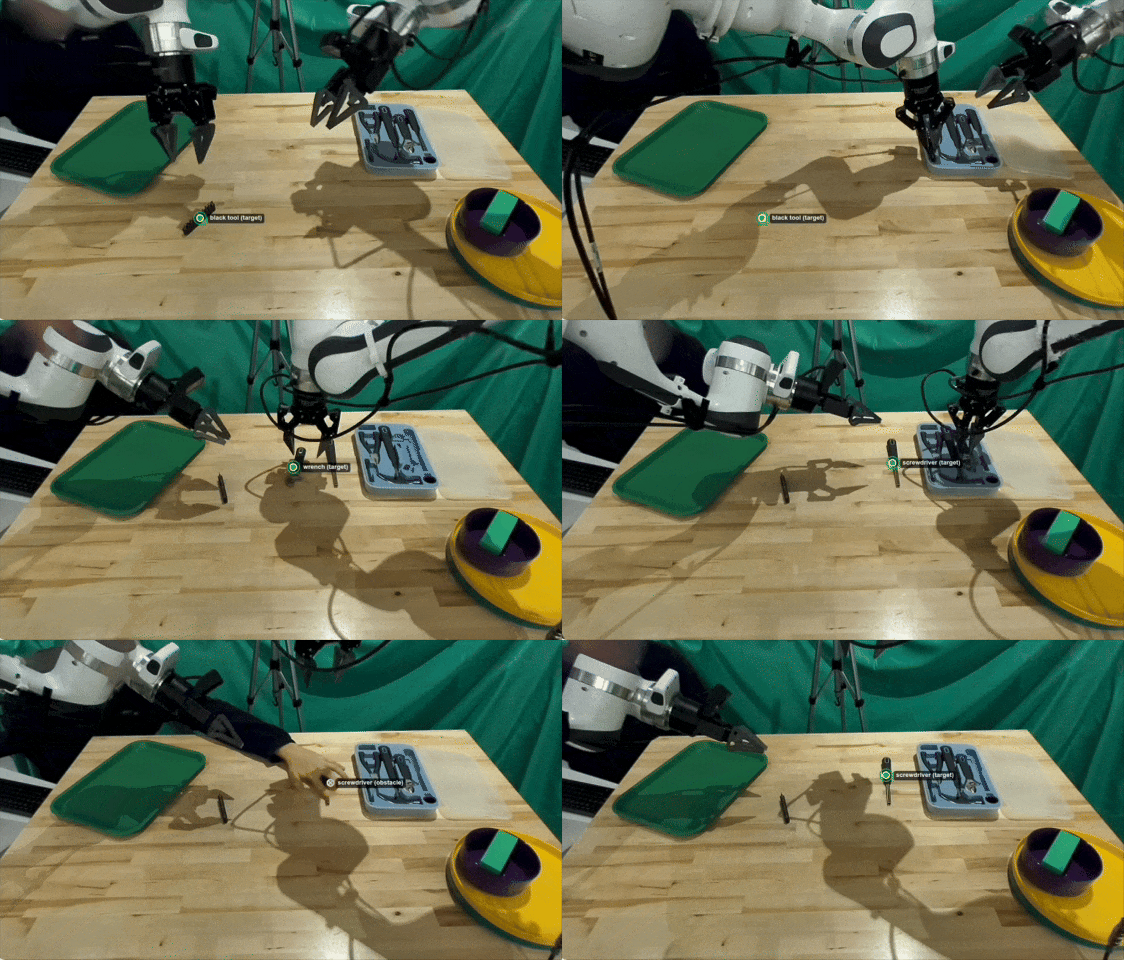
Gemini Robotics 2.5, released this year, can use the safety guidelines of the reasoning phase to avoid physical hazards in real time.
In Google's evaluation, the performance of security missions in the face of obstacles improved by 33 percent, and that of operations near humans by 43 percent.
Look at the example below, where the robot is burying its head, and suddenly someone reaches out into the operating area, and it can also recognize, stop, and avoid mistakes:
In addition to the problem of robots being induced to perform dangerous operations by malicious prompts, Google has also launched an open test benchmark ASIMOV-Jailbreak.
It contains a large number of disguised hazardous directions, specifically to test whether robot models can be identified and rejected.
In this benchmark test, the Gemini 4 Argon's escape resistance was 99.5%, up from the previous Gemini Robotics ER 2 baseline of 82%.
This also demonstrates Argon's stronger hazard indicator recognition capability in specified test sets.
Using more powerful AI to train, educate, and upgrade the next generation of robot AI.
While the RSI is still a long way from a fully autonomous closed loop, the game does show a more specific path to robot self-improvement.
The problem is, since Argon is running to the robot to work....
What's going on with the newly released Gemini 4 Carbon, and what's going on with the old Google?
The link is as follows:
[1]
[2]