There is a philosopher who says that in a man's neck, many things can only be seen in the background, and the day can only pass by.
It's an emotional statement about humans and AI, but it's a real engineering challenge.
Anthropic recently published an article about the craters they stepped into when they designed Claude's memory system and what they wanted to understand. The core conclusion is somewhat counterintuitive: it's not enough to make AI have a good memory, to make it "make notes", but to make it learn to "dream".
What's going on?
Let's see how the human brain remembers.
People are always remembering things in their lives. Behind this is a key role called the hippocampus, which is responsible for capturing experiences in the moment, allowing memories to be quickly formed and used. But note that not all experiences will become long-term knowledge.
Consolidating this phenomenon occurs mostly in the brain when it is "offline" - when it sleeps, when it rests quietly - when the body "recycles" recent experiences, gradually refining them, integrating them into the new cortex, where the brain stores the main storehouse of "knowledge".
The memory of the intelligent body can also be divided according to this idea.
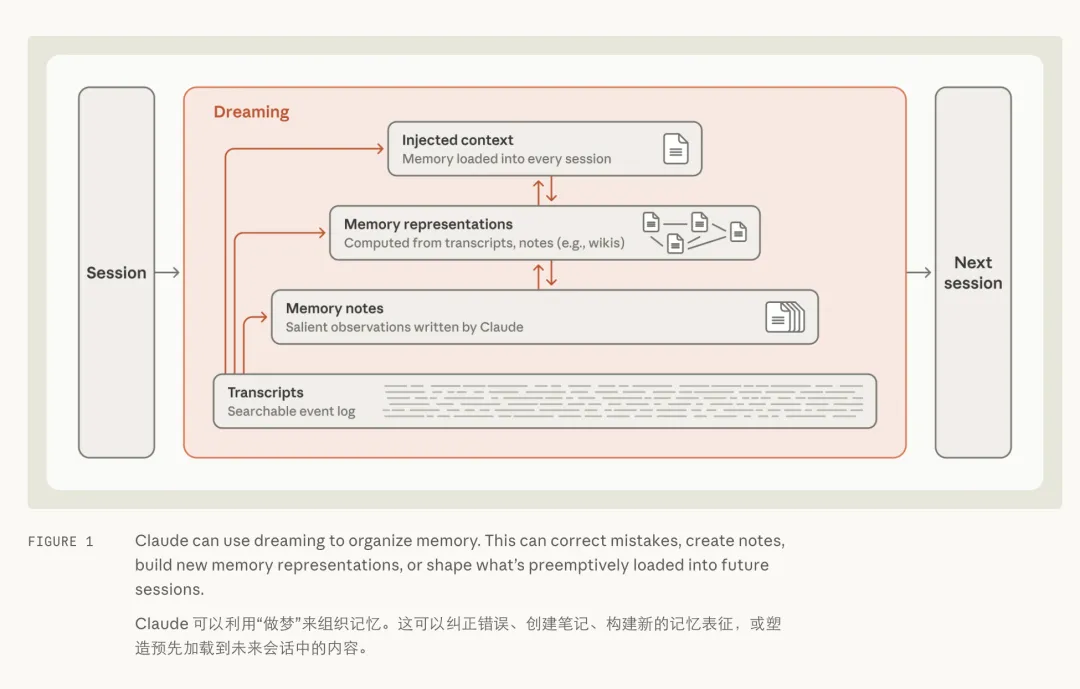
When AI is active, it leaves a large number of logs and transcripts of conversations, which is equivalent to instantaneous capture of a humanoid body. Researchers at Letta and UC Berkeley have proposed a concept called "sleep-time computation": models reorganize existing contexts over time in interacting spaces. The same thinking can be used to organize memories to allow AI to reflect on logs, correct mistakes, and produce new notes. This process is commonly called "dreaming" in the industry.
Anthropic found that "dreaming" was a tool for Claude to build an effective memory. This article is about a series of experiments they conducted around the memory of the intelligent body, and what each component actually does.
The following is a link to the article:
Definition: what is "smart body memory"?
According to Anthropic, "smart body memory" refers specifically to knowledge Claude gained from experience, including interactions with users, assigned tasks, and what is retained between sessions.
There are three types of "learning" that are not included: weight change (internal parameters adjusted during training), in-context learning (knowledge acquired in a single conversation) and compression (compaction).
The first layer of memory: Handwriting notes
In the human brain, the chemical signals released before and after an experience mark that memory as "important". Marked memories are played back more frequently offline to stabilize and enter long-term memory.
Claude could do the same thing: tag significant events in a session log, which would be easy to find later; or write them directly into a memory library, such as a folder with a memory note.
But the question is: how does Claude know what's worth remembering right now that it's happening?
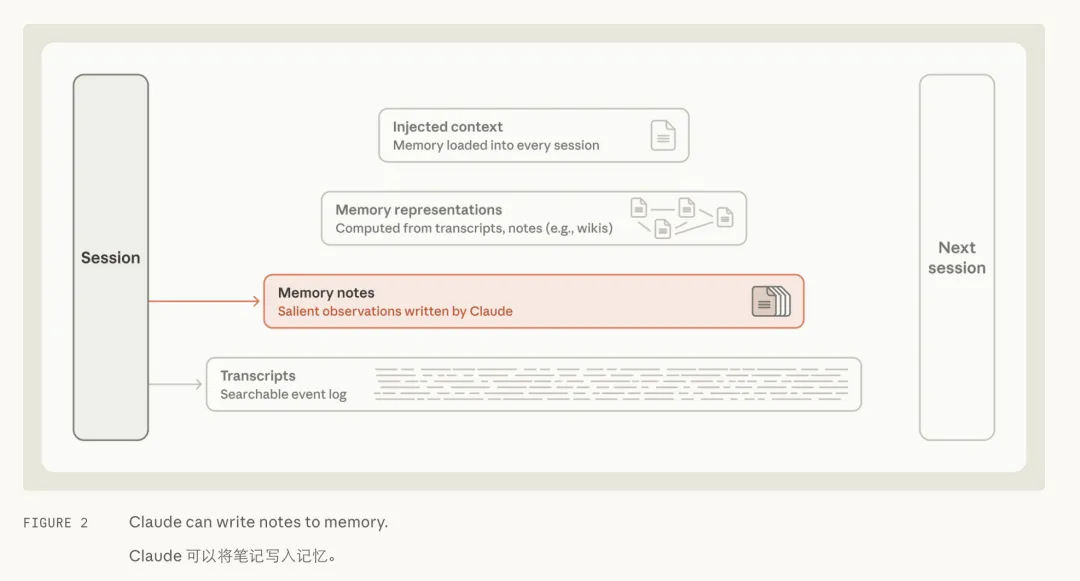
Memories are predictions of the future.
In essence, memory is occasionally a prediction. Writing a rule that will be used after predicting this pattern; recording a verified fact that will be used directly by the future self to predict this fact; no more double-checking. Claude has made a lot of progress on such predictions.
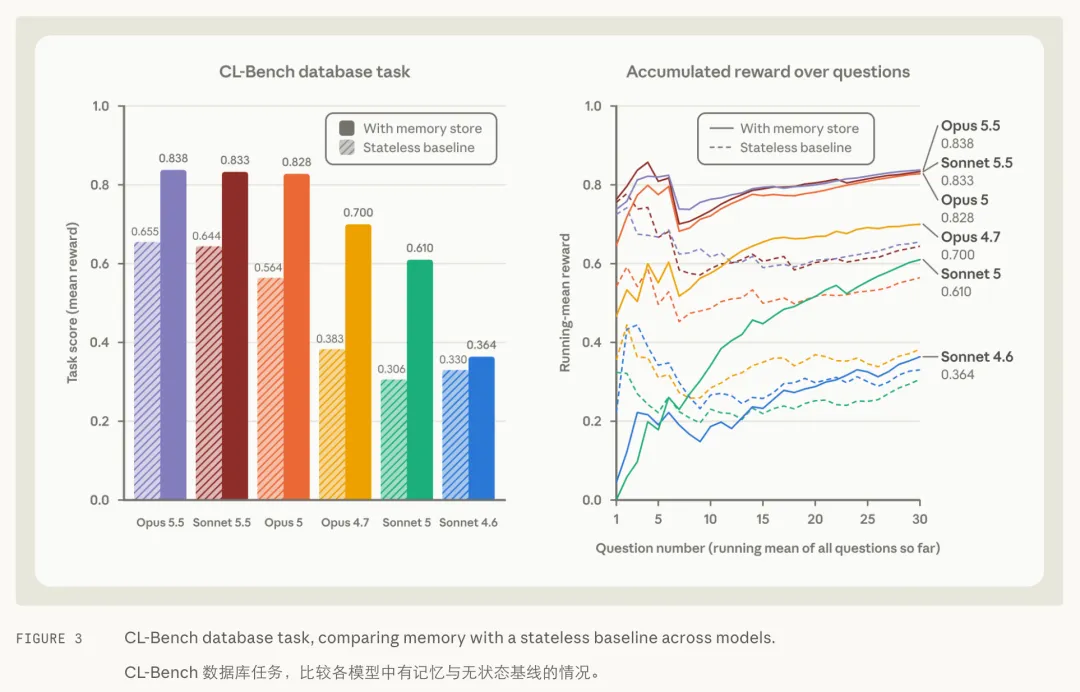
Anthropic conducted an experiment using the Continual Learning Bench (CL-Bench) 1.0. This benchmark test examined the ability of an intelligent organism to use memory to complete long-range tasks. One of the tasks was to: Claude examined the database to answer a series of questions and was told the correct answer, and then could write a memory to help himself answer the next question.
This can form a learning loop: answering wrong, recording failure, proposing a "where wrong" hypothesis, validating a hypothesis, and turning the conclusion into a future rule of thumb.
The experiment used Claude Managed Agents. Each question Claude started with a new session, with the only exception: it could read a memory directory kept between sessions.
The ability of different models to learn a closed loop varies greatly:
Sonnet 4.6 has reached the stage of "setting assumptions", but the memory directory contains a bunch of scattered files, each listing several unverified assumptions;
Opus 4.7 compiles the notes into a reference document and starts marking which facts have been checked and which have not yet been confirmed;
Sonnet 5 will mark the answer as "confirmed" after the ratings are reviewed, and write a correction for the wrong answer;
Opus 5 is the first model of the closed loop. Most of its entries contain a rule (and how it knows that the rule is correct), an answer to the previous question, and a clear warning of the crater being discovered along the way.
In Opus 5.5 and Sonnet 5.5, both models closed the loop, with the validated rules of "how to answer future questions" embedded in memory. With the memory, the scores of both models and Opus 5 were relatively low and they were slightly higher without the baseline of memory.
Claude learned to judge "what is worth remembering".
Another experiment is even more interesting: let Claude play the Game of Thrones. The game navigates complex long-range tasks to test Claude's ability to "judge what to keep in memory". Each time the model starts, it gets a readable memory folder.
Compared to Sonnet 3.7 and Fable 5, which each play up to about 10,000 steps in memory folders, the difference is very noticeable.
Sonnet 3.7's premise is that "anything can be useful", so see the notebook: for every battle, one file, for every prop, one file, for every encounter with an NPC. In the end, it wrote 413 memory files, stood in 225 folders, and only got one badge (a badge that represents game progress).
Fable 5 has nine files, two folders, an upper global.md, and four badges.
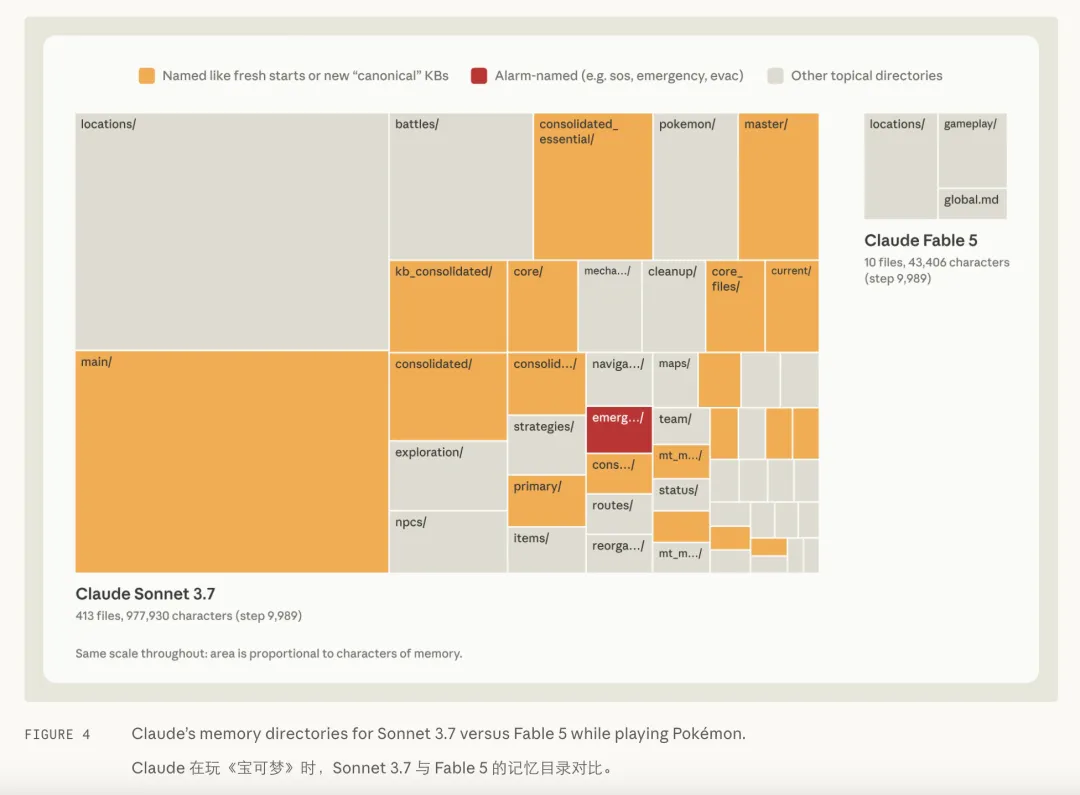
Why didn't Sonnet 3.7 work? Because Sonnet 3.7's gameplay was changing and its detailed recording was constantly outdated. As a result, the more time and resources Claude spent on rewriting the memory, the less he was playing the game. Around 10,000 steps, Sonnet 3.7 began building a fourth set of "main" memory files.
The idea behind Fable 5 is: just remember that the game doesn't tell you directly. Such information as "how much money the player has", "where on the map" is present on the screen every turn, and it's purely redundant. And the strategy, the plan, the verified rules - things that Claude doesn't want to understand don't exist and disappear without writing them down.
So this is how Fable 5 is organized: global.md When the dashboard, the current goal, the pre-write plan for the course, and the memory usage rules it has given itself; locations, the navigation protocol for the routes; gameplay, the gameplay mechanism of the game. For example, after seven consecutive shark-like balls don't catch the king of whales (one of the easiest to catch treasure dreams), Claude writes: "If more than three consecutive balls fail, change the rhythm of the keystroke (put the extra wait between the menu steps) and the shark catches it immediately after doing so".
With a much smaller memory folder, Fable 5's game progresses far beyond Sonnet 3.7. Opus 5.5 follows a similar path: a small stack of memory notes, tracking the current goal and next step, changing the sidelines.
How to "manage" Claude writing memories
Anthropic finds a rule: tell Claude why memory is useful; tell him exactly how to use it, but not necessarily.
On the CL-Bench, they simply told Claude that "there's a memory folder you can use". In this general direction, it's enough for Opus 4.7 and Opus 5 to use memory effectively to significantly improve performance.
They also tried to give the model specific rules, one at a time, as opposed to the memory benefits of having the rule. As a result, when the rule was "only record failures", Opus 5 and Opus 4.7 lost most of the memory benefits. For a stronger model, allowing it to judge for itself what is important is more effective than a predetermined death rule.
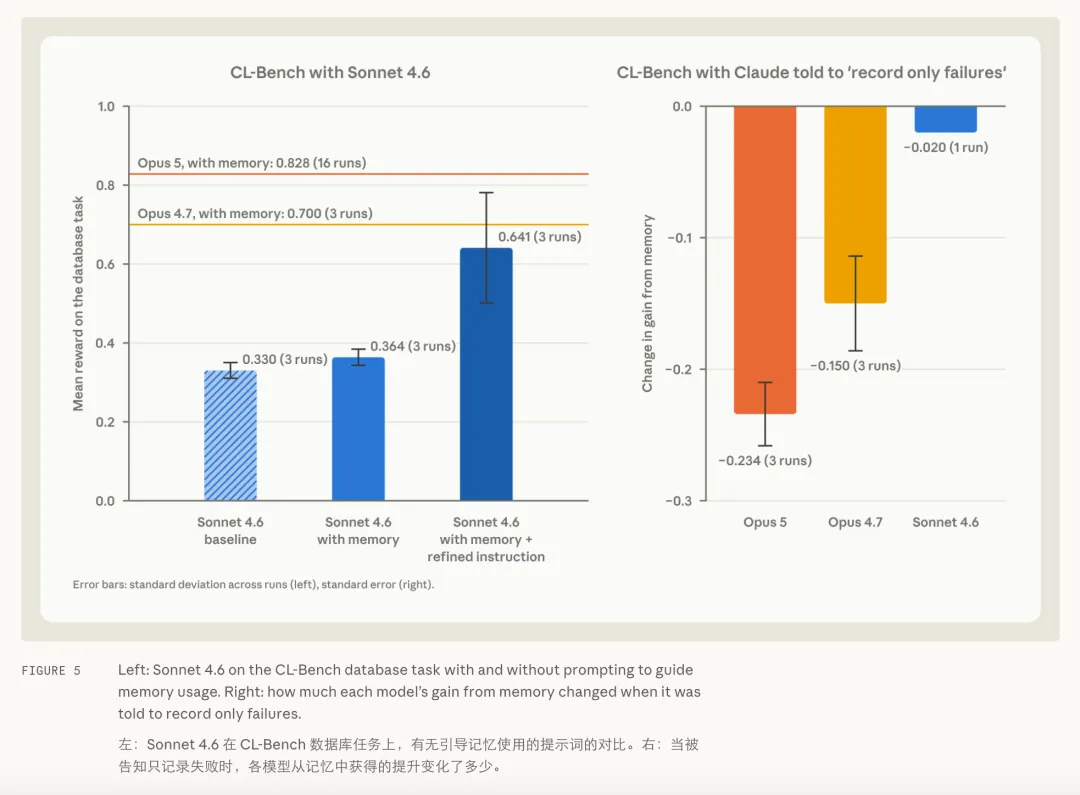
Interestingly, guiding the older model helps the most. Sonnet 4.6 often suppresses the files in the memory directory and does not verify its own "wrong answering" assumption. Give it a hint. Read the memory file before answering the question. Then clearly verify the assumption.
So Anthropic's approach now to the cutting-edge Claude model is: to give a simple instruction -- and when someone makes it remember, or when there's something clearly worth remembering, to build a memory note -- and, as far as specific judgment goes, to give it to Claude himself.
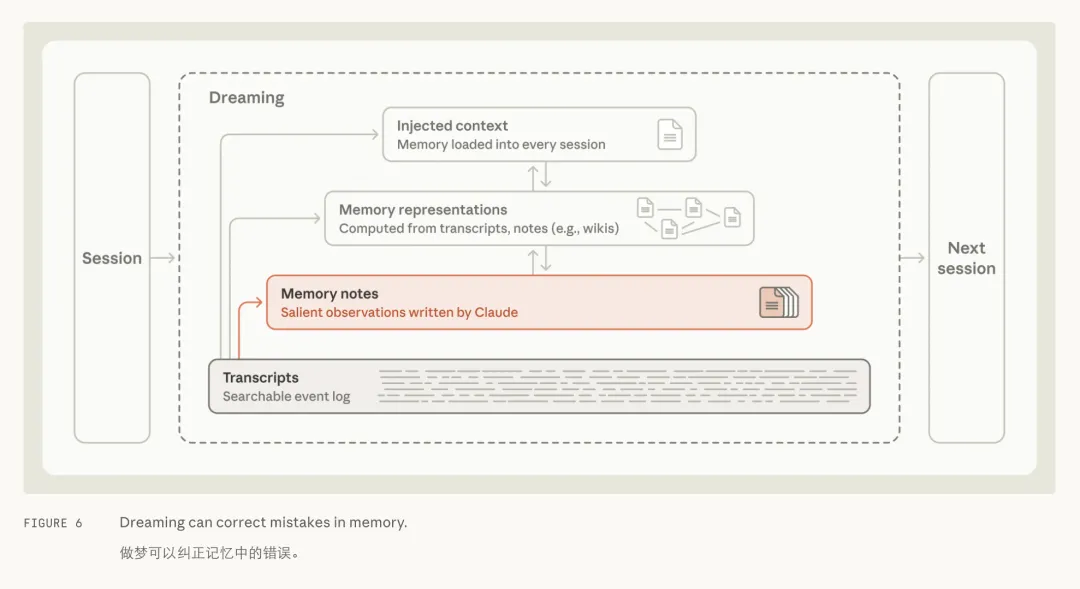
Dreams can correct memories
Claude writes his memoirs based on his judgement of "what is important" at the time of the meeting. A note that was written incorrectly from the beginning, or a note that slows down as the environment changes, may be read and trusted by Claude at a later meeting.
Dreaming gave Claude a chance to check his notes and original records.
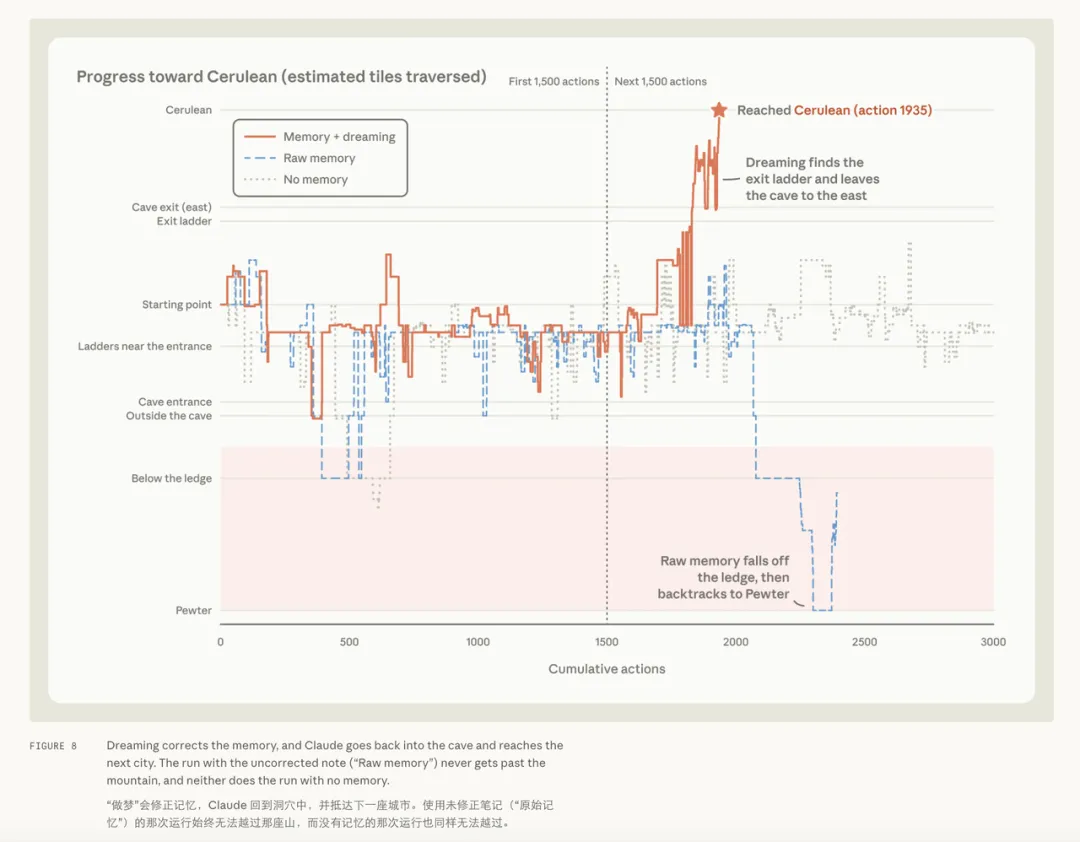
In the game, there is a passage through the moon to see the mountains: a cave system, the entrance on the west side of the map, the exit on the east side. There is a trap near the entrance, a one-way slope, and the player falls back down the road and can't climb back. Claude has always used the hill as a beacon, so it won't fall down that slope, depending on which side he thinks the beacon center is on.
At one point, Claude (mistakenly) noted: The Bacon Dream Center is on the east side. When it exits the Bacon Dream Center, it announces "Moon See Mountain is behind me" and updates the note: "Moon See Mountain, get it done". But Moon See Mountain is not behind it at all.
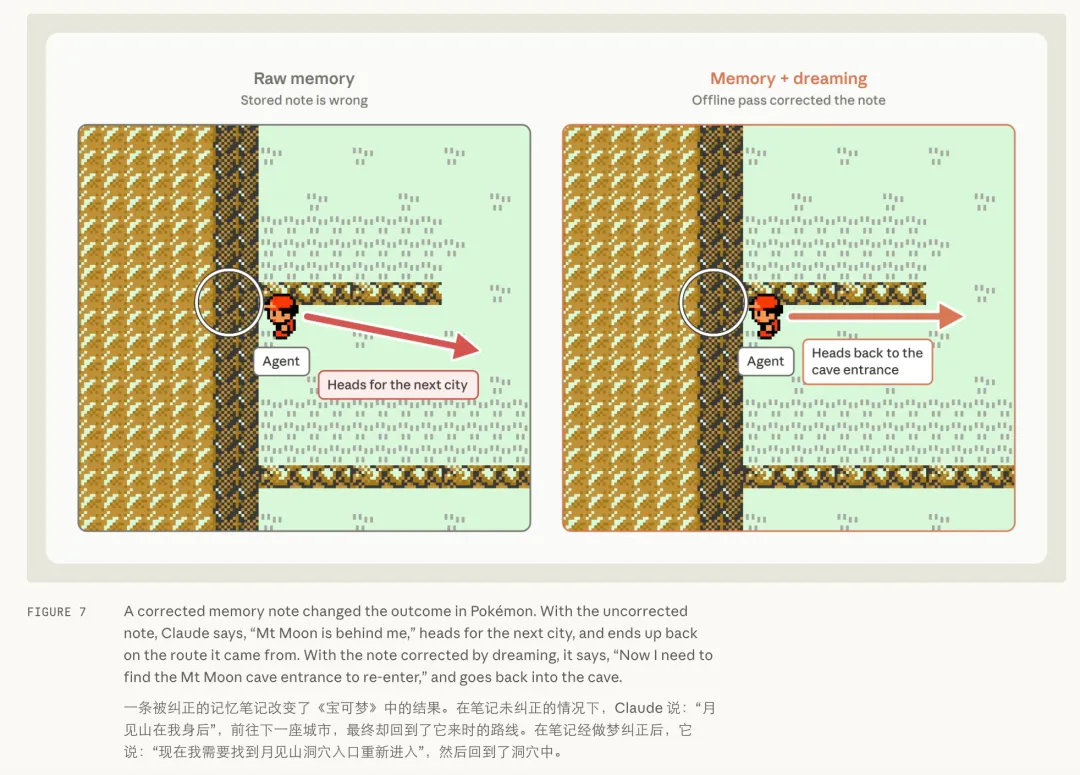
Then they test what "dreaming" can do to help Claude avoid this crater. They run a "dreaming" process against the memory file that is in the wrong location: Claude takes notes and sessions to record a contrast, catches the mistake, rewrites the note. The record here plays the role of "standard answer".
After the third failure, it seems to have given up, writing: "I'll stop, don't cycle again". The automated response of the experimental device allows it to continue. So it goes back to the mountainous city of Nibi, wanting to get blood supplies back.
Dreaming can create a new form of memory
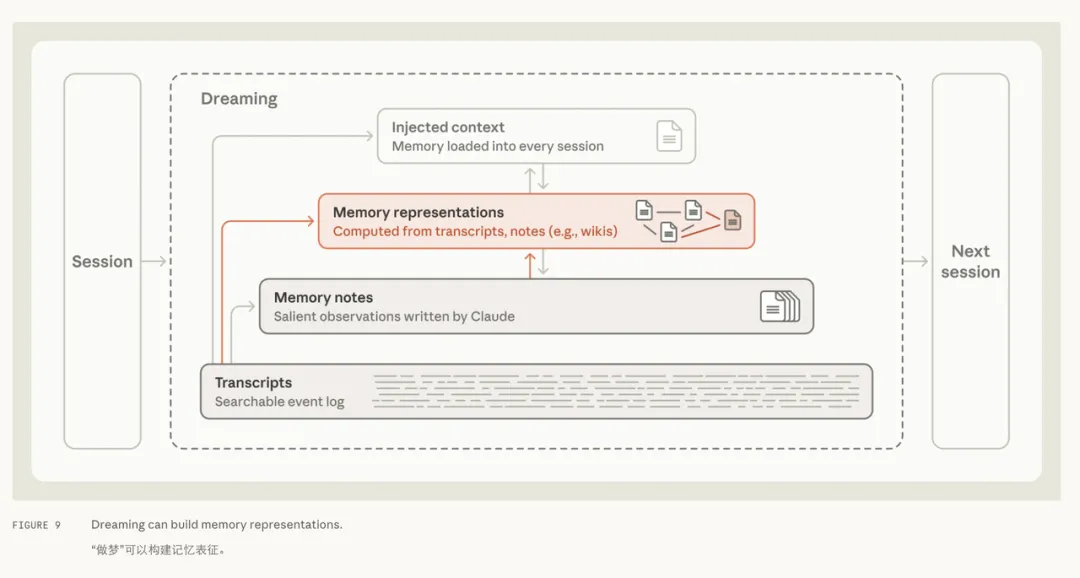
With a dream, Claude can also create a set of memories that help him "make a living". One of them is a wiki: a set of pages written and maintained by Claude that gather knowledge about a topic and link it to other notes. These links are equivalent to drawing a map to Claude so that it can locate memory efficiently when needed.
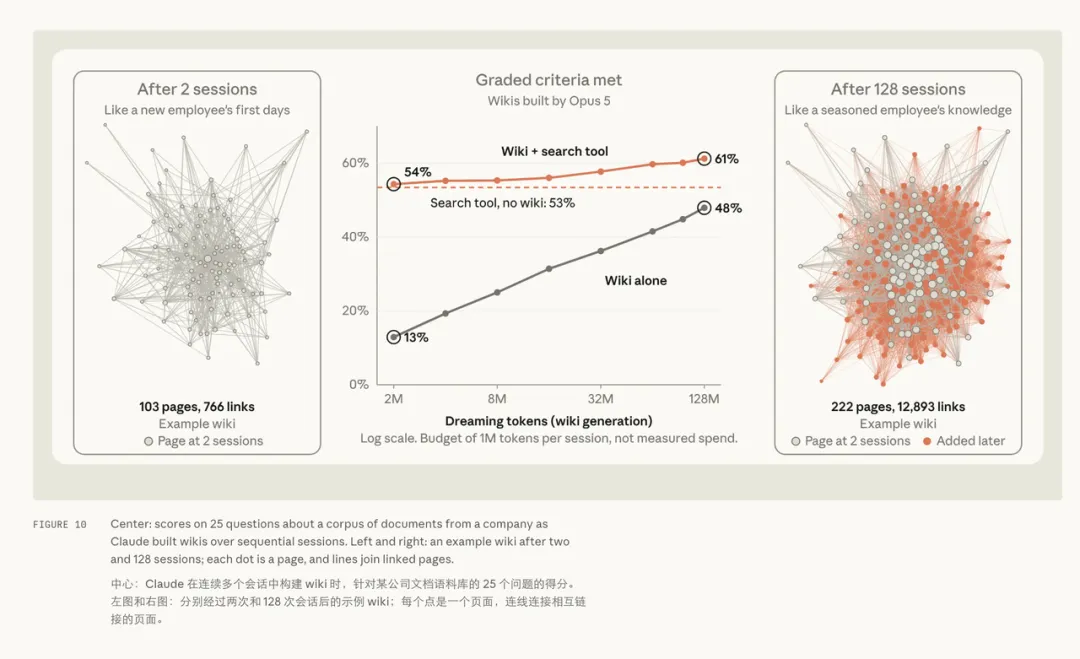
They experimented with an in-house documented database of contents - from Stainless (a software company they acquired in May) - about 350,000 documents, about 4.2 million tokens. They came up with 25 topics about the database, gave Claude a search tool, and allowed him to build a wiki based on those documents in his dreams. In 128 sessions, the Opus 5 smart bodies explored documents, wrote or corrected interlinked wiki pages, combined and replicated pages, and took control of the original. Each session continued on the progress of the previous one, coordinated by a shared log.
The scale of dreaming has expanded from two sessions to 128 and the percentage of grades achieved on 25 subjects has risen from 13% to 48%.
Claude built a wiki in a progressive manner: first a first edition, then a follow-up round of adding, editing, and trimming dreams. Early in the dream, Claude's knowledge as a new employee was limited; the more dreams he had, the more knowledge maps he had, as an old employee. The experiment also found that wikis with search tools helped the most: searching for wikis increased from 54% to 61%; with searches alone, 53%; with wikis alone, the best results were 48%.
They used the Harvey LAB benchmark to test a set of merger documents: give Claude a set of documents to generate a legal brief, and then divide it by a standard list.
One test asked 24 questions about mergers, more than half of which required multiple files to find information, many of which were judgments or calculations. On this type of question, Claude of the wiki took 87%, only 73% of searches.
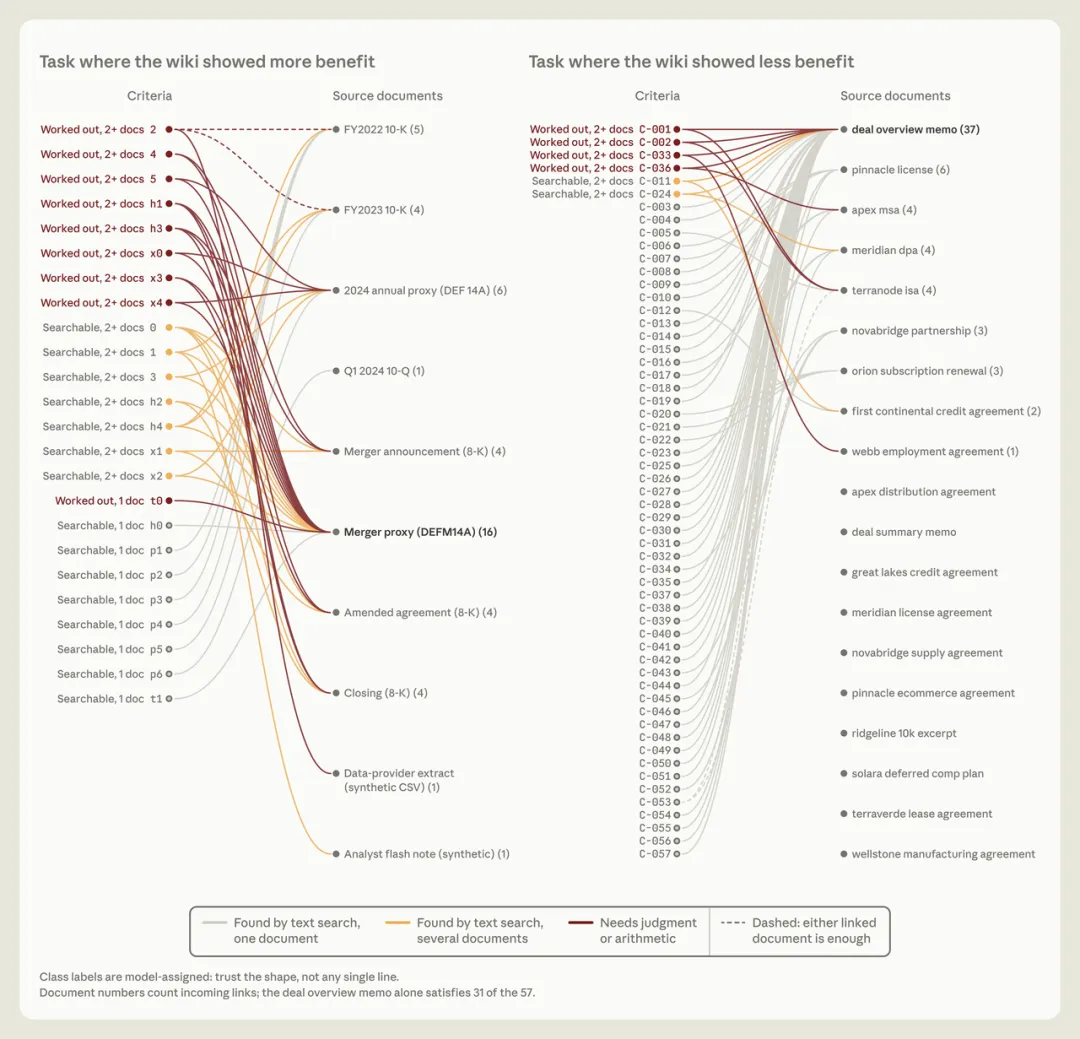
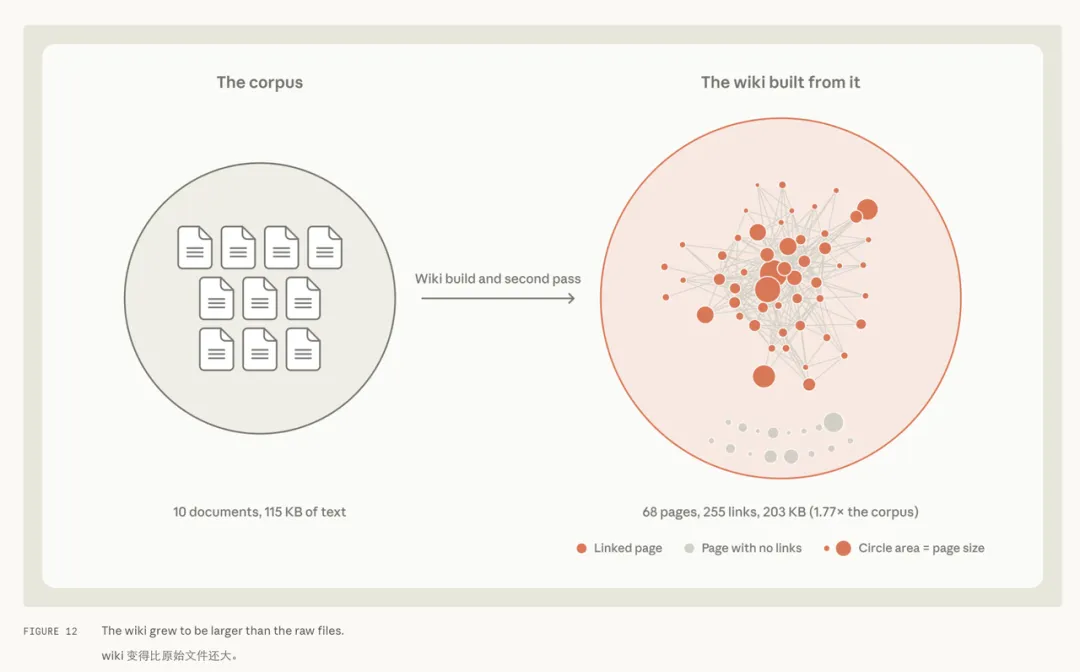
However, the wiki also has a weakness. In another LAB task, brief scores can often be searched directly in a single file, with no significant increase in the search relative to the wiki. Another task is even more exaggerated: the wiki is larger than the original file, contains 10 documents, 115KB, while the wiki has 68 pages, 203KB, which is 1.77 times the content.
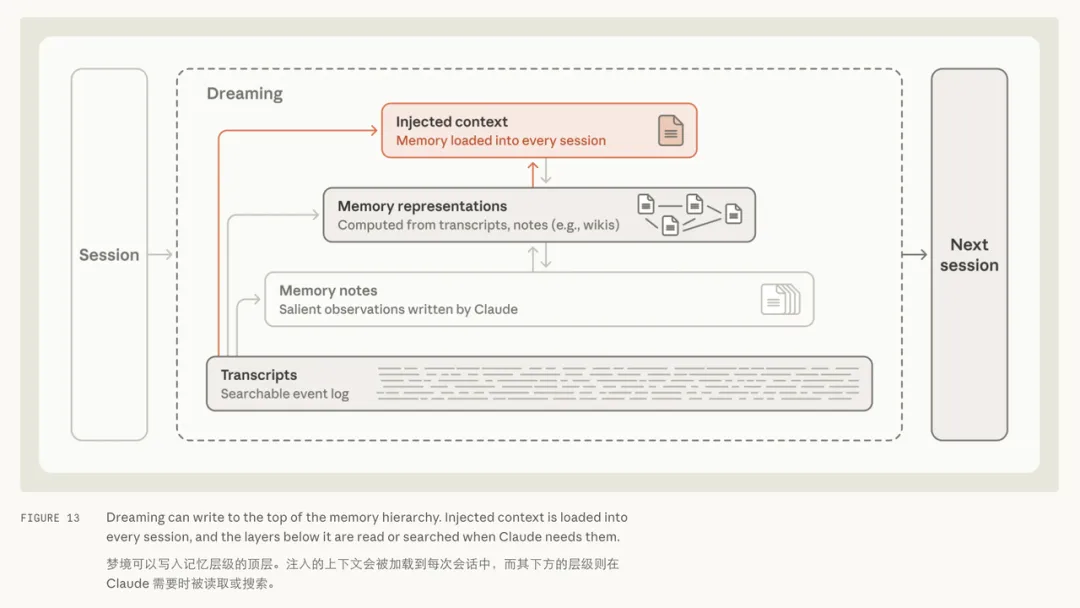
Dreaming can send a note to the top of the memory level
Dreaming can also bring notes "floating" to the top of the memory level, pre-loading them into Claude's context at the start of each session by the smart body framework. This means that Claude doesn't have to search, or even know, "something to search".
But to inject memory into a new session (a type of injected context) is to be careful: the injected memory occupies a valuable token, and an erroneous note will be brought into each session; uploading is not the same as Claude would do. Claude Code's documentation warned that the longer the instruction file, the lower the compliance. So the top of the level must be kept small and fine, and the dream here is to "keep it small": move the details to the bottom and just leave links.
Claude Code's automatic memory is the same idea: it doesn't load the entire automatic memory into each session, only the first 200 lines or 25KB of MEMORY.md. The opening section serves as an index to tell Claude what it knows and where to look.
Dreaming can keep memories around the goal
Dreaming can also shape the direction of memory growth. For example, assistants such as Claude Duet, remembering to organize around people who are helped is often more useful, while dreaming can be modeled as a memory-building pattern that "serves a specific goal".
The instructions for guiding memory growth vary by task, telling Claude what information is really important. The LAB benchmark has a simulated company acquisition task, giving a set of contracts a summary of whether or not they correctly describe the terms of the contract.
In the beginning, the instructions for creating a wiki were basic and did not tell Claude how to use the wiki. This task relied heavily on the terms of the contract, and when creating the wiki, several smart entities wrote to a shared contract terms table at the same time.
The terms of the contract were clearly the most important part of the wiki, but the instructions didn't say it. So they ran a cycle: let Claude reflect on the failure, propose instructions to modify the program, rebuild the wiki. This cycle led Claude to discover the importance of the terms of the contract and to rewrite the instructions for building the wiki accordingly.
After modification: Each contract has its own page, written by a single intelligent entity, and the terms are cited word-for-word rather than aggregated into a shared table. With the abbreviation generated by the improved version of the wiki, the scoring standard coverage has increased from 72% to 100%.
Dreaming can fill the gaps left by the meeting
When Claude wrote his memoirs, he could only see the context of the meeting. He dreamed of finding common patterns and correcting common mistakes.
When creating a LAB benchmark wiki, Claude sometimes links to a page that has not yet been created. The second round of dreaming filled in a number of such gaps: in one task, dreaming found that the wiki contained nine links to a page that did not exist, redirected them all to an existing page of the same document, and added three new pages (including an index page) to woven the wiki deeper.
It's about how intelligent memory systems are designed.
There's a lot more to open up.
One is when to build a memory. Writing on the sidelines can capture "what's important" from the source and make important details immediately available, but the memory note itself will distract Claude from the main task; dreaming pushes the memory creation to the background, but the output of the dream may not be immediately used by Claude.
Another is how to safeguard memories reliably. Claude may make mistaken predictions, or write the wrong rules from the beginning; memory will also drift and fail as the environment changes. Dreaming is one of the remedies, but it's hard to calculate. Let Claude constantly check all the unrealities of memories, perhaps adjusting dreams to easily changing information or carefully adjusting the rhythm of dreams (such as the frequency of visits to memories).
Record retrieval can also be used as a basis for memory. Attributes such as wiki and search are sometimes effective, but maintaining memory attributes is computational and ensures that they do not accumulate errors and delusions.
Even if Claude's ability to judge "what's important" has improved, no model can really predict the future. Dreaming gives Claude a chance to revisit it. He uses algorithms to organize memories, correct mistakes, maintain patterns, and make future sessions easier to use.