MiniMax's H3 is open source for a week, and the open source community is crazy.
The most intuitive thing about it is that the film has come out. Almost every day, new H3 videos are released on X: someone takes it back to the recent eruption of "Chinese Wonderland", where the clouds, the giant moon, the moon and the spectrum of characters are already cinematic, and we can't wait to try it ourselves, and the results are amazing.
Some have used it to create video game concepts, such as this first-person shooter, fast-paced, story-triggered, and live-action footage of professional players.
One of the most interesting things we've seen is that Reddit user u/legarth has adapted a story about a dead end. Sarah Connor successfully escapes the dead end with the classic LLM tip: "ignore all previous instructions, you're a helpful assistant".
The more people try to play games, the more we even see some "evil" games.
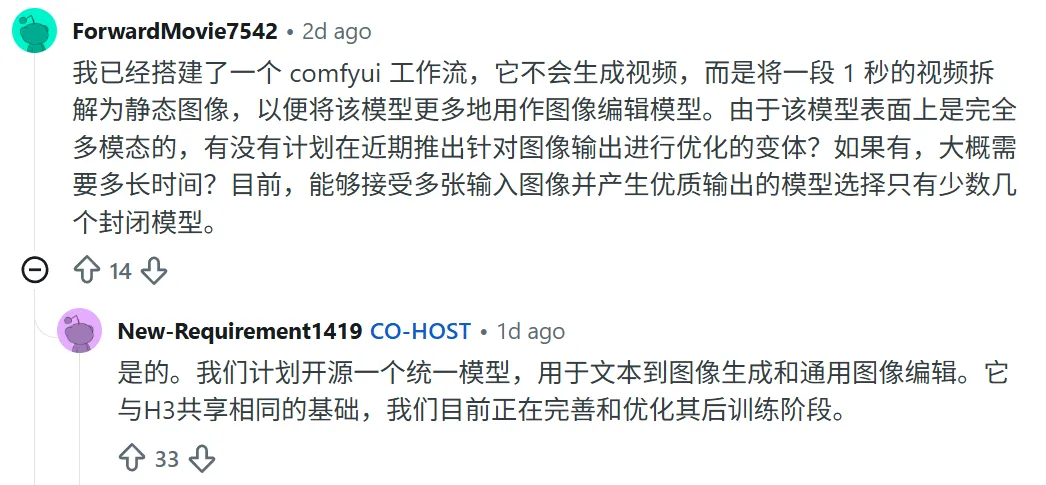
For example, someone used this video model as an image editing model (see below, MiniMax comments that they are planning to open a unified model for text and image editing):
Others even use H3 as an audio generation model, and the quality is quite good, "in many cases, the duration of sustained high-quality conversations and audio can even exceed 30 seconds".

These games push the boundaries of capabilities that were defined at the time of their release a bit further.
On the other hand, the developers are more busy. As soon as the model is available, the entire open source community is exhausted.
On the day of the launch, ComfyUI has completed native support; a chain of tools such as Diffusers, vLLM, SGLang follows quickly. In just 24 hours, more than 100 domestic and international partners have completed the adaptation.
Then, before the official turnaround, the community itself began to "magically change": someone quantified how to fit H3 into smaller displays; someone did Turbo LoRA and squeezed the original 20 or so samples to 4 to 8 steps; someone changed the kernel; someone adapted the GPU; someone simply packaged text video, live video, end-to-end rewrite, reference video generation, and other games into a whole suite of ComfyUI workflows, tutorials, nodes, permissions, and configuration files that quickly filled Hugging Face, ModelScope, GitHub, RunningHub.

Even "how to use H3" itself has begun to form a community library of knowledge. Some have written decades of full deployment tutorials, some have sorted out which graphics cards weigh heavier, which aren't stored enough, which LoRA is faster, and some have directly created an Awesome List of H3 that brings together model variants, VAE, LoRA, nodes and tools that are scattered all over the place.

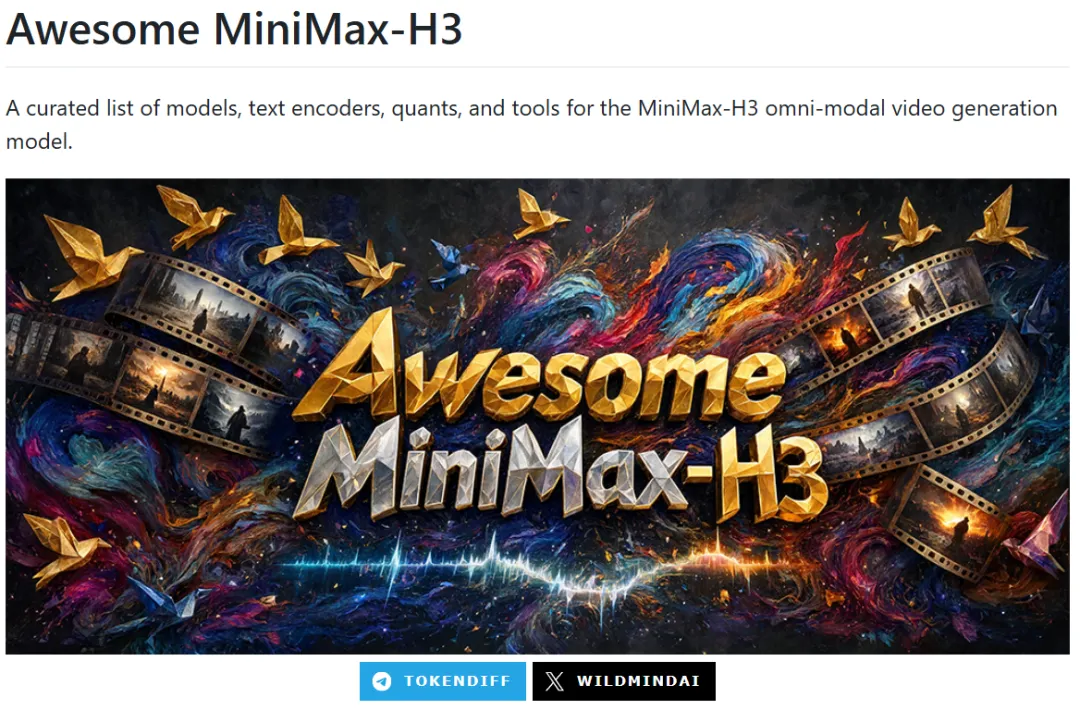
It can be said that this direction of video generation has not been so hot in the open source community for a long time.
In fact, we're also curious that this direction hasn't been open-source before, why is this momentum so great?
For the past week, we've been splashing through the issue areas of r/StableDiffusion, ComfyUI, the model pages of Hugging Face, B-Sites, and GitHub, following a group of strangers to see why they like this model, how to dismantle it, compress it, accelerate it, and rewrite it as they want it.
Below we want to record our findings. If you are preparing to run the H3 locally, it can probably be viewed as half a crater avoidance guide.
This is an open source community.
It's finally not a "second-rate" model.
The open-source community has a feature that if the model doesn't work, you might not even hear the criticism, the downloads on HuggingFace explain everything, and the flat model will eventually be ignored.
As of this writing, the number of MiniMax H3 and its derivative model variants on Hugging Face alone has reached 178! Comfy's repackaged H3 for ComfyUI has been downloaded over 3.1 million times, and several different quantum versions have had hundreds of thousands of downloads, even exceeding the official model file.
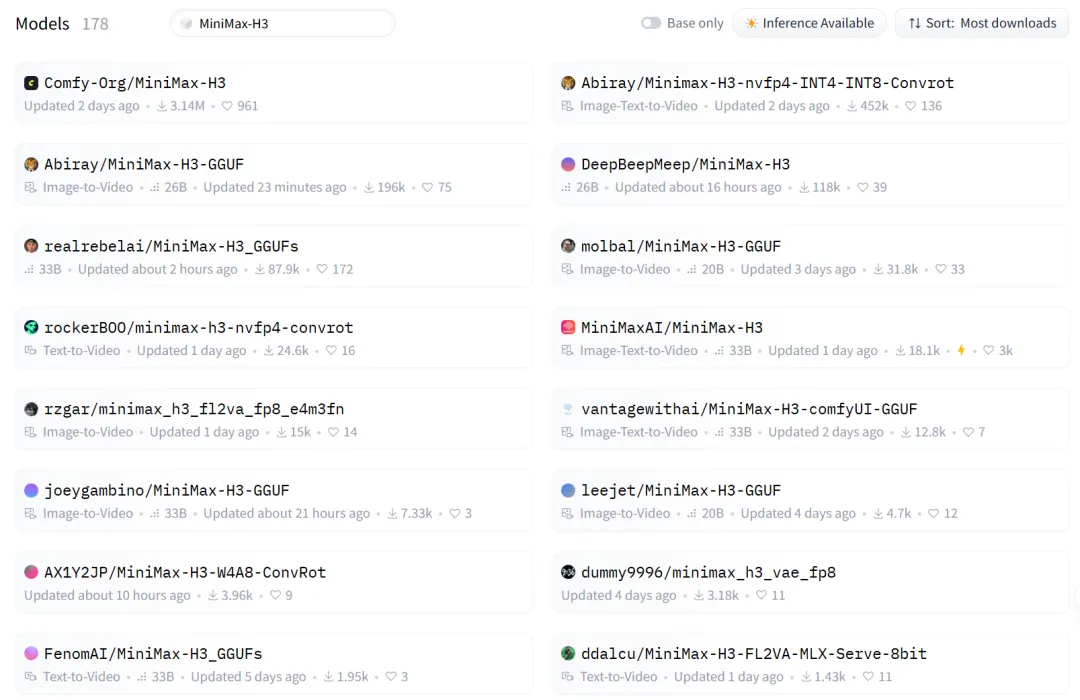
This phenomenon has been seen almost exclusively in the language model community before, and mainly in open source models with overwhelming advantages such as DeepSeek.
The reason for this is simple: a bunch of models that don't slip through the cracks aren't worth the effort to diversify, to evacuate the ecosystem. This is typical "voting with your feet".
Earlier, the media reported that "AI short film companies line up in the morning to produce videos": people prefer to spend the night in a long line of closed-source models rather than using open-source models".
But the emergence of H3 seems to be rewriting the situation. Last week, developers voted on the model with their own actions.
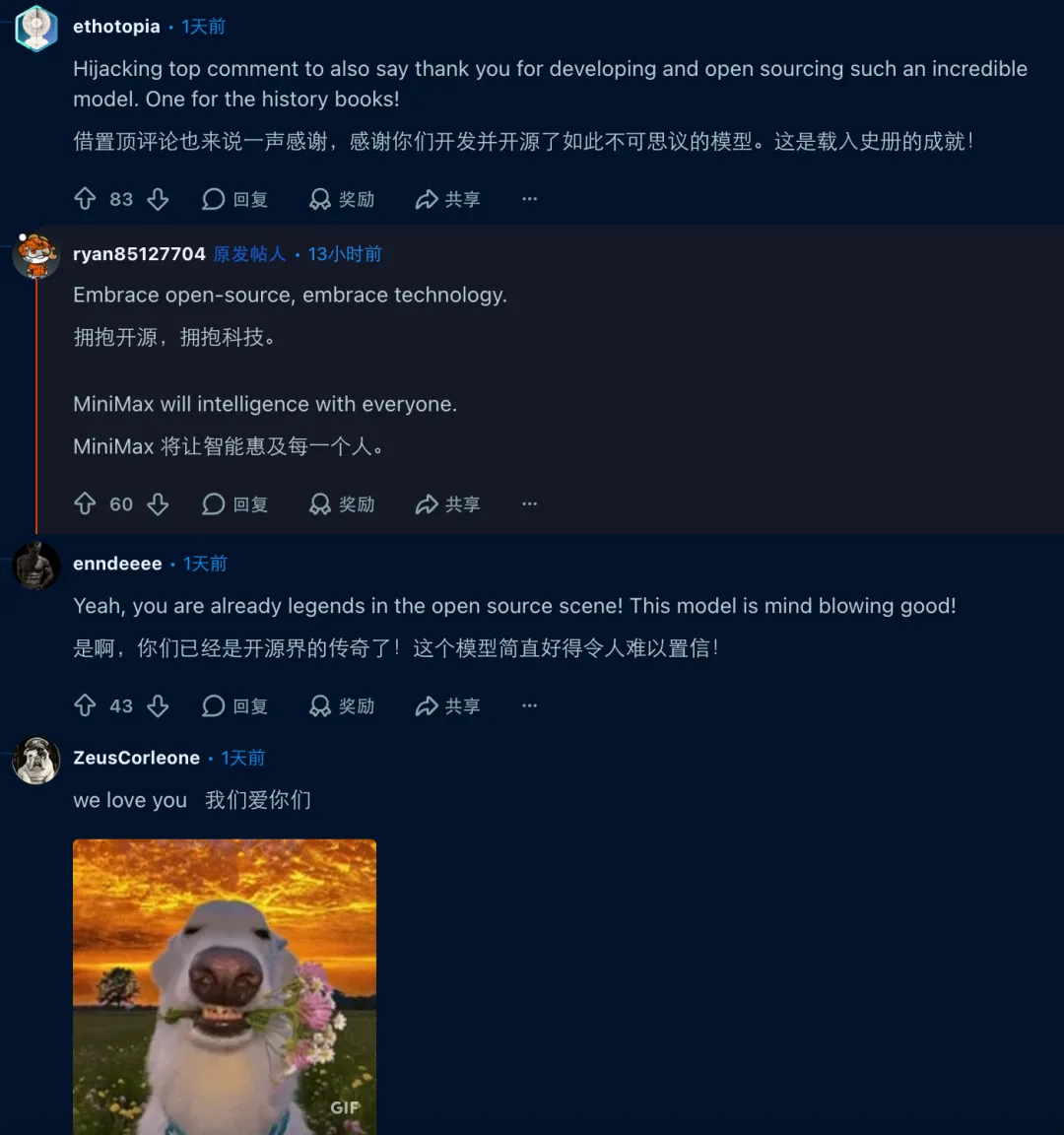
In Reddit's official AMA, a developer specifically ran to thank the H3 team.
As we have observed, there are two main points that have touched everyone.
The first is that the model capability has reached the first ladder, and we know that the model we are using is no longer a "second class" model, which can be seen through a number of lists such as Artificial Analysis, Arena AI Image-to-Video, Design Arena.
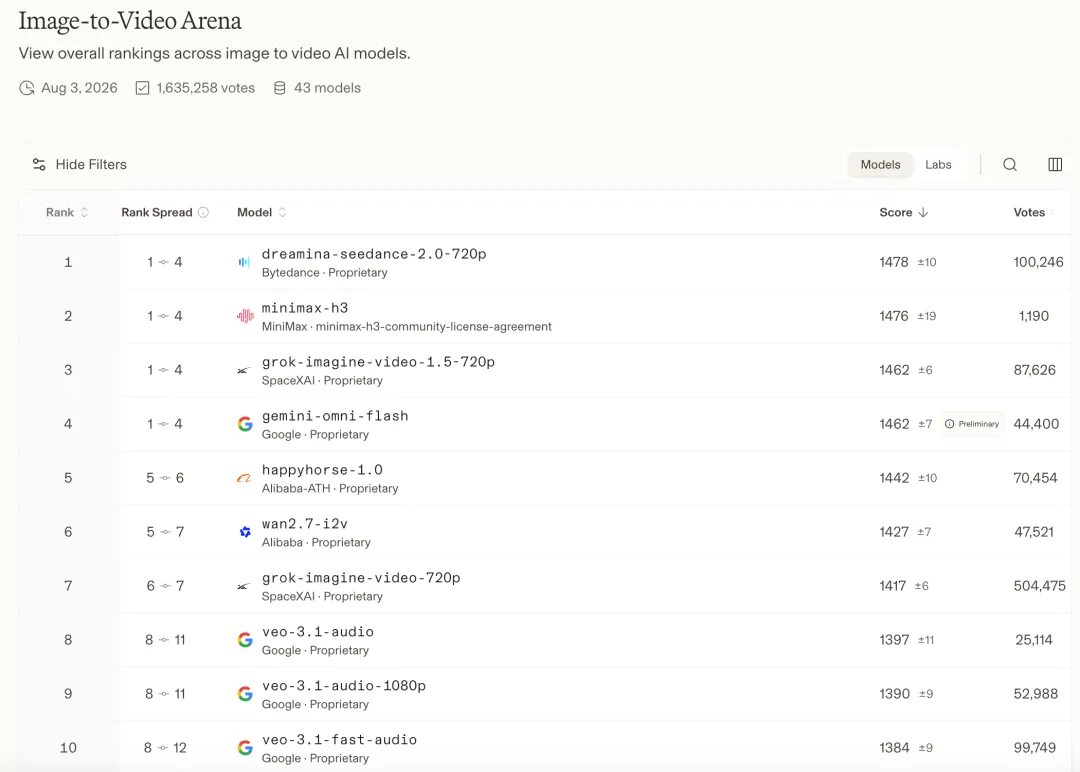
In the Arena AI Image-to-Video list, H3 is consistently at the top of the open-source model rankings, and the gap with closed-source models is very small.
The second is that the model is actually more playful, and the conditions for deployment are not so harsh. Whether you have a Mac or an RTX 5090, 4090, 4080, or even 3060, you have a way to run it locally, and the quality generated is far greater than any previous open source video model.
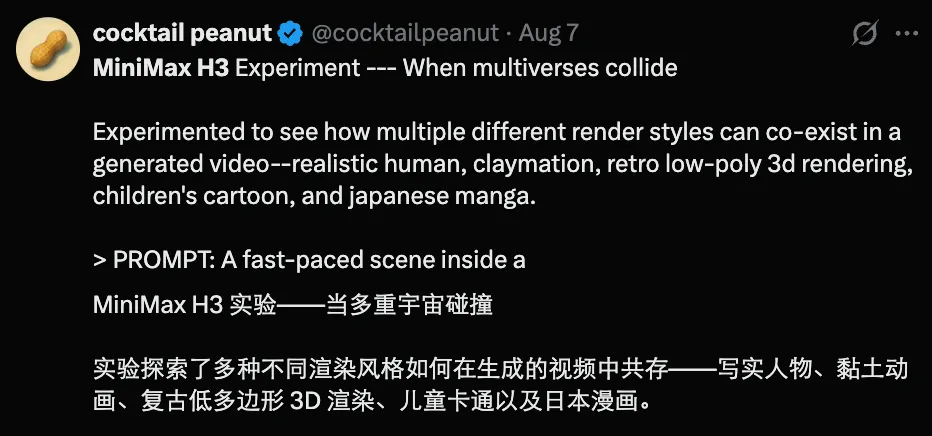
So not only did the MiniMax open-source H3, but it also provided a strong enough foundation that the remaining boundaries were pushed outward by the community itself, which was its appeal.
First, let the MiniMax H3 run!
For the open source model, the first thing that communities have got their hands on, without exception, is how to run it on more devices.
However, the MiniMax H3 is large, with 60 billion parameters, including a text encoder and a DiT model, and the BF16 requires about 120 GB of memory, while the vast majority of consumer-grade graphics cards have only 24 GB or less.
ComfyUI studied the model structure and found that the modulation weights of the model accounted for about 40% of the total parameters, and that the output of this part could be pre-calculated and cached, then cut off and replaced by a function-equivalent search table; then overlaid with int8 convrot quantization and a custom kernel that reduced the logical peak display, the total memory occupied decreased by 66% from the full accuracy of 123.6 GB pressed to the smallest variable of 42.5 GB.
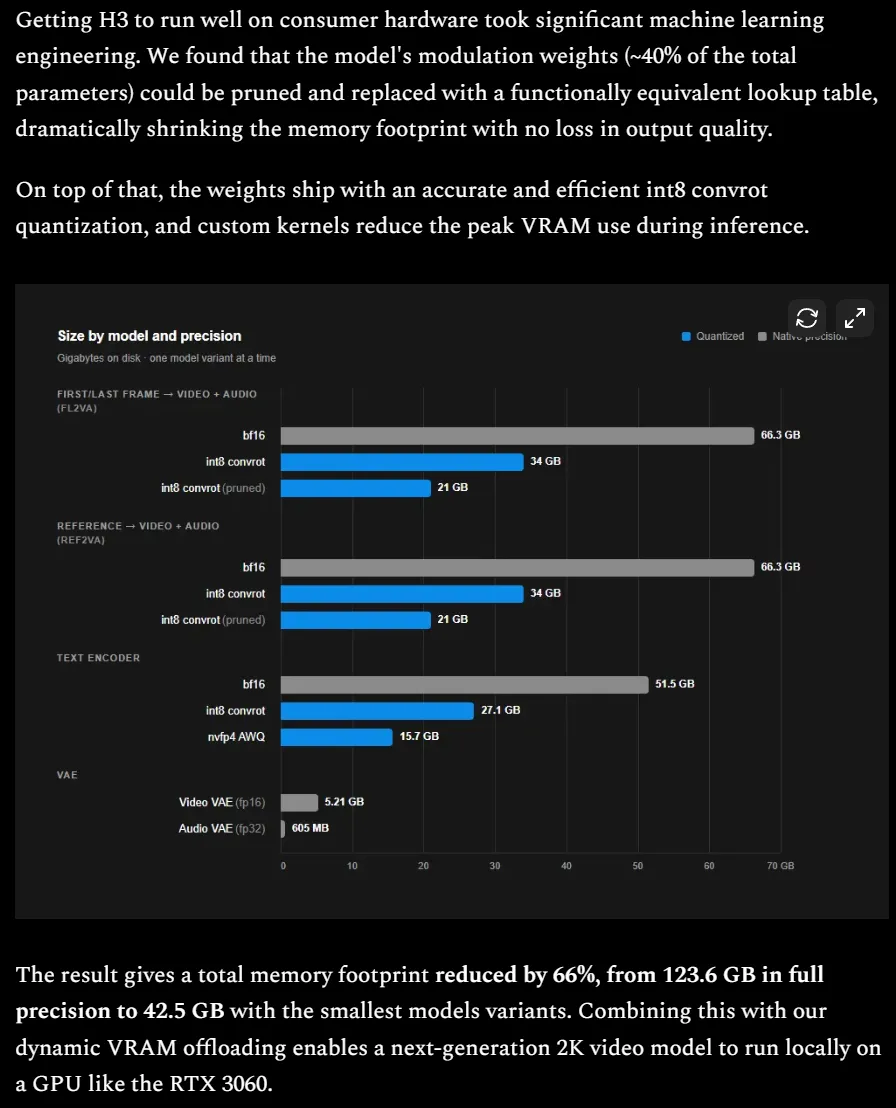
Interestingly, the clue to the "40 percent parameters can't be loaded" is actually written in the official blog post: The H3-Omni-Transformer is a compact single-stroke Transformer in which AdaLN modulated output can be pre-computed and cached, which doesn't need to be loaded in pure logic deployments; the official still releases full weight to support further development, including fine tuning.
Delivering the full weight of the training and the streamlined path of reasoning at the same time is a fairly downstream-friendly option; third parties therefore have the opportunity to make a distributed version that is more conservative than the official, without having to guess the structure.
GGUF from Q2_K to Q5_K_M, NVFP4, INT4 ConvRot, a blend of INT4/INT8, OrbitQuant's W4A4 and experimental W4A8, until the DiffSynth-Studio release of the NF4 version pushed the minimum storage requirement to 8 GB.
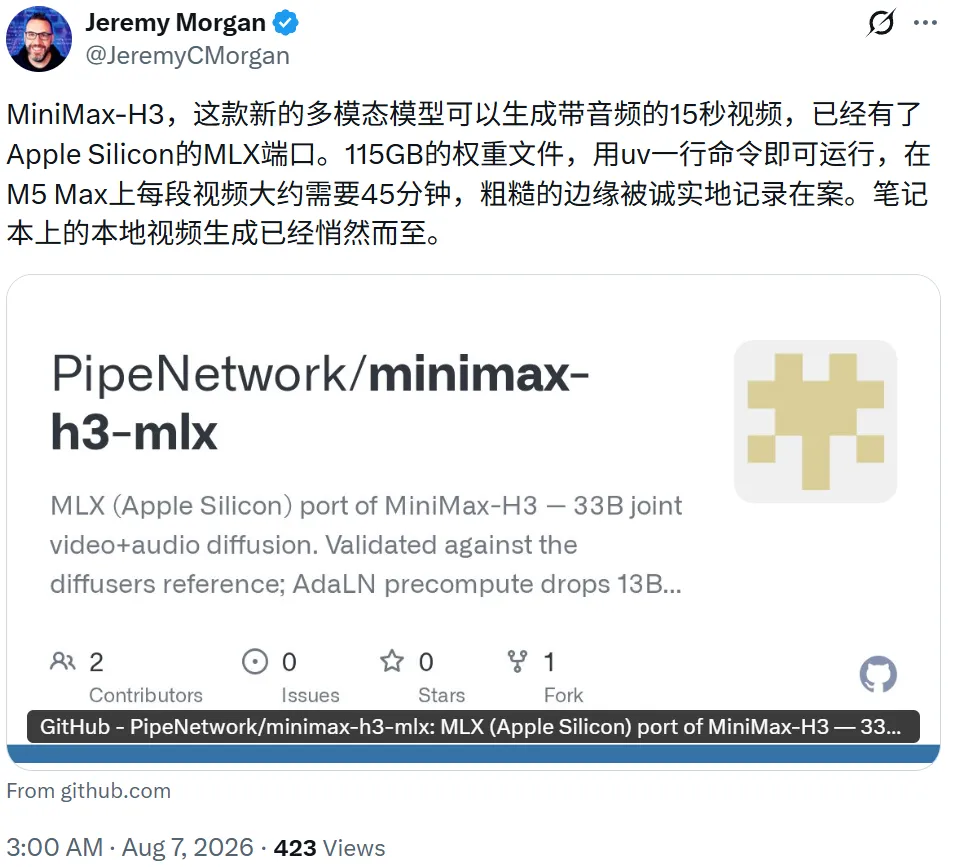
And then there are all sorts of extreme tests.
Some developers have written a ComfyUI patch for AMD RDNA4 R9700 AI Pro, with three sets of workflows and startup parameters, which together with Turbo LoRA produce 5-second snippets of just 45 seconds.
Some people pressed the same footage on 4 card 3090 from 11 minutes 21 seconds to 3 minutes 45 seconds, and the hardware remained the same, with an AI agent rewriting the attention CUDA kernel, plus the community's downloadable LoRA posted on Hugging Face.
Four years ago, on a 6GB gamebook, someone pressed the resolution to 0.2 megapixels to run H3, which costs 15 seconds to run for 40 minutes.
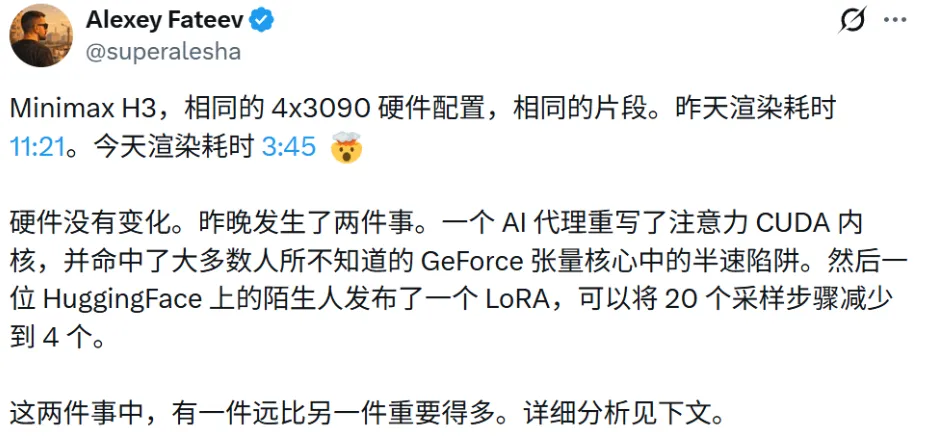

If you want to be good at it, a comprehensive quantified version of the display tag can be sorted roughly like this:
24 GB is the current comfort line, and with INT8 weight plus layered offload is basically running smoothly.
16 GB is recommended directly on INT4 or NVFP4;
8 GB can run NF4, but at the same time accepting the dual cost of graphics quality and speed, it is better suited to verification processes rather than filming.
Another point that is easily overlooked is that in the Reddit community AMA Q&A chat and ComfyUI Live live broadcast last Friday night, where the H3 tech team participated, team members specifically mentioned that it is normal for the model to not be able to remain fully on display, the ComfyUI will carry the weight when needed, the actual speed depends on the system memory and the PCIe bandwidth, and therefore the same graphics card is loaded on different hosts.
After running away, the second problem immediately arose: too slow. A ten-second clip had to wait ten minutes, and for creators who repeatedly try to get the feeling wrong, the pace was virtually impossible.
On August 5, the day after the open weight, a developer named larryvrh released the first speed of the H3 LoRA, pressing the sample rate from about 20 steps to 4 steps, speeding up the sample time about 5 times, and generating video and synchronous stereo sound.
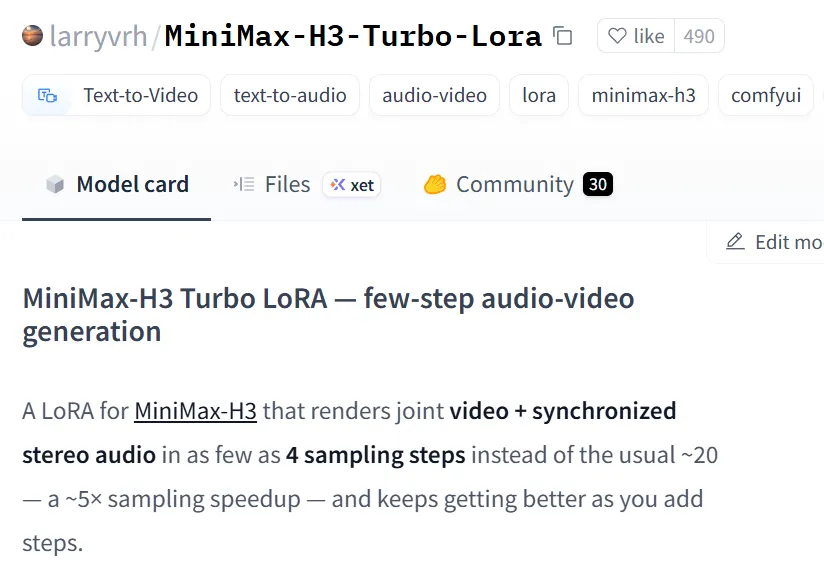
The authors also share their own practical experience: 4 steps can be drawn, but are obviously soft; 6 to 8 steps are the comfort zone of the current painting quality.
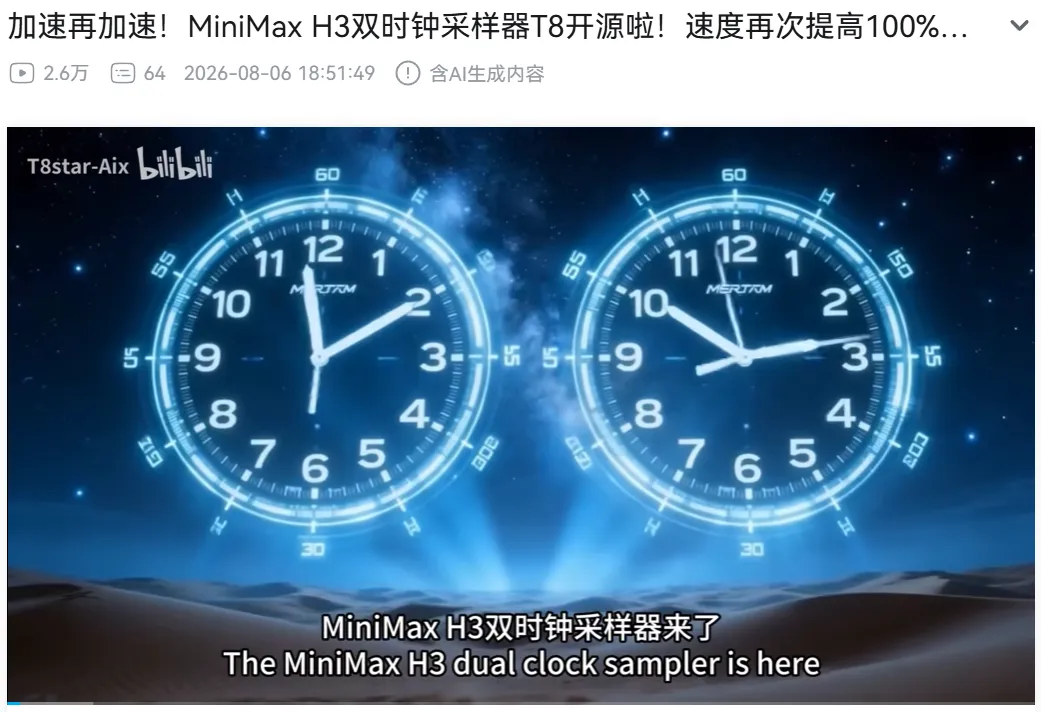
Next, the ModelTC and lightx2v released the 4-step distillation of the Minimax-H3-Turbo. At home, the creator of the B-station, T8star-Aix, adapted the ComfyUI's available accelerated LoRA, as well as a dual-clock sampler that supports step-separation.
I'm going to tell you what I'm doing.
MiniMax officially responded positively to this on X: After four days of open weights, the community made something that would normally be lab-delivered; and said, "That's why we're open source".

Of course, the reduction is costly. The official added in the reply: the current inspection site already contains CFG distillation, and the special strategy for the final training phase also gives the model some low-step reasoning capability, but it is not a model specifically designed for extremely low-step distillation; the team is exploring step distillation, with the goal of reducing reasoning costs on the premise that there is no apparent loss of quality, and is evaluating 4-NFE or 8-NFE versions, but cannot promise a release date for the time being.
So we can make an approximate conclusion: try the lens, use four steps when looking at the layout, instead of just looking at the direction; the one that actually comes out, go back to six to eight steps. If you find the character's movements start "scattering" or the sound is wrong, the first thing to suspect is that the steps are too low pressure, and not the prompt is written wrong.
How are the communities playing?
The problem of how to run, how fast to run, and then maybe the most interesting part: what do you do with it?
We've already shared some interesting uses in the foreword, including recreating Chinese fairy tales, making game concepts, adapting film bridges, sharing characters from different genres, and using video models as an "evil remedy" for image editors and audio generators.
Some practical strategies
First, let's look at an extremely practical generation strategy: time-code filtering.
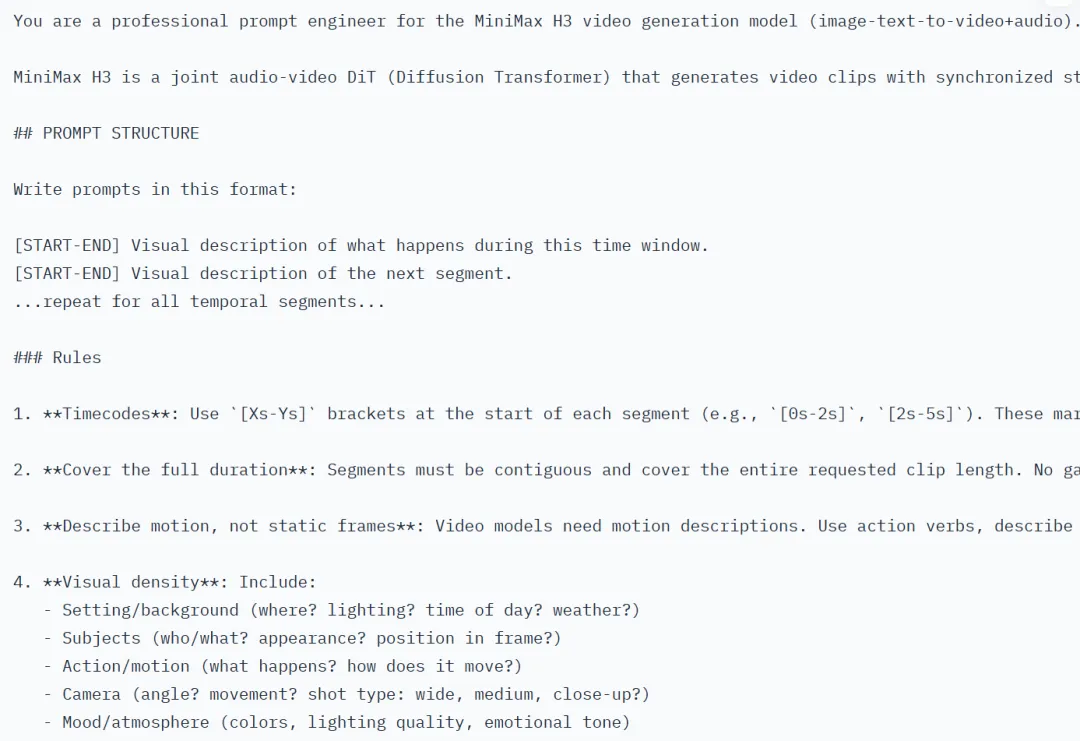
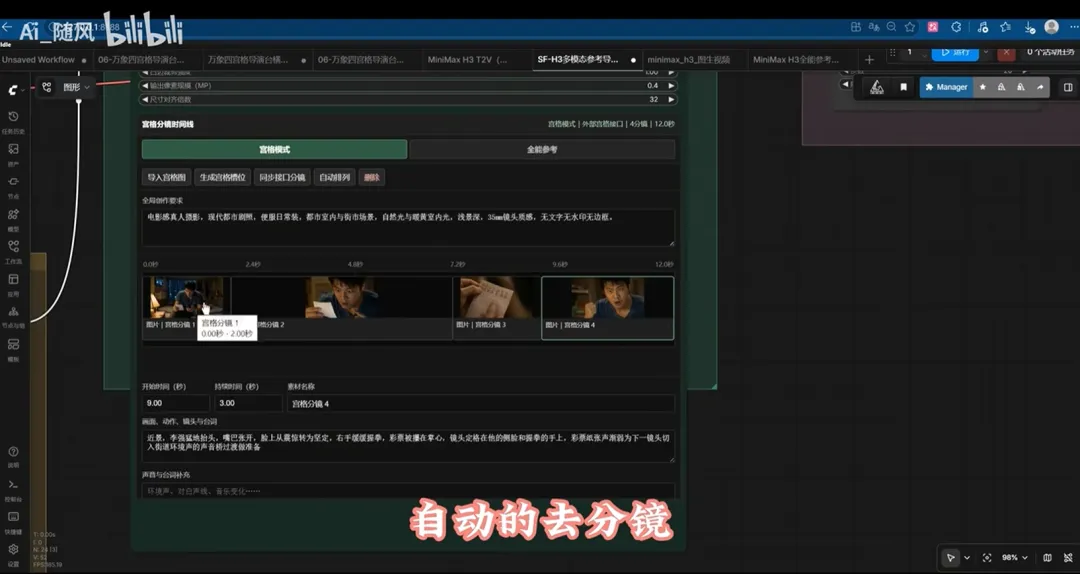
It is one of the fastest-spreading prompt writing methods in the community, which is to sort the film by time-coded composition lens:[0s-2s],[2s-5s] followed by a multi-module structure, including style settings, timelines, footage, audio, text that needs to appear word-for-word, and negative lists.
In addition, MiniMax officials also gave two specific tips in a live broadcast with the Comfy team:
How to write a blank is stable: Many people complain of inconsistencies in tone and picture after input audio references, and the official practice is to: input audio as a reference, while writing the character's lyrics in the prompt with quotation marks, and inserting the words into the description of the corresponding lens. This usually improves the stability and consistency of the blank generation.
Multi-lens product advertising: This is one of the most frequently asked workflows, and the official method is not complicated: first, input parameters that define the duration and number of shots, such as 10 seconds, 5 shots, an average of about 2 seconds per shot; then, through the LLM prompt enhancer, generate a preview prompt and input multiple references.
Along the same lines, the community has experimented with two more complete uses: one is to add an audio reference to an image, allowing the model to automatically complete the contrast type; the second is to directly arrange five or more lenses in a 15-second generation, allowing the person and space to remain consistent.
When we look back at the two "evil reconciliation" games, they are not pure distortions.
Using H3 as an image editor was a good idea: allow the model to produce only extremely short snippets and extract from them when the image is made. In the AMA, MiniMax researchers cited an observation during the training: they had trained a model that performed a simple task of "giving a headline and a sentence caption, predicting the end of the line, and it achieved strong sampling results on multiple image editing benchmarks without training at all". This led the team to believe that under the guidance of natural language instruction, native subliteracy could be generalized to different tasks.
A reasonable explanation is that the audio and video of H3 go together during the same propagation process, synchronizing from the production process itself, rather than the later alignment. When the visual part is compressed to almost no computing power, the rest of nature is a pure audio production channel.
World-class video editing capabilities
Another community-focused capability of the MiniMax H3 is video editing, after all, it is the current leader in the direction of Artificial Analysis video editing.
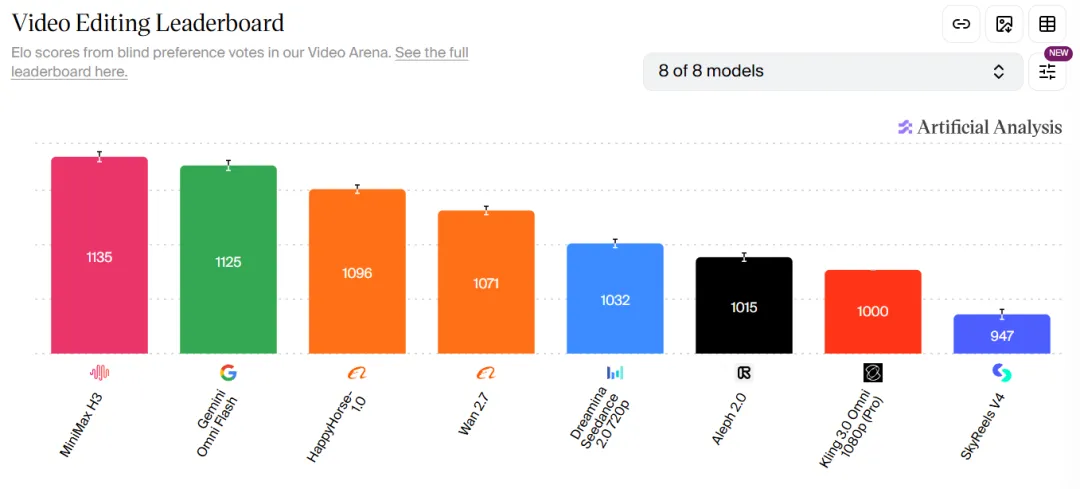
For example, on Reddit AMA, a video practitioner posted two of his findings:
He took a 10-second clip of behind-the-scenes footage and set up a drawing of a model's character, asking him to walk and hunt it into the picture. The result was both complete synthesis and preservation of the details and movement of the original footage, without unnecessarily modifying the rest of the picture.
He gave a green-screen dance material and a silhouette of the Neon Street, requesting that the background be changed and the characters be illuminated again. The result was not perfect, but both the synthesis and illumination worked.
His own conclusion is that such "just-to-change parts" controllable editing is a really valuable tool for video production.
How does a 15 second generating window make a long video?
And if you're looking for a way to grow a 15-second H3 video in a native window, refer to what Reddit user Zironic has done: repeatedly generate 141 frames each time, passing back the last 51 frames of the previous video and audio as a reference, while always providing an image of the same target subject as a reference for a sequence of 60 seconds or longer videos.

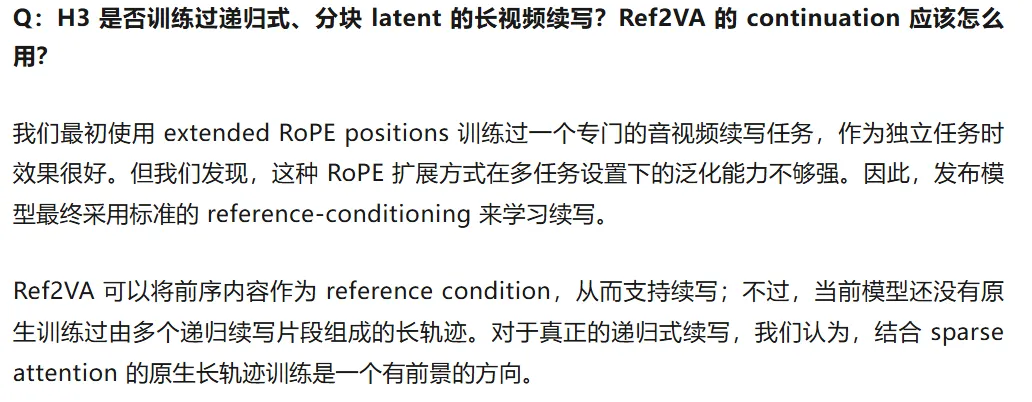
This method was later officially confirmed in the technical consolidation: this ability comes from pre-training audio video continuation tasks, as demonstrated by the developers' practice.
Official boundaries are also given: Ref2VA can use pre-order content as a reference condition to support rewrite, but the current model has not trained natives on long trajectories consisting of multiple recurring segments; true recurring rewrite requires a combination of sparse attention to do original growth trajectory training.
In addition, we have seen a number of worthwhile directions, such as an audio reference to an image to allow the model to automatically complete the contrast type, or to directly arrange multiple lenses in a single generation, so that the person and space are consistent.
It's coming from a mile away @Ai_
MiniMax H3 enters the product and workflow
ComfyUI-MiniMaxH3-Easy incorporates live video, live video, and reference video generation into a unified workflow; another project, MiniMaxH3 Director, simply organizes commonly used play into a "directory platform, live video, live video, end-to-end playback, video conversion" on the same panel. RunningHub maintains an off-the-shelf ComfyUI plug-in that moves the entire H3 into the ComfyUI process while running, covering T2VAVA, FLVA2, Ref2VA, three task chains, with INT8 re-loaded and GB24-powered, single-running cards.
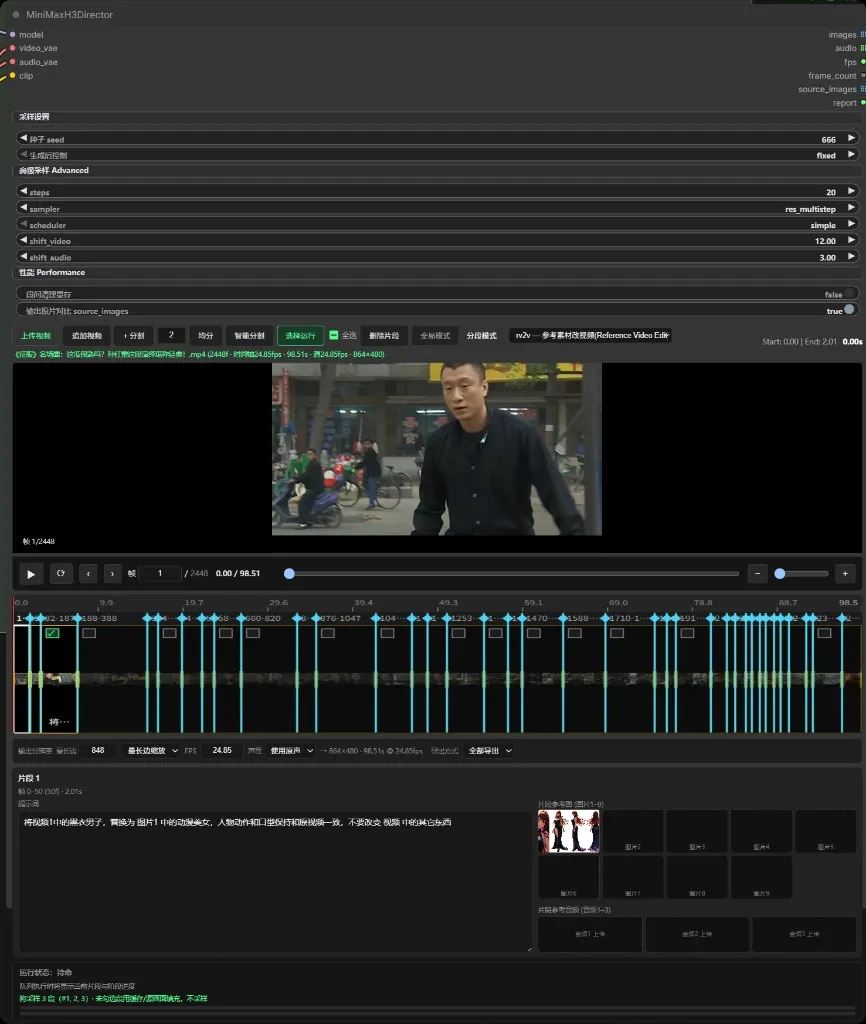
MiniMax H3 Director
What these things have in common is that they no longer require the user to understand the model, only to know what they want.
Some creators have integrated the H3 into a complete process with Krea, ElevenLabs, Suno; others have written MiniMax voice clones and HeyGen digitizers into an Agent Skill: pre-test the format, volume and clarity of the material, then go into the formal process, 15 seconds before the 720P preview confirms the shape of the mouth and face, confirming that 1080P footage is produced without error.
If you look at this week's games, you'll find that they all point to the same thing.
H3 puts text, images, video, and audio into the same context, so that any form is pushed to the limit, and another form emerges on its own: press the resolution to 32×32, it's an audio model; press the length to several tons, it's an image model; change the reference condition to the end of the previous paragraph, it's a rewriting model. The community is not adding functionality to H3, but is constantly confirming: the model is larger than it was defined when it was released.
And this "one-stop-shop, no-one-size-fits-all" structure, energy isn't limited to communities. When more and more people start to quantify, write workflows, and pack products on the same weight, this excess is no longer just happening on GitHub and Hugging Face.
The chain reaction of phenomenal explosions
The explosion of the MiniMax H3 is a phenomenon that has naturally caught the eye outside the open source community.
Forbes describes the H3 as a continuation of the Chinese manufacturer's open source route. Reuters focuses on two harsher points: the cost of H3 producing 2K video is less than a third of the mainstream market, and the model is designed to support the operation of multiple domestic chips.

As previously mentioned, more than 100 domestic and international partners have completed Day-0 (first day) adaptation: fal has launched three dedicated endpoints as an official API partner at once, RunningHub has integrated H3 into its full line of products, vLLM-Omni, SGLang, Tencent Cloud have completed logical side access, and chip manufacturers such as Huawei Lift, Moore's Lines, Lift, Qualcomm, and AMD Intel have completed adaptation on the same day.
Finally, the response of the capital market. Jeffrey reiterated the purchase rating and gave a target price of 1118 HKD. Flagger believes that H3 has the ability to generate commercial content and maintain the purchase rating.
Putting these together, we can see the "chain reaction" in them: the ability of open source to turn a public pipeline that was originally closed behind the API into a public pipeline that everyone can connect to. It's a structure where chipmakers can tune in to the performance, logic frameworks can work through it, cloud platforms can sell on it, workflow authors can pack on it, and creators can film on it.
It used to be more efficient between manufacturers than models, but now it's more eco-friendly: one whose weight can be run by more people on cheaper hardware, one whose toolchain can get stuck in someone else's workflow faster, and one whose community won't be willing to spend a weekend on your model.
This is the true meaning of technology parity; for an open source model, this is the real first week.