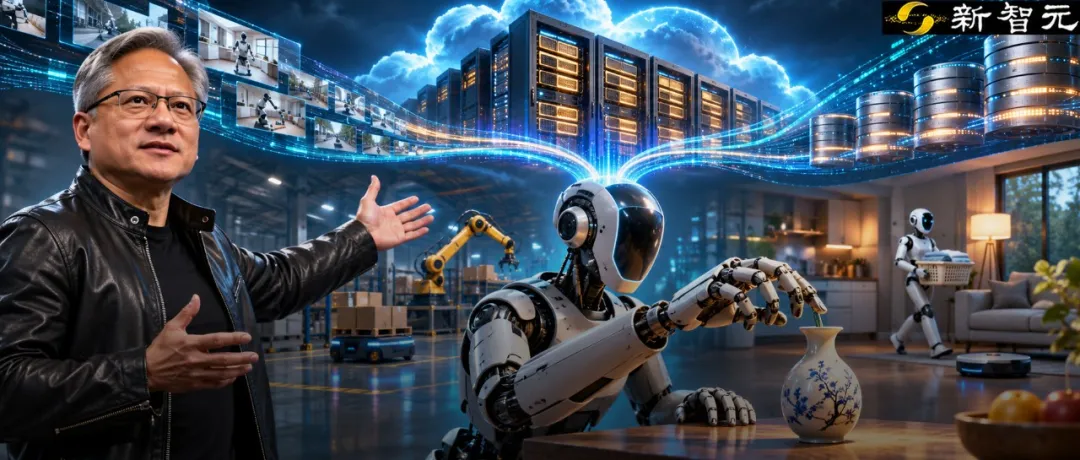
It's the first time in the history of the world.
In the meantime, I'm going to take a look at some of the most important things I've seen in my life.
At the GTC Berlin conference, officials announced the expansion of the Isaac robot development platform, along with models, data, simulation tools and computing systems.
The "ChatGPT moment" of the robot is getting closer and closer.
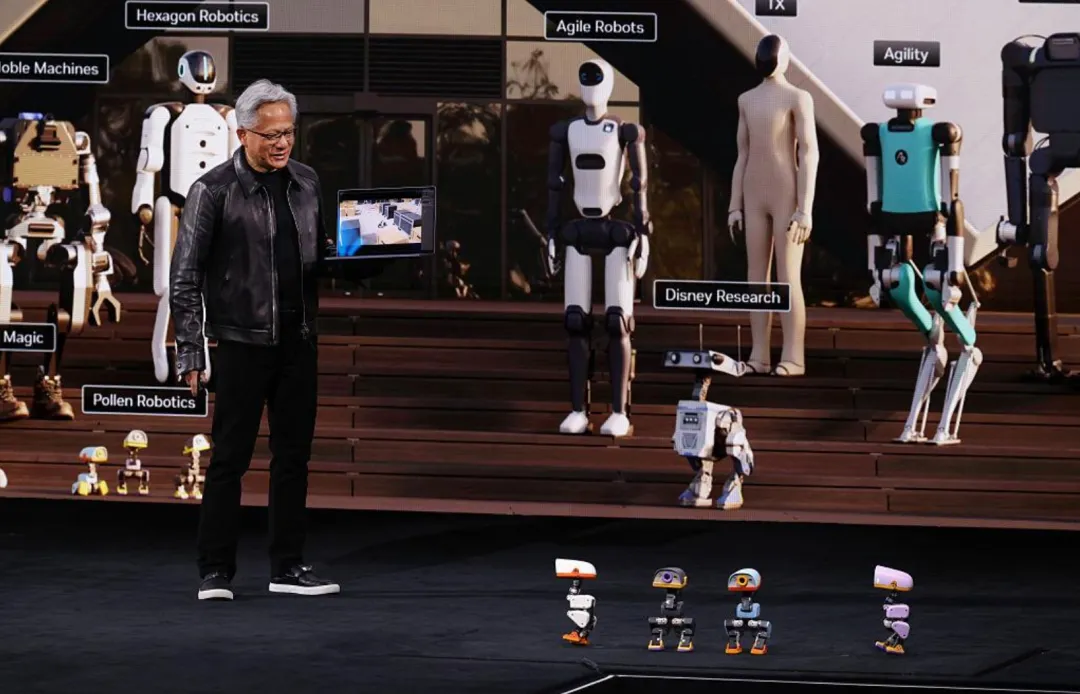
But the question is, when will robots really become addicted?
People are staring at their clever hands and their mechanical legs, and the R&D team is staring at another screen: training tasks, how did you stop?
The GPU is ready, the data is still on the way. The model is waiting for an update, the original video has not yet been processed.
AI is busy, but it doesn't necessarily work.
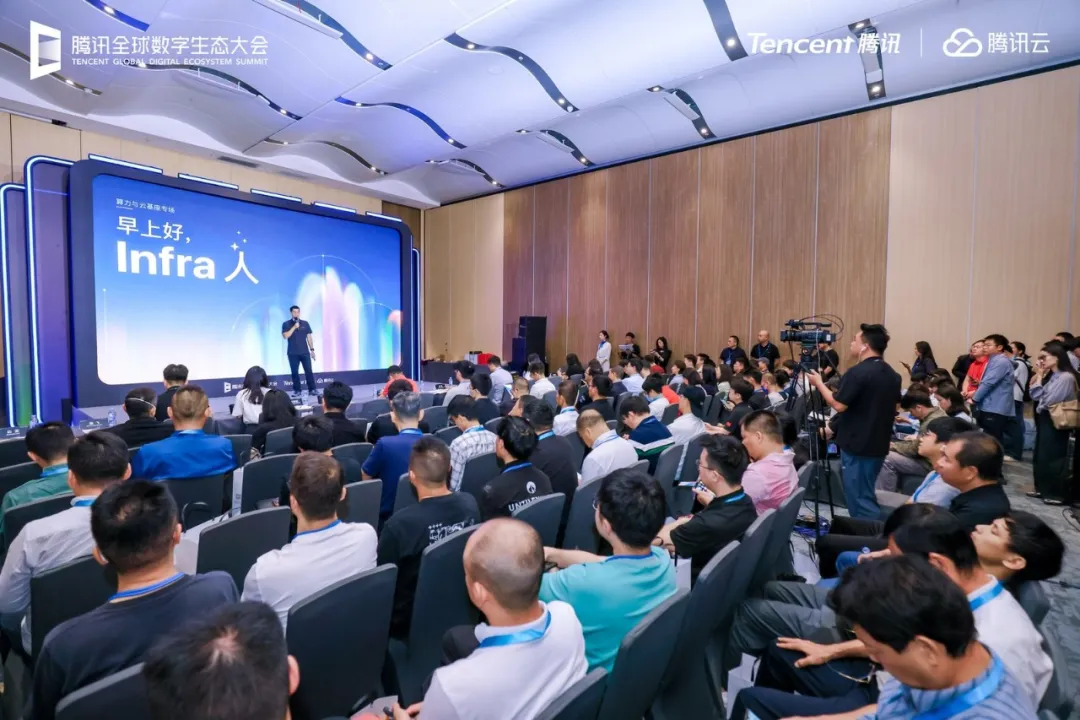
The hotter the body, the harder the bottom can hit.The 2026 Tencent Global Digital Ecology Conference was held in Shenzhen from October 29 to 30.
In computing and cloud-based platforms, companies that make world models, large-scale models and household robots, put forth their own explorations, and also unleash the infrastructure needs behind it.
Xi Jinping's Vice President Li Li Li said on the spot, "Without Infra, AI is building a high wall on the sand".
In his view, AI's intelligence and decision-making centers will ultimately return to the cloud. The development of the Internet over the past few decades has taken this path: from a single point on a personal computer to a layered distributed system.
Agent is accelerating in the cloud. Tencent Cloud is launching its brand-new Agent Hosting on the ground, which will bring together a cloud-based Agent product family for different scenarios, serving individuals, developers and businesses, enabling teams to use it in an orderly, well-informed way, with complex preparation behind the scenes.
In his speech, Lee said that Tencent Cloud has made a number of attempts to host Agent Cloud. These explore how to make Agent stable in the cloud, allowing Agent systems and their management to be industrialized like the Internet.
The three classic themes of Infra, computing, storage, and networking, have a new theme in Infra:
Calculation, determining whether or not computing can be stable and run efficiently;
Storing and determining whether bulk data can be fed into training in a timely manner;
The network, which determines whether large groups can't work together.
At this ecological conference, the three Furniture Intelligent Companies' landing practices, the computing, storage of products and programs of the two largest modules, and the cluster communications and network transmission capabilities provided by HCCL and AI Link, together presented the "Tripartite Volume" of Tencent Cloud AI Infra best practices in the field of Furniture Intelligent.
The national arithmetic is going from "available" to "useful".The brain grows in the clouds.By giving AI an image, it can expand the image into an interactive space.
Press WASD to control directions, change angles, and drive changes in natural language in real time.
This is one of the outcomes of the world model that brought Manifold AI floating space to the scene.
In the robotic direction, the team is also exploring a more intuitive way to learn: let the robot see a human demonstration and then try to complete a new task.
The founder of Flexible Space, CEO Wu Wei, uses a shoelace as an example to showcase the exploration of reasoning through a demonstration. Feedback from deployment can also be used for continuous improvement.
This model is backed by a round of mass training.
And the selection of fluid space is based on national output.
According to Wu Wei, it took about two weeks for the two sides to jointly optimize from the calculator and infrastructure level, improving the performance of the training by almost three times. Currently, the stable training of the computing cluster consisting of 512 domestically produced chips will continue.
In his view, in the past, this type of optimization was largely done by the team itself; together with the Tencent Cloud, upgrading from the sub-level, the infra-level, gave the team confidence in the state-owned computing ability.
The story of fluid space, in fact, tells the story of two camps that many teams have to go through.
The first is how to choose the algorithm. Today, more and more teams are seeking to diversify the algorithm, and are also promoting the adaptation and adoption of domestic algorithms. Switching a chip is not as simple as switching a plug: the framework needs to be compatible, the algorithm needs to be adapted, and the performance needs to be repeatedly optimized. Many teams moved to find out that the model "can run, but doesn't run fast".
Secondly, how to use computing well. Computing is a small input, but there is often a lack of resources in multi-machine training; the need for data processing, simulation, and training is up and down.
It's just that being physically intelligent makes both of these things even bigger.
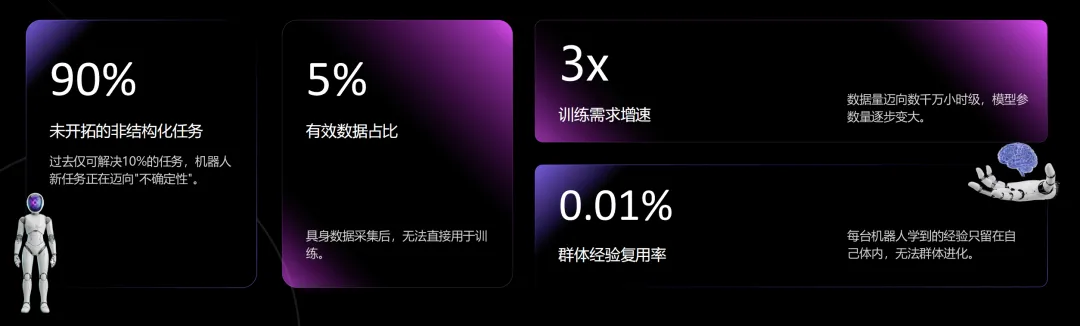
On the conference site, Huang Yang, vice-director of cloud computing products at Tencent, gave a set of figures: current robots can only complete about 10 percent of structured tasks, and the remaining 90 percent of unstructured tasks cannot be replaced; the amount of data for single customers has grown from hundreds of thousands of hours to tens of millions of hours, and training needs have more than tripled; tens of thousands of robots each try and fail, and the repeatability rate of group experiences is only 0.01 percent.
In his words, the scale of the body cannot be compared to the scale of intelligence.
The positioning of the Tencent Cloud is also very simple: don't touch your algorithm, only take over the scheduling you don't want to control.
Data base, converting raw data into training sets.
Only about 5% of the raw data collected can be used directly for training, and the rest must be cleaned up before processing. This layer is taken over by HAI DataFlow and Data Universe.
The customer's own calculators can be packaged into mirrors and business logic is not required to rewrite; without calculators, it is possible to use the Tencent Cloud self-development calculator provided by the data universe. Environmental deployment, step-by-step connection, CPU and GPU deployment are all delivered to the cloud, with the team only submitting tasks and getting results.
In this case, it's just the two canyons that the fluid space encounters.
The so-called calculus can be understood as the basic process of model computation. Some processes are not well suited and hardware reinforcement is difficult to fully implement. In addition to framework compatibility, cluster communication and operating stability, each link slows down progress.
Fast migration: HCC multicore algorithm combined with AI algorithm optimizes Agent to move the model from the original program to the domestic chip, doubling the migration speed. VLA training task of a head-body model team, completed the migration to the domestic chip in two weeks, boxes throughput improvement of about 30%, superimposed HyperAcc acceleration improvement of about 52%.
Fast training: HyperAcc training accelerated the launch of a line of code for the kit, which improved performance by at least 22% in domestic chip kilocalorie tests;
Running steadily: HyperTrace pre-examines the entire cluster before training, collects and monitors by-tracks during training, and reduces training stoppages by 91%.
Reinforcement learning simulation also runs on the same backbone, with enterprises retaining their own simulation environments and reward designs.
The "last meter" of the body applies to the basement.
The robot and the objects it comes into contact with are often within a meter of each other, and tasks must be completed in a hundred milliseconds.
High-performance application services HAI introduced an arithmetic backpack that packs arithmetic and models together, with robots using subscription access, API or SDK calls, without purchasing and running arithmetic themselves.
Businesses focus on church robots and the cloud is responsible for making good use of computing.
The data is flying.The GPU utilization rate is over 90%.The problem of arithmetic is solved, and the next bottleneck comes along: data.
RoboScience has developed its own large-scale model, Visics, which adds hundreds of thousands of hours of simulation and video data each week: video, images, 3D dot clouds, real-time spin-offs, format fixes, and labeling clusters in Beijing and Nanjing.
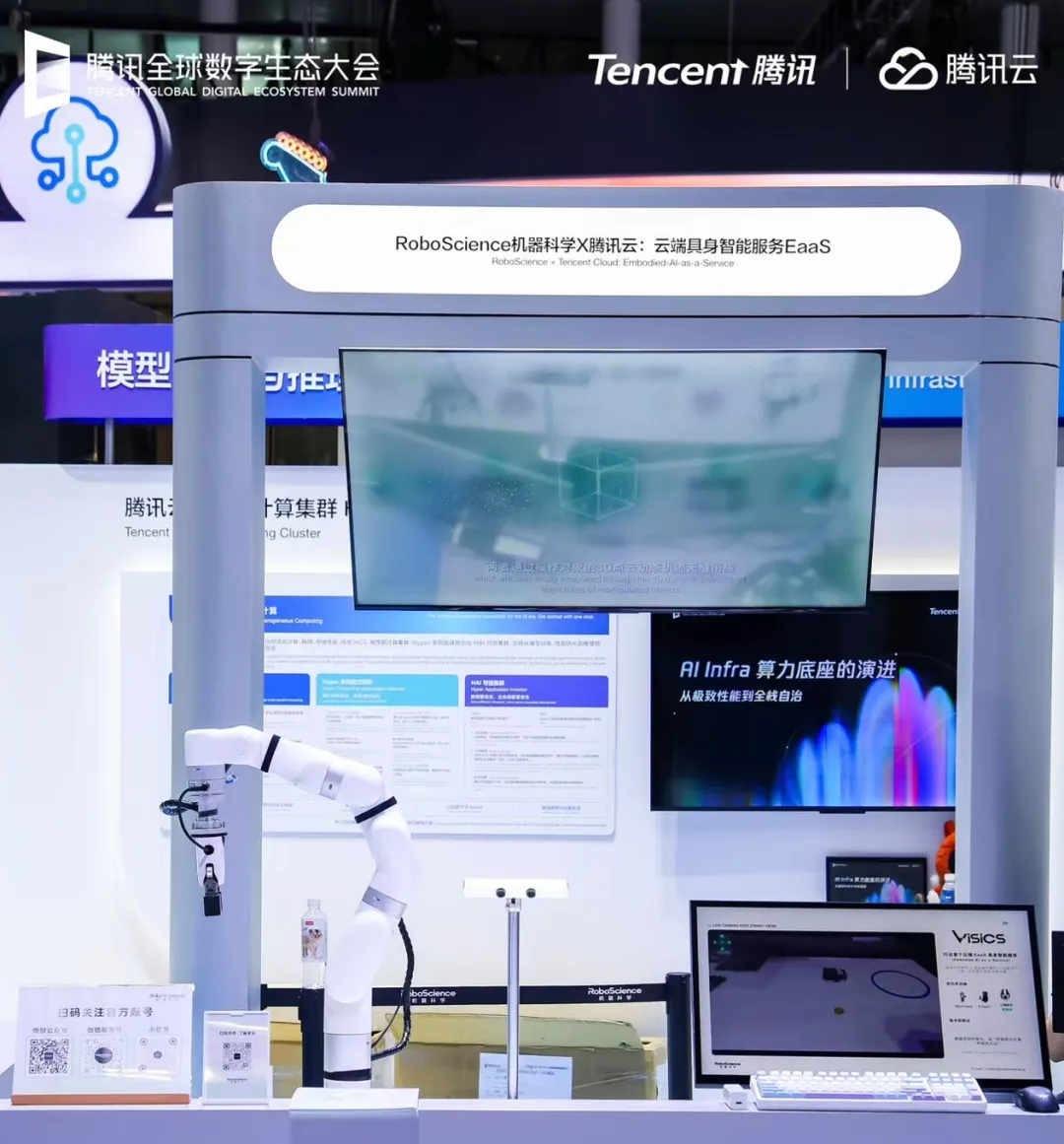
Seroth, the hub of a home robot, is another problem: the robot is online 7x24 hours a day, with video, voice and sensor logs sourced continuously, many of which are repeated ineffective moves that the team manages internally called "dirty data".
One is that data is too cumbersome, the other is that high-value data is too hard to find, and the point is the same.
In the "model three elements" of algorithms, computation, and data, the first two are converging rapidly: the mainstream algorithm routes are different and smaller, and computation is becoming more diverse and more accessible.
So Tencent's director of cloud storage solutions, the chief technology expert, said frankly, "It's the quality, the source and the amount of data that determines the limits of physical intelligence that can really bridge the gap between furniture companies".
From data collection to training, after cleaning, format conversion, marking, authorization and version management, delivery, any loop sticks, bulk data doesn't fit into the GPU, and computing can only do that.
The solution given by Tencent Cloud is to turn the data plane around: collect, process, train, then verify the real machine, where it doesn't do well, and start the next round with the problem.
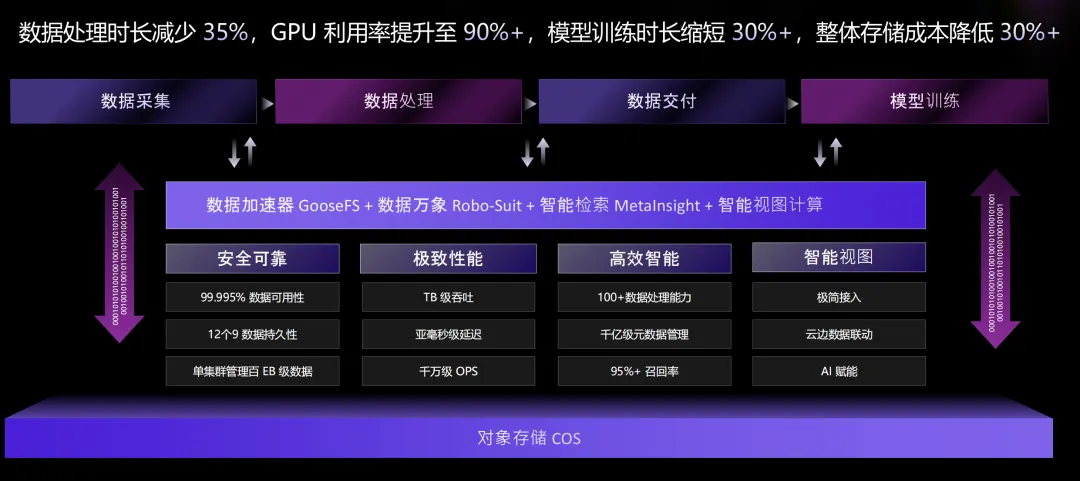
Underground: Surviving and Surviving
The object storage COS is a unified base: real-time, simulation, Internet video, BAG, LeRobot, MCAP, HDF5 and other formats can be installed directly; single clusters can manage 100 EB data, availability of 99.995%, and durability of up to 129.
The cost is also calculated. Tencent Cloud has more than 2000PB of storage on cassette tape, QLC, TLC multi-medium heating layer, the heat-release heating layer, and the cold-release cooling layer.
Middle level: Processing pipelines for data flow
The Data Universe Robo-Suit provides quality assurance, decomposition, marking, reconstruction, retrieval, de-sensitivity of 6 types of algorithms with more than 100 capabilities; MetaInsight supports more than 95% recall through text search and graph search.
In addition to cross-accounting, cross-park copying and global acceleration, format conversion, authorization control, and data-oriented delivery, all are done at this level.
Top floor: attachedGPUThe Accelerator
There is a performance gap between large-scale, low-cost object storage and GPU training.
The data accelerator GooseFS adds to it: single-client throughput of 40Gbps, time delays of milliseconds, hotspot data near caching, re-reading of zero-source. The newly released COS Express, which reads throughput of 10 to 20 times that of standard object storage; training scenes for high concurrency, bulk files, are handed over to the parallel file system CFS Turbo for the entire NVMe.
With the three layers connected, the benchmark clients' observational data were: data processing time reduced by 35 percent, GPU utilization increased to more than 90 percent, training time shortened by more than 30 percent, and overall storage costs decreased by more than 30 percent.
The two companies that started up again.
Field, founder and CEO of Machine Science, set a tough standard: one data, multi-level sharing. Tencent Cloud uses COS to build a single data lake in Nanjing, Beijing, and Nanjing to read the same data across regions, saving tens of millions of yuan in investment in building a high-performance storage system in both locations; and training with CFS Turbo with 400Gbps-grade RDMA to reduce data waiting.
The two sides have also developed tidal computing capabilities: training during the day, GPU running VLM pre-labeled at night, and improved marking efficiency by 5 to 10 times.
Zeroth uses COS to receive PB-level data from multiple parks in Shanghai, North America, and Europe, smart view computing platforms support remote viewing and real-time playback, and MetaInsight helps engineers quickly extract high-value footage.
In the words of Co-CTO Li Yuanqing: "A minute of high-density interaction is often more valuable than an hour of repeated ineffective actions".
The data must be stored and read in a timely manner. Otherwise, the calculation will be stronger and can only wait a few minutes.
Multi-machine communication, cross-domain connectivity, no link can break the chainThe data will be sent to the site, and there will be good coordination between multiple machines.
The larger the body model, the larger the cluster, the larger the cluster, the larger the cluster, the larger the cluster, the larger the cluster, the larger the cluster, the larger the cluster, the larger the cluster, the larger the cluster, the larger the cluster, the larger the cluster, the larger the cluster, the larger the cluster, the larger the cluster, the larger the cluster, the larger the cluster, the larger the cluster, the larger the cluster, the larger the cluster, the larger the cluster, the larger the cluster, the larger the cluster, the larger the cluster, the larger the cluster, the larger the cluster, the larger the cluster, the larger the cluster, the larger the cluster, the larger the cluster, the larger the cluster, the larger the cluster, the larger the cluster, the larger the cluster, the larger the cluster, the larger the cluster, the larger the cluster, the larger the cluster, the larger the cluster, the larger the cluster, the larger the cluster, the larger the cluster, and the greater the greater the cluster, and the greater the greater the cluster, the greater the greater the cluster, and the greater the greater the greater the greater the cluster.
Like a group of people who co-write a report, everyone writes fast, the summary is stuck in a window, and the report can't be delivered the same way.
The answer given by Tencent Cloud is the self-developed collective communications library HCCL, which combines stellar networks to optimize port traffic balancing and sensing congestion and dynamic switching paths when multi-tasking simultaneously.
In a real-life scenario, the use of HCCL has led to a 13 percent improvement in the end-to-end performance of the model.
A smart furniture client needs to schedule data between multiple nodes, and the original self-built link is difficult to meet the need for rapid expansion.
Tencent Cloud AI Link, through multi-link load balancing, combined scheduling of its own backbone network, partner network and public network combinations, and through QoS queue classification, prioritizes the use of empty bandwidth for large-scale data transmission and clogging to ensure critical operations. In this case, the bandwidth can be delivered up to five times the original, reducing unit costs by more than 50 percent.
Cooperation from within the cluster to cross-regional data transmission, both of which have to be reduced together, are waiting for computation.
The three-volumeThe bottom determines the landing speed.From models that generate the world, to large-scale models that rely on massive data, to household robots that enter the living room, fluid space, robotics, and three-pointers, the difficulty is the same: the algorithm is stable, the data is fast, the network goes through.
The only thing the model can do is break the chain.
Looking back, the three lines of computing, storage, and networking, the answers are basically the same: who has physical intelligence going from the lab to the industry, the complexity of infrastructure coming from.
The results of the three furniture companies are the best practices of Tencent Cloud AI Infra on the smart racetrack.
The focus of the competition is shifting across the physical industry. In the past, it was about who walked more steadily, who grabbed more accurately; in the future, it was about who turned the data wheel faster, whose models shifted more hard, and whose ability to replicate more widely.
Individuals can create their own, algorithms can write their own; but from data collection, training and simulation to deployment online, this long link is increasingly being handed over to the cloud.
When the bottom is no longer dragging the back legs, the robot will shorten the distance from "built" to "used".
The day robots really got addicted might not have been so far away.
Click on "Read the original" to see the full re-release of the 2026 Tencent Global Digital Ecology Conference, "Centre for Computing and Cloud Basics".