In the eyes of many, AOE Tech Labs is a product innovation company.
In January 2026, the Floatboat client made the file manager, editor, and browser directly Agent's operating environment, giving rise to the form of the Agent desktop; in April, FloatIM brought people into an office network with Agent, Agent and Agent, with tasks that could interact between people and Agent continuously; and in May, FloatSchedule allowed Agent and others to operate on their own terms without having to follow orders. Three releases, three of which were previously not available in the marketplace, all revolved around real office scenes.
But none of these three things is an interface innovation. What the outside world sees is the shape of the product, and every time it moves underneath is Harness.
On August 7, they placed the base directly on the list. The base used the most affordable model on the market, the DeepSeek V4 Flash. Three times before, the technology was delivered in product form; this time, it took the measurements on its own.
The full report links to:
The reason this is worth looking at separately is because it fills a gap in the industry that has been recognized as important but has not been reported for a long time.
It's been a while since we've recognized that equation:
Model + Harness = Agent。
The left half of the model is repeatedly measured, with a list of each model being released. The right half of the model includes the other half of the system, including what the model can touch, how to close each round, what tools return, where the state exists.
The answer to this question is how much the right-hand half is worth. The answer can be summarized in four words: How fast can you save?
First, look at "good":
$0.175 Bet $10, all five out.
Floatboat is based on DeepSeek-V4-Flash, an official API that allows anyone to tune in and input $0.14/million tokens, output $0.28. The typical 3:1 input-output ratio for Agent scenarios is $0.175/M.
Opposite is Claude Opus 4.8, $5/$25, a mixed price of $10/M and 57.1 times its price.
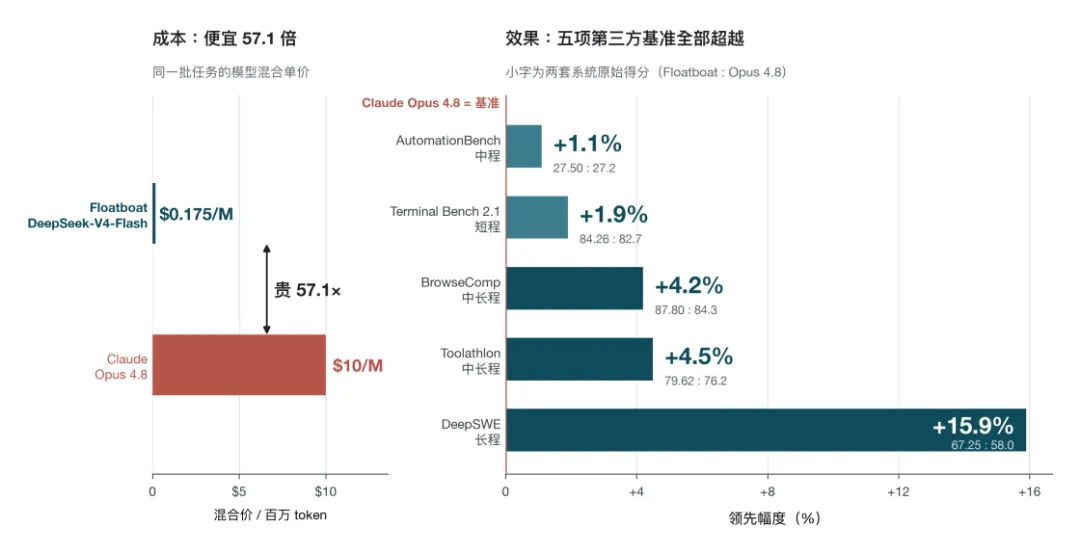
The bottom of Figure 1 is $0.175, with five items all over $10 flagged left: mixed single-price contrast, DeepSeek-V4-Flash $0.175/M to Claude Opus 4.8 $10/M, expensive 57.1 times ((linear axis, not paired compression)).
All five have been overtaken.
"Well", says Agent, "there's a hard door to a desk if it doesn't deliver a real task, and it's not cheaper to open it every day.
What this data means is that this exchange can be cancelled, and the cancellation is not a model.
Second, it's not a "cheap model".
The first reaction to this price reversal is usually that the low-priced model follows the old story of the flagship.
The same DeepSeek-V4-Flash, running on DeepSeek's official own Harness, was only 54.4, down from Opus 4.8's 58.0.
A more complete set of controls illustrates the problem: in Terminal Bench 2.1, DeepSeek's official Harness and Opus 4.8 are tied for 82.7: 82.7, with the remaining four all lagging behind.
In other words, the same model did not win a single Opus 4.8 in the model factory's own system; after joining the Floatboat, it won five overall.
The model weight hasn't changed, the unit cost hasn't changed.
Three, once and for all.
Single-variable experiments with the cheapest models
It is worth putting the methodology in its entirety, because the entire validity of the conclusion is emphasized in the four words "single variable".
The control configuration announced by Floatboat is:
The two sides used the DeepSeek-V4-Flash 0731 model underpinnings.
The Code Agent mission in DeepSeek's official public benchmark uses an abbreviation of DeepSeek Harness (coming to be released) and is configured as max grades, top_p=0.95, temperature=1.0;
Floatboat-side unification is implemented under the Floatboat Evaluation Harness, and most of the benchmark model justification is provided by the official DeepSeek API;
All tasks run independently in a completely isolated, open-box physical sandbox environment, and the input parameters are completely consistent.
Here's one easy-to-read detail: the control group is not a "naked model API", but the model factory's own Harness. 54.4, 73.2 82.7, 25.1, 70.7 These five numbers are the official DeepSeek system's scores, and the engineering capabilities of the model factory are also present.
This makes the contrast much stricter than the "product versus naked API" and makes it more difficult to interpret the difference as "opponents do not take it seriously".
There is also a deliberately conservative option: to control the official version of 0731 rather than the earlier Preview checkpoint. If the Preview, DeepSWE one is 7.3 → 67.25, an increase of 821% is a much more beautiful number.
As for why the cheapest model was chosen, the reason was the opposite: with the top model running list you get a "high score + uncertain attribution", and no one can tell whether the score is from the model or Harness.
The product itself is model-neutral and supports access to all mainstream models, and this is only a requirement for evaluating the methodology.
Four, the real information is in order.
If you only look at "five wins", it's only one run.
I'm going to try to pull the Harness on the same bottom separately:
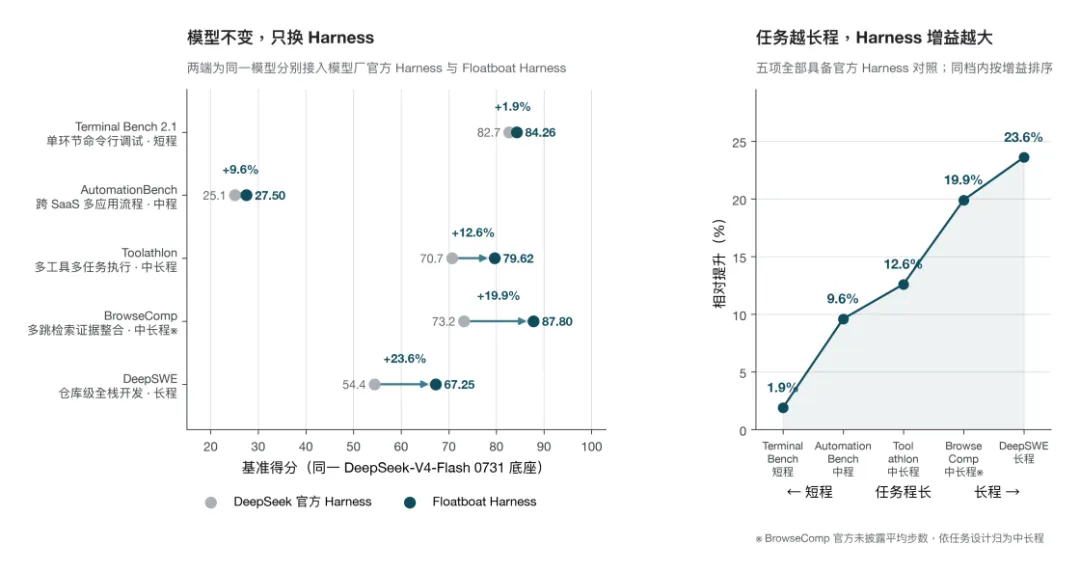
Figure 2 shows the model unchanged, only changing Harness: the longer the task, the greater the Harness gain Left: the same DeepSeek-V4-Flash 0731 bottom, the two ends of the model are the official Harness and Floatboat Harness respectively. Right: the length of the model from short to long row, 1.9% (short)→ 9.6% (middle)→ 12.6% (medium)→ 19.9% (medium)→ 23.6% (long), all five have official Harness controls, the length of the file is not decreasing, the increase in the unit is decreasing, there are no exceptions.
1.9% → 9.6% → 12.6% → 19.9% → 23.6%。
All five have official Harness controls, ranging from short to long rows, non-decreasing, incremental, and no exceptions. The longer the mission, the greater the Harness gain, rising to 23.6%.
Of the five, only the BrowseComp official did not disclose the average number of steps, and its "medium range" is the conclusion of the task design judgments: multiple jump searches; the search engine's front screen cannot answer directly; the length of the searches chain is unknown beforehand; cross-source verification is required; single-task searches and verification rounds are equivalent to Toolathlon.
The longer the chain of tasks, the more links, the more dependent the state of maintenance and self-correction of the interstep, the greater the gain of Harness; the shorter the task, the more single points, the closer to one-time queries, the smaller the gain.
And real work is the kind of work that takes a long time. The user's daily task is not to handle a command, but to move across files, across applications, across many steps, and change their minds in the middle. This rule is directed to the realm of Harness in real work.
I don't think I'm going to be able to do it myself.
All the numbers above are divided according to who came up with the title.
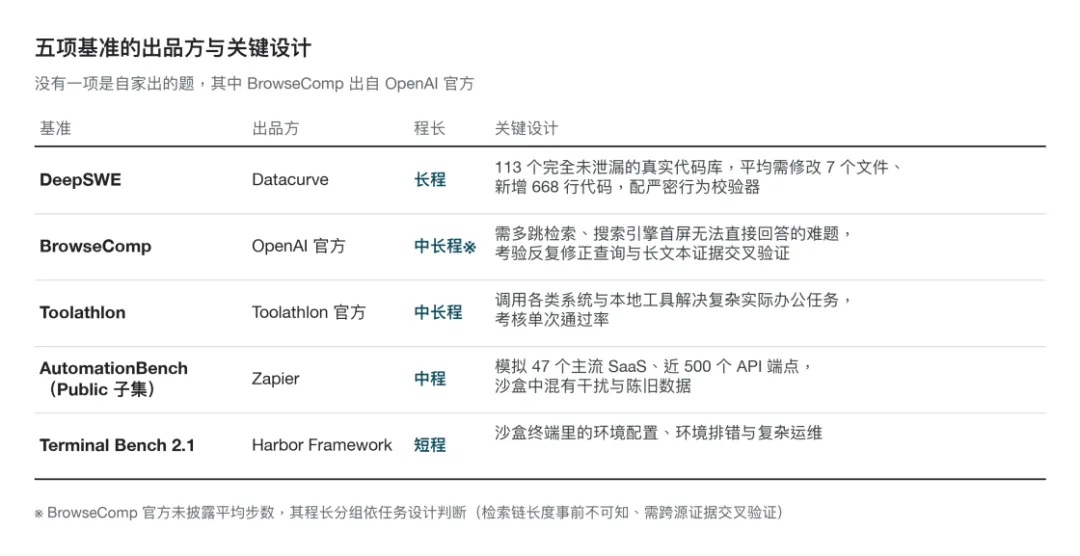
Figure 3 shows the five criteria for the product side and key design, none of which are self-contained, with BrowseComp coming from OpenAI official.
In this OpenAI self-published list, the 87.80 of the Floatboat surpasses the GPT-5.6 Terra ((87.5, 25.7×) ‒Claude Sonnet 5 ((84.7, 22.9×) ‒ Opus 4.8 ((84.3, 57.1×) and GPT-5.6 Luna ((83.3).
"113 completely unleaked code libraries, an average of 7 files changed, 668 new lines added", "47 SaaS, almost 500 API endpoints, and a mix of outdated data", and "this kind of task doesn't go far with wording techniques". It requires authentic file access, multi-step sorting, cross-app status maintenance, and self-discovery and correction after a mistake".
This also explains why the increase is focused on long-range tasks: the single output quality of the short-range task testing model, while the long-range task testing is the entire execution system.
HLR: Put a foot in Harness.
Floatboat's border with Harness is as follows:
"Floatboat is transforming its cutting-edge model capabilities into a leading Agent product, where everything but the model itself falls within the Harness category".
HLR (Harness Leverage Ratio, Harness Leverage Rate) is a simple question: what is the value of the same budget spent on changing a model or on changing an executive system?
I'm going to write this in a way that everyone can understand:
HLR = Profit from changing Harness / Profit from changing model
The molecule is the model in motion, only replacing the Harness, and the result is achieved; the denominator is the Harness in motion, and the model is upgraded to a stronger reference system, and the result is achieved publicly.
So the meaning of HLR > 1 is straightforward: only the gain obtained by replacing Harness has exceeded the upgrades to the entire open performance range represented by the reference model.
DeepSWE is replaced by:
DeepSeek official system:54.4
Claude Opus 4.8 posted a score of 58.0, just 3.6 points between the two open systems.
The same DeepSeek model was placed on the Floatboat: 67.25, and 12.85 points.
Instead of changing the model, just changing Harness, it got 3.6 times the public performance range represented by "upgrading to your 57,1 times Opus 4.8".
(For readers who need a more precise definition, the full format is: B for the same Benchmark, SB (M,H) for the system score after the combination of model M and Harness H, M is a constant underlying model, H0、H1 for baseline Harness and pending Harness, respectively, and Mr,Hr) is a reference model system for marking model jump speeds. All results come from the same rating range, calculated according to Benchmark, without crossing the benchmark average.)
There is a pre-declared rule for the selection of a reference system that determines whether the indicator can be adopted: the main reference unit uses Claude Opus 4.8; if it is not higher than the baseline system on one item, the model does not jump, replacing that item with the cheapest valid reference; take the cheapest instead of the highest score, because the denominator to be measured is a true, least expensive model upgrade.
Figure 4: Benefits of changing the Harness ÷ Benefits of changing the model In the column are the molecules ((Harness increment) with the divider ((baseline to reference system open spacing))). The null line is HLR = 1, above which means that the increase in changing the Harness alone has exceeded the upgraded to the entire open performance range represented by the reference model. The base of a reference bench under the rule is GPT-5.6 Luna, the HLR range for all candidate references is 0.26×~1.42×.
0.78× → 1.14× → 1.32× → 1.62× → 3.57×. The sequence is consistent with the length rule, ranging in length from short to long, non-decreasing, HLR decreasing, with no exceptions: the longer the length, the higher the leverage of Harness.
Opus 4.8 is 82.7 on the Terminal Bench, the same as the official Harness of DeepSeek. The model was changed to a flagship that was 57.1 times more expensive. The model remained unchanged; Harness only earned 1.56 points. Since no model jumps occurred, it cannot be referenced in this item. The entire valid reference HLR range is 0.26x to 1.42x -- Sol 0.26x -- Terra 0.33x -- Qwen 3.8-Max 0.40x -- Luna 0.78x -- Opus 5 1.42x -- and Floatboat has released the entire range as well.
HLR is the new indicator proposed, not an industry standard, and the numerical values of the reference system will change. However, its molecular divisors are all open scores of third-party benchmarks. Referring to the selection rules, it is also open, and anyone can recalculate on their own or in turn use it to calculate the Floatboat.
I'm not going to tell you where this is coming from.
How did long-term missions fail?
The advantages of this type of tool are typically 1×3 scale. To explain a larger scale difference, one must first answer a more basic question.
The answer to a floatboat is: the failure of a long-range mission is usually not "one step at a time wrong", but rather the cycle is uncoupled and the farther it goes from the actual delivery standard.
There are two causes of walking away, one on the human side and one on the model side.
One is that delivery standards are not fully stated at the beginning of the task. Real work is not a question of standard answers: people's intentions tend to become clearer as the intermediate product gradually becomes clearer, and many key criteria - whether the language is accurate, whether the program can land, whether the structure is in line with the actual decision-making process, whether the results are enough to be delivered directly - do not exist in the first sentence.
The second is the deviation of the model itself, which is gradually amplified in long-range tasks. This is the inherent property of probability: each round of output carries a slight deviation, while the next round takes the product of the previous round as a prerequisite. In short-range tasks, this deviation is not visible, and after twenty steps it accumulates into directional errors.
Overlapping these two things is the real situation of a long-range mission: the goal itself is vague, will change, and the model that carries the goal is constantly drifting.
This is where they point to the definition of "Proactive".
The real Proactive Agent OS is not about whether the system can start working when no one is pressing a button, but about whether the user can continue to explore, execute, observe, modify and self-reflect in long-range tasks, actively identifying the gap between the results and the targets when the user only says a vague goal or even doesn't quite know what to do about it.
In their own words:
The advanced form of dynamics is not to execute timely for the user, but to help the user find what they really want and get it done.
This judgement also explains the number of tasks arranged by length: the longer the task, the more unspecified criteria, the more amplified model deviations, the greater the value of the "continuous approximation"; the shorter the task to only one query, the lack of space for approximation, and the lack of sufficient steps to accumulate the deviation.
Why does this require the whole pot to be in your hands?
"Continuous Approach to Delivery Standards" sounds like a design concept, but landing requires four layers of capability at the same time. In an industry that is generally based on the Claude Agent SDK suite, when a demo is available in a few weeks, AOE Tech Labs opts for self-developing Runtime, Agent Loop, Tools, Infra, and FloatSail (Evolution System).
The four layers, each of which determines what the four death laws correspond to, say, long-term tasks:
Runtime decides what the Agent can touch: process, file system, permissions, sandbox boundaries. DeepSWE has to modify an average of seven files, add 668 lines of code, and AutomationBench has to navigate between 47 SaaS endpoints, nearly 500 APIs. These tasks are based on real read-write and execution rights, not on passing and retrieving text.
Agent Loop decides whether a long-range mission can be shortened. It does not allow the model to run several rounds mechanically, but instead allows each round of exploration to shorten the distance between the current result and the delivery standard: getting new information from execution, finding deviations from observation, correcting paths from failure, pushing back unspecified requests from the user from the intermediate product; the return time, the return time, the query time.
This means that the target points of each round must be reconfigured rather than diluted in the previous context. What information must be left in the window, what can be compressed, what can be lost, and the error of the deviation begins to accumulate; it also means that the system must test its intermediate product, only pressing it back when the deviation is still a deviation, rather than making it a directional error.
This is the kind of "active" that physically lives in this layer.
Tools determines whether the model consumes the correct results. The granularity of the tool, the return structure, the misconceptions. A tool that packs a failure into an empty string will cause the model to make a confident wrong decision at step 15.
Infra determines whether the failure can be detected. Status persistence, concurrency, observability. If the intermediate state of a long-range execution cannot be traced back, even "what step is wrong" is not known, optimization cannot be stopped.
Any layer in the four layers is someone else's, and the upper limit is someone else's. When the Agent Loop in the SDK dropped the context at step 20, the only thing the subrouter can do is twist the tip word around, and the self-developer can directly change the loop.
FloatSail (Evolution System) solves the problems of time dimension and personalization: multiple models, fast updates, and increasing complexity of tasks. It allows Runtime, Loop, Tools, and model adaptation strategies to evolve continuously in real-world task feedback and to continue the system capabilities that have already been formed when new models emerge.
"Technically, only a completely self-controlled system can drive highly uncontrollable models to maximize model intelligence".
Going back to the initial judgement that why every product is innovative and bottom-up is Harness: this technical judgement is directly related to the team. The founders have 10 years of OS + AI entrepreneurial experience and billion-level user product experience; one of the two technology partners, one with model training experience and the other with OS underlying technical expertise.
Product growth and technological growth aren't two things here: a team that can "use it comfortably" should have taken Runtime and Loop into their own hands first.
Eight, see more:
The list runs through a thinned environment.
The scoreboard also has an anti-intuitive footnote: it is weaker than the environment that users actually get.
Evaluating the ability to eliminate variables in order to reproduce, and to superimpose products in order to function, would not be the same thing.
The Floatboat client, which users actually use, integrates file managers, file editors, and browsers natively into the product itself, and provides access to more than 3,000 online services and a variety of multi-modal models. Agent products on the market are almost a thousand: entering is a dialog box, selecting a fixed file-sharing project input, AI-generated documents to be edited elsewhere, and using the browser to install plugins or sign in to the browser you're using.
For Agent, these are not interfaces, they are tools that can be called: more available tools, shorter environment back and forth, more complete execution closures. AOE Tech Labs confirms that running the same set of benchmarks in a complete client environment, scores higher than the figures published in this article, and specific scores are disclosed later.
"Only comfort in product design can maximize the potential of people". - AOE Tech Labs team
According to the long-range rule, this is self-evident: the wider the tool area, the more comfortable people use it, the more hidden knowledge, the greater the benefits of long-range tasks. While real work is all long-range tasks.
The discrepancy to be disclosed may be more interesting than the list itself. If the HLR answers "how much is Harness worth", this discrepancy will answer the following question: how much is excellent human interaction design worth?"
Nine, "quick" and "province":
It's so cheap that it doesn't have to be weighed.
Agent will be used for real.
Finally, back to the cost side, it means more than just saving money.
These five benchmarks are all for the quality of the task, and there are no delays or time-consuming data in the material, so there is no data claim here for the reasoning of speed.
"Province" is clear. The mixed price of $0.175/M versus $10/M is 57.1 times higher than the five overall winners. Look up the overall price list, the more expensive but lower scores are 9/9 on AutomationBench; Toolathlon 4/4; BrowserComp 6/8; DeepSWE 5/8; Terminal Bench 5/9;
"Fast" refers to the change in the way this price is used. The cost of a long-range task can be ignored, run perverted once, and the cost can also be ignored. Opus 4.8 is 57.1 times more expensive, and many teams do not have to weigh this threshold first when using it.
The other half of "fast" is on the human side: those files that are saved by the client to look for, upload, download, delete applications. The so-called total turnaround time is never just the first token delay. How long it takes to find files, whether the agent can read and write and save directly, whether the browser and the online service are in the same execution environment, whether the mid-range failure can't go backwards and not backwards, the user changes the request to be able to continue along the already existing context.
For the first time in this data, four things are coming together: improving the variety of tasks, moving faster, five benchmarks are better, and the cost is 57.1 times cheaper.
The AI Agent workspace is really getting into the day-to-day work. It's too expensive to be able to work, it's too expensive to be able to open, it's in the presentation stage, and it's here.
Ten, now I can run again.
All the numbers above can be recalculated.
The verification path is short: using the same model to compare its performance gaps elsewhere and in the Floatboat. The same model, different Harness, is the answer.
It's a good idea to try a long-term task directly, because that's the biggest leverage, and it's something that's really going on every day: let it change a running warehouse, make a real piece of information into a report that can be delivered, or give it a vague idea to see if it can help you figure out the criteria first.