
It's the first time in the history of the world.
OpenAI and mathematical discoveries are not public?
In an interview with Cheeky Pint on Oct. 29, Ottman revealed that OpenAI's contributions to mathematical research also include many unpublished discoveries.
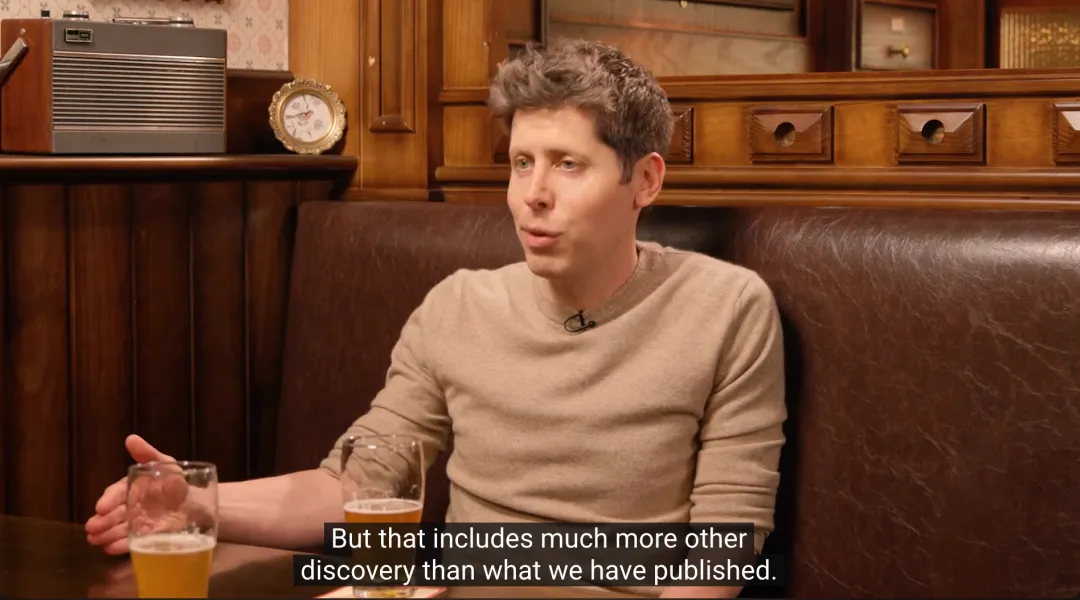
The host, John Collison, asked: "Are there any other results beyond the 700 proofs?"
Ottman replied:
Yes, of course I do.
In recent months, the mathematical results of OpenAI have been hotly debated.
After the results were made public, the researchers began to dismantle the public data to understand its ideas and the key steps in verifying inference.
In the field of biology, AI's proposed solutions have been put to the test.
Models analyze data, come up with designs, researchers screen out the program, conduct experiments, then feed the results back to the model, and continue to improve the design.
From verifiable mathematical derivation to verifiable biological design, humans and AI are starting each round of results as a starting point for their next exploration.
Big discovery to be publicWhat about mathematicians?Speaking of the investment in mathematical research, the host gave a quantification of hundreds of millions of dollars, which Ottman acknowledged.
However, he added that this input also includes other unpublished findings.
As to how these results should be made public, Ottman acknowledged: there are two difficulties.
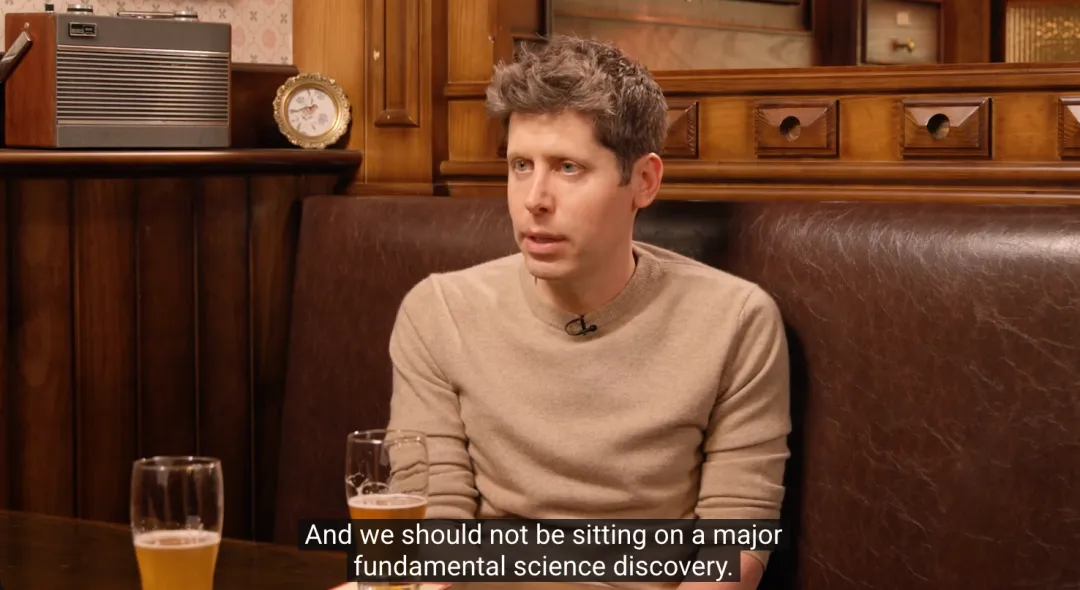
Ottman argued that major basic scientific discoveries should be made public.
Ottman believes that human beings should have basic scientific knowledge and that important scientific findings should be made public.
However, the professional development and achievement of researchers is largely due to the discovery itself.
He hopes to find a way that both benefits the world from knowledge sharing and promotes researchers in these fields to continue to participate in scientific research in the future.
Once the findings have been made public, it is also necessary to help researchers understand the thinking, verify the inferences, and make these findings the basis for further research.
What are mathematicians adding to AI manuscripts?On GitHub, mathematicians launched an independent revision project called oai-math-revised.
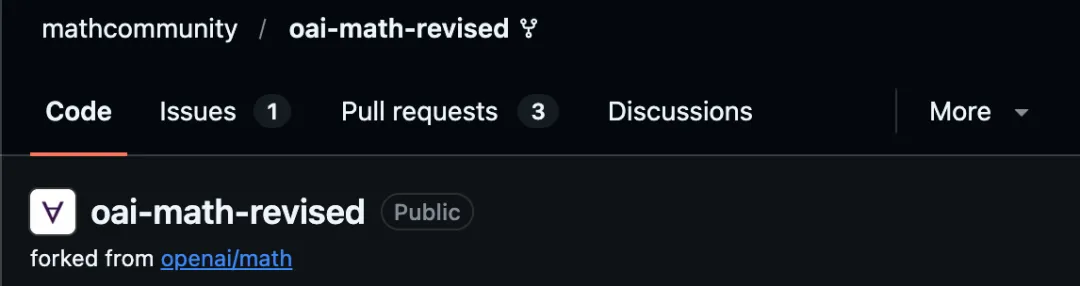
Mathematical researchers launched the oai-math-revised project to collaborate on the revision of OpenAI's publicly available mathematical research manuscripts.
This project refers directly to the two short boards of some OpenAI mathematical manuscripts: difficult to understand and incomplete citations.
To this end, the project initiators invite students, postdoctoral fellows, professors and mathematics enthusiasts to participate, supplement the literature, reason, identify and correct errors as much as possible.
AI releases a mathematical paper and the scientific community has to turn it into knowledge that others can read, understand, and use.
How to support these follow-up efforts has also become a question to consider when releasing the results.
OpenAI is trying to adjust the way it publishes its results.
On October 26, the company ranked the newly released relevant research manuscripts as "original research data" and introduced different practices such as inviting external experts to lead, organizing teams to interpret the results.

OpenAI identifies these manuscripts as "original research data" and explains that the results are at different verification stages.
Its mathematical repository also makes it clear that the relevant results are at different verification stages, some of which have not yet been formally verifiable by a computer.
After the publication of the manuscript, the interpretation, verification and revision will continue.
To allow more researchers to read these results and identify which methods can be used, new research can be developed on this basis.
About one out of every six.There's a disclosure that uses a large model.In the field of biology, researchers are actively using large models in their work.
On October 30, Epoch AI released a set of biological pre-print statistics:
Of the 4,922 bioRxiv pre-printed copies examined in September 2026, 846 disclosed that large models were used, or 17.19%.
It's about one out of every six.
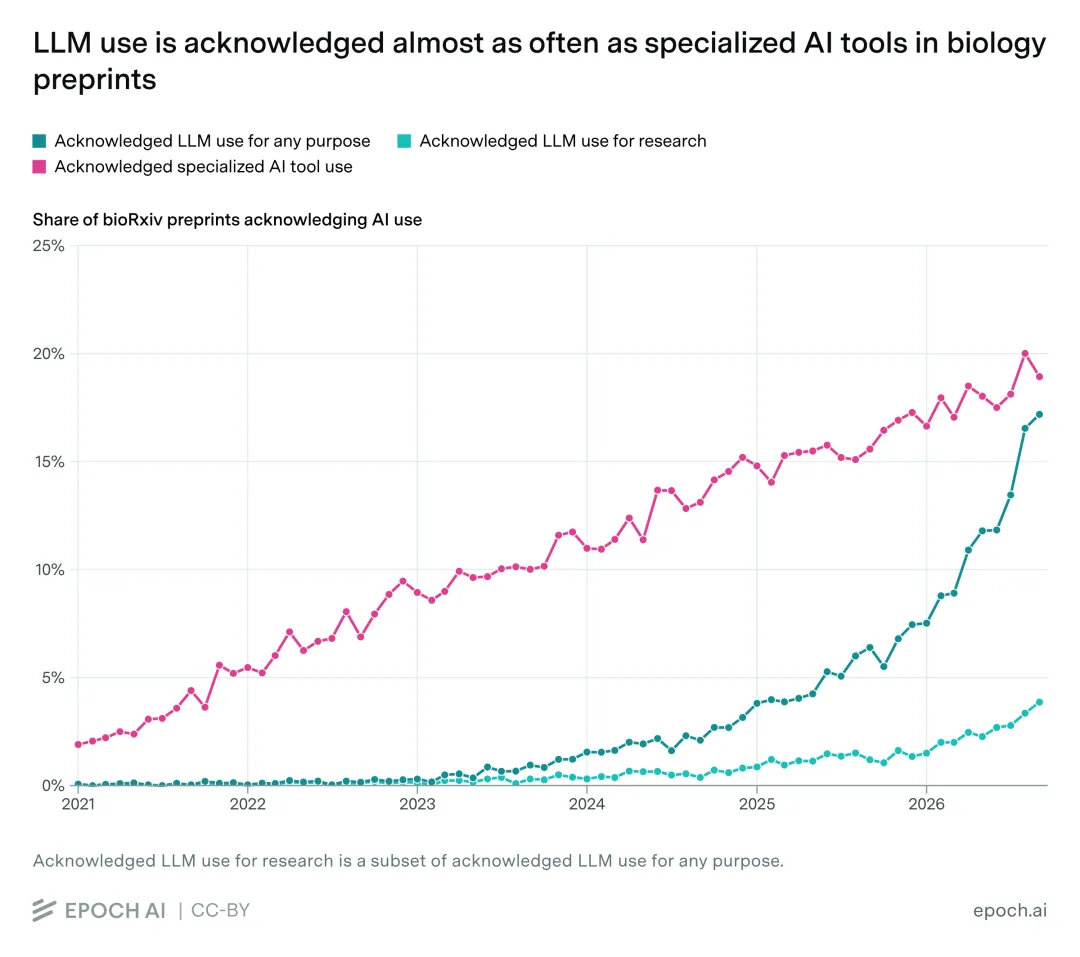
Big models of biological pre-printed books use disclosure ratios that continue to rise.
In September 2025, this disclosure rate was 6.40 percent. A year later, it was approaching 18.94 percent of exclusive AI tools in the same month.
These disclosures relate to literature, writing, programming, and research analysis:
A total of 190 pre-printed copies were disclosed that month, and large models were used for research or analysis, accounting for 3.86% of all pre-printed copies inspected.
According to the Epoch classification, this includes experimental design, data labeling, and statistical analysis; writing, literature synthesis, code, and computation, respectively, are included in other categories of use.
Epoch statistics show that large models are already involved in many aspects of scientific research.
What is the role of the model in a particular study, and how do researchers judge, validate and use its output?
From the analysis of dataTo get feedback from experimentsTwo recent public collaborations have shown how humans and AI can collaborate to advance research.
On October 21, OpenAI, PerturbAI and Scripps Research announced a collaboration:
Thousands of GPT-Rosalind-powered smart objects analyzed experimental data from millions of mouse brain cells.
According to the team, this round of data analysis and interpretation took 32 minutes.
Each intelligent organism revolves around a genetic disturbance, analyzes cellular responses, searches for relevant literature, and then offers explanations.
The results of these analyses ultimately put together a logical diagram linking genes, cell changes and possible biological mechanisms.
Researchers can follow this pattern, select clues to test for the next step, and continue to design experiments.
If there is a clue, the next step is for the experiment to give feedback.
In another study, biotechnology company Generate Biomedicines is using AI to design proteins, research and develop drugs.
On October 27, the team announced progress with the modification of the CAR-T receptor by Claude Code, which they wanted to shorten the part of the signal transmitted inside the receptor while retaining functionality.
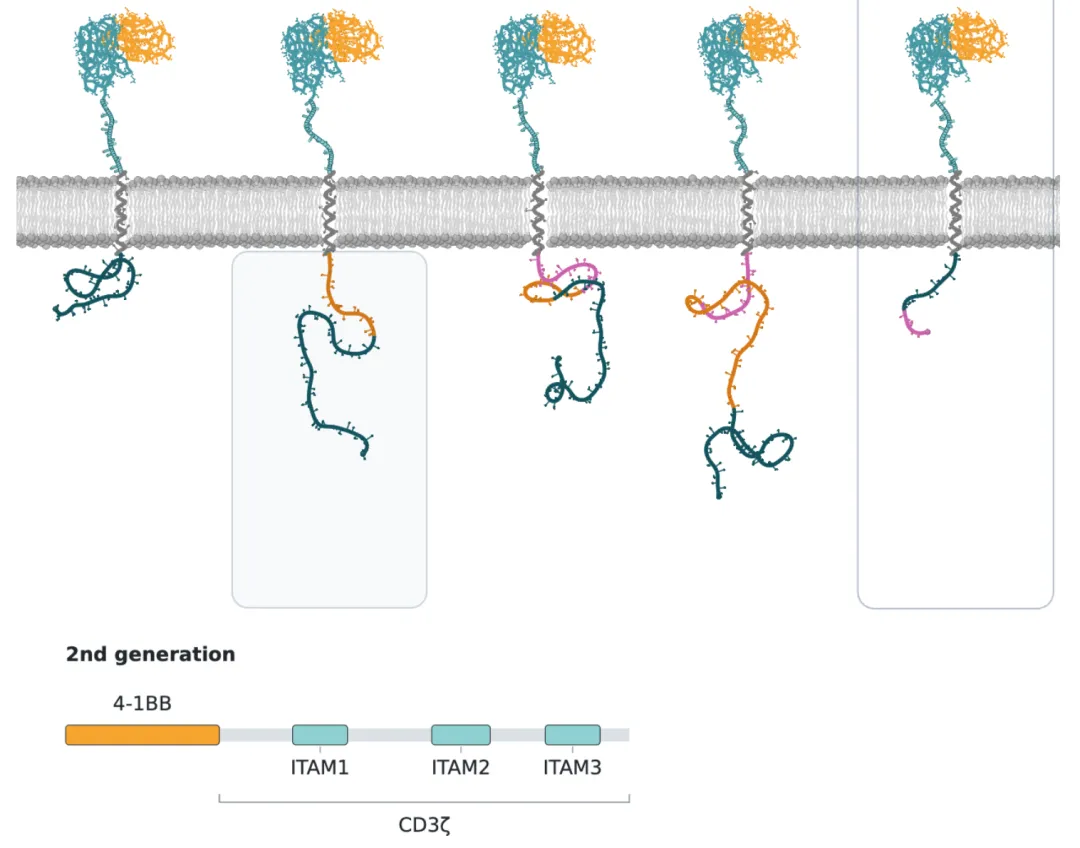
In contrast to different CAR receptors, the gray band represents the cell membrane.
CAR receptors are "recognition and initiation devices" of T-cells: targets for identifying parts outside the cell that transmit signals inside the cell to trigger T-cells to respond.
The researchers selected 186 first-round experiments from the models involved in the design. After the results came out, they handed over to the system, continued to modify the program, and conducted experiments.
After three rounds of design and screening, the team obtained a signal structure composed of only 45 amino acids, about 70% less than the second-generation CAR signal structure used as a counterpart.
In extra-corporeal experiments, the team reported that using the same dose of mRNA, more CAR receptors appeared on the surface of newly designed T cells and the ability to kill target cells was maintained longer.
The design was gradually modified in a round of experimental feedback.
AI researchDo you have access to ASI?From a series of mathematical derivations to a series of biological experiments, AI is entering more areas of scientific research.
It searches for clues, proposes designs, and then adjusts programs based on verified results.
If we focus on AI, another question arises: Can AI's scientific achievements, in turn, accelerate its own development?
As early as 2025, Google DeepMind has revealed that AlphaEvolve will accelerate one of Gemini's computational kernels by 23%, reducing the overall training time by 1%.
The algorithm optimization discovered by AlphaEvolve has been used to improve the training efficiency of Gemini.
AI-proven optimization programs have been used to improve model training.
Going a step further, if the system is able to develop the next generation of systems that are stronger on its own, and the next generation continues to push for AI development, the RSI (recursive self-improvement) cycle is formed.
If this cycle continues, it could be a driving force towards ASI.
From local optimization to continuous push for new discoveries, there are still many possibilities.
For the future of ASI, humans and AI may be exploring together in ways that are unimaginable today.
And perhaps it all starts with one attempt: to verify an idea faster, to confirm a finding more rigorously, and to get the next researcher to start a new exploration sooner.