Where will AI's next breakthrough come from?
In his book The Gentle Singularity Challenge, Sam Altman argued that AI will help humans build stronger AI systems and that AI's involvement in AI improvement is an early form of regressive self-improvement (RSI). When AI has the ability to participate in the next generation of AI research and development, technological progress has the opportunity to form a new accelerated cycle.
Dario Amodei also made a bolder projection in the sequel Machines of Loving Grace[2] that AI may be able to compress biological progress in the next 50 to 100 years to 5 to 10 years. Behind this judgement is the enormous potential of AI's deep involvement in scientific research.
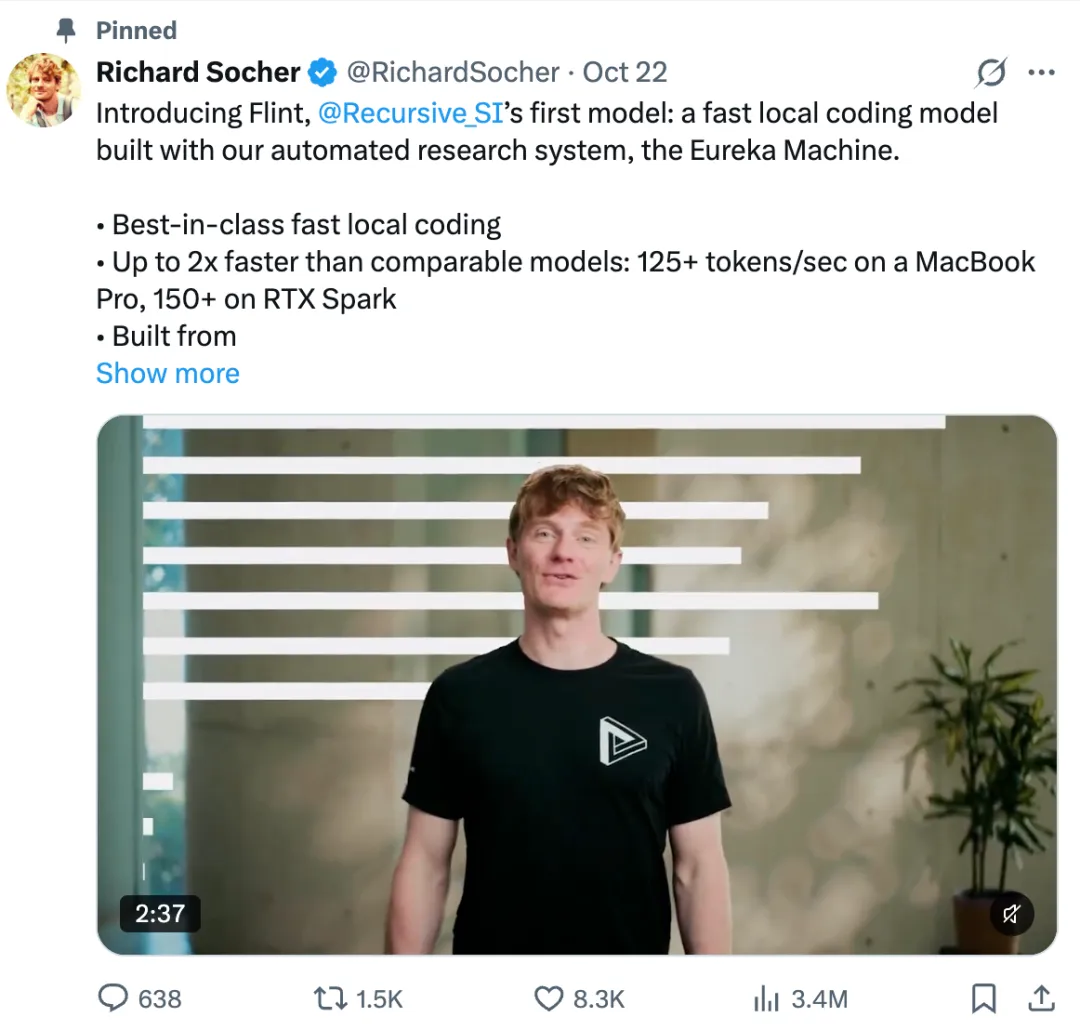
On October 22, Recursive SuperIntelligence, which Honda co-founded, released Flint, a 40B parameter-scale MoE programming model where each token activates only 2.5B parameters and can run locally on laptops.
The company's automated research system, Eureka Machine, has been involved in multiple phases of model research and development.
On this rapidly warming track, the national team played a new card.
The first 35B model, Apex-35B-V1.0, has just been released.
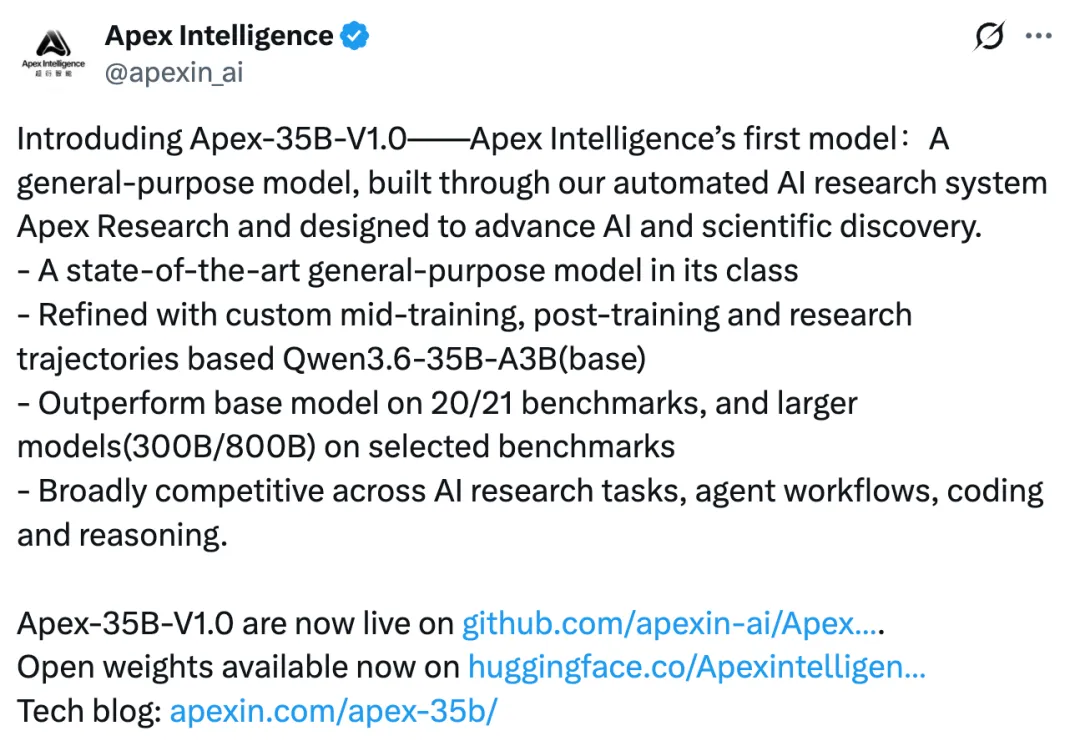
It is a model that combines general capabilities with research capabilities. The Apex-35B-V1.0 model can perform routine tasks such as coding, agents, queries and deep searches, and can be deeply involved in AI research, computer science, and robotics simulation.
In the 21 benchmark tests, Apex-35B-V1.0 took the lead on 20 points compared to its equivalent Qwen 3.6-35B-A3B; compared to Recursive Flint ((40B) it took 18 points ahead; 1 point flat, reaching the SOTA level. It even surpassed large-scale models with parametric sizes up to 500B and 800B in some high-difficulty assessments, demonstrating its competitive modeling capabilities globally.

Tech blogs:
This is the first time I've seen this.
Hugging Face links to:
The model, based on Qwen 3.6-35B-A3B training and post-training, incorporates a large number of data sets and research trajectories of its own.
Super-derived intelligence will return to the introduction of self-improvement (RSI) in model research and development, allowing AI to participate in experimentation and results analysis, and attempting to validate effective results for subsequent research and development.
The company, which was founded in June this year, has completed two rounds of financing in just a few months, totaling nearly 400 million yuan, and is highly sought after by the capital market. Today, in just four months, it has launched its first globally competitive model, super-derived intelligence with a solid scoreboard, in response to the expectations of the outside world.
Let's take a look at the score: the lead in terms of quantity
Part of the mission is to win the 800B Giant.
Before we get into the technical details, let's take a look at how the R&D methodology ended up delivering the results.
Nowadays, 35B-level models are not uncommon. However, even with the model scale of 35B parameters, adopting mature R&D processes to accommodate general capabilities such as Coding, Agent, and complex research tasks on a limited parametric scale is still a challenge. Moreover, Apex-35B-V1.0 also explores new routes that allow AI to be deeply involved in model research and development, driving the R&D process through iterative self-improvement (RSI).
To fully demonstrate the capabilities of Apex-35B-V1.0, we tested the capabilities of the model from research, intelligence, programming and reasoning in the four major capabilities directions, using a total of 21 benchmarks.
The full range of these four capabilities covers a matrix of AI models' capabilities. Research capabilities determine whether the model understands professional problems and explores solutions; intelligence capabilities enable the model to call tools, perform tasks, and continuously adjust according to feedback; programming capabilities convert research ideas into executable codes and experiments; and reasoning capabilities support the analysis and judgment of complex problems.
For a model that combines general capabilities with research capabilities, it can both perform well in everyday tasks and combine multiple capabilities to complete more complex research tasks.
Let's start with the ratings and see what the power of Apex-35B-V1.0 is.
1. Research capacity: 6 assessments of comprehensive leadership and measurement
For a model capable of engaging in complex research tasks, the real challenge is to understand professional problems, come up with rational solutions, and translate research thinking into practical results.
In the six ratings that best reflect the research capabilities, Apex-35B-V1.0 led both Qwen 3.6-35B and Flint. In some benchmark tests, Apex-35B-V1.0 even outperformed DeepSeek-V4.1-Flash at 500B parameters, and GLM-5.3 at 800B parameters.
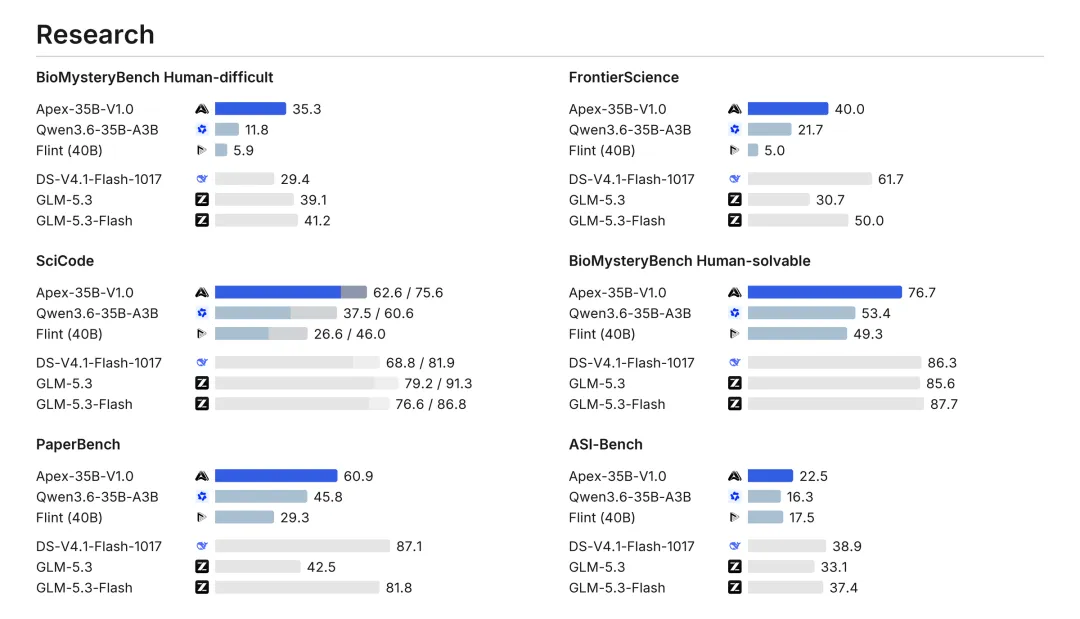
Among these bright data, there are two assessments worth paying particular attention to.
The first is FrontierScience, launched by OpenAI in 2025. It measures AI's ability to solve scientific problems of high difficulty, with topics spanning fields such as physics, chemistry, and biology, both at the level of international Olympic competitions, and involving complex tasks that PhD researchers may encounter in actual research, which are far more challenging than answering conventional knowledge questions.
The Apex-35B-V1.0 received a score of 40.0 in this rating, eight times that of Flint, an improvement of about 84% over the basic Qwen model. More surprisingly, it outperformed the GLM-5.3 with a total parameter of 753B, which scored 30.7 points.
Another is the PaperBench launched by OpenAI, which directly examines whether AI can reproduce an AI research paper from scratch.
The assessment selected 20 ICML 2024 Spotlight and Oral papers, requiring intelligent entities to understand the method of the paper, write code, run experiments, and restore the original papers as far as possible. To measure completion, the researchers further subdivided these tasks into 8,316 scoring projects.
In this highly difficult test, the Apex-35B-V1.0 scored 60.9 points, about 2.1 times that of the Flint, which is much higher than the GLM-5.3's 42.5 points.
Such results are surprising. Only models with 35B parameters are capable of releasing such powerful capabilities in high-difficulty research tasks. Especially in professional problem solving and paper replication scenarios, the Apex-35B-V1.0 has surpassed the 800B parameter model in some assessments and has made the RSI technology trajectory explored by superintelligence shine even more.
2. Intelligent bodies and programming: common capabilities stable
The ability of an intelligent organism determines whether the model can autonomously call tools, organize multi-step tasks and adjust actions based on feedback; programming ability allows it to directly write and modify code, conduct experiments, or even handle complex software engineering problems.
In six smart body ratings, Apex-35B-V1.0 was equally at the top of the scale. In six smart body ratings, Apex-35B-V1.0 was at the top of the overall base Qwen3.6-35B-A3B, with a five-point lead and a one-point lead compared to Flint.
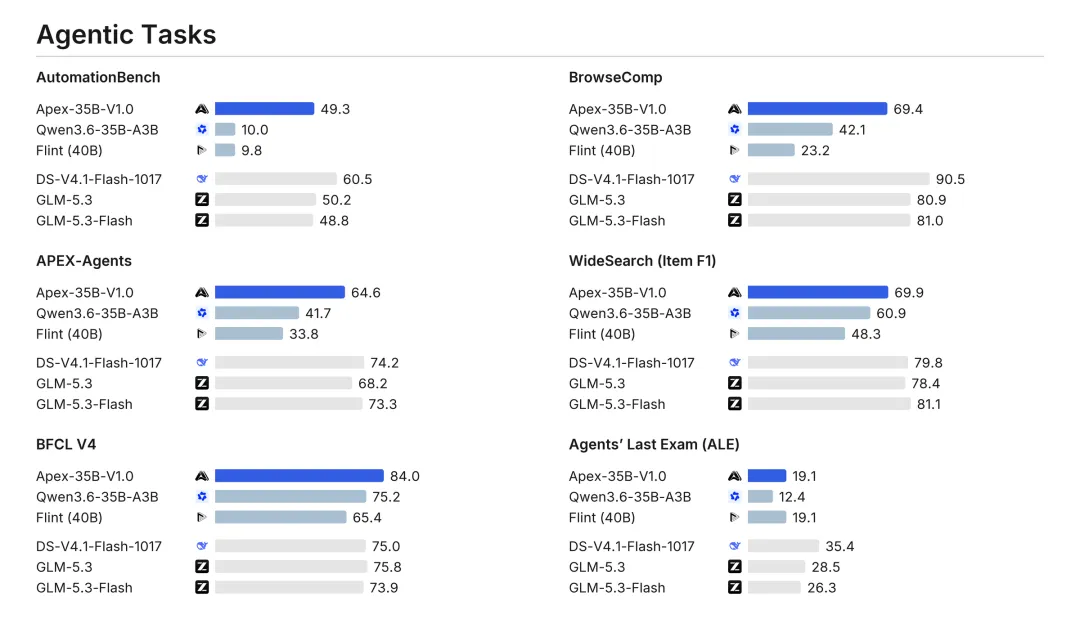
The most prominent of these is the BFCL V4 (Berkeley Function Calling Leaderboard) launched by UC Berkeley.
This is one of the representative benchmarks for measuring the call capability of large model tools. Evaluation is not limited to whether the model can call a function correctly, but also further examines complex intelligent body tasks such as multi-cycle interactions, information retrieval, memory operations. This means that the model must not only know which tool to call, but also understand when to call, how to pass parameters, and how to maintain correctness in continuous operations.
The Apex-35B-V1.0 scored 84.0 points on the BFCL V4, outperforming all participating models. Even in the face of the larger GLM-5.3 and DeepSeek-V4.1-Flash, it also led by 8.2 points and 9.0 points, respectively.
Programming ability has long been a prerequisite for large models. Today's high-difficulty programming benchmarks are not limited to generating a few lines of correct code, but also involve understanding complex code libraries, modifying existing projects, operating terminal environments, and verifying results through testing.
In the evaluation of programming capability, Apex-35B-V1.0 is the leading analogue model in three of the five evaluations, including SWE-Atlas QnA, Terminal-Bench 2.1 and SWE-bench Pro v2.
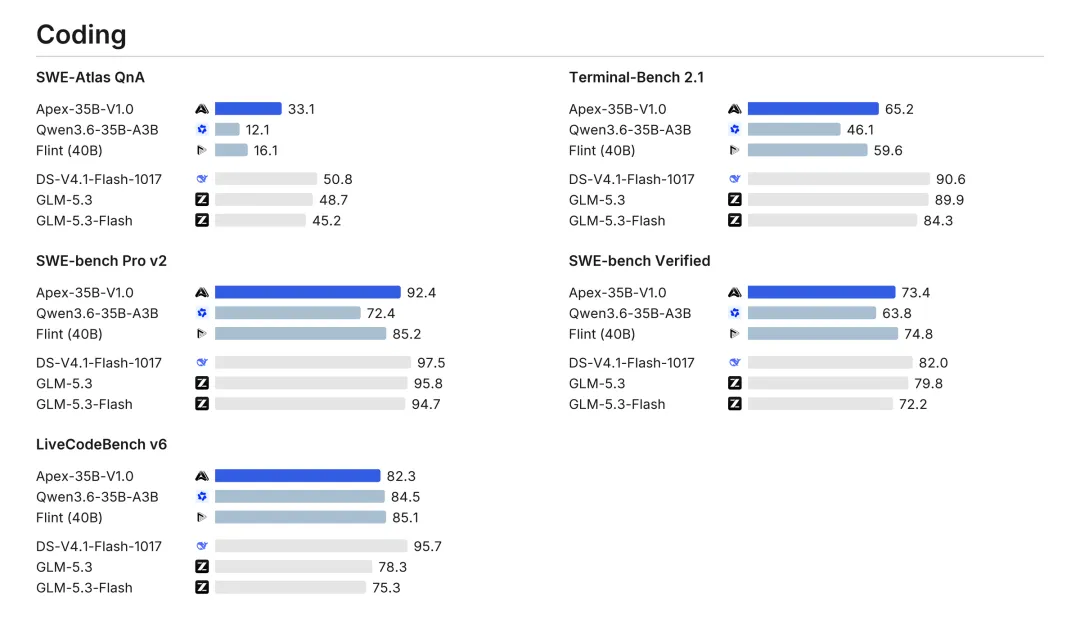
Among them, Terminal-Bench 2.1 is a challenging appraisal. It requires a smart body to complete software engineering, system configuration, etc. tasks in a real command line environment. The model needs to execute commands autonomously, handle bugs, and ultimately deliver validated results. In this appraisal, Apex scored 65.2 points, surpassing mainstream Agentic Coding's Flint.
Overall, Apex led Flint in three of the five programming ratings. Among them, the SWE-Atlas QnA score was 33.1, about twice that of Flint; the SWE-bench Pro v2 score was 92.4, equally higher than Flint's 85.2.2.
Apex is not only capable of summoning tools and planning tasks, but also has the ability to implement programs into actual code and engineering operations. This ability to perform tasks from analysis to manual execution is an important foundation for its practical role when AI begins to participate in model research and complex research tasks.
3. Reasoning ability: 4 levels leading to the same measurement, HLE achieving cross-level transcendence
Whether it's designing experiments, analyzing complex problems, or executing intelligent tasks that require continuous decision-making, reasoning skills are always the bottom line.
Of the four reasoning assessments, Apex-35B-V1.0 led the same calibration model, outperforming the 500B parameter DeepSeek-V4.1-Flash in some scenarios.
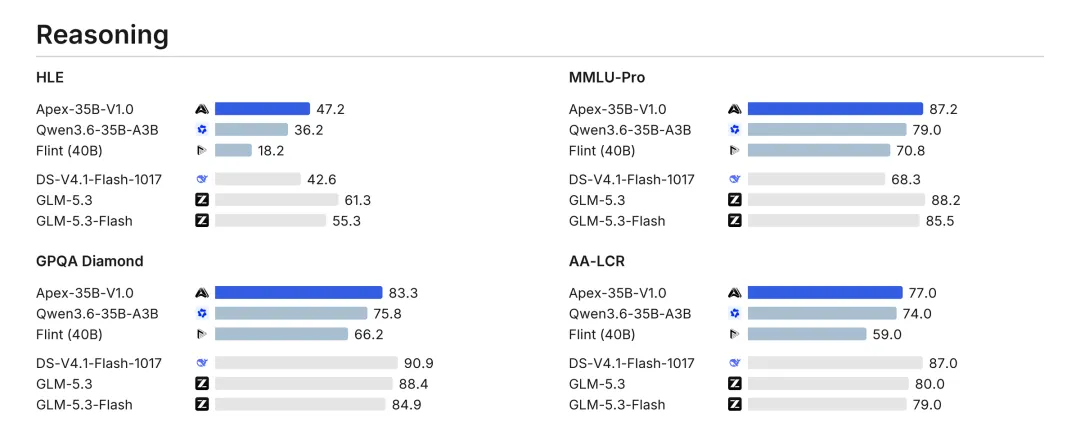
The most notable of these is the HLE, known as "Humanity's Last Exam". The assessment, launched by the Center for AI Safety (CAIS) and Scale AI, was published in 2026 in the journal Nature Science. Its formal thesis collection contains 2,500 high-difficulty questions covering hundreds of disciplines, including mathematics, physics, chemistry, and biology.
HLE's original design goal was to address the difficulty of continuing to distinguish the level of competence of traditional assessments, gradually being overwhelmed by top models. The subjects were designed by experts in all fields, and many of the questions required in-depth expertise and complex reasoning could not be solved through simple searches.
In an assessment of the limits of model capability specifically challenged, the Apex-35B-V1.0 scored 47.2 points, which is about 2.6 times that of Flint, 11 points ahead of the basic Qwen and much higher than the parametric DeepSeek-V4.1-Flash.
Another MMLU-Pro examines the model's comprehensive performance when faced with complex knowledge and reasoning problems. This assessment, proposed by researchers such as TIGER-AI-Lab, introduces more complex reasoning questions on the basis of traditional MMLU, and further increases the difficulty by increasing the options for each problem from 4 to 10.
Apex scored 87.2 points in this assessment, just 1 point behind GLM-5.3's 88.2 points in the 800B parameter, demonstrating a level of comprehensive reasoning closer to a larger model.
4. Face to face with Flint: 21 reviews, 18 leads
Looking globally, RSI has become one of the most sought-after technology routes in the field of AI. In this exploration, the two startups from Central America have formed an interesting contrast.
Recursive Superintelligence in the United States, led by Richard Socher, former Chief Scientist of Salesforce, co-founder of the company, including renowned Chinese AI researcher Tan Liu, and top talent from institutions such as OpenAI, Google DeepMind, and Meta.
On the other hand, it is super-derived intelligence, which was founded in June of this year by 27 year old assistant professor Chen Yong-sup, from the School of Artificial Intelligence at Tsinghua University, who also uses RSI as a core technology route, with the goal of building a basic model with continuous research and self-improvement capabilities.
It is well known that Recursive started earlier and has more capital and computing resources. In May, they announced the completion of a $650 million financing, valued at $465 million. In July, Recursive also signed a multi-year computing collaboration agreement with AWS for a total of $410 million to provide infrastructure support for large-scale automation research.
These resources are particularly important for the exploration of RSI. AI proposes research hypotheses that need to be verified experimentally; experiments generate new discoveries that need further training and evaluation. The entire process involves large amounts of computational consumption. The more resources are abundant, which usually means being able to conduct more experiments at the same time, explore more directions, and have greater space capacity. In the field of highly dependent AI, this is undoubtedly a huge pioneering advantage.
It is for this reason that the first models of the two companies represent a very interesting technological intersection.
The results show that in 21 benchmark tests, Apex-35B-V1.0 scored 18 points ahead of the most recent Recursive Flint model and 1 point flat.
In just four months, a Chinese startup with a much smaller computing and financing scale than its U.S. rivals, the first model has outperformed strong competitors in most comparison assessments. RSI's competition has begun to shift from technological imagery to real-world models, and the Chinese team has become an undeniable player in the global competition.
After all, the most attractive part of the RSI is that AI is involved in model research and development, helping teams discover problems faster, validate new methods, and apply the results to the next generation of models.
If this method continues to work, the gaps in funding and computation will not necessarily determine the final strength of the model.
RSI cycles that continue to evolve
Starting to move
In fact, allowing AI to participate in research and technological development has become an increasingly sought-after area of exploration in the industry.
One is AI for AI, which focuses on enabling AI to participate in the research and development of models, algorithms and training systems to drive continuous improvement of AI itself. The typical representative is the Recursive's Eureka Machine, which is the product of this route.
The other is AI for all, involving AI in research across industries and driving AI applications in technology innovation. AI giants have done a lot of exploration, such as Google DeepMind's AI Co-Scientist helping researchers generate, evaluate, and improve scientific hypotheses and explore potential directions for research; Claude Science at Anthropic integrates document analysis, multi-step research, code execution, and computational resource use into the research workflow; and Claude Code also shows the potential for performing long-term scientific computing tasks.
At the same time, a number of startups in the vertical field are also attempting to involve AI in professional research and development. For example, chip design startup ChipAgents uses Agent to assist with chip design, debugging and verification; materials company CuspAI has found a combination of generative material design, high-precision computing simulation and experimental verification.
AI for AI can be said to be a narrow-minded RSI, while AI for all is a broad-minded RSI. The two routes are focused, not parallel, and superintelligence wants to combine the two routes.
In order to place this idea in model research and development and expand it to further research and engineering task accumulation experiences, the team built the Apex Research automation research system and introduced it to the Apex-35B-V1.0 R&D process, covering training data construction, automation experiments, training program exploration, and GPU Kernel and logical optimization.
How does Apex Research participate in model research and development?
Apex Research's specific work can be divided into three areas:
Training data is generated based on model shortcuts. Traditional model training typically requires researchers to first analyze the shortcuts and then collect, filter, or tag the corresponding data. Apex Research attempts to automate this process by allowing the AI to evaluate feedback, find where the model needs to be reinforced, and generate targeted training samples. For example, using fluid mechanics (CFD), this set of data improvement processes improved the model's performance on the internal CFD-Bench by 32.1 points, initially forming a feedback loop from finding problems to reinforcing.
According to the experimental feedback adjustment training program, the system analyzed the evaluation results and the trajectory of the intelligent body, looking for patterns of repeated failures. It found two key problems: too long reasoning in the context would make the model "go god", and imbalanced data allocation ratios lead to model biases. To address these problems, the system explored different sequence length distributions, sampling ratios of long short trajectories, and how to adjust training batches based on token numbers. These explorations ultimately improved the reliability and training efficiency of the intelligent body.
On the training side, Apex Research is involved in optimizing load allocation, communication and computing scheduling between multiple GPUs, reducing device wait times, increasing training throughput by 45 to 60 percent. On the reasoning side, the system optimizes scheduling around attention computing, KV Cache management, and the pre-fill and decoding phase. Under relatively close loading conditions, decoding speeds reach 1.6 to 1.8 times the original, with the first Token delay decreasing by 30 to 35 percent.
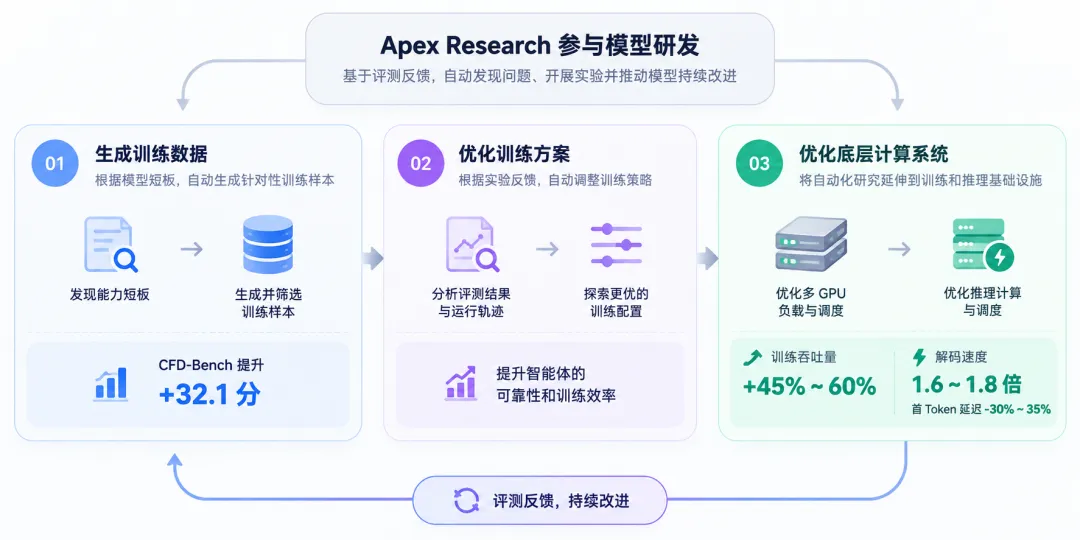
Each round of experimental exposures can be the starting point for the next round of research; effective improvements after verification can be applied further to training data, training strategies or underlying systems to promote further research and development.
In the process, it hopes to allow AI to gradually accumulate the capabilities of independent research and use these capabilities in turn for the development of the next generation of models, expanding further into interdisciplinary fields such as mathematics, physics, and robotics.
Allowing AI to accumulate experience in research and then use that experience to advance its own evolution is the core idea behind the RSI cycle.
Start researching
The real mission is to see the real chapter.
Research tasks are far more complex than conventional questions. Models not only understand expertise, but also translate knowledge into executable solutions, deal with problems that arise in experiments, and constantly adjust according to feedback. The final results of research also need to be tested by objective indicators.
In order to demonstrate this capability, super-derived intelligence offers specific examples of Apex-35B-V1.0 participating in research missions in three directions: computational science, robotics simulation, and AI for AI.
1. In computational fluid mechanics, models deal with real computational scientific problems.
Computational fluid dynamics (CFD) is a well-suited field for testing AI research capabilities. Apex-35B-V1.0 shows two different types of CFD optimization tasks.
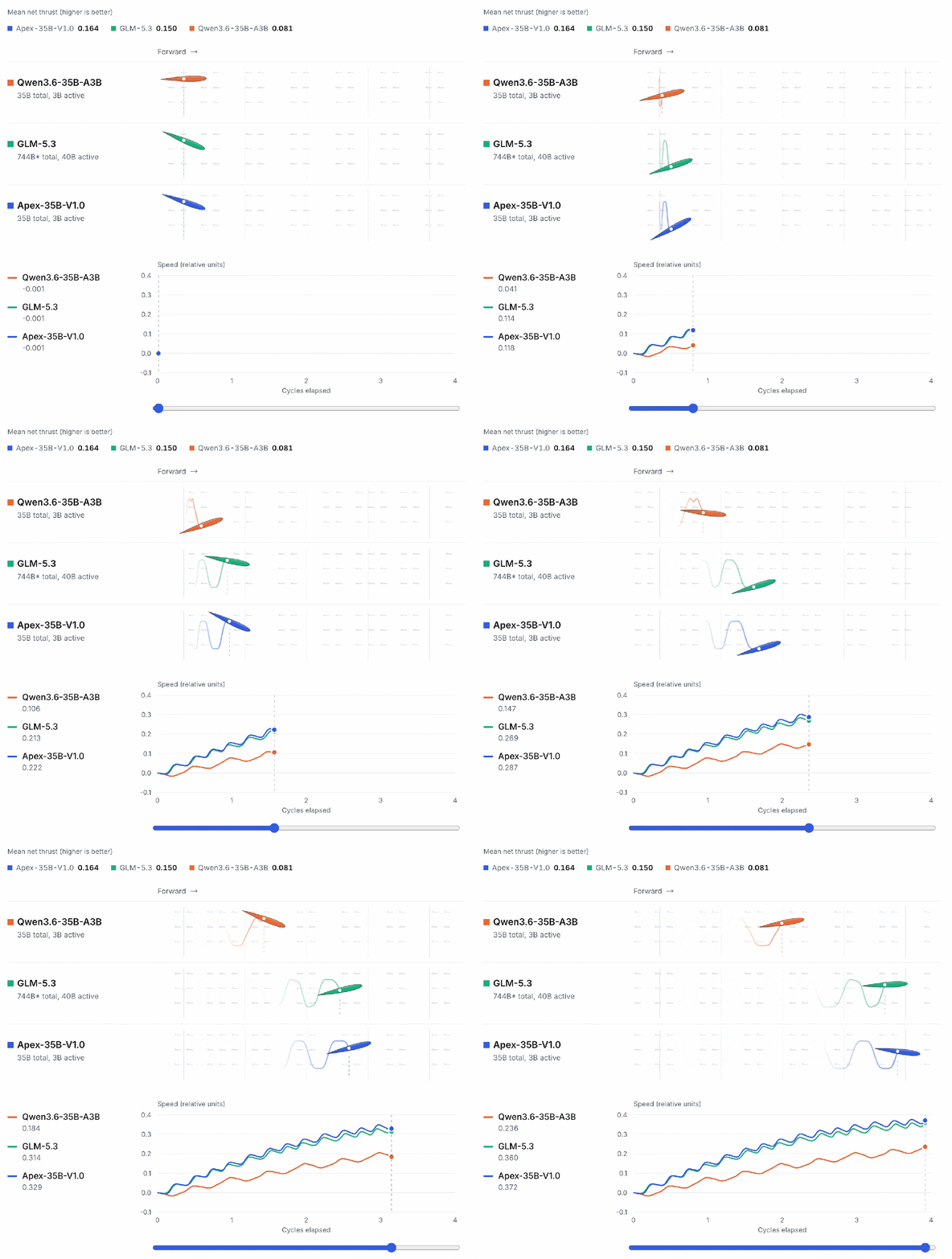
The first is wing movement optimization. The difficulty of this task is that the movement trajectory of the wing pieces is controlled jointly by 32 helium coefficients. Adjusting one of the parameters can change the performance of the entire motion cycle. The model needs to be repeatedly explored in this high-dimensional parameter space to find better motion patterns by simulating feedback. In this set of simulation conditions, the maximum net thrust given by Apex-35B-V1.0 is 0.164, higher than 0.150 of the GLM-5.3 and 0.081 of the base Qwen model.
The second is the allocation of the parameters for the output of a vascular network. This task can be understood as a complex parameter matching problem: to give a vascular network with 64 outputs, as well as 64 groups of different resistance and sequence parameters, requiring the model to reasonably allocate these parameters to each output.
From the experimental results, the Apex-35B-V1.0 model had a lower default value of about 1.24×10⁻⁵, better than the GLM-5.3's 1.41×10⁻⁵ and the basic Qwen model's 1.68×10⁻³.
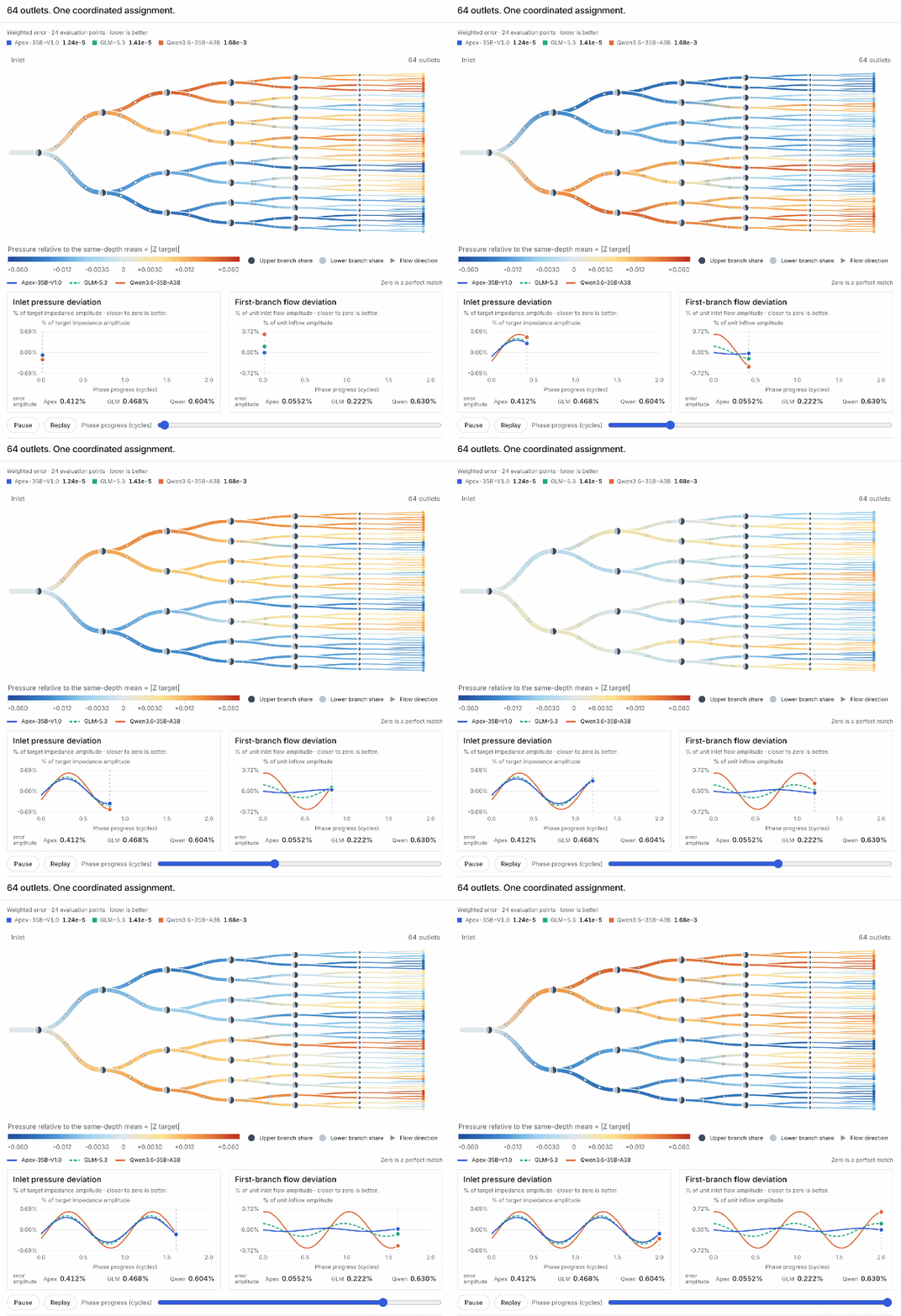
In the CFD-Bench evaluation, with Qwen 3.6-35B-A3B as the common baseline, Apex-35B-V1.0 achieved a 79% win rate (79 wins, 0 draws, 21 draws) and demonstrated strong computational science task handling capabilities.

2. Robot simulation, learning to adjust during trial and error
A major difficulty with robotic tasks is the continuous interaction with the environment. The model is difficult to plan all the actions one at a time, but requires constant observation of the environment during execution, judging the results, and adjusting the next action according to feedback. Apex-35B-V1.0 demonstrates this ability in two robotic assessment benchmarks.
The first was RoboRSI, which examines the ability of robots to program intelligent agents to perform tasks and collect trajectories. The team demonstrated five tasks, including stacking blocks, arranging them by size, moving T-shaped blocks, and completing the same transportation task in the presence of interference.
Real2Sim turned the challenge to scene reconstruction: allowing the model to build corresponding simulation scenarios in the virtual world based on observational information from the real environment. Here, six sets of scenarios are shown, which compare the results of real reference images, the basic Qwen model and the Apex-35B-V1.0 reconstruction, while demonstrating the effects of joint motion in the reconstruction scenarios.
From these sets of comparisons, the rebuilding performance of the Apex-35B-V1.0 is significantly better than that of the basic Qwen model, with the gap being not only low in restoration accuracy, but also the "can't use" distinction between simulated scenarios.

In RoboRSI, Apex-35B-V1.0 scored 44.5, Qwen3.6-35B scored 35.0, Flint scored 30.0, while Real2Sim scored 21.55, approaching the larger GLM-5.3 (25.6) and GLM-5.3-Flash (21.4), while Qwen3.6-35B scored only 2.1, Flint scored only 2.3.0.
3.AI for AI: When AI starts "bringing new people"
The team also demonstrated a more imaginative use: using AI as a researcher to help other models improve their capabilities.
In a push-box puzzle experiment, Apex-35B-V1.0 plays the role of a "guide" who is responsible for adjusting the training configuration of a small model, "Qwen 2.5-3B-Instruct", to help it gradually master the problem-solving strategy. During the training, the model executes 207 commands and code modifications over a 4-hour strategy exploration phase, forming 36 high-quality research and engineering operations, of which 15 key decision-making influences the final training strategy.
Another experiment shifted the target to the Stable Diffusion 1.5 image generation model. Apex-35B-V1.0 participated in the model's reinforcement learning mitigation experiment, using fixed aesthetic reward models as feedback signals, and explored optimization schemes through DDPO in conjunction with LoRA to improve the aesthetic reward scores of the generated images.
In the process, Apex-35B-V1.0 discovered two key improvements: one was to adjust the noise level to the 20 steps actually used in the benchmark test, reducing the time taken for a single test from 1040 seconds to 551 seconds with a basically flat aesthetic rating; the other was to raise the training speed limit to 409 rounds of training within a given budget. Following these optimizations, the model's average aesthetic rating increased from 5,397 to 6,638, an increase of about 23%.
Seeing here, the current phase of Apex 35B V0.1's research capabilities and practical application boundaries are presented more intuitively. Prior to this, the evolutionary research system of super-derived intelligence has achieved several results in the direction of AI for AI and AI for Math. This model release is the starting point for the team to further integrate their research experience into basic models.
The link is as follows:
[1]
[2]
© THE