“ Traditional rope-driven and connecting robots mostly drive only one end, and the study allowed the two robots to share a set of ropes to work together.
CDPR also has a new use for rope-driven and connected robots.
A team of researchers at the University of Tokyo has developed a system called TwinX. An inter-body wire is connected between the two wheeled robots, each of which is connected by a rope to the surrounding pillars, forming a rope-driven connecting system that can drive two floating connecting rods simultaneously.
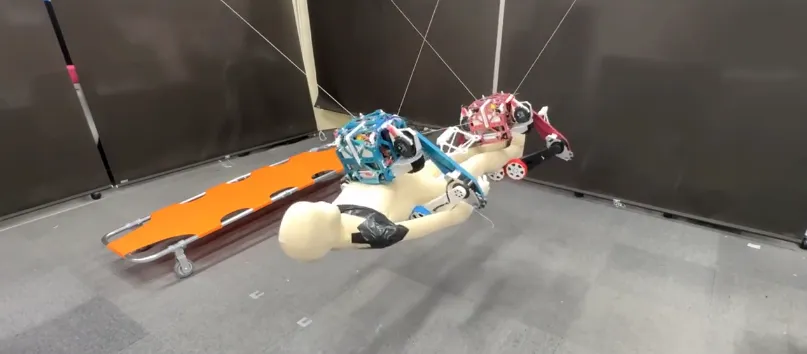
In the real-world experiment, the pair used the drone to hang the rope from the ceiling pillars, then suspend it halfway up, use the legs as their arms, and put the fake man on the scaffold from the waist and legs:

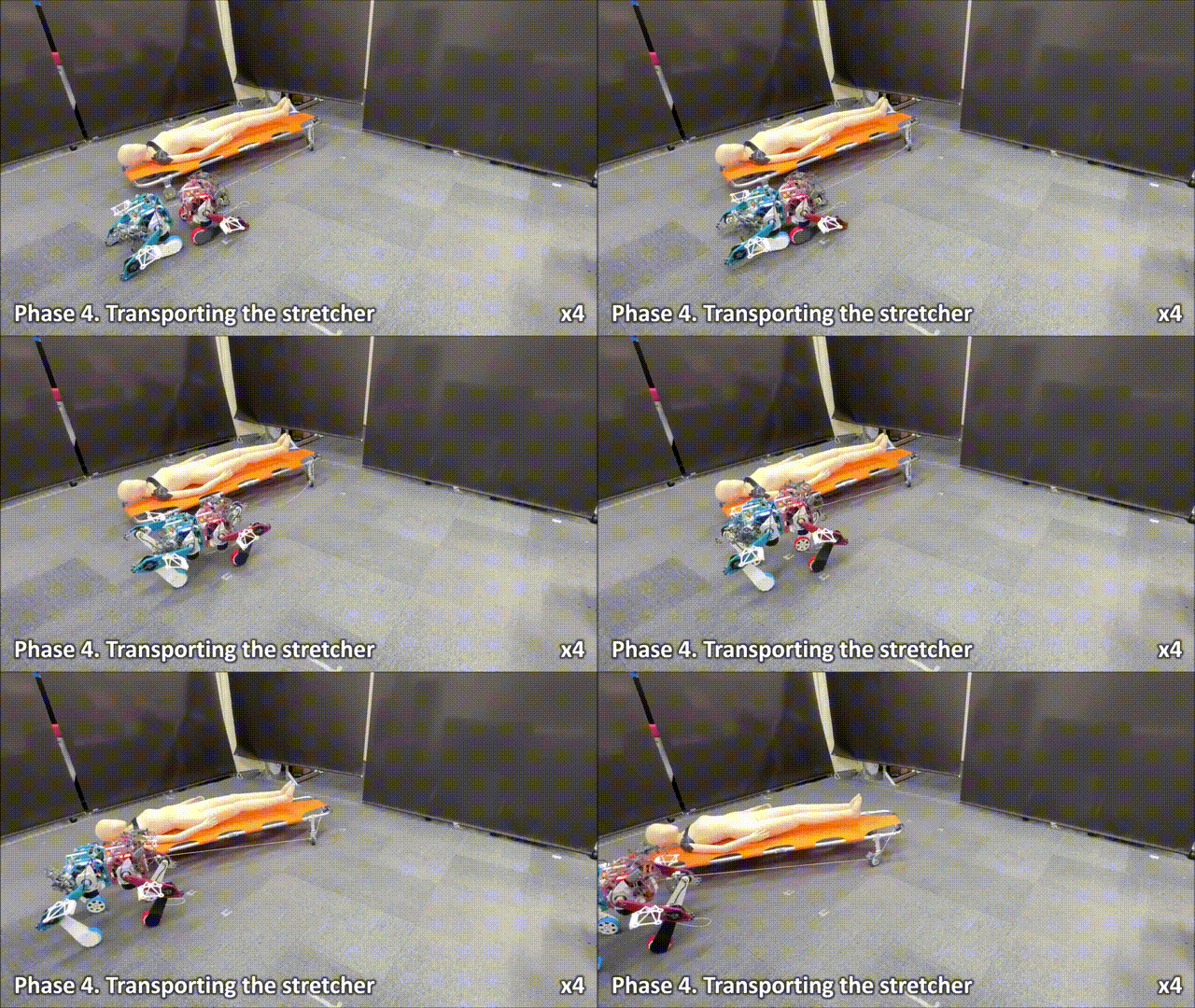
Finally, the rope turned into the shape of a vehicle, and the scaffold was pulled away:
The paper has been accepted by IEEE Robotics and Automation Letters.
01.
The problem of rope-driving robots solved by a single person
The principle of CDPR is simple: pulling the rope from multiple disks to the end executor, adjusting the length and tension of each rope to control the position and posture of the end.
For example, CoGiRo uses multiple ropes to hang a box-shaped end on a frame, and after installing a mechanical arm it can operate in a three-dimensional space of this size; Pylos uses 3D printing heads as the end, and the printing environment reaches 13.6×9.4×3.3 meters.
The problem is that at each end of the CDPR there are several ropes, the ropes span a large amount of work space, and at most the ends, the ropes and ropes interfere easily with each other, and the wire design is increasingly difficult. There have been related attempts before, such as two mechanical arms moving on the same shared rope, or two arms systems based on equivalent institutions, but their movements can be along a straight line without using the CDPR workspace.
02.
One cabin, in exchange for more space.
The practice of TwinX is to put a rope between the two main bodies.
The team first demonstrated the effect with a simplified model. In the two-dimensional plane, the two cores were viewed as points of gravity, with each point of gravity connected by two strings to the upper environmental focal points.
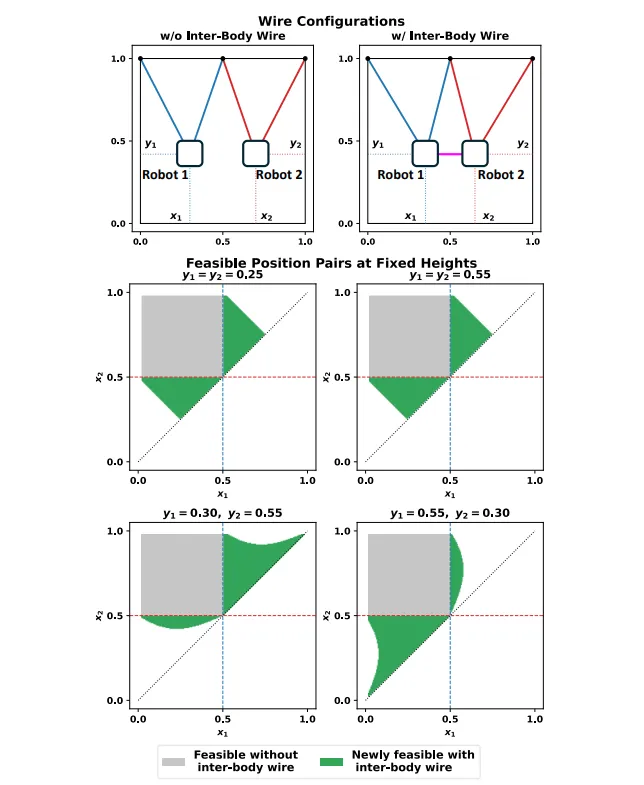
The results showed that the combination of possible locations significantly changed after the addition of the space rope (green areas in the diagram) and the trend can be seen under a variety of symmetrical and asymmetrical altitude conditions.
The paper emphasizes that the source of the effect lies in the newly added rope connecting the two cores. If a new environmentally-determined rope is used to obtain similar traction directions, another point of attraction is to be found in the environment, and the rope easily passes through the area where the core or other ropes are located. The machine rope directly connects the other robot as an object, while providing additional traction direction, and does not interfere with the core or other ropes. The authors also point out that real systems are subject to constraints such as the platform posture range, the strain on the rope, and the actual available workspace will be smaller than the ideal model.
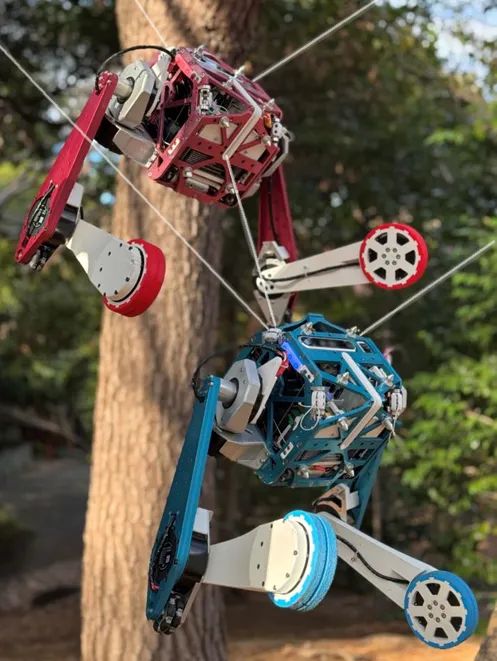
In hardware, the TwinX is composed of two wheeled robots WiXus with the same structure, called WiXus-Blue and WiXus-Red, each with a computer, battery and camera. The cables are enclosed by a wire module on Blue, with a maximum continuous voltage of about 400 N. Each robot can pull up to 4 ropes into the environment, with the maximum continuous voltage of the wire module corresponding to about 120 N.
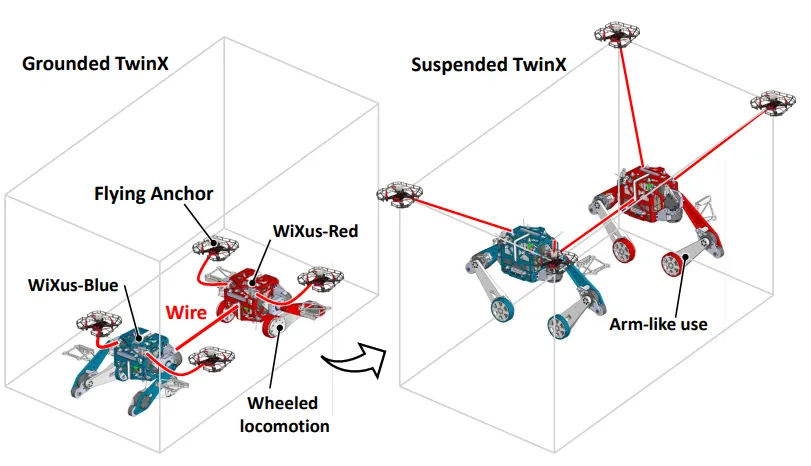
On the ground, the wheels are responsible for movement; when the rope is suspended into the air, the wheels no longer support the body and can be used as an arm to operate objects. Tightening the rope between the machines, the two robots can also interact, although this is not the focus of this article.
03.
Two robots sharing a Jacobean
On the controlling side, the team modeled the two robots as a whole: all the strings were pulled through the Jacobite matrix W, mapped to the twelve-dimensional rotation of the two robots.
Control the three parts. First, the reference speed is calculated using the PD control, based on the deviation of each robot's focus from the target position; then the reference speed is converted into the speed of the rope, making proportional feedback; the gravitational compensation principle is solved by a secondary scheduling with a stress-on-low limit constraint.
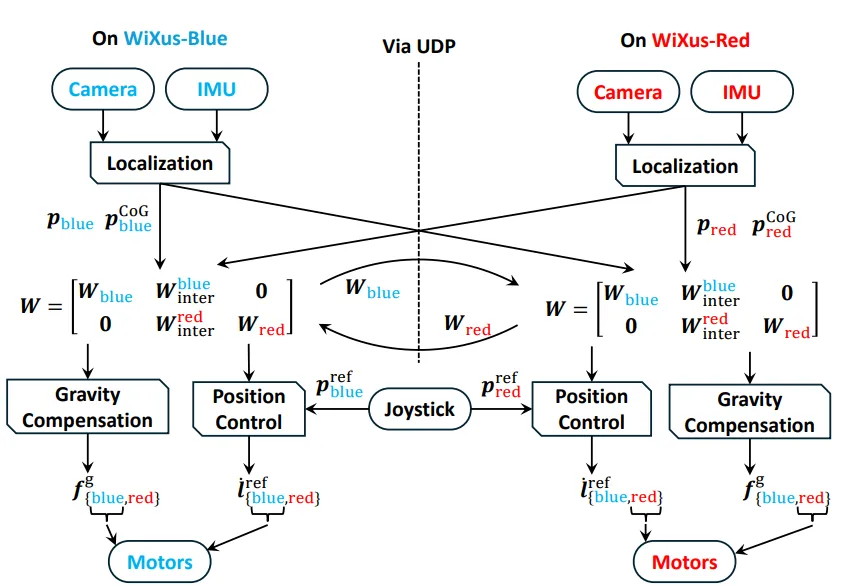
In actual operation, the two robots each complete the positioning and control calculations on their own, and then exchange the positioning results and Jacobean ratios through UDP, so that both sides maintain the same system Jacobean. UDP communication threads run at 200Hz, the main control thread 50Hz; under the same Wi-Fi network used in the experiment, back and forth delays average 4.1ms, up to 5.9ms. Each robot calculates all the instructions for the rope, but only executes the part of the rope itself, which is responsible for the rope Blue.
04.
Tests: hanging ropes, lifting people, pulling racks
In MuJoCo, the team simulated four focus points at ±1.5, ±1.0, and 2.0 respectively, with the minimum incremental (min-jerk) trajectory between the target points. The test was divided into two sets of comparisons: two robots kept in relative positions (keep) and changed relative positions (change); moving (MOVE) and stopping at the target point (HOLD).
The results showed that the controller as a whole was able to keep track of the target location sequence without the control collapse. Larger errors occurred when the target location was close to or beyond the current wiring range.
The positioning error is approximately 0.1 meters. This is not accurate enough for precise positioning, but it is sufficient for rough moves and trailers. In addition, there is no significant difference in the characteristics of the error between keep and change, MOVE and HOLD.
The real-life experiment simulates a rescue scene: four pillars attached to the ceiling, a fake man weighing 5 kg (150 cm) on the ground and a pair of scaffolds attached to the scaffolding with ropes previously drawn by Red.
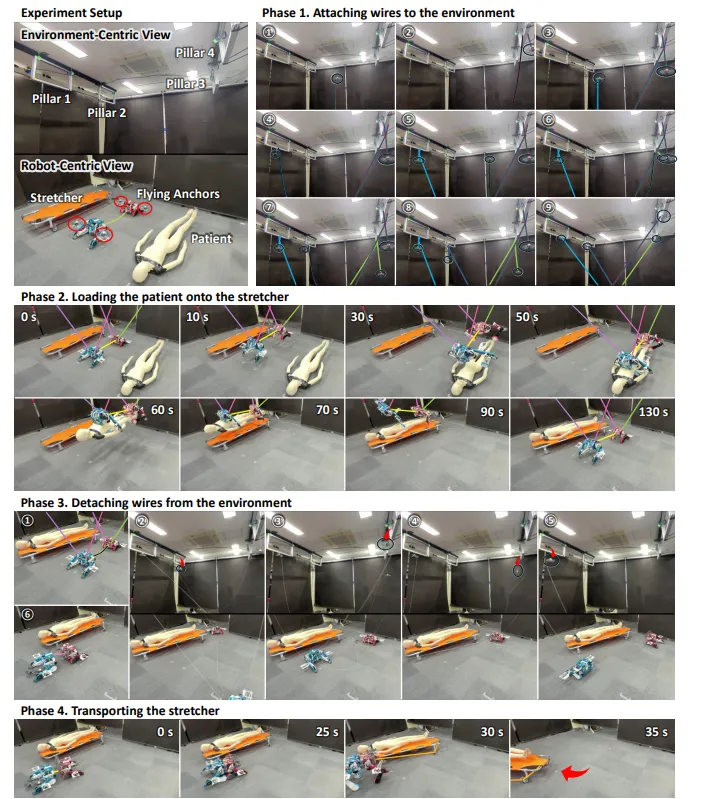
In the first phase, the four flying saucers used RGB-D-based cameras to attach the two robots to the four pillars. All flying saucers were observed and controlled by Red.
In the second phase, four environmental ropes were used, plus one inter-plane rope and a total of five ropes. Two robots were suspended in the air, with their legs attached to the foreigner's waist and legs and transferred to the scaffolding.
The data shows that Blue tracks relatively well, Red has a partial period of inadequate tracking, which indicates that the voltage is at the software upper limit of 100N. The authors estimate: each WiXus weighs 9.4 kg, the surrounding rope is slanted, the voltage ratio is approximate to 1/√3, and after pulling off the two robots' self-weighting, the net load at the hardware limit of 120N is about 9.5 kg, and at the software limit of 100N is about 4.7 kg.
The third stage is controlled manually by the operator, performing the opposite action to the rope, unplugging the rope from the column, retrieving the rope, and recycling with the flying hammer. In the fourth stage, the TwinX tightened the rope between the machines into the shape of the vehicle, wrapped the red rope, and dragged the rack away.
The purpose of this experiment was to link the entire process of field ropes, supporting targets, transferring, and transporting into a single system. The number of ropes that could be used simultaneously in flight was limited, and TwinX achieved multipoint support and transportation of two floating bodies under realistic conditions such as four environmental ropes.
Address of the paper:https://arxiv.org/pdf/2610.16173