Before robots start, can you take a look at the consequences of different choices? ParallelWorld will introduce a multi-step preview of high-level planning for physically intelligent agents, raising the success rate of missions from 56% to 83%.
Putting the two mock-ups on the table on the stove looks like all you need to do is pick them up and put them over the stove. But for the robot, which one moves first, from where to grab it, or where to put it, can change the outcome of the task.
If a seemingly reasonable action is chosen only on the basis of the immediate picture and the problem is not discovered until the execution is completed, subsequent planning must be restarted from a more difficult situation to handle.
Researchers from the University of Qingdao and the National University of Singapore have proposed ParallelWorld in an attempt to assess this part beforehand: allowing the intelligent organism to proceed from its present state, exploring multiple candidate action paths, comparing future observations with mission progress, and then deciding what to do next.
At the heart of this work is the preview of the results of operations using the computations added during testing. The system retains the more hopeful branches, continuing forward as needed; after selecting the trajectory, only the first of these moves is performed, and new observations are re-planned based on the execution.
The paper is titled: ParallelWorld: Test-Time Scaling for Agentic Embodied Reasoning
Link to the paper:https://arxiv.org/abs/2608.22971
The main page of the project:https://agenticei.github.io/ParallelWorld-page/
The code repository:https://github.com/AgenticEI/ParallelWorld
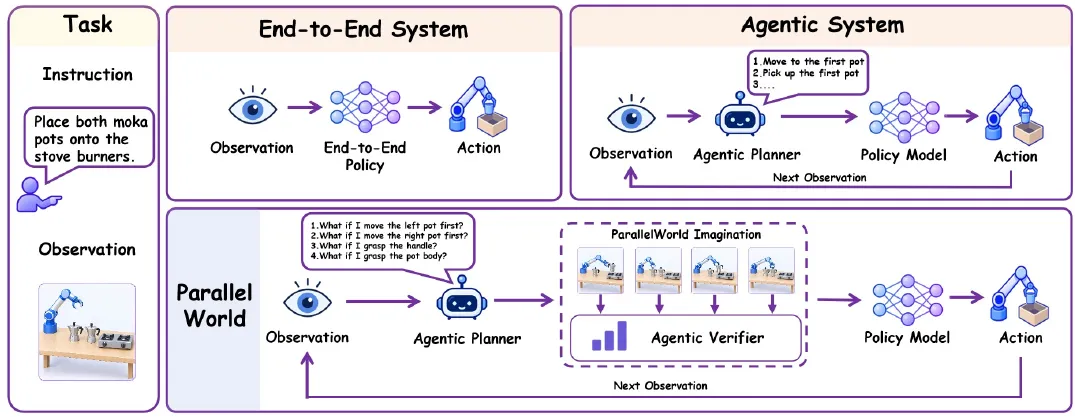
ParallelWorld joins the previews and verification of candidates' futures between high-level planning and action implementation, allowing follow-up results to be involved in current decision-making.
After the dismantling of the mission, there is still a long way to go.
High-level planners can break down complex instructions into multiple executable skills. For space-understanding tasks, they arrange camera movements or object interactions to look for evidence to answer questions; for operational tasks, they combine actions such as grab, move, and place to drive changes in the environment toward the target state.
The problem is that disassembling tasks in sequence does not automatically mean that the system takes into account the subsequent effects of different movements. Some movements have value that can only be realized after several interactions. When the current viewpoint is unable to recognize an object that is shadowed, a single movement may only change the shadowing relationship, but creates the conditions for subsequent observation; when operated, a method of grabbing may be conducive to picking up the object, but not necessarily to the next placement.
ParallelWorld therefore looks at what the future will see, where the mission will advance, and includes action choices. The search here takes place on high-level actions with clear execution scope and termination conditions, while the underlying control is still done by skills or strategies already in place.
Let different futures come into the same decision making
ParallelWorld will organize the planning as an interconnected preview cycle and execution cycle.
In the preview cycle, the planner proposes multiple candidate moves based on the task and the current observation, each moving on from a branch that already exists. Observations after system prediction or simulation of the move form a search tree containing different future paths.
The verifier then compares the candidate results, determines which branches are more helpful in obtaining evidence or completing the task, and gives feedback. Poor branches are cut off and those that deserve further exploration are retained.
The width and depth of the search can vary depending on the decision situation. The planner decides how many candidate moves to make, the verifier decides which branches to keep, and the planner decides whether to move forward.
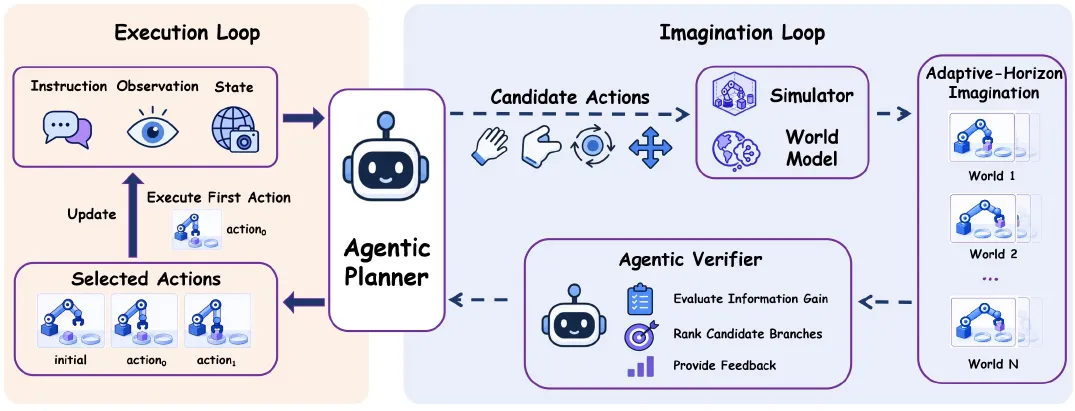
Figure 2 Preview and execution cycles of ParallelWorld. Future results of different movements on the right side, the first move of the selected trajectory on the left side, and the new observations are sent back to the next round of planning.
After entering the execution cycle, the system takes only the first action of the selected trajectory. The remaining steps provide a reference to the current decision, but are not executed one-time.
This rolling planning mechanism has practical significance: future forecasts may gradually increase in number and deviate from the environment. Each execution step is re-observed and can timely modify the plan, allowing the benefits of multi-step previews to be combined with the execution of feedback.
From being clearer, to being more precise.
Physically-understood gains focused on tasks that require diplomatic interaction
The ESI-Bench covers 10 classes of fission-spatial intelligence tasks, 29 sub-categories. Due to the inability to perform a liquid-to-liquid motion in the environment, the study excludes sub-categories of liquid volume and evaluates the remaining 28 items. The proactive method uses the same response model.
According to Table 1, ParallelWorld surpassed Active Exploration in 26 of these items. Some representative results are as follows:
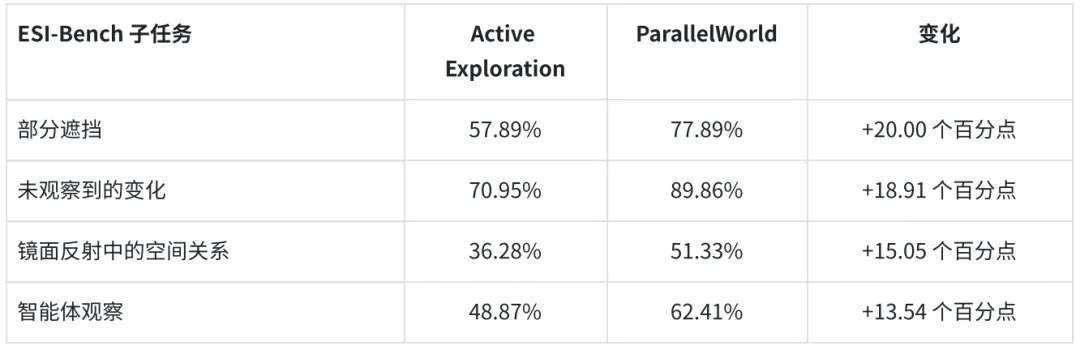
The common difficulty of these tasks is that the current images are insufficient to support reliable judgments and require more distinctive observations through interaction. In the qualitative case of the paper, the goal is misidentified in sequence, while ParallelWorld finds a more informative perspective and identifies the pen.
The upgrades did not cover all subtasks. The rigidity containment task decreased from 60.00% to 50.00%, the geometrical configuration task decreased from 17.96% to 16.90%. This also suggests that after more observations, the model may still be limited to geometric reasoning capabilities.
Eight robot-operated settings exceed the direct baseline
Operations evaluation uses LIBERO-Pro, which focuses on the ability to generalize instructional redirection and position switching under two types of disruption. The study covers four task suites, Spatial, Object, Goal and LIBERO-10, each set containing 10 tasks, 10 random seeds per task, for a total of 800 rounds.
ParallelWorld is based on HarnessVLA implementation. The paper reproduces HarnessVLA as a direct comparison object with Codex as a high-level planner. The following table summarizes the success rates of the two approaches in Table 2.
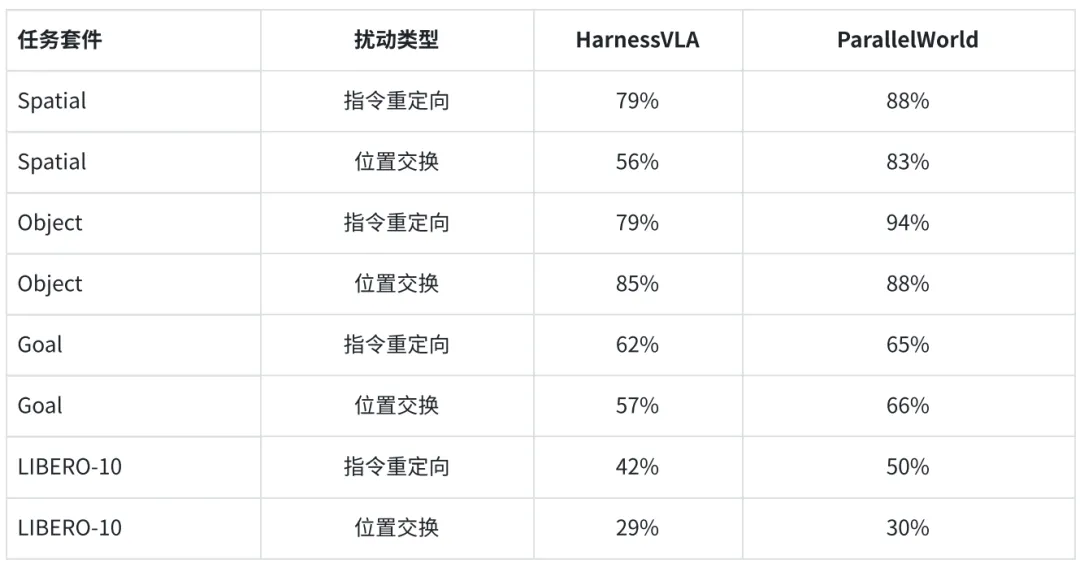
ParallelWorld achieved a higher success rate in all eight settings. Among them, the Spatial location swap settings improved by 27 percentage points and the Object redirect settings improved by 15 percentage points. The visual consequences of the candidate's actions can provide a useful basis when it comes to target identity, relative location, and positioning geometry relationships.
Goal and LIBERO-10's gains are relatively limited. The accumulation of linkage status, contact processes and errors in long tasks has a greater impact on execution outcomes, and it is difficult to fully illustrate these factors with predictive images alone.
Think of something useful, but how you search is equally important.
The paper analyzed the search width dilution in three Spatial location swap tasks, each using 10 random seeds for a total of 30 rounds.
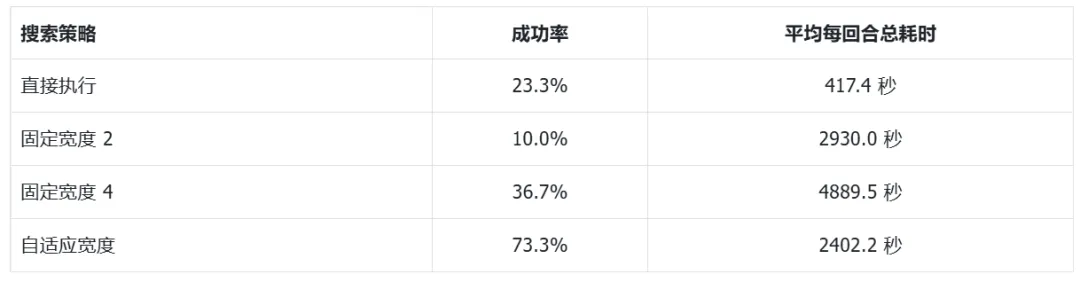
Self-adjusted width achieved the highest success rate in this group of experiments, and was less time consuming than both fixed width strategies. The fixed width was 2 times lower than direct execution, indicating that increasing previews did not guarantee gains.
The authors attribute the differences to the matching of the search budget with the uncertainty of current decision-making: too few branches are likely to miss useful choices, and too many branches increase redundancy and difficulty in screening. Adaptation strategies allow the system to adjust the number of candidates according to the task state.
However, these results also reflect a clear cost. The average total time spent on customized searches is about 5.8 times that of direct execution; this merger covers only three tasks and is not enough to establish a universal law of computational quantity and performance growth.
The frontier of the preview is whether we can predict the really important consequences.
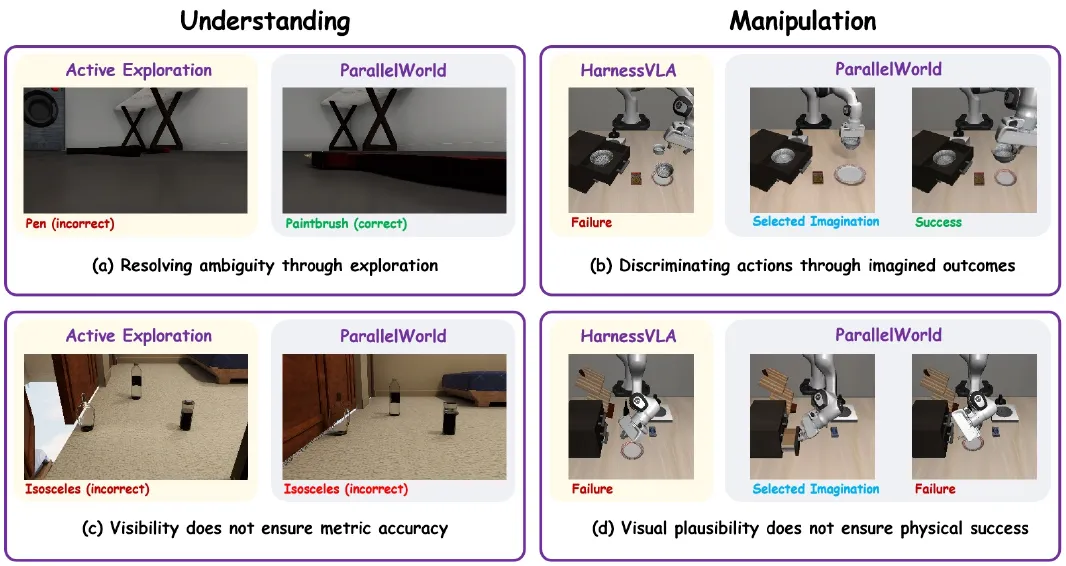
Figure 3 shows effective scenarios and failures. The top row shows more informative observations and more favourable operational options; the bottom row shows that accurate geometrical reasoning and physical contact can still lead to failure, even if sufficient observations are obtained or a seemingly reasonable future image is generated.
The benefits of ParallelWorld depend on whether the factors that determine the success of the mission can be reliably expressed by the results of the previews. When the difficulties are mainly from perspective selection, target identification or spatial layout, different futures can improve the decision; when the task requires precise measurement, contact dynamics or precise prediction of execution errors, visual previews still have clear boundaries.
In the failure cases given in the paper, models sometimes have seen enough information, but still cannot judge the precise geometric relationships between objects; sometimes producing images looks reasonable, but the action fails when executed. Visual rationality of image predictions cannot be directly equivalent to physical feasibility.
This study demonstrates a specific use of computing in a body system when testing: comparing the subsequent observations it may bring with the progress of the task before the action occurs, and then executing a continuous modification plan with feedback.
To make this preview work in more real-world scenarios, more reliable physical predictions, more accurate verification mechanisms, and affordable reasoning costs are needed. The results of ParallelWorld provide a testable starting point for further study of these issues.
© THE