Since the phenomenal firebombing of movie bulls, the rough-shaped, generally yellow-colored calf has become the first reaction of many when it comes to 3D modeling.
The director's words "pure handkerchief" also unexpectedly awakened the model's soul among netizens. Some tried to jump in and some couldn't cope: nowadays AI is more sophisticated than "Bull Come" to create a 3D model.
What is the extent to which AI 3D generation has evolved today? Let's take a look at the two sets of contrasts and get a sense of how sophisticated AI modeling is today.
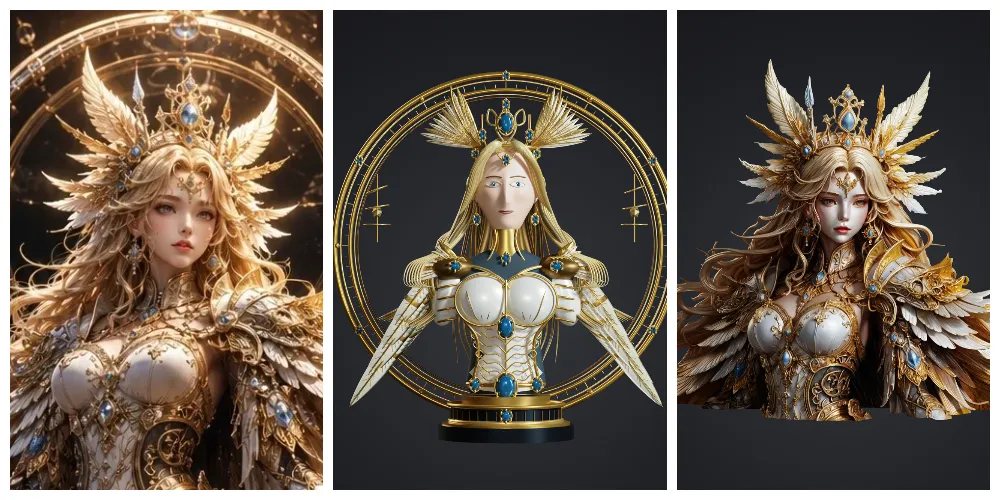
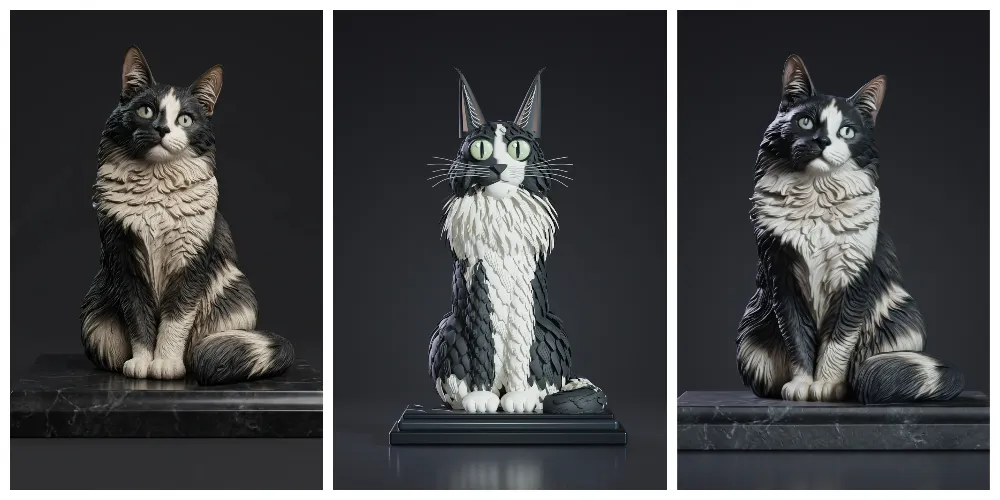
/ ChatGPT6 model generated / Hi3D Agent generated
These results, derived from Hi3D V3.0's self-developed three-dimensional generation model, are advancing geometry and appearance expression to an unparalleledly fine scale. It achieves the industry's first-ever 20483 nominal geometrically finite resolution, with a maximum 8K texture output. Hi3D V3.0's three-dimensional model generation capability far exceeds the general model GPT-6.

From these two sets of cases, it's easy to see that Hi3D V3.0 demonstrates a surprising performance on the complexity of three-dimensional modeling of structures and animal hair: the bumpy ups and downs of thinly carved details, the clear structural boundaries between adjacent parts, the shape of animal hair growing naturally. These seemingly unremarkable details are the most experimental in three-dimensional modeling.
As the self-development model continues to evolve, the Hi3D V1.0 model, which has been produced and verified, will bring everything to open source.

It's a bit of a mystery.
Hugging Face experience links:
Hugging Face code weighting link:https://huggingface.co/hi3d-official/Hi3Dv1.0
The official project link:
If Hi3D V3.0 demonstrates the potential for continued breakthroughs in 3D generation technology, then Hi3D V1.0 is open-source, giving accumulated technological achievements an opportunity to enter the actual workflow of more developers.
The training scale of about 2 million 3D assets, the effective scarcity surface extraction grid resolution of up to 15,363 and verification of real user workflows before public release together form the technical basis of Hi3D V1.0. On this basis, developers can further build their own creative tools, professional applications and business processes to extend AI's 3D generation capabilities to more real-world scenarios.
I believe that from now on, rough three-dimensional production in the "cowboy" style will be a thing of the past.
Continuous improvement of model capabilities has also allowed verified results to be used by more people in the open source program Hi3D V1.0, connecting technological advancements in computing with co-creations in a broader industry.
Let's make fine geometry the foundation for continuing to create.
It is well known that the biggest challenge of the three-dimensional model is to get the model from a single image to produce a model that is reasonable from all angles, detailed enough, and can actually be used as a complete three-dimensional asset for subsequent creation.
In 2025, Sparc3D gained widespread attention in the field of 3D geometric modeling with its high-resolution sparse representations and sparse curves from coding pipes. Its core idea was not to represent the entire three-dimensional space using dense physical grids, but to allocate computational resources only around the predicted surface area and to encode geometric information using features on sparse coordinates.
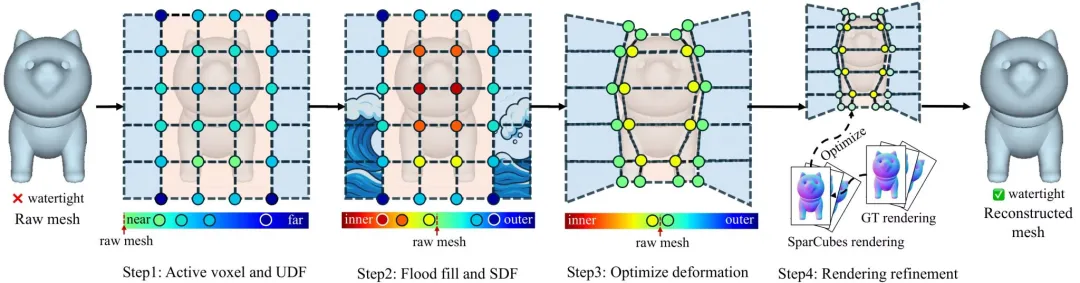
Sparc 3D pipeline diagram
Hi3D V1.0 has done three major works based on this architecture.
First, a substantial expansion of the training scale. The 3D assets used in training have grown from about 500,000 in size to about 2 million and about four times the size of Sparc3D. Why is the amount of data so critical? Natural 3D production is a non-binding problem, with the input of images providing only part of the surface of the object, and the rest of the geometry structure must be inferred from the three-dimensional precedents learned from the training.
Second, the introduction of higher-resolution training data. Based on Sparc3D's original 5123 and 10243 levels, Hi3D V1.0 adds 15363 levels of training data. The improvement in resolution means that the model can learn and express geometrical changes on a finer spatial scale. For example, shallow carvings on complex armour surfaces, fine gaps between mechanical parts, layered structure of feathers, and fine textures on curved surfaces require sufficient spatial resolution to preserve their original structure as much as possible.
It is worth noting that here 15363 is an effective scarcity grid resolution, and the actual flow model does not directly store a dense 15363 cache space. At the first level, on the scarcity coordinate set of the designated 643 structural grid, the decoder extracts geometric details through three learning 2x extensions. This means that the final surface reconstruction is done at an efficient resolution of 5123 without incurring the computational costs of the compact high-resolution grid.
Third, verification is completed in real production environments. Before official open source, Hi3D V1.0's corresponding model checkpoint has entered the production workflow for real users before official open source, and undergoes actual use-scene testing. The technical report emphasizes in particular that Hi3D V1.0 does not introduce new generation targets, decoders or surface representation methods, and all improvements are completed within the existing Sparc3D framework.
Hi3D V1.0 demonstrates a realistic technological path: the limitations of the model's capability to be further excavated through the continuous expansion of data size and resolution in mature geometric generating architectures.
Geometric engineering design
So how does Hi3D V1.0 control the expense of high-resolution computing while generating fine geometry?
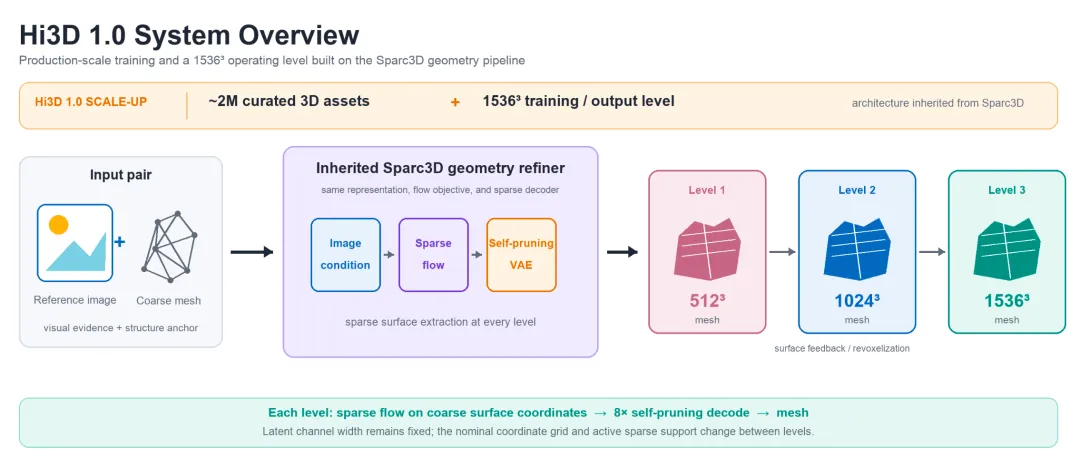
The entire pipeline is divided into two phases. In the first phase, an upstream module generates a rough grid based on the input image, establishing the overall structure of the object. In the second phase, Sparc3D takes over the refinement process, which uses both the reference image and the rough grid: the image characteristics provide appearance and shape clues, the rough grid provides the geometric coordinate basis.
The most critical design here is to generate models that do not have to deal directly with a huge, high-resolution, dense three-dimensional space.
Hi3D V1.0 sets up three incrementally upgraded levels of geometric reconstruction:
Level One: Calculated on the sparse coordinates of the nominal 643 structural grid, and ultimately extracted a geometric surface with an effective resolution of 513.
Level Two: Structural grid upgraded to 1283, corresponding to an effective surface extraction resolution of 10243.
Level 3: Further upgraded to 1923, corresponding to the maximum effective surface extraction resolution of 15363.
Within each level, the decoder is doubled in size by three learning steps, achieving an eight-fold increase in scale from structural grids to surface extraction grids.
This subdivision allows the system to control computing costs while maintaining high resolution. Flow transformers do not need to directly maintain a dense high-level space, but operate on low-dimensional sparse coordinates, gradually enlarging through decoding. This also explains why data scale expansion and resolution level enhancement can be done within the same framework without having to redesign the architecture.
This set of designs gives high-resolution geometry generations greater scalability. More importantly, the expansion of the training data scale and the improvement of the resolution correspond to two different problems in 3D generation.
The size of the data determines how rich the model is able to learn about geometric shapes, while the resolution determines how fine the model is able to express geometric structures.
Three-dimensional assets have a large number of long-tail structures, such as complex gaps, mixed thin-walled parts and asymmetrical organic shapes. Due to limited training samples, models often lack sufficient geometrical precedence, it is difficult to infer parts that are overshadowed, and are prone to structural collapse or over-flattening. Larger training data helps models learn more types of geometric shapes and improve the ability to rebuild complex structures.
15363 The introduction of effective resolution addresses another problem. High-resolution training data enables the model to learn more precise geometric features to distinguish between real surface structure and noise pseudo-shading. When a thin-walled part or pointed angle may be quantitatively mistakenly swallowed at 5123 resolution, the training signal 15363 provides the model with more precise monitoring.
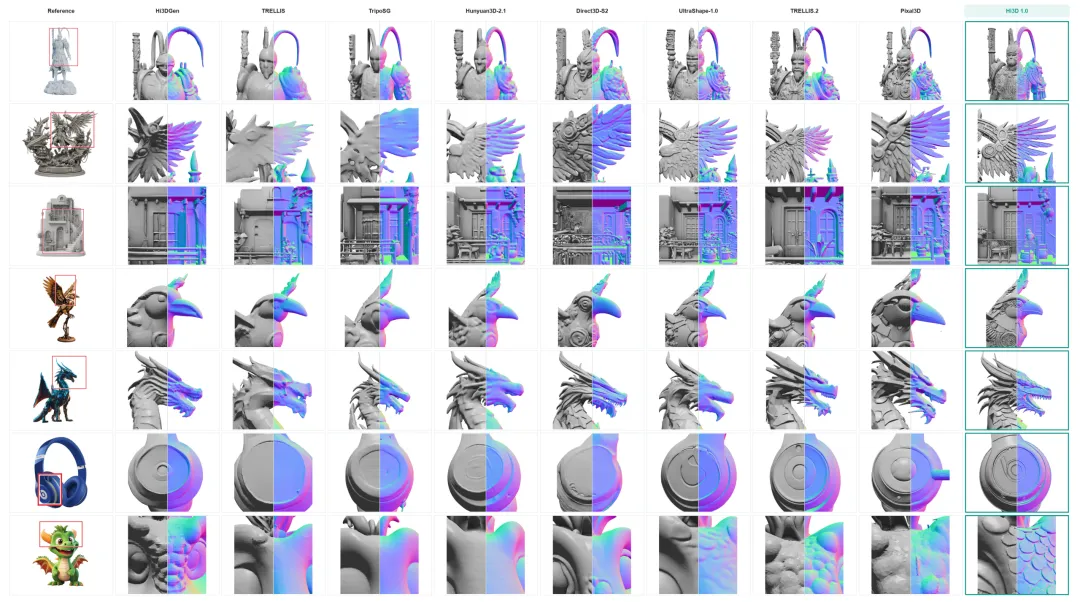
Contradiction of local geometric details in seven typical regions. Source: Technical Report
Overlapping improvements in both directions, broader geometric experiences combined with more precise detail learning together form the core competitive advantage of Hi3D V1.0.
Logic for evaluating quality
Three-dimensional assets cannot be evaluated on a single rendering chart, nor can positive similarities represent a complete three-dimensional quality.
Around this idea, the research team further evaluated the results from three dimensions beyond the traditional indicators of image semantic consistency.
The first is multidimensional geometric consistency (MV Fidelity). The researchers will render the generated asset from six standard perspectives: front, back, left, right, top and bottom, to examine whether the object is structured correctly in different directions, while examining parts missing, suspended fragments, and repetitive geometric defects. This test tests the model's understanding of the complete three-dimensional structure, not just its ability to replicate input images.
The second is the richness of the geometric details. This section evaluates as much as possible the disturbance of textures and materials, using gray mould dyeing and surface line diagrams, checking for subtle surface ups and downs, structural layers, the retention of small parts, and the geometric details of the areas in which images are not visible.
Finally, geometric availability for practical applications. The team also looked at whether there were debris, surface boundary defects, and lack of wall thickness in the grid, and the compatibility of the model with subsequent 3D printing processes through indicators such as cutting success rates.
This more comprehensive assessment also provides concrete data support for the advantages of Hi3D V1.0. Among the nine approaches listed in the technical report, Hi3D V1.0 achieved a multi-point geometric consistency score of 0.75 and a geometric detail-richness score of 0.841, both of which are highest in the table.
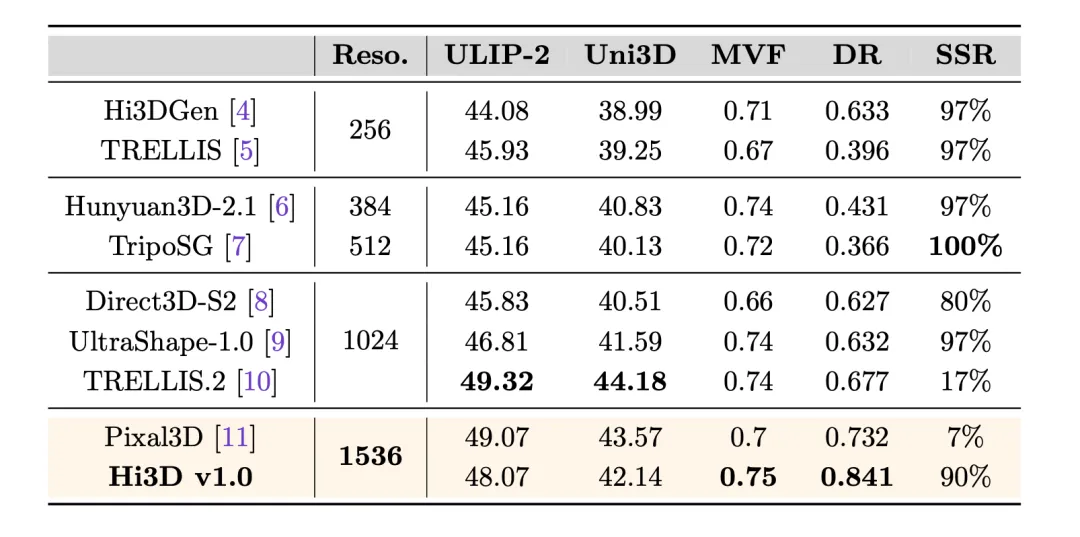
Quantitative contrast between different models in four indicators: geometric resolution, multicolored accuracy, MVF, geometric detail abundance, DR, and cutting success rate, SSR. Source: technical report
In addition, the team designed a set of user preference studies that included 562 groups of human judgments to compare Hi3D V1.0 with representative Image-to-3D methods such as Pixal3D, TRELLIS.2. Hi3DGen, TripoSG.
Geometric integrity from the unseen point of view: whether the structure of the model is still reasonable after rotation to the side, back, bottom
Retaining thin walls and fine structures: easily lost details such as weapon blade parts, accessories, and mechanical parts
How local geometric details are organized: whether surface features are presented in real geometric structures or degraded into textural noise
Downstream production compatibility: whether the generated grid can be directly used for actual processes such as cutting, editing, 3D printing
The results showed that in 562 judgments, Hi3D V1.0 scored 469 wins, 28 draws and 65 losses. The overall human preference score was 85.9%, according to the rules of the 1 point win and 0.5 point draw.
User preference score. Source: Technical report
Continuous transformation, creating new forms of the 3D world
From the initial pursuit of higher geometric accuracy, to the refinement of textures and structures, to the practical application of model generation, Hi3D has gone through three major iterations and the technical path has become clearer.
V1.0 focused high-precision geometry generates an efficient, sparse surface extraction resolution of up to 15363, making complex structures more accurate with the restoration of fine geometry.
V2.0 will extend its capabilities to geometric and textural integration generation, introducing technologies such as shading region intelligent filtering, delight processing, and further improving the structural integrity and material performance of the model.
V3.0 pushes the geometric reconstruction resolution to 20483, continuing to improve complex structures, local details and textural quality. At the same time, supporting capabilities such as intelligent demolition, multi-color printing, and automatic sliding boards continue to be improved, making it easier for generated 3D models to enter the real creation and production process.
How to organize model capabilities so that AI can truly understand creative intentions, call on specialized tools, and complete a complex set of tasks is becoming the new focus of competition.
In this direction, Hi3D Agent is being launched.
Hi3D Agent is the "Creator-First 3D Agent", the steering wheel is always in the hands of the creator and the AI is responsible for stepping on the door. This idea is at odds with the current popular Vibe Coding. The latter allows ordinary people to develop software through natural language, while Hi3D Agent brings similar experiences into 3D creation and explores a new path to "Vibe Creation".
Hi3D Agent uses big-language models to understand natural language goals, arrange tasks, and organize Hi3D professional models and related tools to execute generation and processing. Its exploration directions cover existing asset adjustments, character animation processing, and demolition and print preparation, allowing creators to move forward with the next steps around the work.
Starting from a reference map, the character shape is determined first, then the details are gradually adjusted, and then the path to display, interaction or physical production is selected. Such a creative process provides specific scenarios for the combination of professional models and agents. The creator is responsible for choosing directions and judging the effects, and the system around these intentions organizes the corresponding capabilities.
Creators can go around existing characters, continue to add props, build scenes, integrate these three-dimensional assets into interactive environments, and gradually advance to playable game demos.
At the same time, Microsoft is also advancing Hi3D MCP access, allowing external agents, professional tools, and existing workflows to call on Hi3D's three-dimensional generation capabilities. Developers also have the opportunity to build more AI 3D applications for specific scenarios in familiar environments.
From the continuous evolution of the underlying model, to the continuous improvement of 3D creative tools, to new ways of creating driven by Agent, every step of the way is expanding the boundaries of AI 3D's capabilities and applications.
From an open model, there are infinite possibilities for growth.
The evolution of the Hi3D model is always exciting, because the more ideas it encounters, the more amazing technology it can generate.
Open source Hi3D V1.0 extends this possibility to a wider range of developers and creators.
Independent developers can build exclusive tools around their favorite topics, professional studios can integrate 3D generation into existing production processes, and research teams can build on existing technologies to continue exploring new geometric generation methods.
This is also the importance of continuing to invest in model research and development and promote technology openness. From V1.0 to V3.0, from high-precision geometry generation to Agent-driven creative processes, we are continuing to expand the technological boundaries of AI 3D and are working to bring these capabilities into more real-world scenarios.
Today, with Hi3D V1.0 open-source, this accumulation of production environmentally verified technologies is a starting point for more developers to use, research and continue to innovate.
When the technological threshold is gradually lowered, creators can put more energy into character design, scenic conception, and the expression of works. Models are responsible for providing increasingly rich means of realization, while the final appearance of the work is still dependent on the imagination of the person.
There is no end to technological progress and there is no limit to the possibilities of creativity.
When high-precision 3D generation becomes the ability for everyone to call and explore, the next big thing may be in your hands.
© THE