
It's the first time in the history of the world.
When the end of a task is a decision, should the model start from the decision itself?
To find relevant evidence from a set of documents, to judge whether a condition is valid, or to give a standard rating to satisfy many language model requests, is not a long answer, but a clear, reliable judgment.
The System One model addresses this kind of need: to directly output options, probabilities, or scores without the need to generate lengthy reasoning texts.
However, it's not enough to just consider "giving an answer directly". Should the same question, the same set of answers, just change the order of the options and change the decision of the model?
Consider another scenario: a user wants to make a refund, but the system only offers three options: "modify the address", "query logistics", and "reset the password".
The latest work by the National University of Singapore's XML Lab puts these issues back at the beginning of architectural design.

Link to the paper:https://arxiv.org/pdf/2610.18773
The main page of the project:https://liqiiiii.github.io/Jeva/
GitHub:
The model:https://huggingface.co/LIQIIIII/Jeva-4B
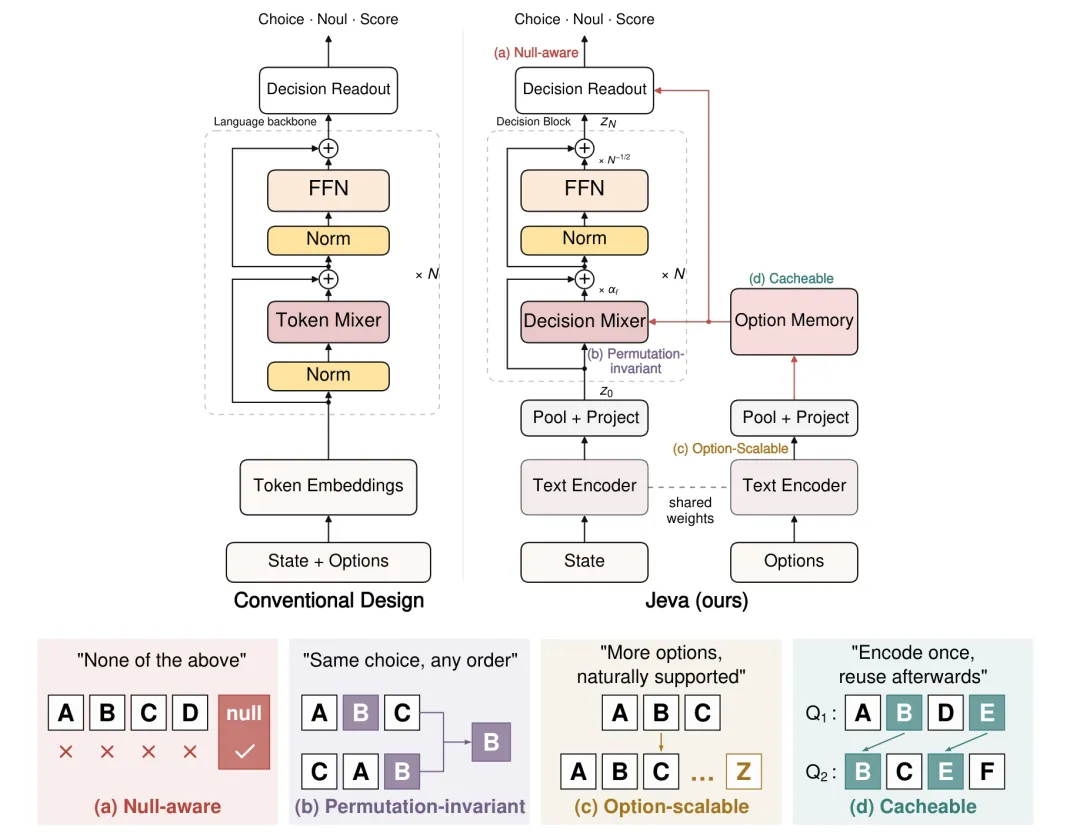
Figure 1 illustrates the architecture of Jeva with four structural characteristics. Above is an architectural contrast, below an intuitive illustration; the original paper illustrates Figure 1.
What basic capabilities should a decision-making model have?
Jeva's focus is not on specific skills in a particular task, but on four structural characteristics that are common to different decision-making tasks.
Null-aware is not the right answer, it's an answer.
The "best option" is not the same as the "appropriate option". Assuming the user needs to make a refund, but the candidate only modifies the address, queries logistics and resets the password: even if one of the scores is the highest, it does not mean that it solves the problem.
Permutation-invariant not to change the order of judgments
The same group of candidates, sorted from A,B,C to C,A,B, should not change their own meanings. Jeva combines them symmetrically according to the candidate group and scores with the same rules, so that the probability follows the candidate's identity rather than the position of the list.
Option-scalable: Option-scalable
A candidate may be a dozen tags, or it may be thousands of documents. Jeva shares scoring rules for each candidate application without having to extend a fixed set of answer codes for new candidates. In large candidate experiments, it deals directly with the entire set, without having to narrow the scope through multiple rounds of elimination.
Cacheable Cacheable Cacheable Cacheable Cacheable Cacheable Cacheable Cacheable Cacheable Cacheable Cacheable Cacheable Cacheable Cacheable Cacheable Cache
Documents, policy terms and rating standards are often more stable than user questions. Java can retain the calculation results of these options and continue to use them when problems change. Candidates reassemble; judgments of current requests are still re-executed.
The four characteristics are not a list of incompatible functions, but a question that needs to be answered together by the same decision-making architecture.
How did Jeva turn these requirements into architecture?
Jeva separates "understanding text" from "making current judgments": the shared encoder represents requests and options respectively, and the lightweight decision module reads the entire candidate set, only updating the request status.
First let the candidate pool participate in the judgingIndividual coding is not the same as independent scoring. As shown in the figure below, a fixed initial request state and candidate A, B, replacing only the third candidate from C+ to C−, can change the direction of the updated state and make the preference shift from A to B.
This structure suggests that individual decision blocks have been able to express collective preferences; in contrast, the relative ordering of A and B cannot be reversed due to changes in the third candidate based solely on the independent scores of the request and the individual candidate.
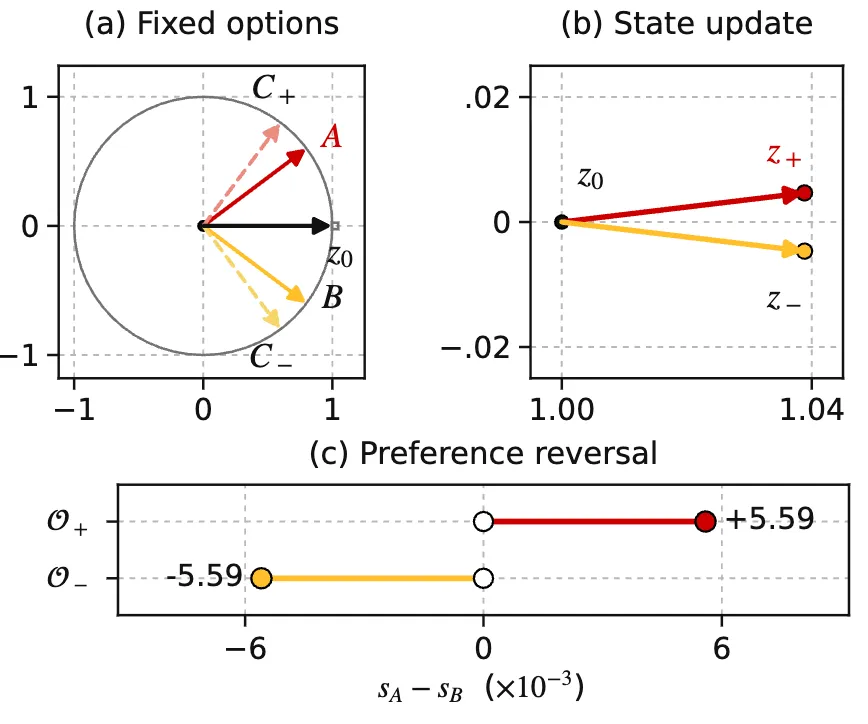
Figure 2 Fixed options, preference for change. (a) Keep A、B and the initial status unchanged, replacing a third candidate. (b) Request status updated in different directions. (c) The scores for A、B are negative; original paper Figure 3.
Change of location should not change the judgement; change of available content, the judgement can be adjusted accordingly.
And the difference between "who's better" and "is there a right answer?"After the candidate score is obtained, it is necessary to determine whether the whole set option applies. Jeva uses q to describe the relative preferences between candidates, and uses probabilityρ to estimate whether there is a suitable answer, and then matches it to a complete distribution containing p containing null.
The top half of the chart lowered the scores of the two candidates at the same time: the relative probability remained at 73% and 27%, while the coverage probability decreased from 88% to 12%, and the null probability increased with it. The second half fixed the scores and added a candidate with a score below the existing highest: the coverage probability remained unchanged and the probability was redistributed between the candidates.
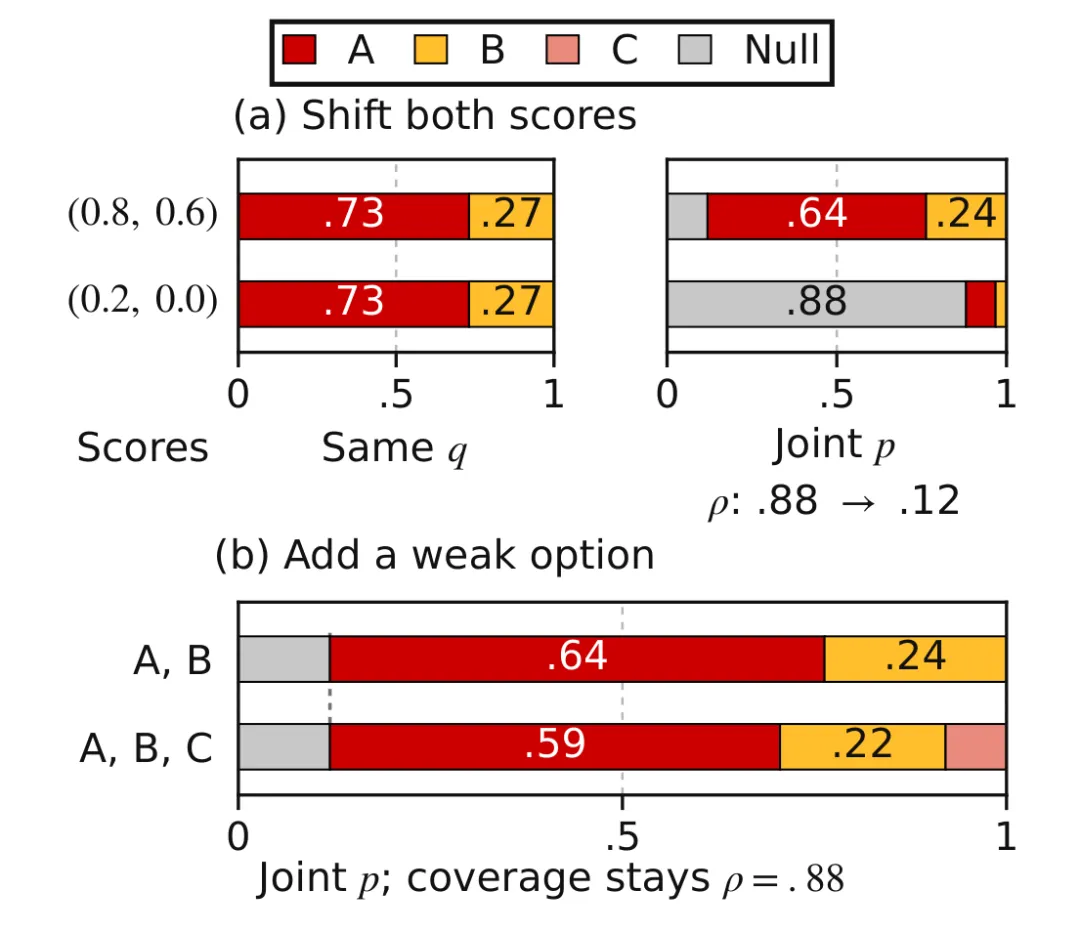
Figure 3 determines whether the relative preferences and answers exist, respectively. (a) The same decrease in the candidate score, q unchanged, covering the probabilityρ decreases; (b) The probability of the candidate in the full distribution p is redistributed in a fixed and already existing score,ρ unchanged; Figure 4 of the original paper.
Finally, the calculation of unchanged options is repeated.The above state updates and output calculations are executed as requested, and the semantic representations of the options and their layered projections can be cached. When models, decision types and coding settings are fixed, new requests can extract these memories and reconstitute the current candidate cluster.
In the diagram below, the first treatment of A,B,C, requires three options to be prepared; the second to face B,C,D, with only additional D; the third to use A,C,D, all three options are repeatable. Each time the request is re-encoded and the current judgment is calculated.
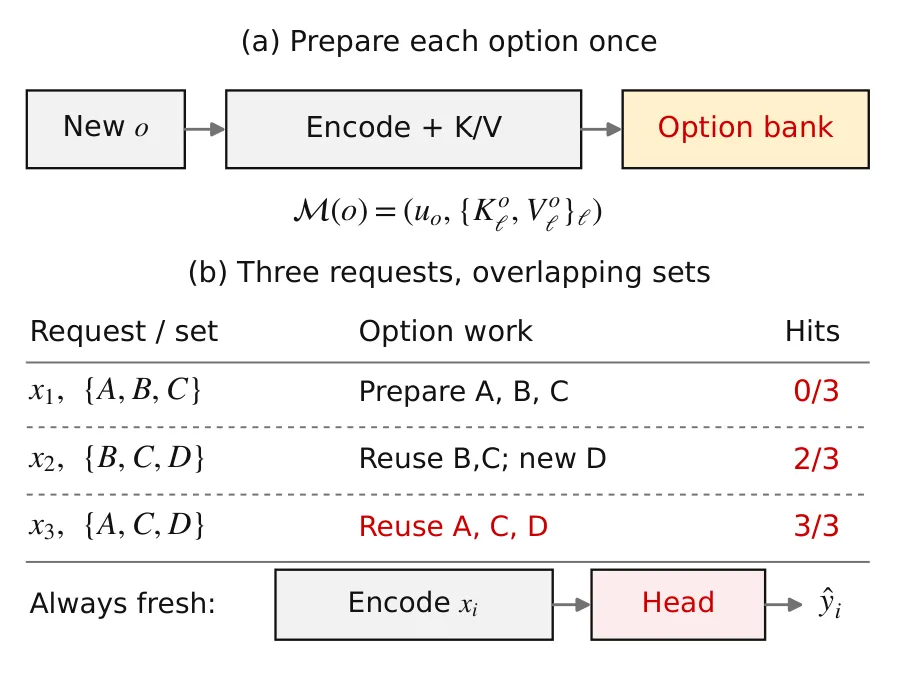
Figure 4: New requests, new combinations, replication of existing candidates. The three groups of candidates are ABC, BCD, ACD, and the single-choice caching life is 0/3,2/3,3 and the original paper Figure 5.
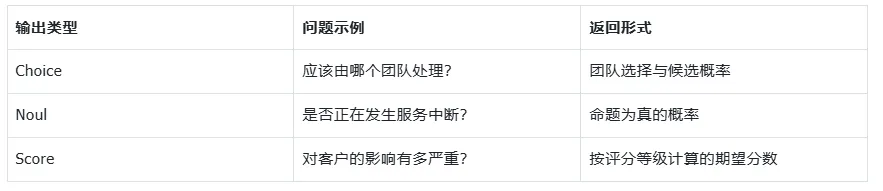
The same set of calculations supports Choice, Noul and Score. Faced with the "production log-in page returns HTTP 503, all customers can't log in or complete a purchase" report, three outputs can be answered separately in the table below.
Experimental testing
In the paper, Jeva-4B uses the Qwen 3.5-4B framework and a decision-making block to evaluate structural issues such as task quality, response absence, reclassification of options, and candidate scale growth.
"Not applicable" can be directly identified?The research team constructed 3,080 matching requests on BANKING 77 for 16 candidates each, including 588 absentee responses. Jeva's zero-detection AUROC was 98.66%, higher than the controlled KEV-BF16 ((93.61%), InternDecision-4B ((84.27%) and JevK5 ((79.44%).
AUROC measures the model's overall ability to distinguish between "with an answer" and "without an answer" at different thresholds. More intuitively, under the threshold of mistaking about 5% of responding requests for no answers, Jeva can identify about 94% of responding requests for absence.
The issue of refunds in the openings therefore corresponds to a clear experimental goal: the model must not only eliminate the names, but also identify the non-applicability of the entire set of options.
The same question, in a different order, will change the answer?Sequence experiments fixed the questions and contents of the candidates, only changing the candidate's ranking. In 600 Choice samples, the research team tested the original order, reverse order, and up to three random rankings, and then matched the results as candidates.
There was no decision reversal for Jeva, with the original accuracy of 76.67% compared to "every test in the same order". In comparison, the reversals for Jev-1.13.0, InternDecision-4B, and JevK5 were 17.00%, 22.67% and 26.17% respectively.
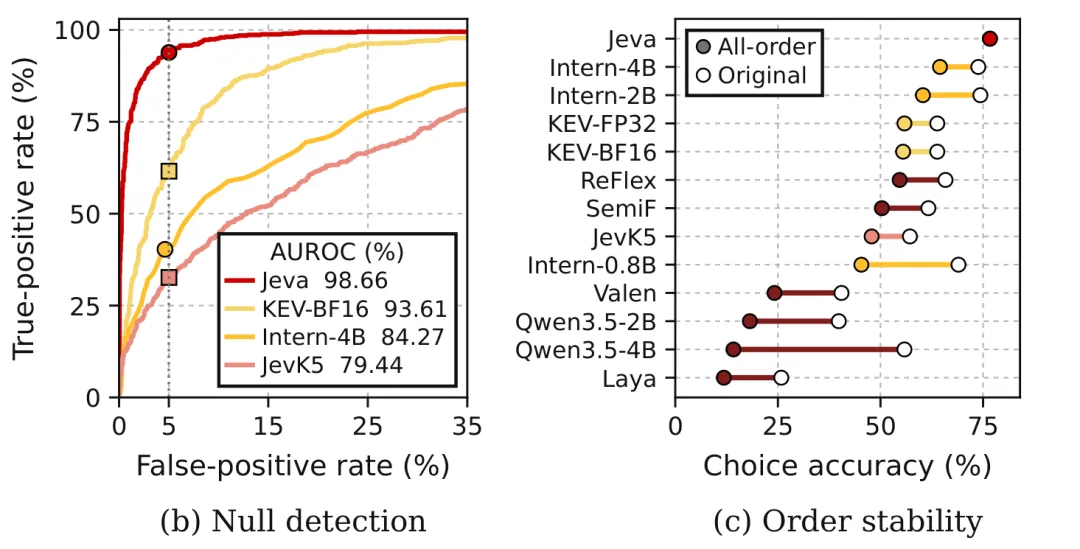
Figure 5 left: identifying the ROC curve where the answer is absent, the closer to the upper left. Right: the original accuracy rate and the correct accuracy rate under all test sequences; the interval between the two shows the effect of the sequence changes; extracted from the original paper Figure 6 ((b,c))
These two sets of experiments break down "reliable selection" more specifically: choices can be rejected when they are not appropriate, and choices can only be judged when they change positions.
Is it possible to make an original and effective expansion when there are more options?As the number of candidates increases, new questions arise: is the model really comparing the complete set, or can it just be broken down into a bunch of small choices?
Requests in the paper's ToolRet diagnosis are distributed across six sets of 32 to 2,048 candidates. Java supports all requests; candidate text can be coded in batches and, once ready, the entire set is still involved in the same decision-making calculation.
In a set of 2,048 candidates, Jeva had an accuracy of 69.88% and a mean delay of 12.04 seconds on the single H200. The JevK5 accuracy of the recursive option was 67.47%, a mean delay of about 28.35 seconds: Jeva achieved a higher accuracy and a speed advantage of about 2.35 times in this setting.
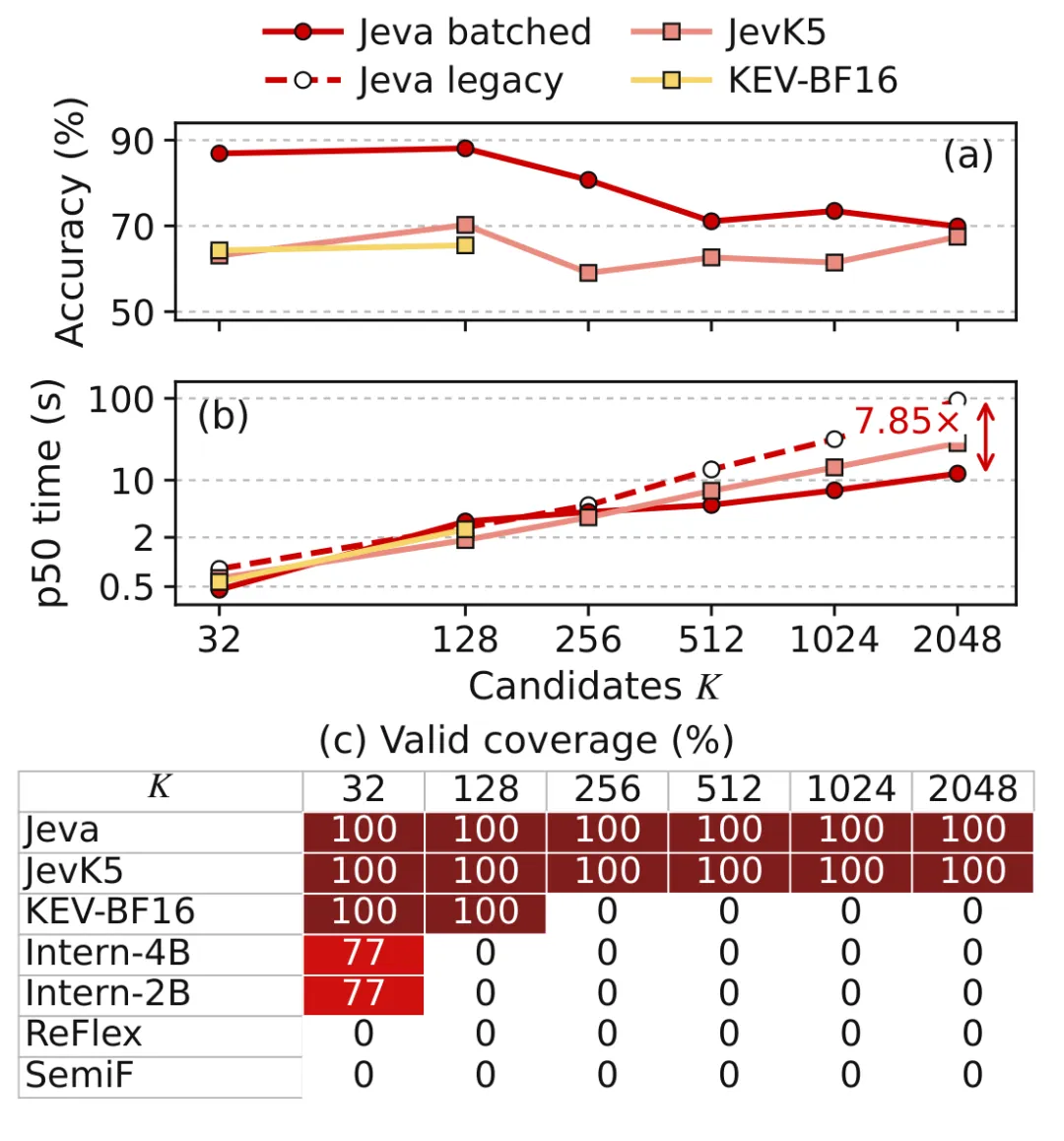
Figure 6: Accuracy rate. Medium: Request medium delay, null line is the old batch settings of Jeva, 7.85x matching batch optimization gains of the same model. Below: Proportion of processing requests.
A more critical question is whether the model can continue to answer yes to the same question, gradually adding more candidates. For this, the paper fixed 83 questions, gradually expanding the candidate pool from 32 to 2,048 for each question.
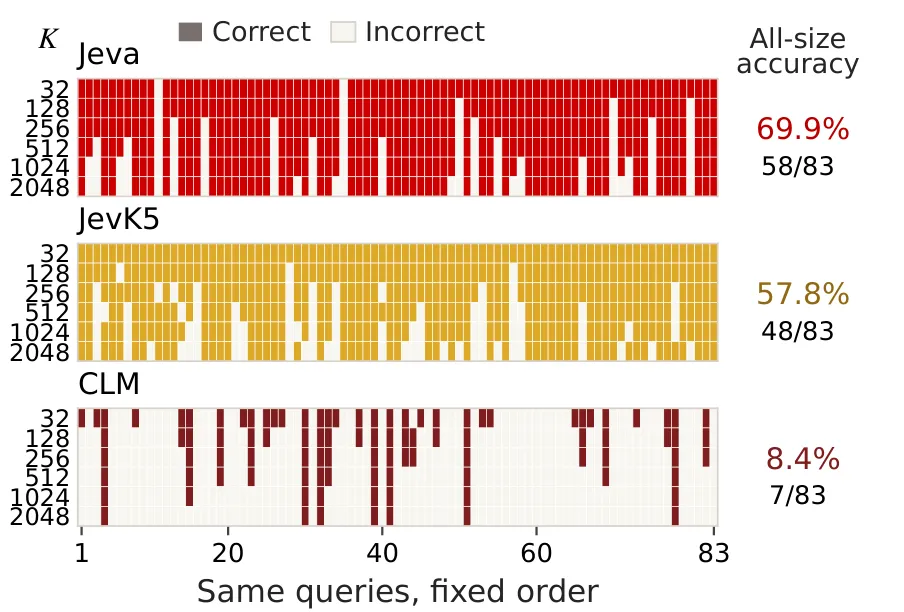
Figure 7 shows that each row is the same question, and that each row corresponds to a different number of candidates.
Jeva responded to 58 of these questions on all test scales, with 48 in JevK5 and 7 in CLM. The experiment showed more directly how much the right decision can be retained when the candidate set is expanded than just looking at a single scale.
The question is, why do you want to understand the same document over and over again?Long documents in searches, policy terms in business systems, scoring criteria in evaluation tasks can be used repeatedly by many different requests. The longer the candidates, the more candidates, the more valuable the cost of re-coding. Java's replication not only addresses the exact same candidate set, but also supports removing existing options from the cache to form a new set.
In the MLDR long document experiment in the paper, in the face of a new portfolio of candidates, the request moderate delay decreased from about 2.10 seconds to 75.1 milliseconds, equivalent to 27.98 times the acceleration; no decision changes were observed under different caching conditions.
Figure 8: Acceleration under different candidate replication ratios; middle: Delayed requests to share candidate libraries; below: Proportion of candidates avoiding repeat coding; original paper Figure 9.
In a nutshell
Jeva unifies the answer to absence recognition, sequence constancy, candidate expansion, and computational repeatability into model design. Its core can be summarized as:
Let the fundamental principles of decision-making become the intrinsic ability of the architecture.
Decision principles, built into the architecture.
Jeva offers not only a faster reasoning, but a design perspective: viewing candidate sets, the absence of answers, and computational duplication as the structure of decision-making itself, allowing architecture to be designed from the outset for these needs.