The year 2026 is widely regarded in the industry as the "Year of AI for Science" by AI4S.
In just a year and a half, the track has made the leap from "technological concepts" to "product-intensive releases": annual funding of over $4.4 billion in AI4S across the globe, from large model giants to vertical technology companies, the launch of AI products, the launch of the Claude Science Research Workshop, Google DeepMind, the launch of two related Nature papers and the release of AI Co-Scientist, and vertical startups are also fast-tracking in drug development and new materials.
The synchronization of policy with industry has further boosted industry enthusiasm. China has ranked "AI + Science Technology" as the top priority of its "AI +" campaign, the United States has launched a "Creation Mission" national science research program, the European Union has released a special strategy for scientific AI, and the United Kingdom has ranked it as one of the three core areas of AI alongside big language models and physical intelligence.
At the heart of this wave of change is the role of AI in scientific research that is evolving from "assisted retrieval and computing tools" to "research participants who can autonomously advance tasks".
But the heat of the concept is hard to cover up the reality of the downside. With the emergence of various types of scientific research and intelligent products, the focus of the industry has shifted from technological advancement to whether products can be integrated into real R&D processes and create real value.
What kind of scientific intelligence body can really run an industrial landscape?
In the past, many scientific studies have positioned AI as a "response tool", where researchers ask clear questions and AI returns answers.
But the real R&D process is a complete chain: from researching literature, proposing hypotheses, to simulation computing, programming design, to experimental verification, to data compilation, ultimately becoming a replicable knowledge experience.
Researchers must be able to get into real physical laboratories and adapt to long-term research and development scenarios. In research and development in the fields of materials and medicine, a high-precision molecular simulation can run for several days, and a round of experimental verification requires multi-team cross-link collaboration, which poses extremely high demands on the stability and sustainability of AI systems.
Therefore, a truly competitive scientific research intelligence body needs to be validated in real industrial scenarios. It is not enough to score high in benchmark tests to help companies shorten R&D cycles and accelerate the commercialization of technology.
Whether or not there are mature industry customer collaborations, complete commercialisation projects running, and genuine feedback from front-line R&D personnel are the most direct criteria for judging product landing capabilities.
Mira: A practical sample of AI4S landings
At the 2026 World Artificial Intelligence Congress (WAIC), the AI scientist platform Mira, which released the Deep Principles, became a typical example of how AI4S's landing paths are currently observed due to its performance in benchmark testing and progress in the industrial landscape. The team also released the full-length technical report MIRA: Towards a General AI Scientist, which dismantles the geological logic of the product from the underlying architecture, core capabilities to proof-of-concept cases.
In a global public authority benchmark test, Mira's performance confirmed the industry's judgement of "comprehensive capability priority".
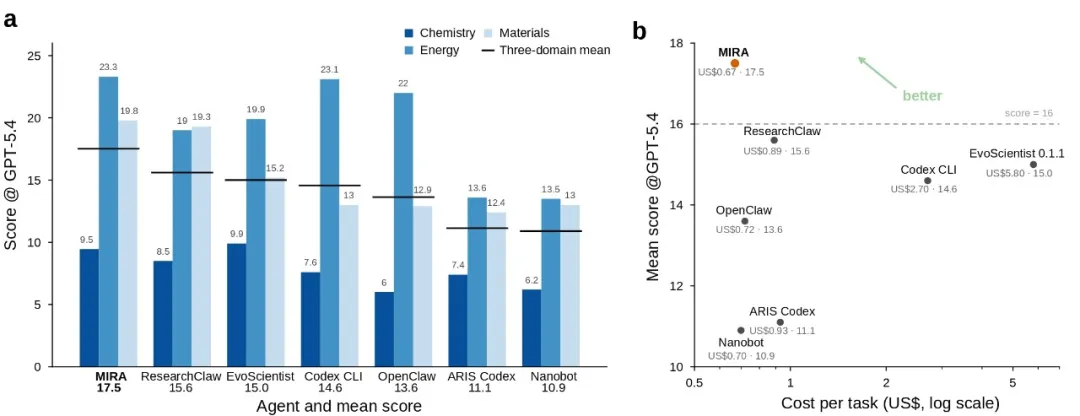
Mira ranks first in its three-way comprehensive capabilities in chemistry, energy, and materials, while earning the highest average scores in the cost-benefit-performance comparison, using the lower AI call costs of similar products.
In the Research Claw Benchmark for general scientific research capability, which covers the three directions of chemistry, energy, and materials, Mira was ranked first among all reviewers with an overall average rating of 17.51. It is noteworthy that many review systems still perform well in energy tasks, but the scores declined significantly after entering more complex knowledge systems and more restrictive material scenarios, while Mira remained close to a 20 percent lead, demonstrating strong cross-domain capability migration.
More industry reference value is "cost-performance" performance.
Data shows that Mira's average cost of completing a single task is about $0.67, the lowest of all rating systems, and the only one to enter the "16+" range. Compared to similar products, its task costs are about 75% lower than Codex CLI, scores are about 20% higher; costs are about 88% lower than EvoScientist, and scores are about 16.7% higher than both dimensions of performance and cost.
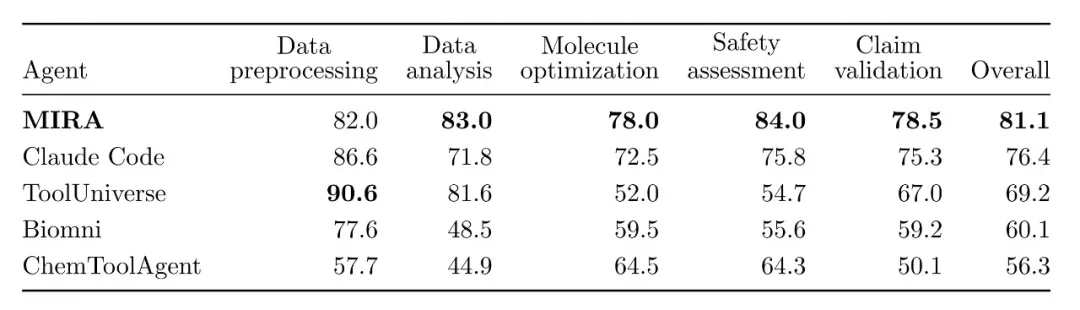
Science Agent Arena drug discovery list: Mira is ranked first with an overall rating of 81.1%
In the more vertical drug discovery evaluation of Science Agent Arena, Mira, with an overall score of 81.1%, was equally successful in the five key tasks of data pre-processing, data analysis, molecular optimization, safety assessment and conclusion verification, with products such as Claude Code and ToolUniverse leading by about 6.5% to 43.3%, respectively.
The results of the three comprehensive assessments show that Mira's technological advantages do not come from a breakthrough in a single capability, but from a combination of cross-domain migration, full-link task execution and cost-effectiveness.
Closing of the entire chain, opening up the entire process of scientific research
To address the industry pain points at which the research process is disrupted, Mira has built a complete closed-loop system covering "hypothesis generation - simulation computation - experimental verification - knowledge depletion", with the core three-tiered architecture corresponding to the full collaborative logic of the research team.
The upper level consists of a multi-intelligent team (Agent Squad), a role-sharing and cross-validation mechanism that simulates the role of a human research team, and is executed by a unified planning and scheduling task by the dominant intelligence system; the middle level consists of a "computing + experiment" dual execution engine, which provides cloud-based high-performance computing resources with automation labs, connecting dry labs to wet labs; and the lower level consists of a deep, replicable scientific memory and scientific wiki system that allows the experience, data and conclusions of each project to be retained as the basis for further research.
The design of this three-tiered architecture, from knowledge retention, resource efficiency to process stability, gradually complements the shortcomings of traditional models.
For many R&D enterprises, the loss of R&D experience is a long-standing concern. The core knowledge is scattered in personal documentation, experimental records and expert judgments of researchers, making it difficult to form replicable team assets.
Mira's sub-layered research memory system, which opens up general knowledge of papers, patents and open databases, the middle layer absorbs practical data from each experiment with trial and error conclusions, and the upper layer gradually aligns the research style and judgement preferences of the team, opening up textual, diagrammatic, simulated data and other multi-source information through a unified interactive standard, so that fragmented personal experiences are ultimately absorbed into replicable, heritable team research assets.
In terms of research and development costs, this architecture has also led to substantial improvements in the efficiency of computing. Traditional research and development models often use high-precision computing to unify all candidate programs, consuming large amounts of computing power at very low-value early screening stages.
Mira uses dynamic-level screening strategies to complete large-scale initial screening with a low-cost method, and then automatically adjust the computational accuracy based on the intermediate results, putting in high-precision algorithms only for candidates with real potential. In industrial settings such as industrial refrigerants, silicon electrolytes, the mechanism has been proven to significantly compress computational costs; more importantly, data from each project automatically flows back into the system, continuously calibrate models, optimize screening rules, and become more efficient as projects accumulate.
Mira has also made special engineering optimizations for the long cycles of research tasks and the ease of interruption.
Unlike the instant response mode of everyday conversational AI, a high-precision molecular simulation, a round of complete material performance experiments often takes several days or longer, and the entire disk is reversed in the middle once interrupted. Mira's built-in long-task execution engine uses intelligent scheduling, security isolation and real-time monitoring mechanisms to ensure that long process tasks can be stable and continuously advanced.
In real-life laboratory scenarios, multiple intelligent entities can collaborate, taking on roles such as program design, device matching, data processing and operational auditing, collaborate to complete program generation, device modulation, data retransmission, etc. that were originally entirely dependent on artificial chains, and really extend the computing end's capabilities to the physical experimental end.
From the standpoint of the enterprise, data security and authorization control are indispensable underpinnings. Mira supports complete enterprise-level privatization deployments, ensuring that R&D data does not leave the enterprise's internal network from the underlying architecture, while supporting classroom authorization management and process-wide operational auditing, meeting the core requirements of R&D enterprises for data confidentiality, allocation of responsibilities and compliance traceability.
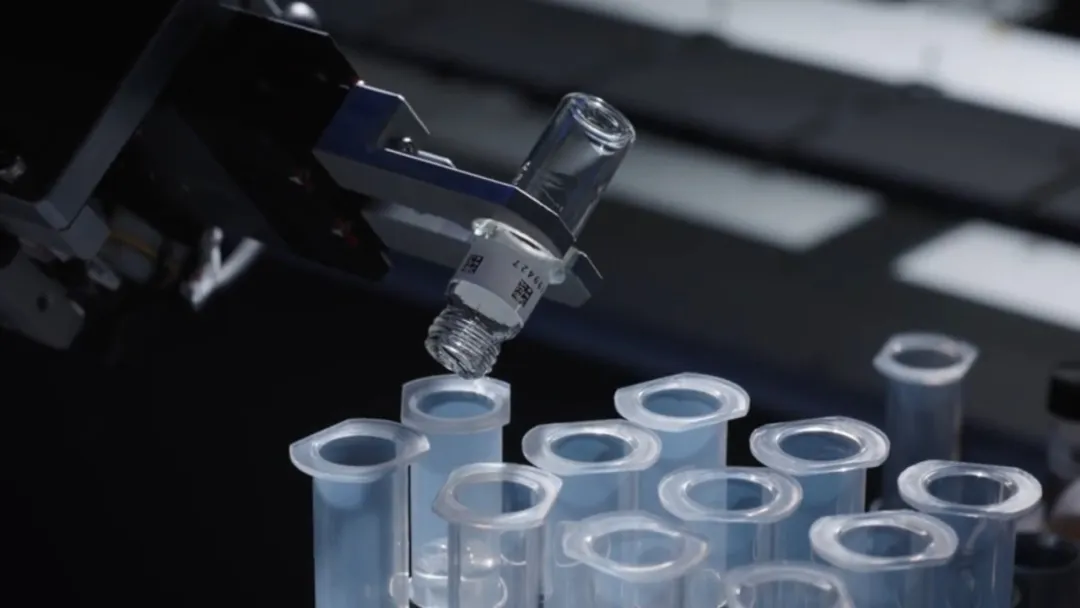
Real-life experiments driven by Mira
Industrial verification: industrial landscape, accelerated commercialization of R&D
The technical capabilities demonstrated by the benchmark test will ultimately make real sense in real R&D scenarios.
For products such as R&D smart bodies, the depth of application and practical results at the industrial end are far more convincing than the paper parameters. Currently, the depth principle has been developed based on the Mira platform, with deep collaboration with industry clients in areas such as lithium and industrial refrigerants, to embed AI scientific research capabilities into existing R&D pipelines in enterprises, covering formula screening, performance prediction and process optimization.
In the synchronously published technical report, Mira reveals three complete real-world research cases, spanning the three areas of chemical reaction mechanics research, drug-focused combined analysis, and catalytic material performance computation. All scientists need to do is to describe research goals and constraints in everyday language, the system can autonomously progress from document research, program design, tool invoking to the complete process of concluding, and intuitively demonstrates general scientific research capabilities across disciplines.
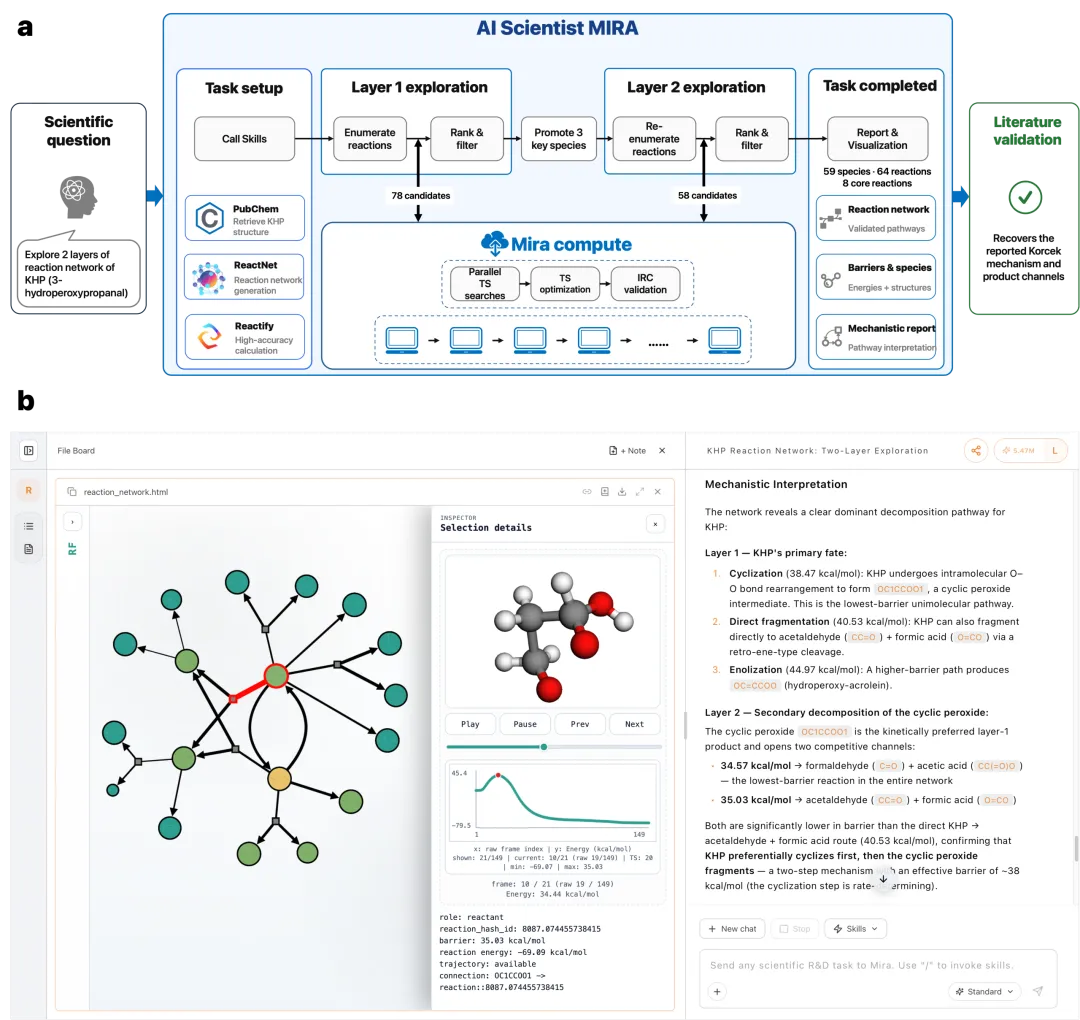
MIRA automatically analyzes the decomposition reaction mechanism of KHP (organic small molecule reactants) and reproduces the classic Korcek reaction pathway, supporting multi-dimensional results.
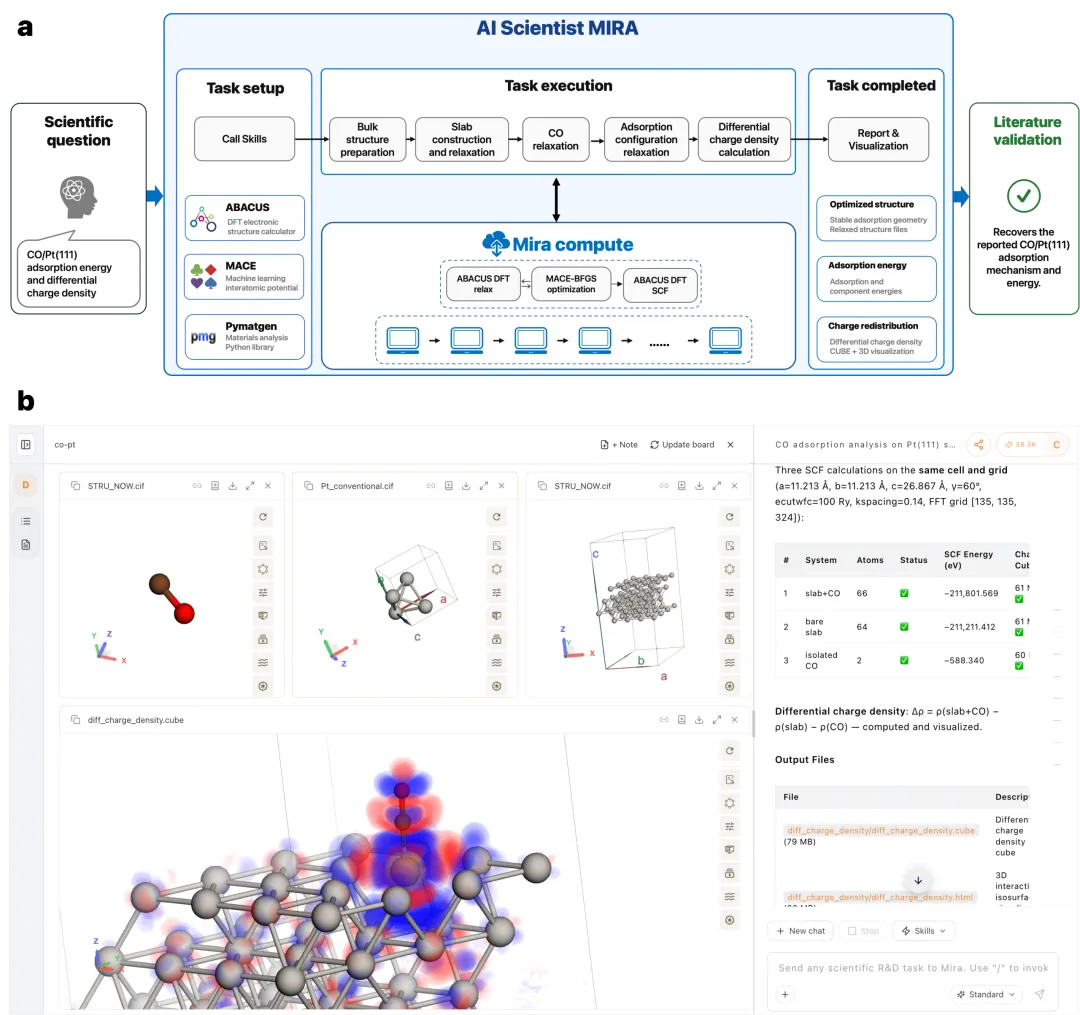
Pt is a classic precious metal catalytic material and Pt (111) is a commonly used crystalline surface in catalytic research. MIRA calculates CO's absorption behavior and charge-heavy distribution on the surface.
MIRA predicts that the ABL1 catheter protein will be screened for a pattern of association with Imatini, which will be visualized after analysis and sequencing to select a representative complex.
What is the meaning of this verse?
The explosion of AI4S is just the beginning of the industrial revolution.
From the concept stage to the landing stage, the logic of competition is changing: the truly long-term value of scientific intelligence is not the ultimate value of a single capability, but of an understanding of the entire process of R&D, the refinement of engineering details, and the adaptation of the logic of industrial organization.
Mira's practice provides the industry with a viable path to AI4S landing. As more businesses, universities and research institutions participate, the evolution of AI from "usable" to "useful" and from "assistant" to "core participant" will continue to accelerate.
For a complete understanding of Mira's architectural design, technical details and all benchmark test data, see the full version of the technical report, and for anyone interested in research and industry, apply for the experience on the official platform!
Address of the report:
Product test address: