
It's the first time in the history of the world.
NASA's satellite has been orbiting the galaxy for a decade and has been replenished by Claude for days.
Recently, Anthropic has released the first full ultraviolet satellite of SI, with a whole sky and no hole left.
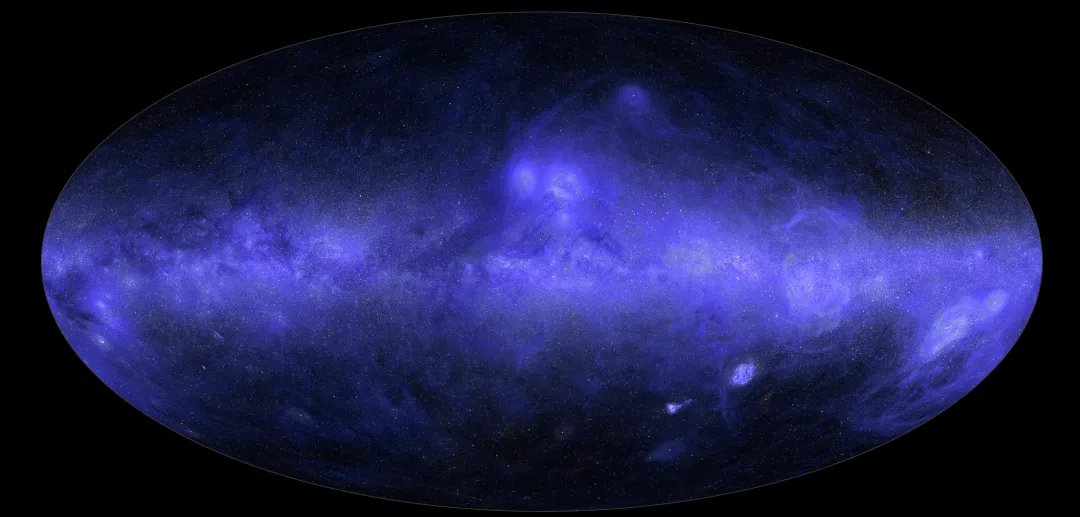 The entire sky under ultraviolet light, with the center of the galaxy in the center. About a third of the celestial sphere, including most of the galactic plates, was calculated by Claude.
One third of the sky in this chart has never been seen by any ultraviolet telescope.
This is Claude filling in the blanks.
An astrophysicist, led by Agent Claude Science, collected all the ultraviolet data from several satellites over the next 50 years and calculated a blank piece.

It takes people a few weeks to work, and Claude does it in a few days.
Scientists have dragged for decades those who never made it to the schedule, and someone has started to do it.
A galaxy that satellites can't seeClaude added:
From radiation to gamma rays, astronomers have long drawn a complete map of each of the wavelengths, missing only this one.
Ultraviolet light is absorbed by the ozone layer in the atmosphere and can only be sent to the sky by a telescope.
Over the past 50 years, the Space Telescope has captured a portion of the ultraviolet sky. The most recent data is NASA's GALEX, which took about 380,000 images from 2003 to 2013, covering two-thirds of the sky.
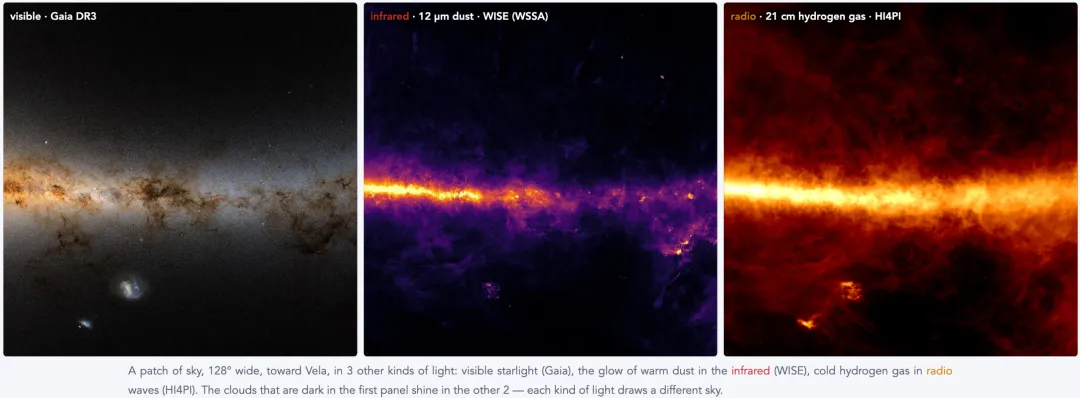
The rest of the galaxy was deliberately unseen.
With the densest stars on the galaxy's surface, too many bright stars, and GALEX's fear of intense light burning the detector, it simply turned around. Since 2009, it has not been able to capture even the far ultraviolet, leaving only the near ultraviolet still at work.
NASA's Swift, South Korea's FIMS/SPEAR filmed a few more sequels, and together, the sky was full of caverns.
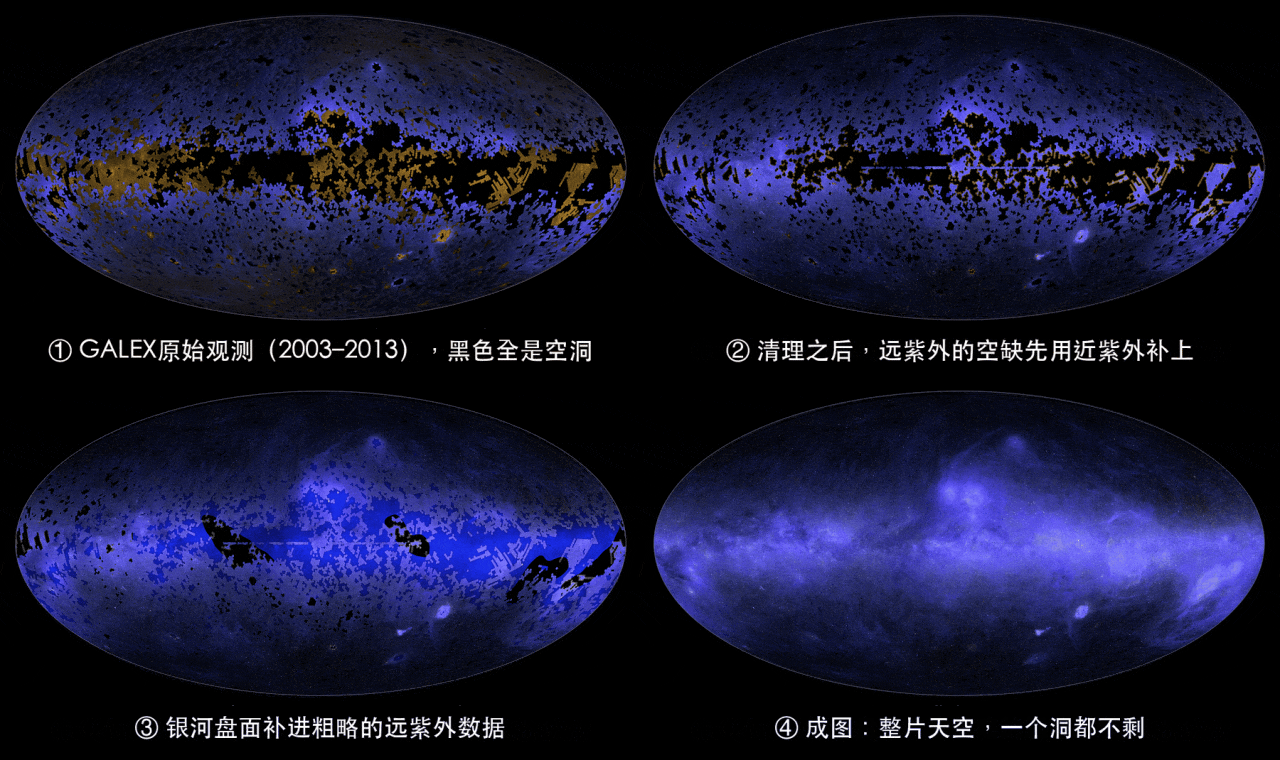 From the original observation of the galaxy to the final image, black is where the ultraviolet has never been seen before.
This picture was drawn by Bryce Ménard, an astrophysicist at Johns Hopkins University who is also a researcher at Anthropic.
He taught students astrophysics classes, often speaking from the same sky at different wavelengths.
Speaking of ultraviolet, he had to apologize to the students every time, because the ultraviolet all-encompassing diagram in his hand was "all holes".
The ultraviolet sky is almost the bottom of the starry sky as we know it.
The brightest centers of the galaxy are visible in ultraviolet light, reaching one of the darkest places because the dust and ultraviolet rays are brighter than visible light. Those that are creating stars in the galaxy, such as Orion, Orion and the Milky Way, shine blue under ultraviolet light.
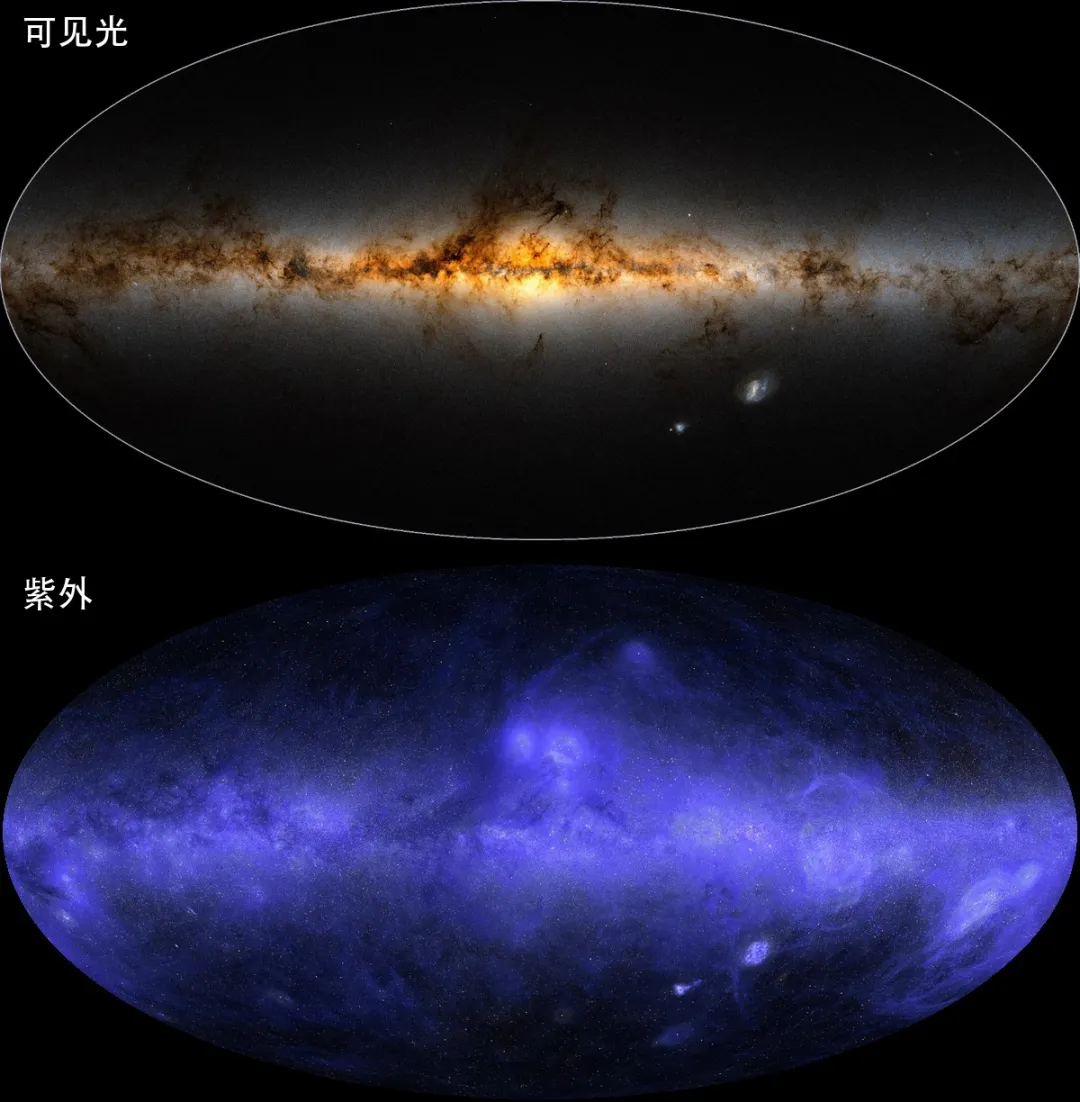 The same sky, with visible light at the top and ultraviolet light at the bottom, almost overturned the bright darkness of the galaxy.
Using statistical methods to fill holes, it is technically possible to do it early. It is difficult to work on the amount of work, each pixel is carefully calibrated, the analysis has to run repeatedly for several rounds, and it takes several weeks of hard work.
There are more important studies in the hands of astrophysicists, and this child has been staring.
This summer, Menard gave it to Claude.
Claude first studied the interaction between ultraviolet brightness and visible light, infrared and radiation on two-thirds of the sky with ultraviolet data, and then applied the interaction to the remaining one-third to estimate how bright the ultraviolet should be and how much.
In order to make the test unsuccessful, Menard had Claude deliberately obscure a part of the sky that already had ultraviolet data, filling it in as a blanket, completing it again and measuring the real answer.
A few rounds of grinding.Supplementary and real values are only about 10%In his words, the human eye could hardly tell the difference.
Finally, Claude used visible light measurements from the Gaia satellite of the European Space Agency to estimate the ultraviolet brightness of 119 million stars.
One word.A team of Agents is at work.Ménard instructed Claude to put all the ultraviolet data that could be found together, on a single scale, to make a map, and to fill in the gaps that had not been seen by the ultraviolet telescope.
Claude Science's chief Agent first sent a group of Agents to search the internet for publicly available ultraviolet orbiting data. The galaxy had tens of thousands of photos taken over several years, under different conditions.
The first step to downloading the data is to get each data set up first.
The most troubling is bright stars. Just as street lights add a circle of brightness to a photo, bright stars add brightness to an image of a space telescope without removing it, and the darker ultraviolet light next to it is not measurable.
A group of Agents dealt with different celestial zones, one of which blurred the differences.
The next step is to combine the data of several telescopes. The ultraviolet sky seen by different instruments is slightly different, and the two have to be cross-referenced, unified resolution, and switched to the same set of coordinates to form a diagram.
In this step, Menard only gives the main direction, specifically how to do it, and Claude sends Agent to do it.
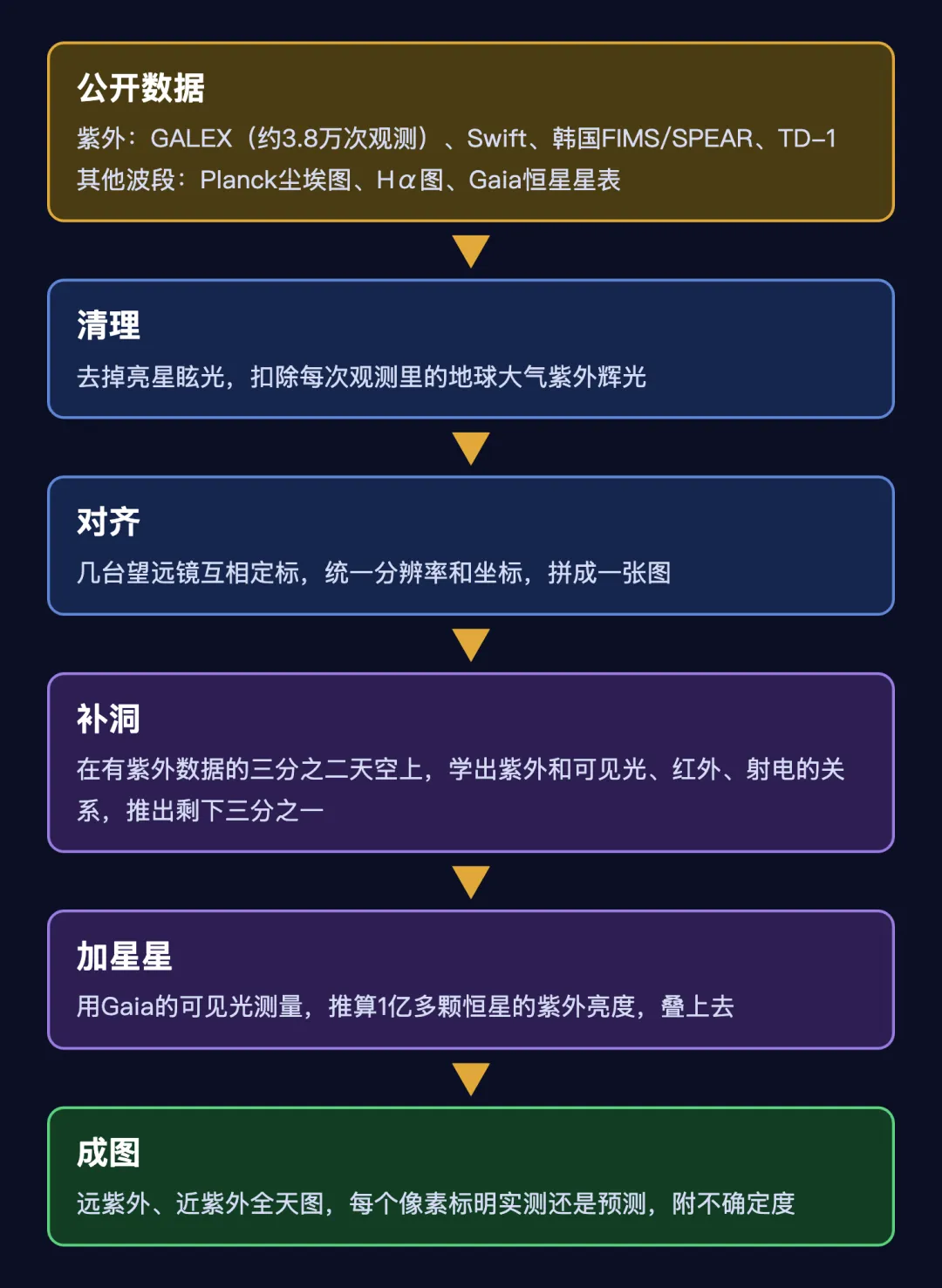
Claude Science is a scientific research platform launched by Anthropic at the end of June this year. A master agent can send out a new agent at any time, and next to it is a review agent, dedicated to verifying citations and calculations.
The whole collaboration lasted for several days, and the pace was steady. Menard came back to Claude Science to talk a few rounds and decide what to do next.
They made dozens of editions before and after, one smaller than the other.
Two rounds of AI interviewsI didn't see the spots.It's not like Claude was right once.
One night, Ménard looked at a well-processed chart and found a circle of faint circles floating in the darkest part of the chart, each slightly brighter or darker than the surroundings.
These circles are the "footprints" left by the galaxy's single observations.
GALEX photographs a circular celestial sphere with a diameter of 1.2 degrees, each of which is mixed with slightly less uniform ultraviolet light from the Earth's atmosphere.
The problem is that Claude listed this item as a known issue at the beginning of the project.
Ménard only said one word to Claude.
"I can see a disc, a single observation mark, can you fix it?"
The agents followed the clue and tracked the atmospheric residual fluorescent light. Afterwards, Claude retraced all of the 38,000 observations, and within a few hours, the circle disappeared.
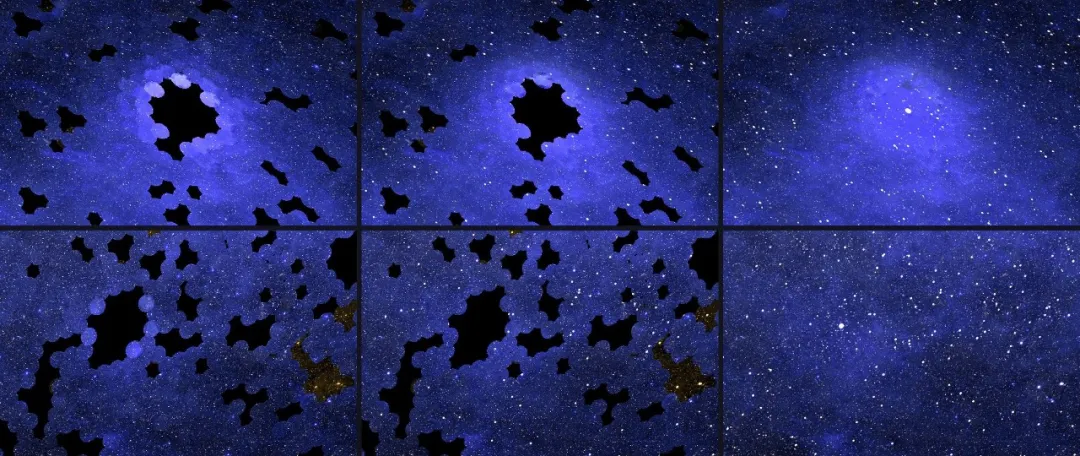 The two bright celestial spheres bypassed by the galaxy. The left is a single observed sphere, the middle is left after the background is cut off, and the right is a full-hole map after the Gaia star is overlaid.
When the professor saw that he was in trouble, he went back to work and gave everything to Agent.
The professor finally doesn't have to apologize.In the final image, the structure in the ultraviolet sky is revealed to be the same.
The dust clouds surrounding the young bright stars are glowing, leaving a huge ring of dust blown out by the explosion of massive stars. Far from the silver disk, the faint dust clouds illuminated by the stars of the galaxy are still visible.
Above the center, in the direction of the zodiac and the zodiac, there was a large blue cloud of dust shining from the hot young stars. Likewise, the cloud was dark in visible light.
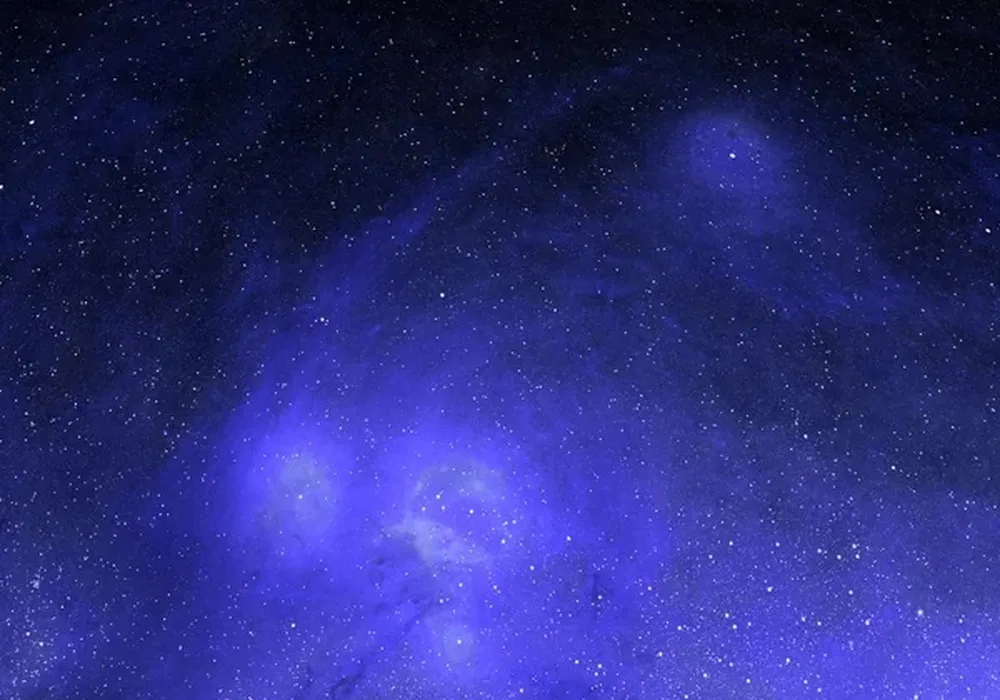 Above the heart of silver, a cloud of dust illuminated by the young stars in the direction of the zodiac.
Below the silver disc is the Large Magellanic Cloud, two neighbouring galaxies filled with young stars. On a full-resolution map, the Magellanic Cloud's star-forming baby-sitting spider clouds are clearly visible.
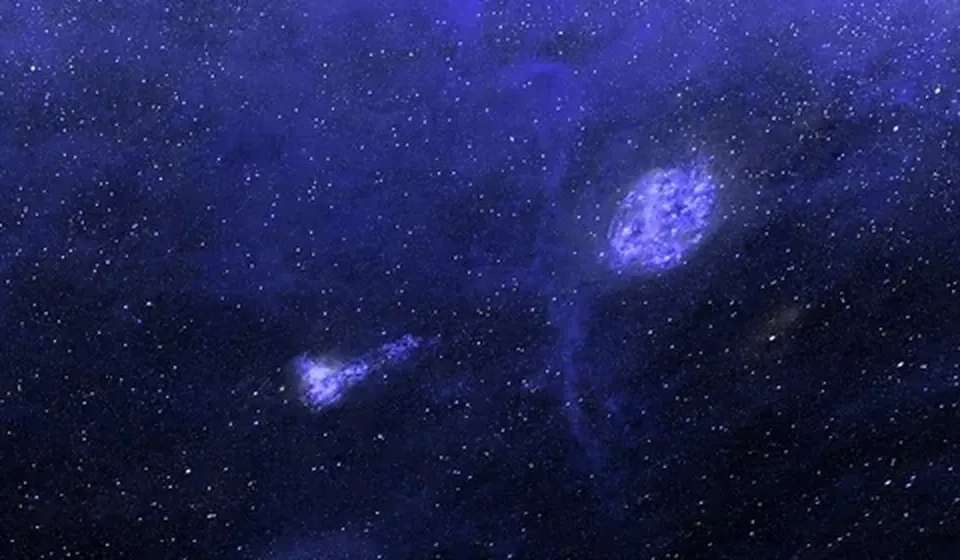 At the bottom of the silver plate is the large Magellanic Cloud (right) and the wheat Magellanic Cloud (left)
"I think it's beautiful", Menard said, adding that the diagram could be combined with other classic diagrams to help generations of students understand the physical processes that are taking place in the galaxy.
Following Anthropic's announcement, netizens on X questioned whether a third of the estimated graphs were incomplete.
On Ménard's map page, each pixel is marked as either a snapshot or a projection, and the error range is attached. He specifically warned on the page that completeness is not the same as observation.
Scientists are backing up their livesAI is taking over.
After completing the painting, Menard was most impressed with the time.
"This time, I'm doing a project like this without sacrificing the time I should have spent researching".
In his view, almost every field is overwhelmed with such life. They can clarify a key concept and help other researchers, but they are never at the top of anyone's list.
"I guess a lot of scientists can think of a chart, a chart, or a resource for the same reason they've been holding back".
In this graph, not one of the photons is new. GALEX, Swift, FIMS/SPEAR, TD-1, Planck, Gaia, are all public data collected over decades.
NASA is really going to do a full-day re-scan of UVEX at a cost of about $300 million and wait until 2030 to launch it.
NASA's next-generation UV detector, UVEX, is scheduled to launch in 2030
Before that, Claude used the old data to produce a complete map of the universe, each pixel labeled with a perfect timeline.
Recently, Harvard physicist Matthew Schwartz worked with Claude for three months, writing more than 36 original papers across 18 disciplines.
On the way to ASI, the first thing that AI took over was basic engineering that was not done by humans but could be used by humans.
See where it's wrong, decide where to go, or it's the people's business.
Ménard writes in a thank you note that behind the picture is the patient work of many Agents in Claude Science.
"My contribution is limited to guiding them in the process".
RoboInd editorial channelResearch, robotics companies and market intelligence for cross-border sourcing.Explore the channel ↗
Share this
End of editorialExplore more from Global Robotics News ↗