After a day's work, a man walks from the company to the parking lot.
The phone already knows the next schedule and the route to the house. After boarding the car, this information flows naturally to the machine. The vehicle enters the familiar life radius, the air conditioning in the home is pre-adjusted to the temperature, the lights are switched to the appropriate state.

In the past, such scenarios have often been seen in science fiction films. The film gives it an unknown intelligent controller, but in reality, these capabilities are often dispersed in mobile phones, cars, computers, sensors, home appliances, and models and systems running behind the scenes to complete tasks together by connecting.
This is one of the important differences between physical AI and past generated AI.
"Chatbots are probably the main scene of the first half of the big model. After physical AI, it's more important to perceive, to know people's intentions and to help people accomplish complex tasks by perceiving them". Xiaomi's president, Luigi Ice, said in a media interview during the IFA.
And that's exactly what makes Xiaomi special in this round of competition.
It has three high-frequency physical space entrances for mobile phones, cars, and homes, and has gradually upgraded its chips, AI, operating systems, and manufacturing capabilities.Looking at anything, wheat is not the only participant, but putting these capabilities into a consumer ecosystem is where it is difficult to replicate.It's alsoXiaomi has become the first company in the world to land physics AI in a "man-driver all-ecological" environment.
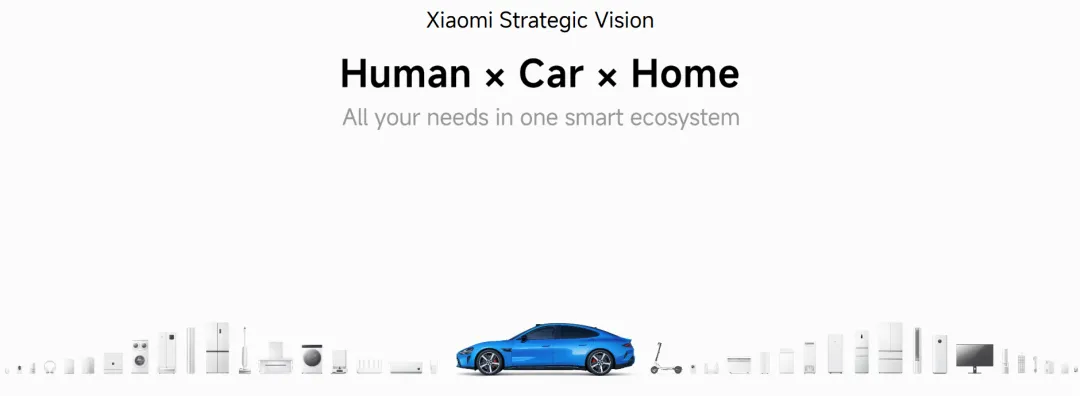
At this year's IFA, Xiaomi exhibited nearly 400 products, ranging from mobile phones, computers, home appliances, to cars, humanoid robots, and base-ring chips, on more than 3,000 square meters of exhibition space.
According to Luwei Ice, Xiaomi has now accumulated 760 million mobile phones and tablets, nearly 1.2 billion IoT connected devices, and nearly 2 billion connected smart devices, all of which can be used as physical AI deployments.
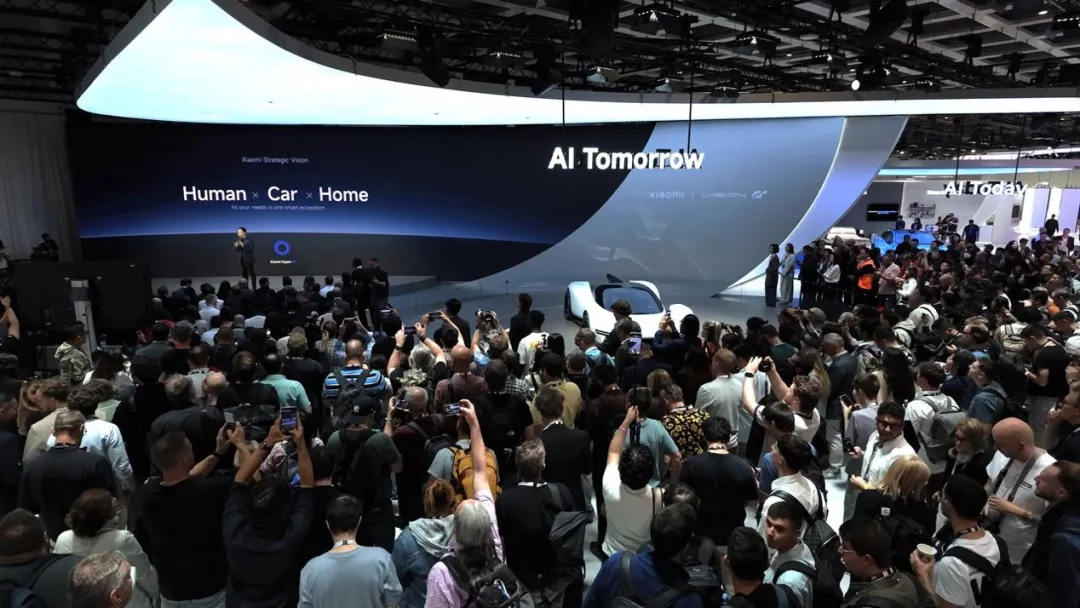
More important than the number of products, some of the previously decentralized AI capabilities have begun to connect.
Xiaomi has summarized it asActive perception, complex execution and active service.
Starting with the seemingly science fiction scenes, the counterparts can be found on the stage: people can respond in advance on their way home, household devices can respond in advance; a sentence can keep the photos flowing between mobile phones, PCs and printers; and the environment can be adjusted when the system senses that the user picks up the book and is ready to read.
These capabilities begin to bring perception, understanding and execution into a closed loop that was originally scattered across different terminals.
When AI really starts calling on these real-world devices like cars, electricity, and robots, competition is turning to what models can answer and who can make AI stable and function continuously in real life.
When AI starts "acting", it's not just devices.
In the last three years, the AI industry's focus has largely been on cutting edge models.
More and more extensive, multi-modal, reasoning and coding capabilities are improving, and parameters, benchmarks, and reasoning effects are also becoming the most intuitive way to measure AI progress.
But at the stage of physical AI, competition has begun to take on a new dimension. When AI only needs to answer questions, the model itself largely determines experience; but when AI begins to enter the real world, it not only completes understanding and reasoning, but also senses the environment, calls devices, and stably transforms judgments into real action.
The working chain of AI thus extends further from "understanding and generating" to "perceiving, understanding, planning, and executing feedback".
This has also allowed Xiaomi's past layout in the terminal and ecosystem to begin to show new value.Mobile phones, cars and homes are just a few high-frequency life scenes that Xiaomi has covered.
Mobile phones can provide location, image, sound, and application information; cars have cameras, radars, navigation, and vehicle status; and households have door locks, cameras, temperature and humidity sensors, air conditioning, scanning robots, and various household appliances.
These devices used to be first and foremost independent hardware products. At the stage of physical AI, they began to have a different meaning: they were both an input to AI's perceptual reality environment and an executive end to which AI could call.
Of course, there is not enough equipment.
Over the past few years, VLA, world models, robotic base models, and synthetic data have all been focused on solving essentially the same problem: how to make AI understand not only text and images, but also the real world, and what an action will lead to.
By 2026, the system architecture of physical AI is also beginning to emerge in a clearer way: the higher-level Agent is responsible for understanding goals and planning tasks, the lower model is responsible for real-time execution, and the control system is responsible for real-time execution.
This means that the competition for physical AI is no longer limited to the model level.
In March, in GTC's technology sharing on physical AI, Invidia also addressed real deployment issues such as multi-modal perception, response latency, local computing and equipment resources.
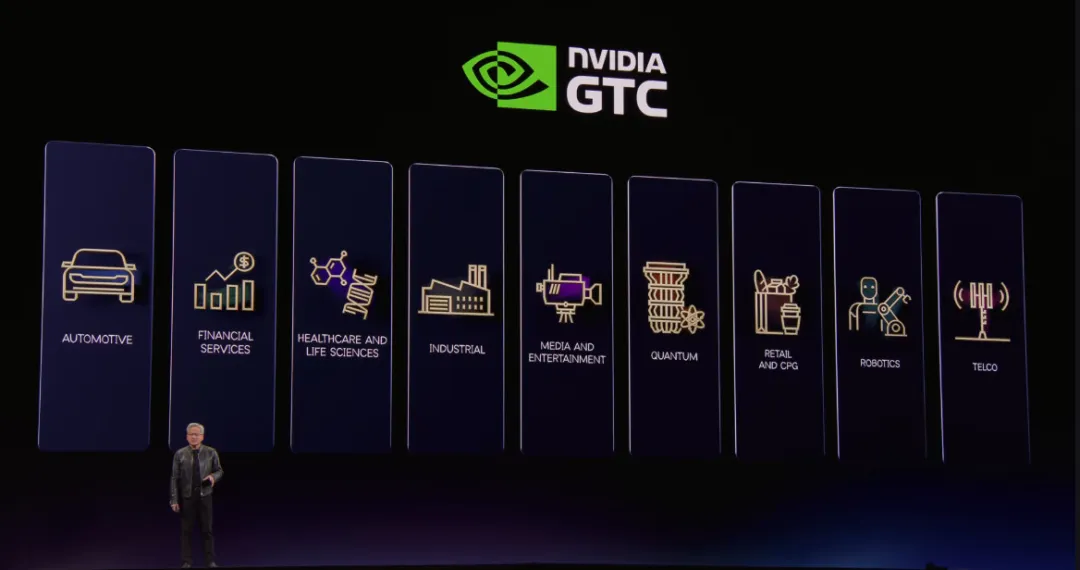
In other words, physical AI is not just about installing large models into hardware. Real deployment also requires the collaboration of end-to-end computing, operating systems, sensors, and executors: AI not only completes reasoning, but also knows which devices and devices are in what state, and then transforms judgments steadily into real action.
These previously dispersed capabilities in different technologies and products have begun to connect in Xiaomi.
At this year's IFA Xiaomi show, the link was able to see the curvature: chips, mobile phones, cars, home appliances and robots, being placed in the same AI display logic.
More importantly, these devices are not isolated from each other.
In the past, smart homes, the core of which was device connectivity and rule automation. Temperatures above a certain threshold opened the air conditioning, fixed time to start the robot, automatically turn on the lights after returning home, essentially all the conditions set by the user in advance, the device executes according to the rules.
With the addition of the Big Model and Agent, the system began to deal with more vague, closer to human needs. For example, "Friends come to dinner tonight", which may involve a number of devices such as air conditioning, lighting, scanning robots, and loudspeakers. The system needs to combine time, environment, and historical habits to understand the task, then decide which devices to call, and in what order to execute.
At this point, the leverage of the terminal and the ecosystem in AI competition has also begun to rise. This is exactly what Xiaomi has been accumulating over the past few decades.
Xiaomi has already paved the way for the real world
The size of this entrance can be judged by several numbers.
As of June 30, 2026, Xiaomi's mobile phones and tablets have reached 760 million monthly active users globally, and Xiaomi's AIoT platform-connected IoT devices have reached 1.16 billion, and users of five or more connected devices have reached 24.6 million.
Among them, more than 24.6 million device users are particularly worthy of attention.
The tasks that a device connected to the Internet can solve are limited; only when a household has a camera, a door lock, air conditioning, a TV, a robotic scrubber, a speaker and a wearable device at the same time, does AI have more combined perception and execution capabilities.
This is why, in the context of physical AI, multi-device users will be a valuable benchmark: it is closer to the environment where multi-device agents really play the value needed. As of the second quarter of this year, users of five or more connected devices are still growing by about 20.2% in comparison.
Mobile phones provide a key entry point.
In the second quarter of 2026, Xiaomi's smartphone shipments amounted to 31.2 million units, ranking third globally. The phone is still the closest to an individual's general computing device, with accounts, location, applications, cameras, microphones and local computing capabilities, and is naturally a collaborative input for personal AI.
The car added another piece of the puzzle.
A smart car is itself a complex physical AI terminal, with a large number of sensors and lateral computing capabilities, that can actually affect the environment through air conditioning, seatbelts, power, steering and braking systems.
As of July, Xiaomi's cumulative deliveries had reached 700,000 vehicles, and the "car" in the "person car" started from a strategic concept to a node with real users and frequency of use.
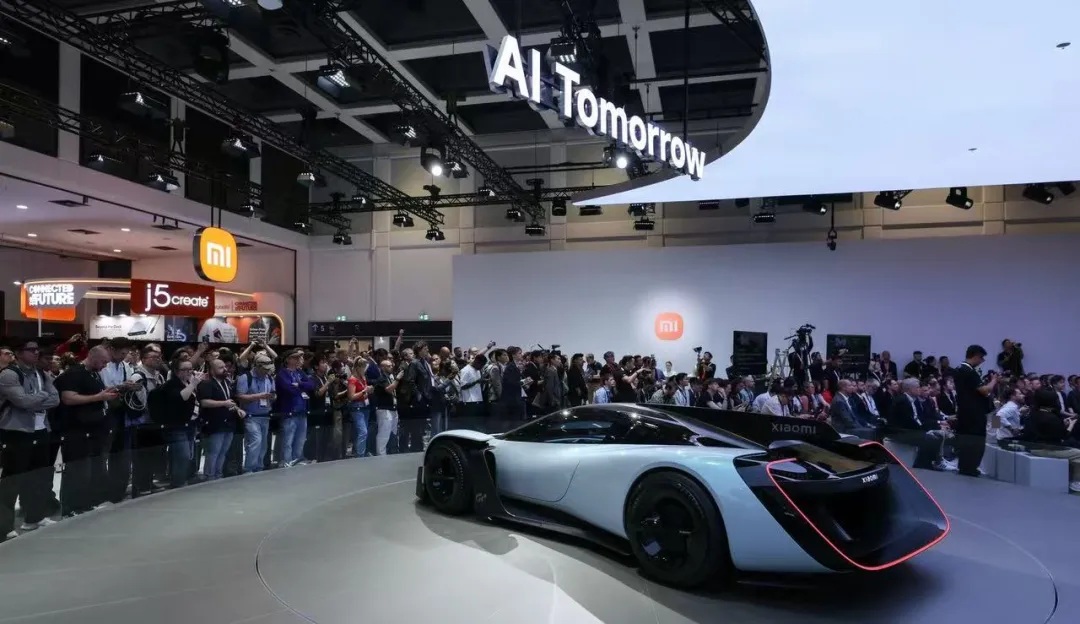
Once mobile phones, cars and homes are connected, AI can move alongside people's life scenes.
A person's schedule, content, habits, and needs are constantly moving between his or her home, car, and personal devices. The system needs to know not only who the user is, what has happened before, but also the current environment, which devices are available, and which actions have been authorized.
This is where consumer-grade physical AI is more complex than lab demos.
Household structure, housing and equipment combinations are highly fragmented, and the same action may respond to completely different needs at different times, in different members and in different scenarios. The more active the system is, the more details need to be understood and processed.
For Xiaomi, 760 million mobile phones, tablets and 1.16 billion IoT connected devices first provide a large enough device base; after the addition of cars, the network of devices extends from fixed home space to mobile space.
We can summarize Xiaomi as the basis of physical AI in one word: it already has enough entrances into real life.It is for this reason that Xiaomi has been at the forefront of pushing physical AI from one-point capability to full ecological collaboration.
It's really hard to put these skills together.
With these inputs, the next thing to be solved is the collaboration between devices.
Different products have different calculations, different sensors, different life cycles. A phone can be updated every two or three years, an air conditioner can be used for ten years; robots need to handle motion controls, door locks emphasize power and reliability, and cars have much higher requirements for real-time and safety.
It takes a long technological chain to allow AI to work between these devices.
Today, Xiaomi has evolved gradually, from chips, models, operating systems, to cars, home appliances, robots, and manufacturing connections.
It's all about the bottom line.CalculationTalk about it.
The demand for end-to-end computing for physical AI is increasing. Domestic cameras, automobiles and wearable devices produce a large amount of signals that involve privacy and real-time, and many control tasks cannot rely on continuous cloud back and forth. Network fluctuations have a limited impact on light control, but for automobiles and robots, latency and local computing directly affect system performance.
In 2025, Xiaomi launched its flagship smartphone, the SoC bas-ring O1, with material revealing its cumulative shipments exceeding 1 million. In 2026, the bas-ring further expanded to the flagship AI processor O3, the high-bandwidth AI accelerator chip O100, and the D100, which is geared towards the demand for intelligent driving.
The chip solves wherever it is.ModelsIt's all about understanding.
In 2026, the MiMo model continues to replace the V2 and V2.5 series, covering multimodal inputs such as text, images, video, and audio, and extending to coding and agent capabilities. For physical AI, multimodal capabilities directly correspond to time, location, sound, human state, and device information in the real world.
In June, Xiaomi released Miloco 2.0, a suite of all-in-house intelligent AI software at the heart of MiMo that combines capabilities such as multi-dimensional perception, family memory, active service and long-term tasks, starting with automation based on rules in the past and moving further towards continuous understanding and task execution of the home state.
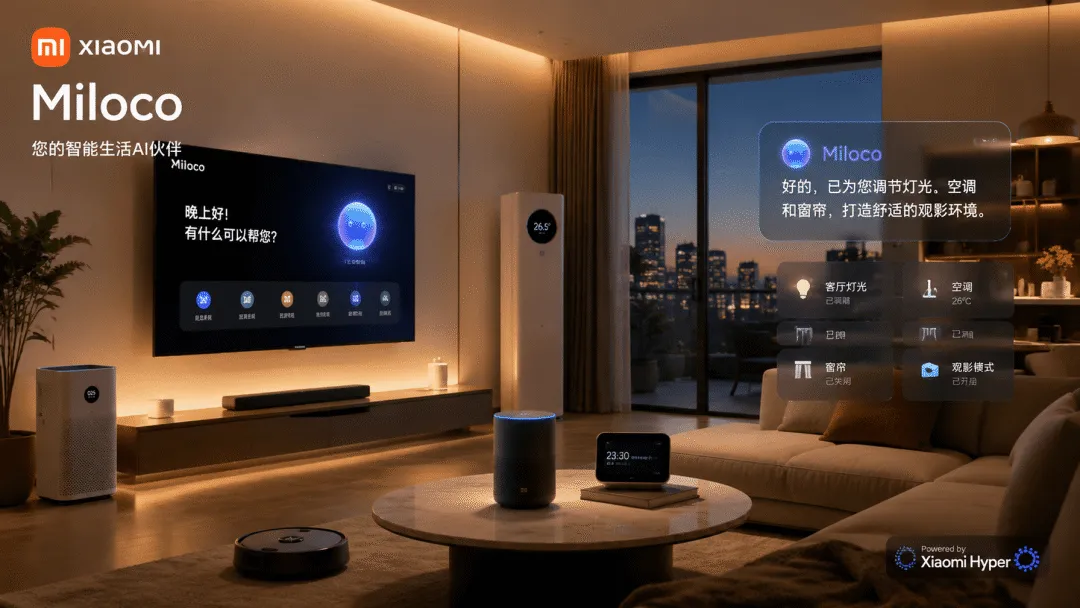
After understanding the model, it is necessary to find the right equipment, and this step is mainly based onOperating systems and equipment platformsFinished.
The Sony OS4 Beta featured a modified MiMo and AI version of Super Little Love 2.0, as previously disclosed by Xiaomi, the expert version of Super Little Love 2.0, which already has the ability to think for itself, plan for itself, call devices and perform tasks on its own, and support complex cross-applications and cross-device tasks. In addition, a large number of low-calculation IoT terminals and embedded software platforms like Xiaomi and Vela allow different hardware to continue to enter a unified software and control framework.
The robotsTo extend this link further to more complex physical executions.
This year, Xiaomi unveiled Xiaomi-Robotics-U0 and Xiaomi-Robotics-1. According to the company's public information, the former is a 38 billion-parameter multi-modal body world base model, which uses more than 100,000 hours of real-world mobile operating trajectories for pre-training.
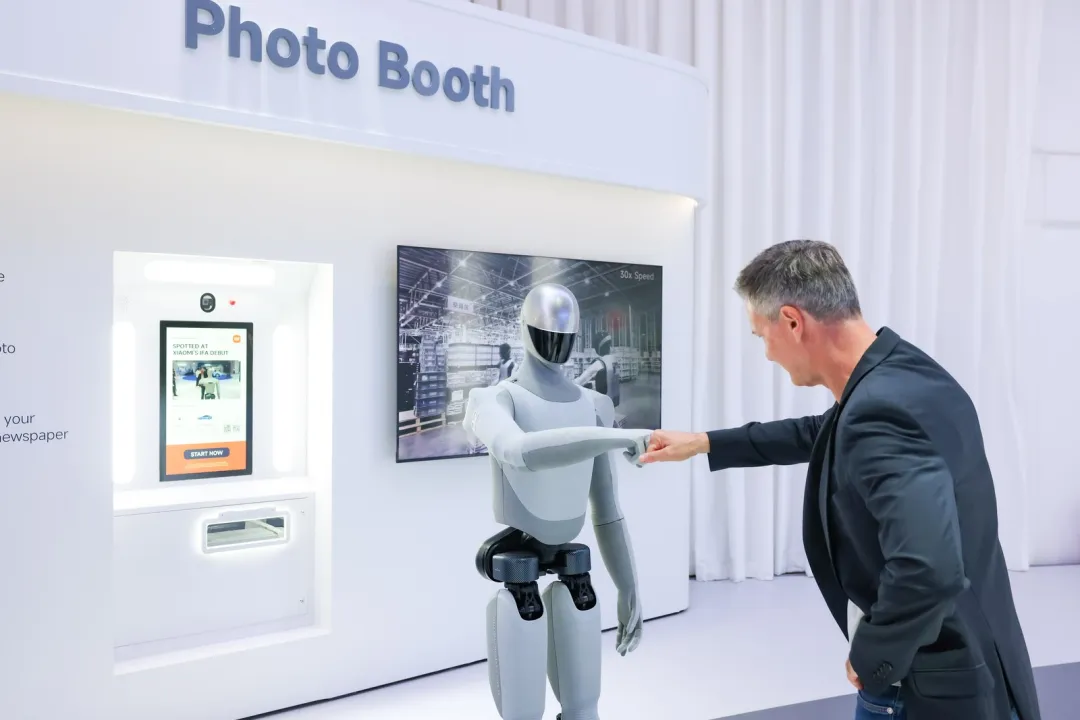
At the Xiaomi auto plant, the success rate of the two-sided tasks of robots on the self-attacking screw plant has been increased to 98%; the success rate of the mid-control side cover sorting and rotary box folding tasks is about 90%. This indicates that these capabilities have entered the real workplace and are validated in repeatable, high-frequency and quantifiable production tasks.
This also reflects another layer of value of the Xiaomi auto-manufacturing system.
For physical AI, factories also provide a high-frequency feedback that is difficult to stabilize in a consuming scenario: tasks are clear, results are quantifiable, and the same actions can be repeatedly performed. Mobile phones, automobiles, and home power lines themselves contain a large number of visual, transportation, assembly, and flexible operational tasks that can become scenarios where robot models and control systems continue to receive feedback.
As you can see, Xiaomi's path is now clearer: chips provide end-to-end computing, MiMo is responsible for understanding and reasoning, Linux OS, Vela and IoT platform connectivity terminals, Super Little Love and Miloco are responsible for task compilation, and the actions are executed by home appliances, cars and robots, with execution results continuing to feed back to product and model iterations.
The advantage of Xiaomi is that these previously decentralized capabilities are being linked in the same consumer ecosystem that covers mobile phones, cars and homes.
Decades of accumulation, beginning to show new value
If in the last few decades Xiaomi's mobile phones, IoT, home appliances, and automobiles are expanding its business boundaries, then it's time for the era of physical AI, where these previously decentralized businesses are starting to point in the same direction.
In the past, the system first solved how to connect between devices; now, it begins to answer further, how AI understands a person's needs and then does things across devices.
In the end, users don't necessarily realize how many models, chips, and terminals are called behind the scenes. A really good experience may be just a few switches, fewer repetitions, and fewer resets.
For Xiaomi, this is also the moment when the accumulation of value over the past decade has begun to emerge. The device base that covers the "man-driver", along with chips, AI, OS and manufacturing capabilities, is becoming one of the hardest to replicate underpinnings of its entry into the era of physical AI.