Computational limitations are one of the real constraints faced by physical AI landings.
But at the 2026 World Robotics Conference's Intelligent Commercial Landing Forum, Jiang Zemin's Intelligent CEO, Pyongyang, made a counterintuitive observation: This constraint is exactly driving a more engineering-efficient technological pathway.
In his talk on the road to the industrial landing of physical AI, entitled "Bringing One Brain, Multi-Bodies: The Path to the Industrial Landing of Physical AI", he draws his attention back to the real constraints of the industrial landscape: the scale of industrial robot installations, the widespread coverage of 5G base stations, the abundance of power generation capacity.
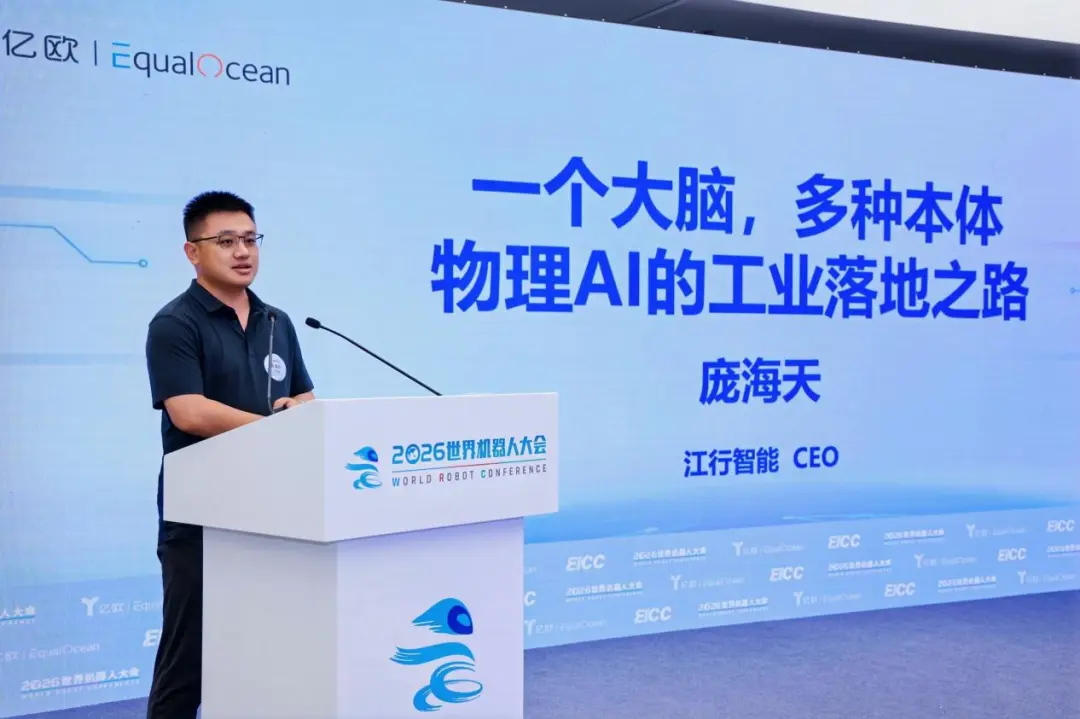
Chairman and CEO of Jiang Zemin, Pyongyang, gives keynote speech
From digital AI to physical AI: a paradigm shift
Pyongyang first clarified the essential differences between generative AI and physical AI.
"Generative AI primarily produces content in the digital space, whereas physical AI needs to enter the real industrial landscape, understand the environment, connect devices, execute tasks, and perform iterations in continuous feedback".
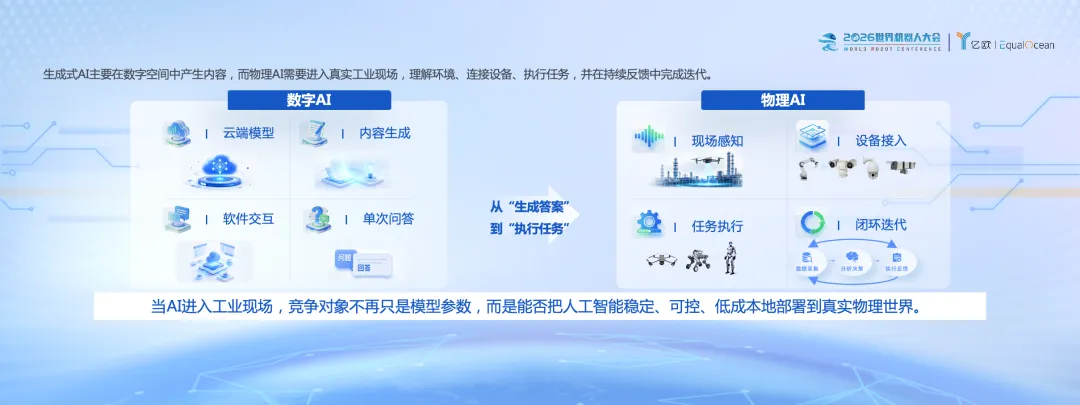
Digital AI and physical AI
In Pyongyang's view, digital AI and physical AI are two distinct technological paradigms: the former relies on cloud models to produce content, interactive software; the latter on field perception, device access, task execution and closed-loop transformation. When AI enters the industrial field, the biggest test is no longer the parameters of the model, but the robustness and engineering efficiency of deployment.
In the speech, Pyongyang Sky Systems outlined key elements to support China's industrial-physical AI deployment:
High-density, long-cycle industrial scenarios provide a natural verification ground;
The rapidly evolving open-source model ecosystem has reduced technological barriers;
The widespread coverage of communication networks makes devices in the physical world "accessible";
An abundant supply of energy constitutes the foundation of scale deployment;
The restrictions at the chip level are forcing the industry to explore the efficiency path of soft-hard collaboration.
In Pyongyang's words: the landing conditions of China's industrial physics AI, from the common role of scene density, model tracking, on-site access, chip efficiency and the energy base. These together shape a path of differentiation that relies not on cumulative computing, but on engineering efficiency.
One brain, multiple entities: the twin engine architecture of physical AI
JX-Phi Brain as the decision-making center, and JX-Phi World as the evolutionary backbone, forming a closed loop from on-site observation, model reasoning to task execution and result backflow.
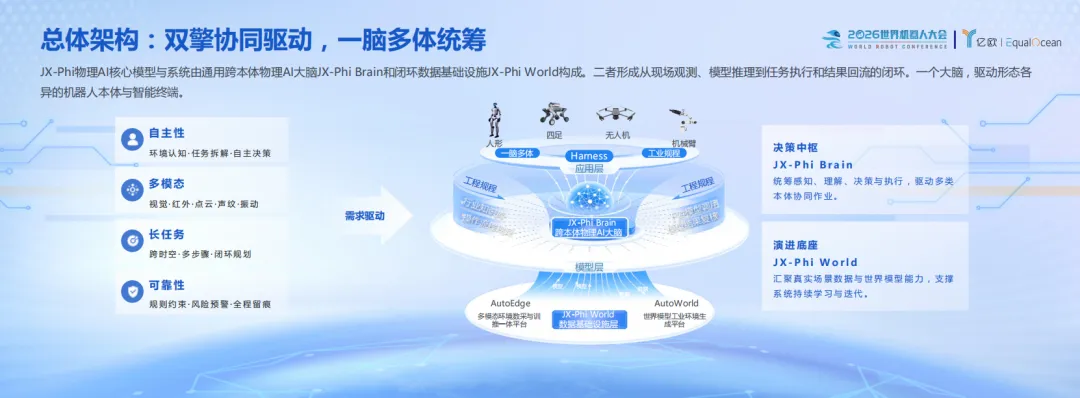
JX-Phi Physical AI technology system
Pyongyang's testing ground for this system is quite demanding: allowing the value of physical AI to be verified first in a very low-error industrial field.
The demands of the industrial landscape for robots are summarized as "four extreme challenges", corresponding to "four core capabilities":
Environmental openness, high spatial heterogeneity, which requires autonomy across the whole domain, autonomy to perceive the environment, dismantle tasks, plan pathways, and make dynamic decisions;
Multiple devices, real-time variations in state, needing multi-modal integration, and providing visual, infrared, dot cloud, sound pattern, vibration, and other information.
Multi-step, long-process operations, requiring long-distance closure, memory and multi-step planning capabilities;
Extremely low error tolerance, stringent safety standards, and the need for extreme stability, and reliable enforcement through rules, risk warnings and abnormal self-recovery safeguards.
At the model level, the JX-Phi Brain is based on the Foundation Model for multi-modal perception and long-range task execution, architecturally using multi-modal coding, sharing a mix of MoE and residual MoE expert design, and evaluating the actions with the Critic module combined with the World Model. It is worth mentioning that the Harness layer in the middle is the core. It is responsible for "a multi-brain collaboration control" and "industrial programming constraints". Over the past eight years, more than a thousand industrial scenarios have accumulated.
On the data side, the JX-Phi World is powered by two engines: AutoEdge's Geo-Hint Automatic Discovery, which is responsible for the data, and AutoWorld, which acts as an industrial scenario projection and pre-training platform for long-term data expansion and industrial world model generation.
It is a unified architecture of "perceiving, understanding, making decisions, executing, and executing" that is downward compatible with domain-controlled servers, body-intelligent modules and controllable terminals, driving drones, machine dogs, bicycles, wheels, quadrupeds, humanoids, and other types of entities; covering pan-industrial scenarios such as power grids, power generation, chemicals, oil, gas, storage, data centers, and more.
Product matrix: brains, modules and eyes
To transform the technical architecture into a landing product, Jiang Zemin's Intelligences built three types of core shapes around the JX-Phi physical AI brain:
The first is the body-operating robot, which includes lightweight and heavy-duty platforms, covering a full spectrum of tasks ranging from smart patrol to complex operations, supporting modular loads, and achieving one-to-many applications.
It combines physical AI brains, spatial perception, navigational positioning and visual recognition capabilities, quickly adapts to different brains through standard interfaces, supports distributed deployment and lateral reasoning, and provides low-cost intelligent conversion for storage robots.
Last but not least, the OmniSight S4 sensing load, a micro four-phase three-axis cloud-based camera with built-in dual 48 million-pixel visible light cameras, 640×512 infrared thermal imaging and laser distance modules, IP66 protection, mounted on all types of robots and mobile patrol platforms, supporting open protocols such as UDP, UART, MAVLink 2.0, and providing a pair of "golden eyes" for robots.
Jiang's hardware and hardware terminals
These three types of products respond to three flexible landing paths: direct delivery of integrated systems, storage of embedded modules, and independent enhancement of perceptual capabilities. Essentially, breaking down "one brain" into standardized components that can be embedded on-demand in industrial sites greatly improves the flexibility and efficiency of deployment.
Value verification: "calculation of accounts" in a very low error scenario
The most convincing part of the speech was the landing results of two groups from real-world stations.
On the power grid side, Jiangsen Intelligent Power Station Physical AI Intelligent Surveillance System has achieved wide coverage, achieving long-term autonomous operation of a large number of power stations. After deploying the system, the frequency of artificial surveillance was greatly optimized, per capita management efficiency significantly improved, effectively solving the high manpower costs and safety risks in power grid operation.
On the new energy side, physical AI operating systems have also achieved long-cycle stable operation at numerous wind and field stations. Both the system's identification accuracy and mission execution success rates remain high, directly driving labour productivity leaps. These results have covered major power generation groups in the country, proving the adequacy and reliability of physical AI in the new energy operation scenario.
These stations are backed by a data retrieval and computing center located in the Guangzhou New District, which, depending on Guangzhou's "East Numbers West" hub status, opens the "Site Retrieval, Guangzhou Training, China National Deployment" cycle.
The way is out.
When the industry is still debating "brain priority" or "body priority" and when humanoid robots come to work in factories, the path that Pyongyang has given is rather restrained. It is not the explosion of a single form, but the use of a cross-body brain that drives all forms, so that the technological value is at a minimum, requiring the most demanding prior verification in the industrial field.
The end of physical AI may be a long way off, but as this forum has repeatedly proven: in 2016, the battlefield came from the idea of "what can be done" to the list of "what has already been done".