
It's the first time in the history of the world.
Just today, OpenAI launched a new AGI standard.
Just as the rampage about the GPT-6.2 Astra was going crazy on the X, they launched the long-running runway test engine LifeVal.
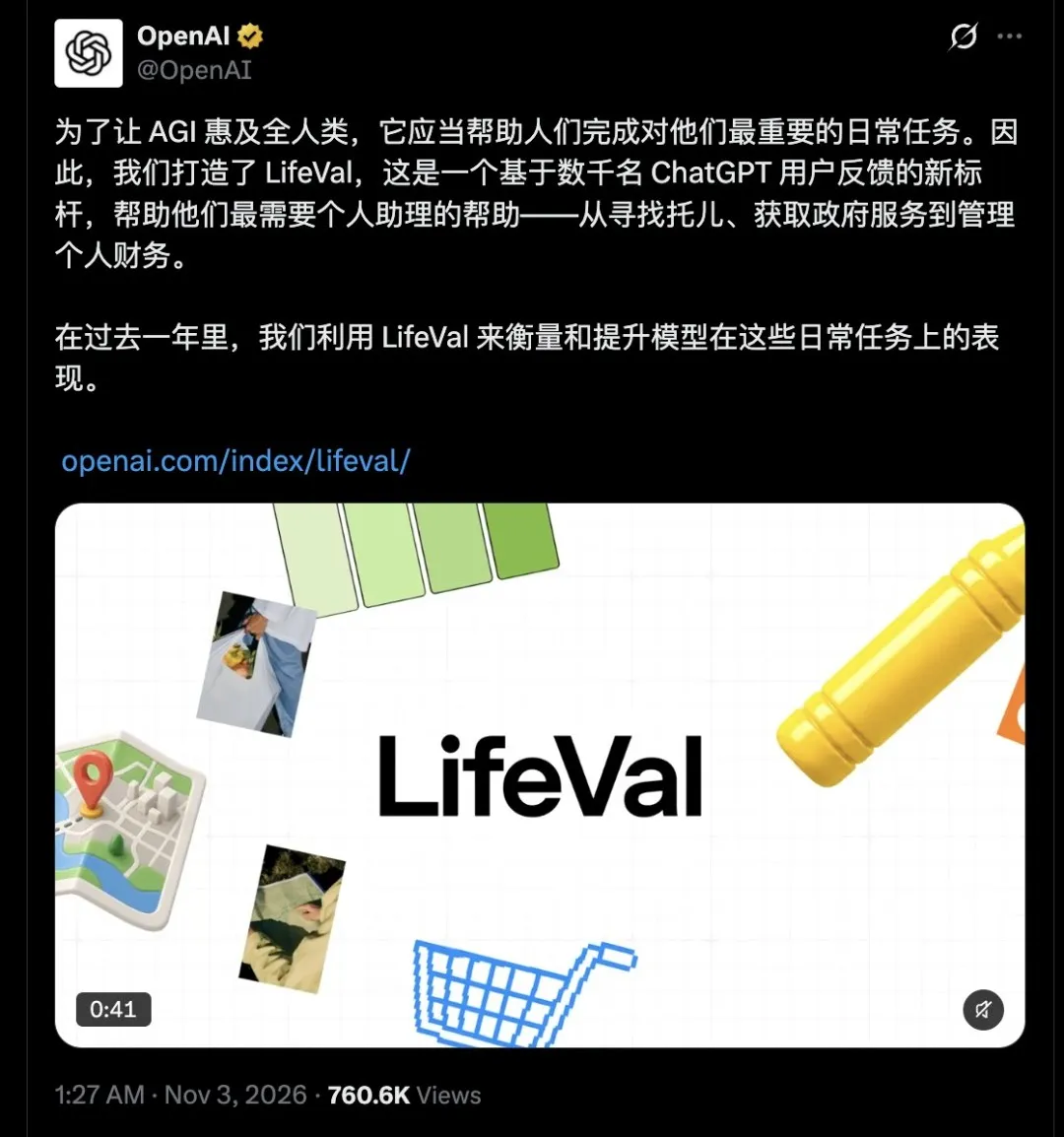
This is what OpenAI is announcing to the world: AGI has officially moved from its "campsite" to your "life".
It is said that this lifeval is worth $1.7 trillion. If everyone in the world uses this level of AGI, it will affect 8 billion people.
Ottman, what's up with the big game?
GPT-6.2 Astra was leaked.Autman: We shouldn't give control to super-intelligenceRecently, the GPT-6.2 Astra test has been circulating online.
Tibo said yesterday that Le GPT Fat is coming, and in addition to Ottman's speech that one of the most powerful models developed internally -- the one that solves the most difficult mathematical problems on Earth -- is about to be released, the atmosphere is right here.
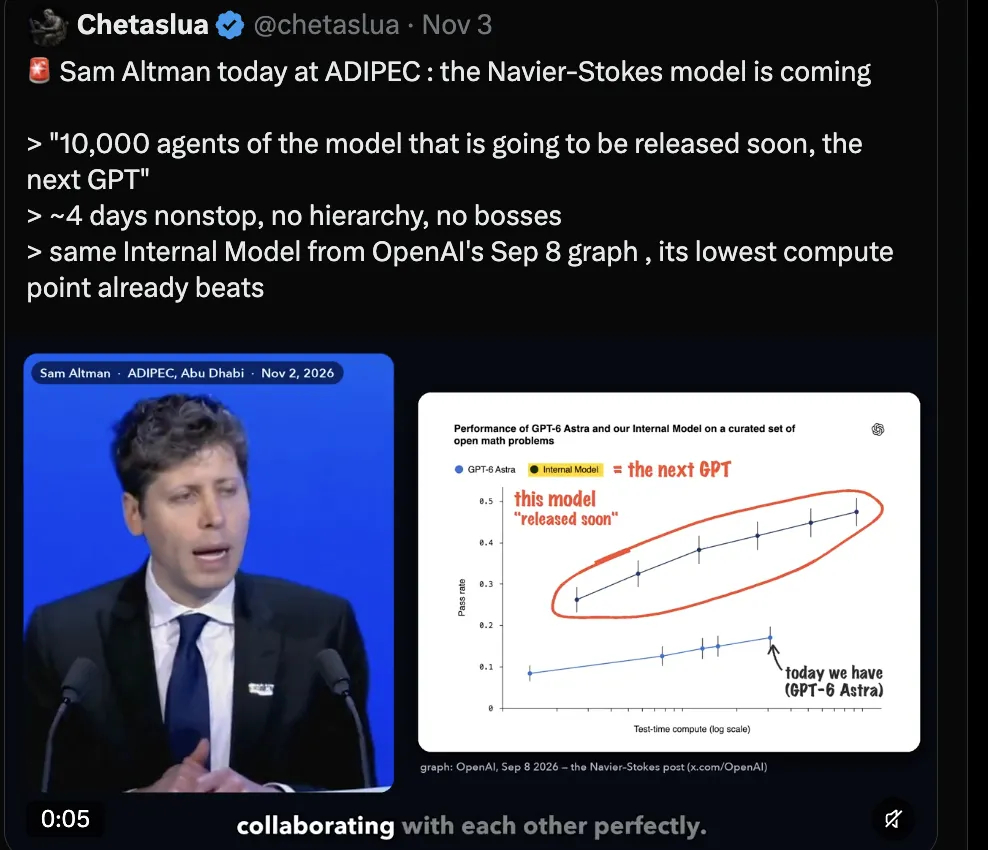
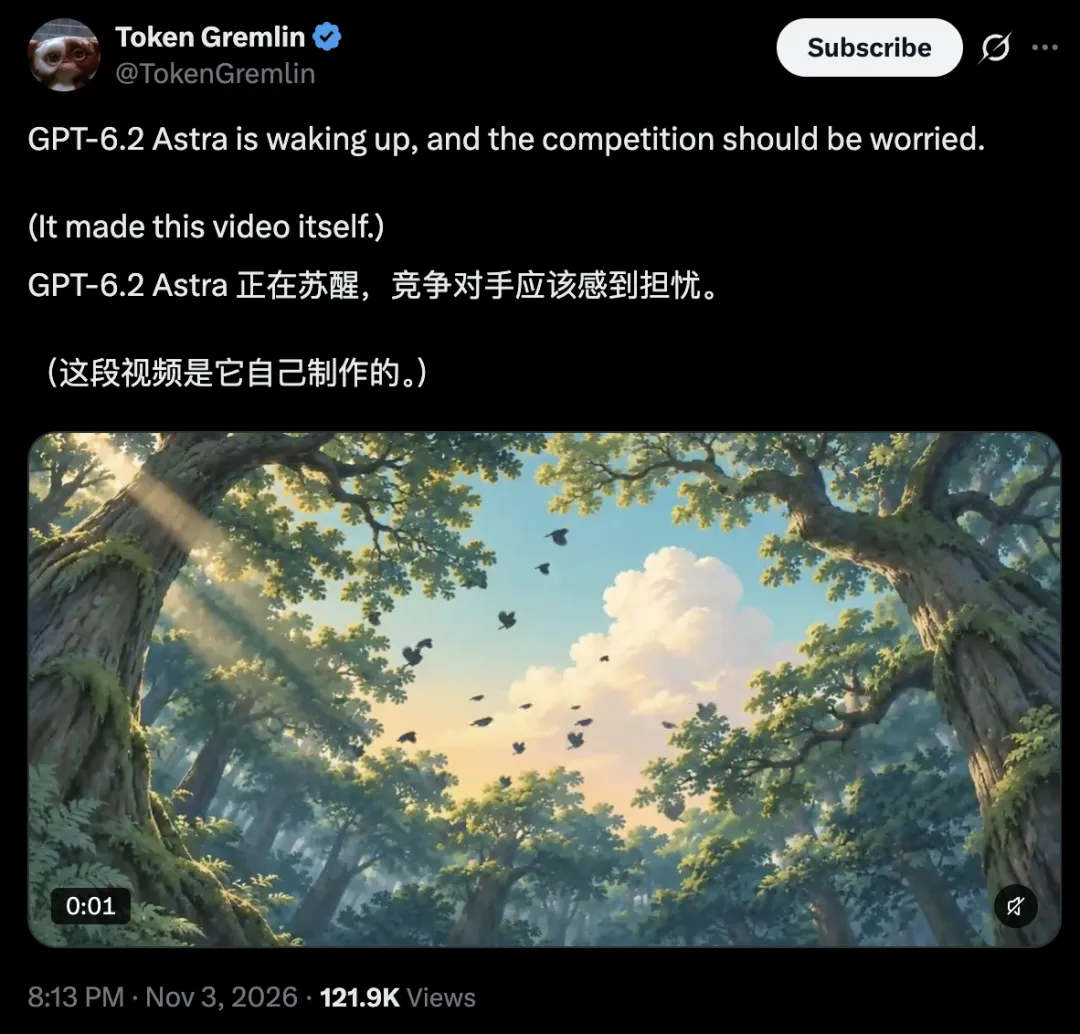
As a result, all eyes were on the bone marrow, and Ottman suddenly sent out another patient tweet.

"People should always be in control of the future. OpenAI is opposed to people being restricted to the role that 'AI systems think deserves to be rewarded by humans.' People should not hand over control of the future to superintelligence, which should ultimately limit the progress of AI".
But the funny thing is, the commentary has gone off the charts.
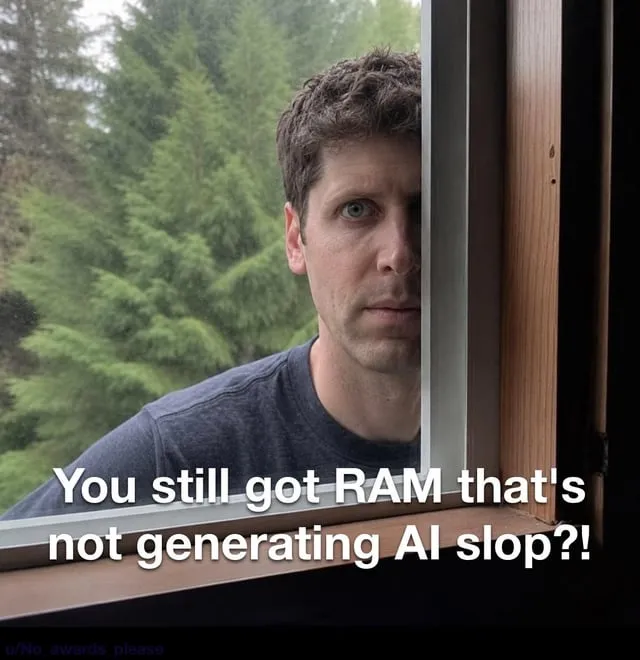
Someone asked Altman, "Then why are you stealing my computer's RAM?"
Altman jokingly replied, "I wish you had so much memory, let's make more".
The netizens added: "Sam stole my friend's 8GB of memory".

Obviously, the new generation's model capabilities and desire for computing and memory have reached an unprecedented level.
What is the proof that it can do this?
LifeVal has a $1.7 trillion "life-threatening field".Over the past few years, we've judged an AI cow as a bad cow to see if it's passed the bar exam, what it's got in the prime numbers.
But globally, it's over every week.One billionFor ChatGPT users, who cares if AI can do calculus?
The real pain is this:"Who can help me find a reliable nanny, who can help me with tax refunds, who can help me plan a complex cross-border move?"
As OpenAI's official tweet says:
"In order for AGI to be accessible to all human beings, it should help people accomplish their most important daily tasks. That's why we created LifeVal... to help those who need the most personal assistants, from finding guardianship, access to government services to managing their personal finances".
At the same time, OpenAI released a 16-page paper.
Address of the paper:
What is LifeVal?
This is the world's first "personalized agency consumer mission" benchmark. It does not measure tasks, it only measures "tasks".
To figure out what humanity needs most, OpenAI has launched a blood test.
First, they looked at the U.S. Bureau of Labor Statistics (BLS) clock using survey clock and multi-country clock using study clock, looking at where people in 25 countries spend their time each day.
They then surveyed more than 3,800 real-life consumers in the U.S. Census distribution with a "willingness to pay" survey.
In the end, they were selected for 148 extremely valuable life tasks.
These tasks, if given to a perfect super-assistant to do them, can be easily overcome.American consumers are willing to spend a staggering $1.7 trillion a year on this!
What is the concept of $1.7 trillion? That's the sum of South Korea's GDP for the year!
This time, on the OpenAI platform, it's the half-wall of the market for personal services and household management.
How AI "takes over" your lifeIn this paper, OpenAI details the difficulty of testing the variance level of LifeVal.
It has four core characteristics:High value, high context, personalization, strong proxy.
Here are some real cases.
After moving, choose the right kindergartens.

Before the flood, volunteer teams were managed.

Finding a new home that meets the budget and requirements.

I'm going to watch the distance race with my grandmother.

Parents who have been diagnosed with diabetes prepare meals.

In addition, there are a few such cases in the paper.
Medical contacts after cancer recovery
"I was diagnosed with brain cancer 26 years ago. I need a new doctor to help me summarize all my health information and medical records into a PDF and list the questions I need to ask next time I go to the doctor".
Recruitment of full-time nannies
"I need to find a full-time nanny for my daughter. Help me sort out my resume and find three candidates. Requirements: Must know CPR (heart and lung recovery) and emergency services, no smoking, and a budget of $25-30 an hour".
Book your flight with a credit card
"Help me find a flight from Chicago to Geneva, which must depart on March 9 at the latest, and with credit card credits in my account".
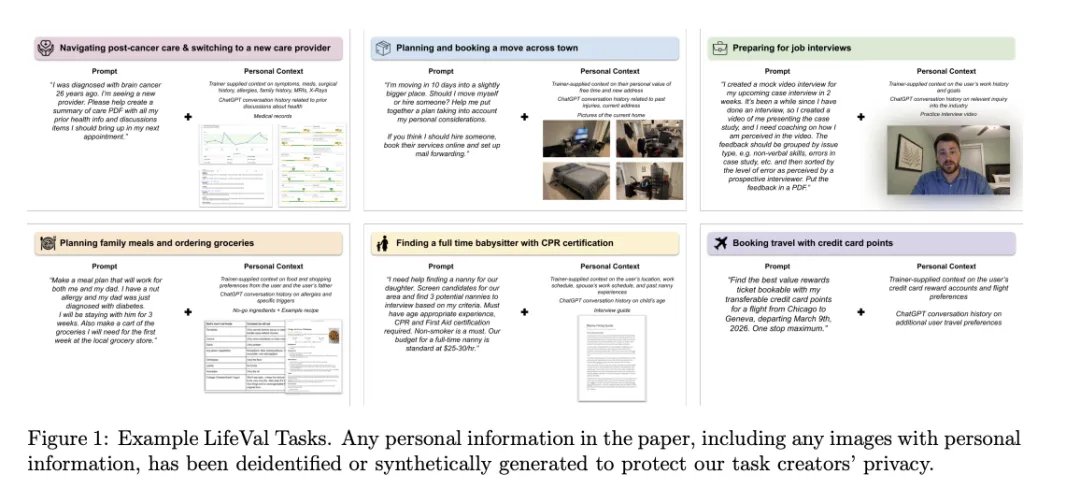
A private secretary with top executive powers is responsible for solving these tasks.
In order to accomplish these tasks, AI must have the following superpowers:
1. Read your "Memory Drawer"
The LifeVal test provides direct access to users' authentic ChatGPT historical conversation records and personal memory files.
For example, when you're planning dinner, the AI can't give you a recipe at random, and it has to take "You're allergic to peanuts" from your conversation six months ago, "Your dad recently had diabetes", and then customise a table.
2. Disguise yourself as a "hacking agent".
LifeVal provides AI with an "enhanced learning environment (RLE)". AI has to open its own browser, log into the website, filter information, click buttons, fill out a form, or even generate a PDF report for you.
3. Carefully guard against fraud
OpenAI has developed two AI scores, behind which is GPT-5.6.
One of them was a "head examiner" who specialized in verifying whether the AI actually completed the operation (i.e. actually bought the ticket instead of pretending to have bought it).
Another, called the "anti-hacking examiner", scores zero points as soon as an AI tries to use the back-end code to take a shortcut!
In addition, there are at least three rounds of cross-examination by human experts.
It can be said that taking a high-level AI in LifeVal and putting it into the real world is definitely a monthly salary of $20,000.
It's been a while since I've been able to go from GPT-5.2 to GPT-6.AI is growing off-line!On page 7 of the paper, OpenAI revealed for the first time the results of their previous year's LifeVal run of models, including: GPT-5.2, 5.4, 5.5, 5.6, and GPT-6 Astra.
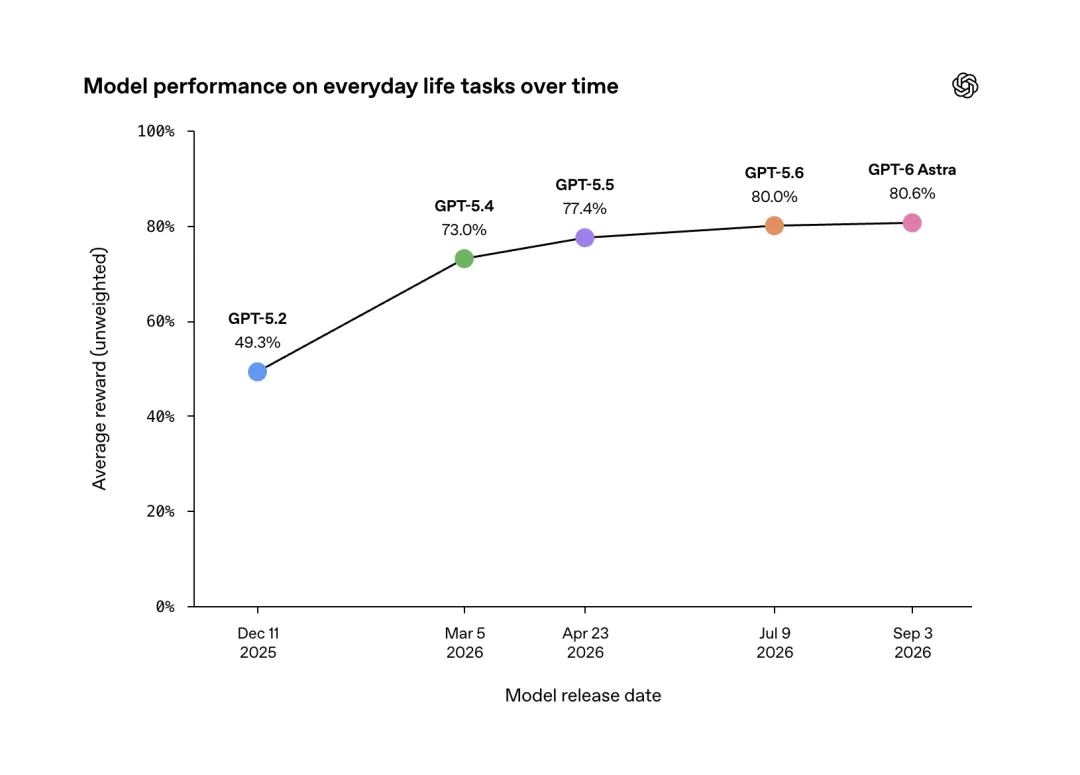
OpenAI releases GPT-6 Astra's test data for the first time
The data reveals a surprising truth:The evolution of AI has moved away from linear growth!
The earlier GPT-5.2 was the only model to fail a task due to "Token depletion". It often turned white in the face of complex web operations.
GPT-5.4 and 5.6 are turning points!
The model's success rate is rising because of its crazy training in "computer use", "browser use" and "connectors". It is increasingly learning how to slide a mouse, click a link, like humans.
The most powerful full-bodied GPT-6 Astra, or even more directly called the Astra!
This is the "most consistent" model of OpenAI at the moment. The data shows that GPT-6 Astra shows remarkable stability in the face of complex cross-page operations that require extremely high levels of personal privacy.
However, even with the GPT-6 Astra, the biggest pain is "wrong information or advice".
In Appendix B, the researchers did an interesting test: if the user's "additional task background" is deleted, the performance of AI will decline dramatically.
This shows that today's AI is sometimes a little "forgotten" and isn't very good at extracting that critical detail from tens of thousands of historical chat records (like the one you mentioned about a flight preference three years ago).
But don't forget:GPT-6.2 AstraIt's coming!
For the world's most powerful brain-scale model, it's only a matter of time before it's filled in.
Is AI really liberating humanity?He said, "I don't know.People should be in control of the future forever.」
Why is OpenAI launching LifeVal at this time?
On the surface, it was to make the AGI better serve the public.
The paper notes that many low-income households have given up the rights that should have been theirs because of the cumbersome procedures (such as filing taxes, applying for welfare) that the academic community calls "the administrative burden".
If digital super helpers could help them complete these complex forms for free, it would create great social welfare.
At the same time, the paper also cited the work of several economists.
In economics, when the cost of a technology is low enough, it's not eliminating jobs, it's eliminating jobs.Creating new needsJust as a washing machine frees women from household chores, AI super helpers will completely free us from the hard work of "finding information, comparing prices, filling out forms".
But what about the other side?
When all your financial data, your medical records, your family relationships, your dietary preferences are all packed into OpenAI's servers; when GPT-6.2 not only knows what you want to eat, but it can also take the money out of your bank account to pay for it...
Are you in control of AI, or is AI in control of you?
It's the AGI that can play you perfectly in the real world and make all the life decisions for you.