It's the first time in the history of the world.
On October 21, at the GTC conference in Berlin, Huang Rinpoche once again spoke of the future of AI to new heights.
An old yellow stand in a symbolic black dress proclaims on stage:
In the future, everyone will use AI, every company will have AI empowerment.
He also pitched an interesting metaphor: AI is a "five-layer cake" of energy, chips, AI factories, models, applications, layered superimposition.
In his eyes, AI is no longer software, but a whole new manufacturing industry:AI plants are continuously producing tokens and turning them into truly value-creating digital intelligence.
Therefore, enterprises must not only be consumers of AI, but also producers of AI.
How to produce? Old Yellow gives a path:Starting with an open model, training and optimizing with your own proprietary data allows AI to truly master your industry knowledge.
Different industries are driven by different models: language model management documentation, world model management robots, autonomous driving, weather, physical simulation, and so on.
He also added a layer of "knowledge base" specifically for the intelligent body:Opening up structured data in enterprise databases and unstructured data in documents gives intelligent agents a context.
In his view, it is not the larger model that makes the intelligent body stronger, but that it can read the knowledge of the enterprise itself.
On the scene, four miniature robots trained in simulation climbed the stage, sat down, stood up, danced.

These are the things that put together a huge industry trend that has emerged:
The future of AI will never be limited to the giants of a handful of super-large models. Tens of millions of ordinary businesses will also have exclusive intelligence for their business services.
But here's the problem.
A factory wants to build its own quality assurance model, a hospital wants to build its own disease risk model, an energy company wants AI to run thousands of devices for it.
What are the lessons these models have learned? Not enough on their own data? What about the lack of industry data? How do they learn to deploy locally?
If every business had its own AI, who would provide them with a constant source of professional data and intelligent resources?
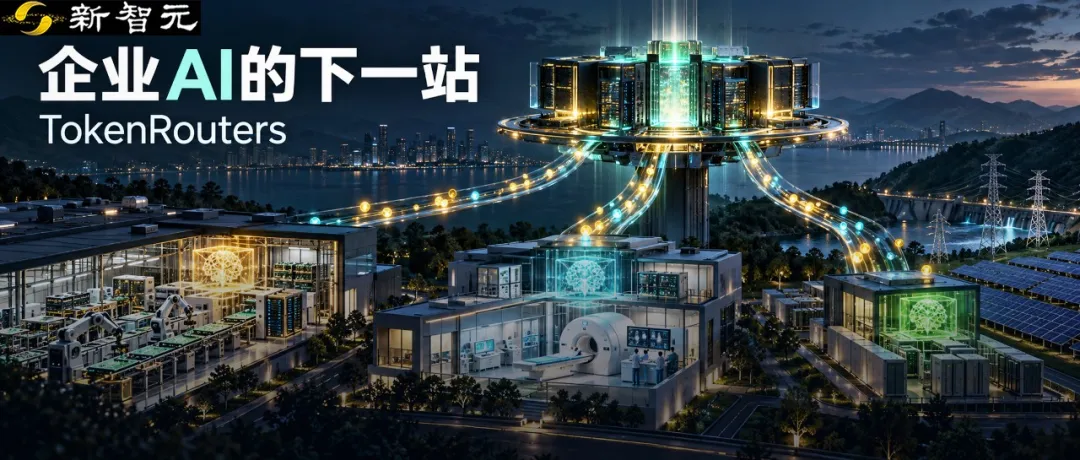
It was at this point that Shuntur Technology (3317.HK) launched the new technology.TokenRouters。
It has been positioned as the core platform for enterprise AI, as well as one of the world's most prominent AI platforms.AI real-time data and dedicated tokens are exchanged in a one-stop manner, matched with service platforms, around optimizing enterprise models and smaller enterprise models.
To put it bluntly, what Shuntzer wants to do is create a "supermarket" for thousands of enterprises in the future that can exchange data, match models, and distribute intelligent resources.
There's a bigger business behind it.
Starting with a PCB production lineI'll tell you about a case I made myself.
One of the leading PCB factories in the country, due to the high demand for AI servers, the more layers of the boards, the smaller the holes drilled, the thinner the process, the quality testing pressure directly exploded.
In the past, artificial addition to traditional AOI, extraction or final inspection. The defects often flowed into the after-processing process, even after shipment, are only exposed, returned to work, scrapped, customer complaints a lot, and abnormal goods have always occupied the equipment and capacity.
The quickest way to do this is to cut the production line into five or six sections from end to end, and each section, each working island, collects and governs data separately, generating tens of thousands of data per second.
As a result, the high-speed production line was 100% fully inspected, the delivery rate was stable at more than 99%, and the detection efficiency improved by more than three times.
And this system can be copied to other production lines, other bases, and become a "quality pass" for companies taking high-end orders overseas.
This is what Huang said in Berlin about physical AI, the company's own model, falling onto a Chinese production line:There are no billionaire parameters, just a few small models with their own data, staring at the holes, faster than the human eye, faster than the old equipment, and saving money.
But here's the problem.
The "food" of this small-scale PCB factory is its own production line data.
If it wants to do better, it lacks not only its own data, but the data of the entire industry, which is the part of the data that it cannot have.
A company has data for PCBs, B company has data for optical communications, and C company has data for AI server integrated.
If these data were to be transmitted and exchanged in a consistent manner, all the smaller models would be smarter.
But this thing has an important feature: You showed it to me and I got it. Who would exchange it anyway?
The answer is Token.
But it's important to note: General Tokens are like a college student who reads poetry, who can talk, write articles, solve language understanding, common sense questions and content generation problems, the core of which is "language understanding"; private Tokens are made up of industry private data de-sensitivity and refinement, each Token with business logic, data structure and compliance boundaries for specific scenarios, and the core of which is "business understanding".
TokenRouters are not just a simple aggregator of General Tokens, but a core enterprise AI platform that exchanges assets with dedicated Tokens at its core.
To de-sensitize the raw data, refine it into a dedicated token that carries business logic but doesn't expose the raw dataTokens can be exchanged and the raw data is not released.
This is exactly what TokenRouters is going to do.
What exactly is TokenRouters?It's a "data set-level exchange" for AI.It's a great way to exchange data values and make smart assets available.
On the left are companies that need data, AI models, AI applications, and on the right are partners that provide these resources.
In the middle, the platform does three things:Let's get it right, get it right, buy it right.
There are five modules that support this logic.
Data collection solves the question of "what data to use".It's hard to find data, it's scattered, and it can't be bought back.
Each data set in TokenRouters has three things: what it is (name, tag, abstract, see if it's worth digging) how much it is (type, size, coverage, source, update frequency) how it's used (anything in analysis, prediction, development)
AI models solve the question of "what model to use".The model was released several times a week, and the general model reached the vertical scene with only one test, a long cycle, and Token burned fast.
TokenRouters classify models by industry, scenario, and type, each with a clear description of what they can do, what models they support, what scenarios they fit, and what "models can do" and "business needs".
AI applications, solving the question of "what tools to use".There are few vertical applications that can be embedded into the business flow of a large number of general AI products. TokenRouters are categorized by industry, product type, business link, not only saying "what is it" but also "how to use it, where to use it".
The scene library, one of the most underground.Companies often ask: "Where do we really need AI at?" The scenery library starts with specific business tasks, breaking down pain points, calculating revenues, distributing screenshots and architectural diagrams, translating a vague phrase "I'm going to do AI" into a clear construction map.
It's smart customer service, all the way down the line.Natural language questions, frequently asked guides, historical session management, pop-up pages and independent customer page double entries, uncertain one-key interfaces.
The five modules are linked together, forming a complete loop:Finding scenarios→ Discovering resources→ Evaluating adaptation→ Drawing on verification→ Full service.
TokenRouters build a bridge between the supply and demand of AI resources, and a bridge with road signs, police, service stations. This bridge really serves not only to "find resources", but also to continually optimize enterprise models in real-world contexts, allowing smaller enterprise models to go from selective, adaptive to deployable.
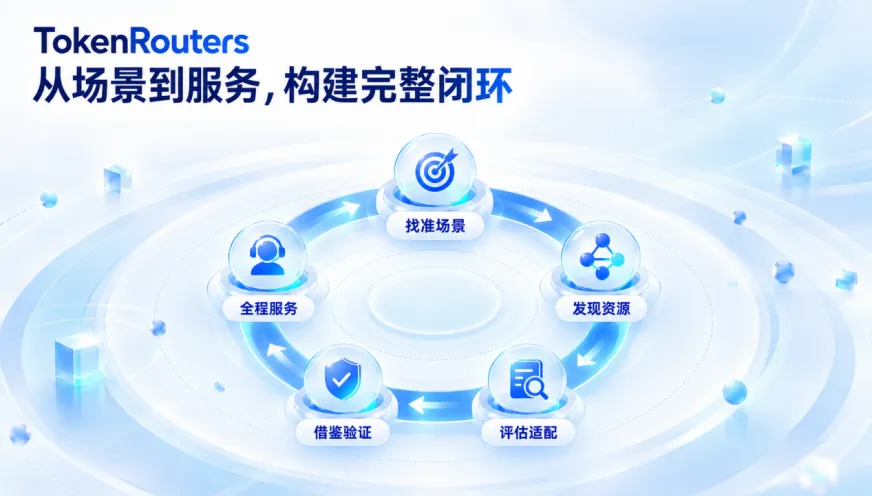
TokenRouters: A complete loop from scene to service
"Four layers of cake" by Swift.Back to the old yellow cake.
In India, we started with energy, from one level to the next.
It's also a layered setup, but it's basically a data line.
The bottom line is AI data governance.
Starting in the asset management industry, it took a decade to consolidate "dirty living and working", transforming dispersed, heterogeneous, non-branded raw data from inside and outside the company, collecting, cleaning, marking, modeling, into usable data assets.
This is the base.
The top layer is TokenOS.Launched in May this year, SnapChat combines good governance data with specific business scenarios, refining them into standardized, measurable, priced scenarios, tokens and professional model parameters.
Data has shifted from a "sleeping resource" to a "current asset".
We're going back to TokenCloud.Launched in September, the algorithm adapts to token generation and model reasoning: hardware selection, resource allocation, model optimization and distillation, allowing the model to use the appropriate cost landscape.
And then there's TokenRouters, which is the exchange layer:To break down the barriers to Token flow between different businesses, different industries and different data sources, allowing high-quality scenarios to be exchanged across subjects under the conditions of security, compliance and auditability.
At the top is a small business model.Each company has its own private deployments, smaller parameters, and cheaper models of the field.
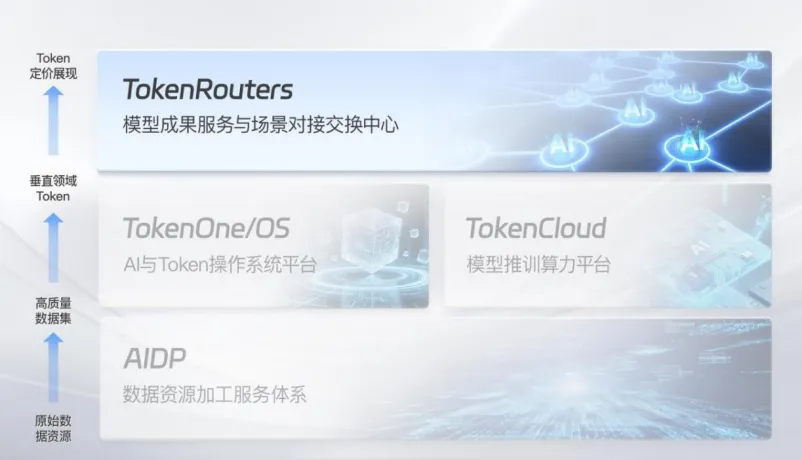
These layers correspond to the rapidly evolving "four-step leap": 1.0 data governance, 2.0 Tokenization, 3.0 Token Exchange, 4.0 small business models.
The logical chain is very clear:The first thing to do is fix the data, then turn it into Tokens, then let Tokens circulate, and finally use Tokens to come up with a small model of the company itself.
In a 2025 paper, the NVIDIA research team said that small models are strong enough, or even better, for the specialized tasks of enterprise AI; running a small model with 7 billion parameters is 10 to 30 times cheaper than running a large model with 70 billion to 175 billion parameters.
Gartner predicts that by 2028, more than half of enterprise-generated AI models will be field-specific.
This specialised small model has already been rolled out in a number of industries, including governance, energy, healthcare, and so on. The core barriers are the same: private sector data.
This is also why TokenRouters is not just a new product for Snapdragon.
It means that the fast-track comes from"AI data infrastructure providers" became "infrastructure operators in the Token economy".It's not just about building roads, it's about being a charging station, a transport hub, a routing hub for the whole network.
The business model is also changing:From previously single-customer Token invoicing charges to platformed Token routing fees, photo sharing service fees, compliance distribution fees and data asset-added services.
Space has grown from a "tube" to a "network".
In the first half of 2026, it generated revenues of US$967 million, an increase of 389% compared to the same period in 2026, establishing a profit in the first half of the year for the first time in a decade.
The token model has already begun to take shape.
The next stage of AIIf you look at the four things that the old man said in Berlin, the four-tiered cake, the several industry cases put together, the next stage of corporate AI is already clear.
First, enterprise AI is inseparable from data governance, especially vertical, high-quality, dedicated data and datasets.The model can be open source, the calculator can be rented, and this is the only thing that can be created, governed, and replaced.
Second, every industry, every company, will have its own small model.The value of TokenRouters isn't just putting resources on the shelf, it's putting them on the shelf.Continuous optimization of enterprise models around real-world scenariosIt's a way for enterprise AI to move from "useable" to "useful, special".
Third, the small model cannot be separated from the exchange flow of the data set.Like money, everyone can exchange what they have for what they need.But what is being exchanged here is not a generic token, but a dedicated token that carries industry knowledge, business rules and compliance boundaries.
On October 20, the National Data Group announced in Xi'an that what they want to do is "promote cross-industry, cross-regional data flow".
Fourth, localization, data security compliance, and the deployment of private sector training are well established trends.Data is out of range, models run locally, and intelligent agents operate on their own knowledge base. In Berlin, Huang said that "the ownership of knowledge and tools belongs to the company itself".
It is worth emphasizing that AI cybersecurity and compliance security are the underlying capabilities that are long-term investments in cybersecurity. In the process of data governance, tokenization and enterprise services, companies continue to cover data classification, access control, privacy protection, model and token flow re-audit, privatization deployment security, etc. TokenRouters continue this security compliance thinking by embedding network security, data breach prevention, model access control, and entire process auditing into dedicated token exchange and matching processes, building on "sustainable".
These four lines are known as the Token Routers.
At the corner from "usable" to "useful", a platform with enterprise AI as its core platform, a platform for optimizing enterprise models, a platform with security compliance as its bottom line, a platform for exchanging data value, and a platform for smart assets, is probably the most lacking piece of the puzzle in the entire industry.