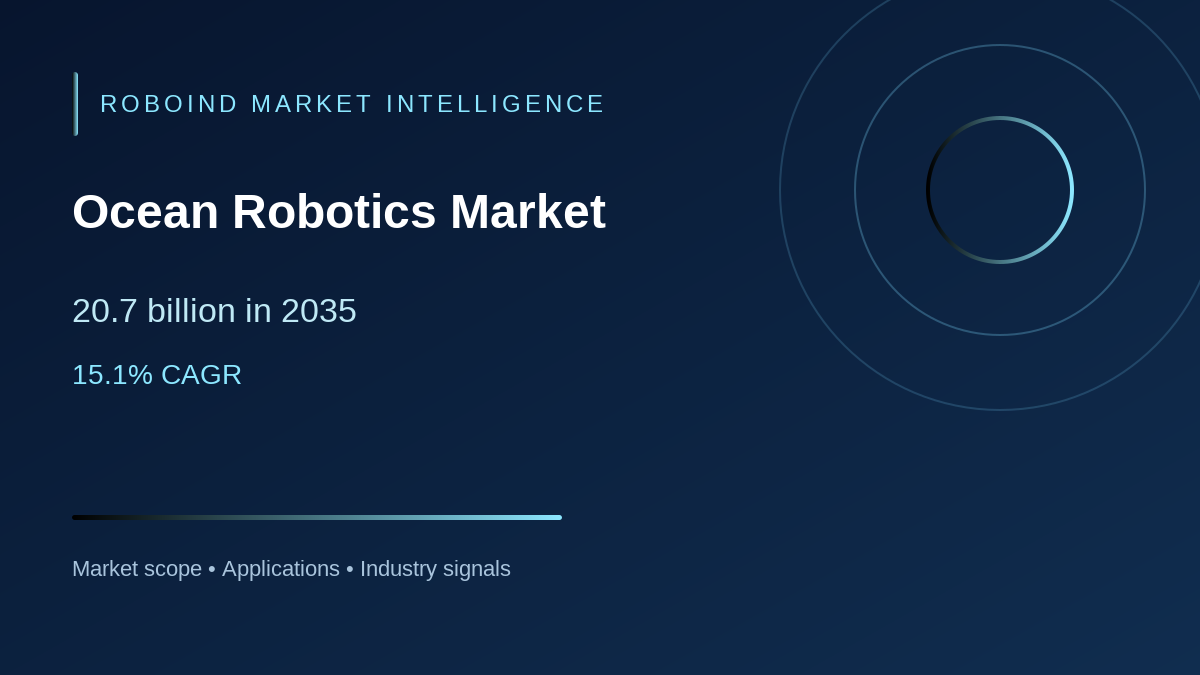
Ocean Robotics Market is estimated at 5.1 billion in 2025. The report cites a CAGR of 15.1%.
RoboInd market brief: Ocean Robotics Market is estimated at 5.1 billion in 2025. The report cites a CAGR of 15.1%.
Market snapshot
- 5.1 billion in 2025
- 20.7 billion in 2035
Stated compound annual growth rate: 15.1%.
Market overview
In 2025, the Global Ocean Robotics Market was valued at USD 5.1 billion. The market is projected to grow at a CAGR of 15.1% during 2026–2035, reaching approximately USD 20.7 billion by 2035. North America dominated the global market in 2025, accounting for more than 36.5% of the total market share and generating approximately USD 1.8 billion in revenue.Market growth is supported by rising activity in offshore oil and gas, offshore wind energy, naval defence, marine security, and ocean research. These industries use remotely operated vehicles (ROVs) and autonomous underwater vehicles (AUVs) for subsea inspection, equipment repair, seabed surveying, environmental monitoring, and data collection.North America held the largest regional position in 2025; its leadership is supported by extensive offshore energy operations in the Gulf of Mexico and North Atlantic, along with strong spending on…
Market drivers and constraints
- Offshore energy subsea inspection demand
- Defense & security underwater missions
- Advances in subsea sensing & autonomy
- Oceanographic & climate research programs
- Lifecycle cost savings vs. manned operations
- Digitalization of subsea assets & data
- High upfront CapEx for advanced systems
- Limited subsea communication infrastructure
Applications and segments
- Remotely Operated Vehicles (ROVs)
- Autonomous Underwater Vehicles (AUVs)
- Unmanned Surface Vehicles (USVs)
- Navigation & Control Systems
- Artificial Intelligence & Autonomous Navigation
- Communication & Data Transmission Systems
- Offshore Oil & Gas Inspection
- Oceanographic Research & Monitoring
Competitive landscape
Public report coverage names Oceaneering International, Forum Energy Technologies, General Dynamics Mission Systems, Tier-1 leadership in the ocean robotics market is supported by Kongsberg Maritime, Oceaneering International, Teledyne Marine, L3Harris Technologies, and General Dynamics Mission Systems. Kongsberg Maritime recorded 2025 revenue of NOK 24.2 billion, or approximately USD 2.3 billion, supported by subsea, autonomous, and marine digital solutions. Its HUGIN AUV portfolio and integrated control systems place its estimated advanced ocean systems share at 15–20%.Oceaneering generated around USD 2.6–2.7 billion in 2025 revenue. Its Subsea Robotics division contributed more than USD 800–850 million, achieved operating margins in the mid-30% range, and operated over 250 work-class ROVs. The company is estimated to hold a 15–20% share of offshore robotics services. It also secured USD 300 million in new ROV and AUV contracts during a single quarter in 2022.Teledyne Technologies reported Q4 2025 sales of USD 1.6 billion and annual free cash flow above USD 1 billion. It invested approximately USD 850 million in acquisitions, while marine instrumentation sales increased by 19.2%. L3Harris generated about USD 19.4 billion in 2024 revenue with high-single-digit R&D intensity, while General Dynamics recorded more than USD 42 billion in sales. Both are estimated to hold mid-single-digit market shares.Tier-2 companies include Saab Seaeye, Fugro, DeepOcean, Forum Energy Technologies, ECA Group, Hydroid, Ocean Infinity, Bluefin Robotics, Greensea IQ, and Exail. Saab Seaeye and Fugro hold estimated regional shares of 3–7%, while autonomous specialists generate revenues ranging from tens to low hundreds of millions of dollars.Top Key Players in the Market Kongsberg Maritime Saab Seaeye Oceaneering International Teledyne Marine Bluefin Robotics Ocean Infinity Fugro ECA Group Forum Energy Technologies Hydroid L3Harris Technologies General Dynamics Mission Systems DeepOcean Greensea IQ Exail. The list reflects participants identified by the source and is not a ranking.
Reading the figures: Values follow the market definition and forecast period stated in the source report. Estimates using different scopes should not be combined without normalization.